Blu-ray blues

We recently got rid of our cable TV (keeping the internet of course) and wanted to get a set up where we could stream Netflix and other video sources directly to the TV.  Of the various options, it seemed that a blu-ray with built in WiFi would be best, and we started with the Samsung BD-C6500.  This claimed to be able to connect wirelessly, stream Netflix and Hulu Plus, and had a bunch of other internet-ready content via apps.

Most of this is true.  We were able to hook it up no problem, got it connected to our wireless network and streaming Netflix, and were able to browse other internet content such as YouTube.  However, one major glitch:  the blu-ray player lost the network settings each time we powered it off.  We’d have to re-scan and enter the password for our network each time.  This makes using it almost unbearable.  Further, Samsung customer support was not very helpful, suggesting a few things that made no difference.  Finally, the apps available were meager at best, with no Hulu Plus or ESPN apps, and the few apps that weren’t there by default were not very interesting.

Contrast this with the Sony BDP-S570, which at Best Buy cost the same.  This blu-ray player set up as easily as the Samsung.  However, it kept the network settings no problem.  No re-entering the network password.  And the number of apps that come installed with it is much greater than the Samsung, with maybe 5 times as many.  I haven’t found yet if it is possible to install new ones, though I assume there must be some way.  Hulu Plus is not available on the Sony, but in contrast to the Samsung, it seems that there is a plan to get it soon.  This one is even 3D-ready (it isn’t 3D capable yet, but with a firmware upgrade expected to be available soon, it will be).  This isn’t something I care much about, but it just points to the overall better product this player is for the same price as the Samsung.
I’m not sure how much of the issues with the Samsung are specific to our setup.  Our router is an Apple Time Capsule, and I saw online others with that setup having the same problem.  It is just odd that this day and age this kind of thing doesn’t work better.  And that Samsung didn’t have a better response suggests they are ignoring the problem.

I’m very happy with the Sony.  And if anyone else runs into these network issues with the Samsung, I would highly recommend taking it back and getting the Sony instead.

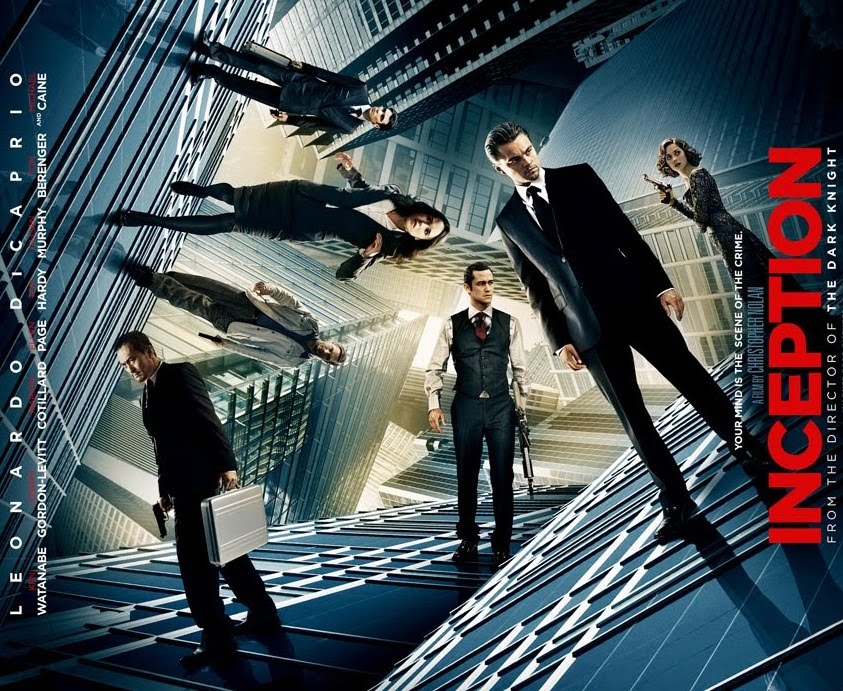
Inception

Lisa and I went on our first date in on the order of three years, leaving our daughter in the care of a friend.  We decided to spend our evening with dinner and a movie, and the movie we opted for was Inception.

I’m not much of a DiCaprio fan, and my fiction leanings tend more towards fantasy than science-fiction.  However, this is the type of sci-fi story that I do enjoy, one where the pseudo-science is used as background for the story and not as the entire crux.  Here, the pseudo-science is that people can enter the dreams of others, either extracting or, in the very rare case that is the premise of the moving, implanting ideas and information.  DiCaprio’s job is to plant a new idea in the mind of his employer’s rival.

I found the world that Nolan, the director, created to be both rich and believable.   (From what I understand, the plot was his idea, something he’s been working on for the better part of 10 years; he was more than just the director.)  The real world is our world — the technological level is the same as ours.  The only big difference is this ability to enter and manipulate dreams.  As a result, all of the fantastic occurs in the mind.  The special effects convey this fantastic world to a marvelous degree, though not outlandishly as sometimes our dreams can be.  This is especially true in the scenes in the second dream level when gravity disappears.

Overall, I enjoyed the plot.  It made sense within the context of the rules of Nolan’s universe.  The ways the different dream levels interacted both with each other and the real world also made sense, as did the potential for getting lost in dream world.  Overall, the world Nolan created and the rules that dictated how it behaved seemed self-consistent.  There weren’t major points that just didn’t work within the confines of the universe.

Probably just as enjoyable as the plot were the characters.  All of the actors did a great job with their characters.  Even though most didn’t have much time to get fleshed out, they still were quirky and hinted at rich backstories that seemed intriguing.  Each actor brought his or her A-game to these roles and made the film that much more enjoyable.

So, not much to say with regard to specific points in the plot, to avoid spoiling it for anyone.  I would just say that I greatly enjoyed the film and would recommend it.

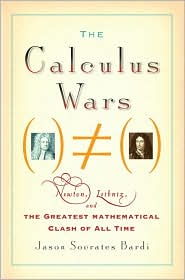
The Calculus Wars by Jason Socrates Bardi

People outside of science often have the impression that the practice of science is a sort of altruistic pursuit of knowledge with all scientists working towards the same goal: increasing our understanding of the universe.  And, in a very rough sense, this is true, if one looks at the development of science itself and ignores the personalities that are involved.  However, if you look at the details, egos and the realities of limited funding often get in the way and produce dramas that are every bit as melodramatic as any other human endeavor.

There is no better example of this than that described in The Calculus Wars by Jason Socrates Bardi.  The Calculus Wars describe the development of calculus, today accepted to be independently discovered by Sir Isaac Newton and Gottfried Leibniz.  In fact, while Newton tends to get more credit (he technically did discover it first, though Leibniz published first), our modern notation is due to Leibniz.  When Leibniz first published his version, there was no big outcry.  But, over the years, as Newton want to assert his primacy over the discovery, the fight between Newton and his people and Leibniz and his became downright nasty, culminating in assertions of plagiarism.  In the end, Newton essentially won, as we tend to attribute calculus to him.  But, to paraphrase Bardi, while the discovery of calculus illustrates the great heights the human mind can achieve, the war that develop between these two demonstrates the corresponding depths we can sink to.

To me, the most fascinating part of the story is the life of Leibniz.  Here is a true genius, a man with no formal training in math (he was a lawyer) who taught himself what he needed to know to eventually develop calculus.  He was a renaissance man befitting the word, with activities in mining, math, science, politics, law, and philosophy.  He was in some sense the first geologist.  He established the first scientific society in Germany.  For all of his accomplishments and his genius, he languished in his later years researching a history of the genealogy of his sponsoring noble, an effort that both distracted from pursuits more befitting such a great mind and kept him in the backwaters of the scientific world.  If Leibniz had the intellectual freedom that Newton did, one wonders what he might have achieved.

Overall, this was a highly entertaining account of two great intellectuals and their personal battle.  It certainly makes me want to learn more about Leibniz.  I highly recommend it to anyone who has even a casual interest in the history of math and science.  While it does highlight the lows of scientific endeavor, showing the all too human face, I still believe that the scientific method is the most powerful way of looking at the universe that humanity has devised.

Westernauts

We should have known better.  But, the profit estimates were staggering and we couldn’t let this opportunity slip through our fingers.  There was no end to the thirst for new forms of entertainment, especially by the rich and powerful.  Already, with enough money, you could visit the deepest parts of the ocean, be king (or queen) for a day on your own private island with all your “subjects” catering to your every whim — and I mean every — or dive into the heart of a volcano.  Hell, with enough money, you could take a rocket to the moon and stay in the Sea of Tranquility Resort, offering what was promised as the best view in the solar system.  But, even with all of these possibilities, people wanted more — more entertainment, more thrills, more escapes from their every day lives.

When we had our “eureka” moment, we knew we were on to something big.  We would offer people the ultimate escape, time travel.  Tours in Time, we called ourselves.  Of course, we couldn’t send you physically back in time.  Clearly, that violates all sorts of laws of physics.  However, we could send your mind back in time, to hitch a ride, so to speak, with someone living in the past.

Mind-spying technology wasn’t new.  It was originally developed by the government to do exactly that: spy on our enemies.  And our friends too, for that matter.  With mind-spying tech, your consciousness essentially left your body and inhabited that of another, any one, without them knowing it.  While you were mind-spying, your thoughts were your own, but you could experience everything that your host experienced.  You would see what they saw, hear what they heard, feel what they felt.  You wouldn’t know what they thought, but you experienced everything else as if it were happening to you.

Very quickly, we learned all of the important secrets of our enemies and trading partners and soon had major advantages over all of them.  We leaked scandals about leaders we wanted ousted.  We knew the weaknesses of competitors that we exploited in trade negotiations.  Soon, we were by far the dominant super-power on the planet, even eclipsing the all-powerful United States of America.

As the technology spread, it invaded other areas of life.  Mind-spying technology expanded beyond the realm of government and became a tool for law enforcement and entertainment.  The police began directly spy on criminal organizations while they plan their crimes.  Fans experienced football games from the perspective of their favorite athletes.  The porn industry was revitalized when they adopted mind-spying technology.  A man experiencing sex from a woman’s perspective?  There were no limits to what could be experienced.

Our team had taken the technology one step further.  We had begun experimenting with using mind-spying technology to send minds back in time.  Our primary clients were scholars, who used this ability to witness historical events first hand, which often led to completely new interpretations and the rewriting of many history books.  Law enforcement soon saw the possibilities and began hiring us to send them back to the scenes of crimes, mind-spying on suspects to determine without a doubt their role in said crime.  But, these were limited cases, funded by the government in very special circumstances.

With time, we perfected our capability to send minds back in time, but were still focused on special contracts with universities and the government.  We knew there would be a huge market for our technology amongst thrill seekers.  Imagine being able to go back in time and experience the World Championship match from the perspective of the MVP Jon Ratcsh or the Battle of Washington from the point of view of General Arthur O’Shea.  The possibilities were endless, and so was the profit potential.

We decided that our first “destination” would be the Wild West of the former United States of America.  Even to us, the West embodied a romanticism and a spirit of individuality that transcended the US, that somehow captured human nature like no other.  Our movies and games continuously featured the West and the characters of that time — Billy the Kid, Butch Cassidy, Jesse James.  What better place to send our first tourists than that most infamous of times!

Our first client — our first Westernaut — was a poker fanatic.  He was known to drop more than the GDP of some of the smaller former states of the US in just one night.  His destination was Wild Bill Hickok, who was killed holding what became known as the Dead Man’s Hand — aces and eights.  Yet no one knew what the fifth card that Wild Bill died holding was and our client simply had to know.  He viewed it as the ultimate poker mystery.

Of course, Wild Bill died in the middle of the game, but that didn’t concern us.  Deaths often occurred while someone was mind-spying.  If the host died, your mind immediately returned to your own body.  In fact, there were rumors that some the very rich but very twisted participated in a modern form of snuff films this way.

However, some mysteries, it seems, are meant to remain hidden.  We sent our Westernaut back one hour before Wild Bill’s death.  That should have given him time enough to adjust to his new surroundings and “watch” as Wild Bill was dealt that fateful hand.  And, indeed, about an hour later, our client’s body shuddered just like bodies do when their mind-host dies.  But, unlike normal mind-spying deaths, our client didn’t immediately open his eyes and gasp for air.  Instead, his body functions shut down, his heart stopped and his brain waves ceased.  He died along with Wild Bill Hickock.

Needless to say, the family of our client, armed with a contract that guaranteed no harm, immediately sued us for all we had, all of the company’s assets.  The judges sided with the family and our company was shut down.  That was the end of our brief experiment with Westernauts.

This story was inspired by Rose and her mispronunciation — or my mishearing — of the word “restaurant”.

Operation Queenstrike

Yes, sir, I understand sir.

Yes, I’m aware how much money and time was invested in this operation.

No, sir, I don’t believe I could have done anything differently.

Yes, I understand that the King is very upset.

Sir, if you would only let me explain what happened.

Sir, as you know, I arrived in London about 6 weeks ago.  After about 2 weeks of searching and contacting other agents already in the field, I discovered a way into Buckingham Castle.  Taking the supplies I brought from Madrid, I made my way into the castle undetected.  I found a little-used room where I settled and began my preparations.  As instructed in my training, I mixed the chemicals together to prepare the poison, all the while observing the Queen to discover her routine.  As we had learned from our agents, she held court every Thursday, during which minor nobles from around the kingdom would travel to have their petty disputes heard.  Judging by the Queen’s manner, she certainly did not view this as one of the more pleasant aspects of being a monarch.

In any case, as we had decided during my training, I chose one of these open court sessions to strike, as it would cause the most sensational assassination.  The week before the chosen date, I sneaked into the throne room at night, and began the final preparations.  I scurried under her throne and created a little hole in the cushion, where I could lie in wait.

The morning of the court, before there were any signs of life in the castle, I took the poison and my weapon, a long, sharp needle, into the throne room, under the throne, and into the hole I had created.  I waited until court commenced. The throne room began filling with a number of despicable beings, men who in Spain wouldn’t merit the title of peasant, much less noble.  One particularly brutish fellow caught my eye only because he brought with him a vile creature, one of the rattiest cats I’ve had the misfortune to encounter.

Once the Queen had sat in her throne and began hearing the various cases brought before her, I dipped the needle into the bottle of poison and was about to thrust it through the cushion into the Queen when that ratty, vile monster appeared under the throne, its eyes glowing a hideous yellow color.  As it hissed and swiped at me, I lost my balance and fell to the floor.  The bottle of poison fell with me, smashing on the stone floor, spilling its contents.  The needle, too, fell and bounced from under the throne.

Fortunately, I was able to escape the infernal beast’s claws, but only just.  I scurried out from under the throne just as the cat’s claws caught my tail, severing it, as you’ve seen for yourself.  I raced for the needle, intending to complete my mission or die trying, when one of the Queen’s vassals stepped on the needle and immediately collapsed.  This of course caused a great commotion, due to which I was able to escape from the throne room, having realized that the mission had failed.

I made my way back to Spain, finally reaching Madrid only last week.  I’d lost of bit of blood from my encounter with that damnable cat, and was very weak upon my return.  The last week I’ve been recovering from my wounds.

That is the extent of my report, sir.

Yes, sir, I realize the opportunity that was lost.  But, as I described, there was little to be done.  The cat completely disrupted my plan.  There was little I could do against such a beast.

Possibly, sir, if I had kept my calm when the cat attacked, I may have been able to complete the mission.  Given the circumstances, sir, I don’t think there was much I could have done differently.

Yes, sir, I understand.  I will report immediately for reassignment to Paris (that god-forsaken cat-hole).

Nothing, sir.

Inspired by the children’s rhyme Pussy Cat, Pussy Cat.

Blah, blah, blah… I've got the blahs.