The Embodiment of Fall

I just flew into Pittsburgh for a conference and was just struck by the beauty of the landscape stretched before me from the airplane window.  I didn’t have a camera, so unable to take a picture, I jotted down my impressions (edited now for flow and readability).

The sky is gray, the air crisp and still.  Rolling green hills peak through forests of golden trees, in shades of orange, brown, and yellow.  Scattered with those golden trees are barren trunks, already in hibernation for the winter.  In stark contrast, small groves of evergreens keep their color, defying the overwhelming autumn hues.  Valleys cut around the hills, but gently, with no drastic or abrupt gorges.  Clusters of houses huddle amongst those trees, in clearings big and small.  Small villages and towns snake along the valleys, conforming with the contours of the land, not defying or challenging them. Occasionally, an old abandoned and ruined house lies forgotten, isolated in a clearing of its own.  Down the river float barges, laden with tons of pitch black coal.  Nearby there are open pits and piles of the stuff, in stark contrast to the greens and golds.  A random smoke stack, remaining from the glorious steel days, punctures the horizon, billowing thick white smoke that then slowly drifts and spreads across the sky.

This is the embodiment of fall.

Venice

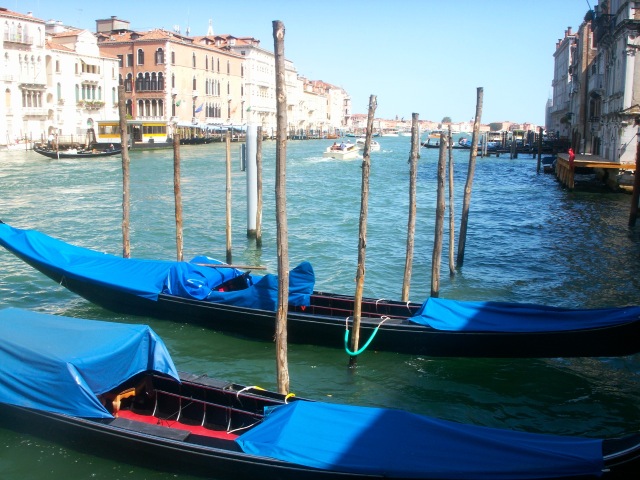
venice-grand-canal-1I spent the first week of September at a conference in Padova, Italy, only maybe 30 minutes by train from Venice.  We didn’t get a lot of time to look around, but we were able to take the day before the conference started to visit Venice, jet-lagged and all.

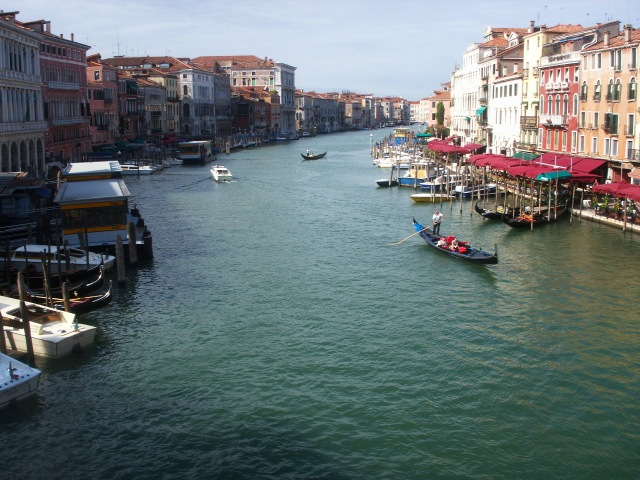
The day started off a bit less than stellar: the train we’d hoped to catch didn’t show.  There was some problem — what exactly wasn’t clear — but they just skipped one scheduled stop.  So we lost one day.  Still, we were able to spend maybe 6-7 hours strolling the streets.venice-grand-canal-2

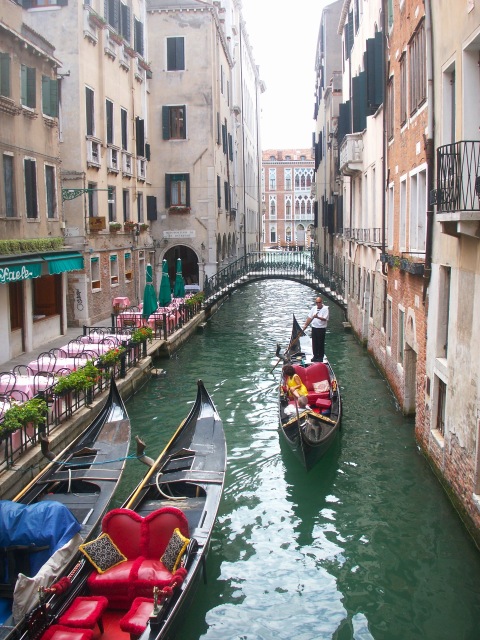
We only made two stops, at the Guggenheim museum and the National Academy, I believe.  Both were interesting, but neither was my cup of tea.  The Guggenheim, a collection of Peggy Guggenheim’s, who lived some time in Venice, was essentially entirely modern art (Picasso, Giro, Warhol, etc).  Not something I get into all that much.  The National Academy, though, was exactly the opposite: many famous Italian religious paintings.  I’ve never been in a place with so many depictions of Jesus.  It was a venice-gondola-1bit overwhelming and underwhelming at the same time.  I did enjoy a couple of depictions of hell and there were a couple of somewhat impressionist paintings of landscapes and rural scenes that I liked the best.  But, overall, it was again not for me.

We spent the rest of the day just wandering the streets, just observing the city.  venice-saint-markWe tried to get away from the main streets, finding the small side paths, exploring the intimacy of the city (so much so that we overheard one teenage girl in a pretty heated argument with her mom from their apartment above the street).

At one point the jet lag hit us and we found a bar and just hung out for a while, watching the tourists pass by and, at one point, a water-borne ambulance stopped just next to where we were sitting.  Thinking about it, it made perfect sense that a city like Venice would need emergency services that went by water, but it wasn’t something that, well, I had thought about before.

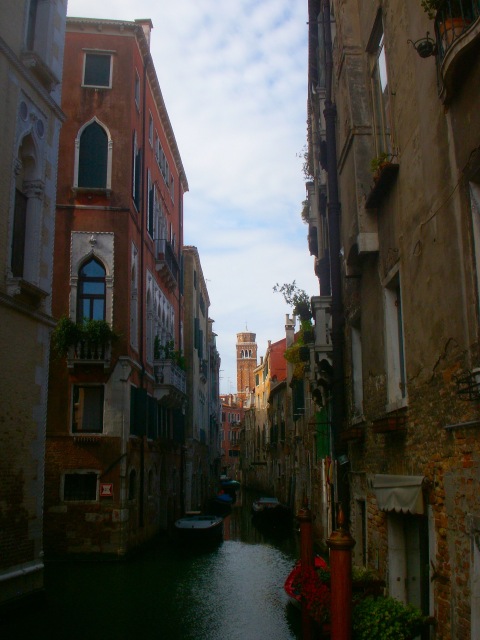
venice-gondola-2Venice is a really enchanting city.  I really liked how the city is connected via the waterways, that the roads are secondary.  It is certainly a city where you couldn’t drive anywhere; it is the ultimate pedestrian city.  There were plazas all over the place, filled with restaurants.  There were shops all over as well, selling paper, masks, food, and other specialty items.  And, of course, there were tourists.  Many of them.  But not so many that it was annoying, at least not to another tourist.

I would definitely like to return and spend maybe a little more time there, a couple of days rather than just a few hours.  Seeing how it is one of my wife’s favorite cities, I’m sure that such an opportunity will come along some day.

Black and White and Grey All Over

The country is politically very polarized, seemingly more so than ever.  You can see it in the town hall meetings, in the blue vs red electoral maps, and in the very people we hang out with.  For instance, an application has been going around Facebook which shows statistics about your friends.  It is very interesting to see that most people’s friends are very strongly either Democrat or Republican.  There aren’t many people with a relatively even split.  So, not only do we limit our news to sites and channels that we agree with, but we surround ourselves with people we agree with, locking our viewpoints even more rigidly on one side or another.

There has been a lot written about this already.  I’ve read, for example, that people who are religious tend to see more connections between seemingly unconnected events, while less religious people do not.  This is in effect a function of brain chemistry and wiring.  And, there does seem to be a correlation between how religious you are and which party you more strongly identify with.

I also wonder if it might also have something, at least a small part, to do with the stories we tell as a culture.  The cartoons I used to watch as a kid always pitted the “good guys” against the “bad guys”.  But, in retrospect what seems to define most of these stories is that the bad guys had no motivation, they are simply bad, or evil.  For example, the bad guys in “GI Joe” are Cobra.  Their only motivation is to rule the world, but they never say why.  They are just evil.  The same with Skeletor in “He-Man”.  And the Decepticons in “Transformers”.  Even in the “Smurfs”, Gargamel is an evil old man, who doesn’t seem to have any real reason for why he is after the Smurfs (except he wants to eat them).  Each story needs a bad guy, and that bad guy is simply bad.  The universes in which these stories take place are completely black and white.  There is no grey.  This is perhaps epitomized in the games that were popular at the time, such as Dungeons and Dragons and the like, and the fantasy novels that fleshed out these types of worlds.  Evil is an inherent part of the fantasy genre, where evil exists explicitly and simply to destroy.  Again, there is no grey.

Our religions, at least how they are interpreted today, also embody this dichotomy:  God is good, Satan is evil.

I wonder how much these black and white views of the universe, or even those universes in which our stories take place, color our perspectives of the real world.  If everything is black and white, good and evil, are those that disagree with us necessarily bad or evil, since we ourselves certainly are not?  Does that mean, if I’m a Democrat, that the Republicans are bad, and vice versa, leading to the polarization we see today?  Or are our stories a reflection of deeper down hard wiring within our brain to view the world in black and white?  Is that a survival mechanism, an evolutionary advantage that helps us more easily determine friend from foe?

I personally do not believe in absolute good nor evil.  I do not believe that there is some ultimate source for either.  Rather, I think that both good and evil are defined by society, by the norms that society creates within which to moderate itself.  And those norms are typically a result of instincts evolved over many generations.  I think that those we typically consider evil — those that live far outside societal norms — have different brain wiring that does not inhibit their base instincts as much as the general populace.  That is, I think it is essentially a different brain structure that makes it so that these people do not see good and bad in the same way as the rest of us.  Unlike the movies and books, I don’t think anyone views themselves as evil, not in an evil for evil’s sake way, hysterically cackling while committing their foul deeds.  Rather, they view the world differently, most of the time, and cannot distinguish right and wrong in the same way.  Either that, or they are like the rest of us, but get caught up by the situation, the power, the moment, to commit “evil” acts but either in the heat of the moment or for some perceived greater good.

Priorities

The other day, listening to ESPN Radio on the way to work, they had an auction to raise money for the V Foundation.  I don’t know much about it, but it’s something started by Jimmy Valvano, a I believe college basketball coach who was diagnosed with cancer and started this to fight back.  This was in the mid 90s, maybe 94 or 95.  The talk show guys mentioned how, since the foundation started, it has raised $80 million for cancer research.

The next segment was Sports Center and it was reported that some player (don’t remember the sport) had either just signed or was in negotiations for a contract worth $60 million over how ever many years, something like 5.

$80 million over 15 for cancer research and $60 million over 5 for one guy to throw a ball around.  It sometimes feels like our priorities are really screwed up.

To be fair, this $80 million isn’t the whole amount devoted to cancer research in the last 15 years, just what this one foundation has raised.  And the $60 million isn’t the player’s fault.  It’s mine as much as anyone’s, as I’m into the whole professional sports thing, watching the games, playing fantasy football, and owning a couple of jerseys.

But, still…

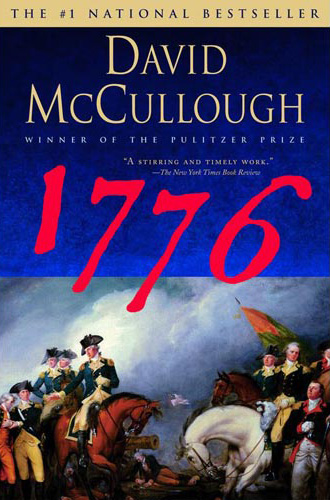
1776 by David McCullough

War ends up being so pivotal in so many developments in history and, yet, the more I read about the most crucial wars in our country’s history, the more I am amazed by how much of the outcome was due to incompetence, bad decisions, or just plain luck.

David McCullough’s 1776 describes the events of that decisive year in the outcome of the Revolutionary War.  Starting with the Siege of Boston, which began in 1775, McCullough takes us through the events that lead to the British abandoning Boston and eventually taking New York.  The year ends with two stunning American victories at Trenton and Princeton, victories that occurred at such a low point in morale in the army that, had they not happened, the war may have gone a completely different way.

McCullough is a master at describing the events on the ground.  Drawing from a huge number of primary sources, especially letters and diaries, he shows us the conditions the average soldier dealt with, including marching in freezing weather with rags covering their feet and hauling cannon through mud and across rivers.  You get a sense for how difficult it was, especially considering that moving the army occurred entirely by foot — there were no transports of course.

In particular, we get great insight into the thinking of the important players, such as Washington, Greene, and Knox, as well as some of the British commanders.  It is amazing that Washington, leading the entire army to determine the future independence of the United States, was only 43 years old in 1775.  I myself, as I write this, am 38.  Jefferson was only 32 and John Hancock, president of the Second Continental Congress, was 38 himself.  Amazing to think how young these leaders were!  Washington is the particular focus, as McCullough tries to uncover the thinking of this most central man.  As the Americans lost battle after battle in New York, due in no small part to the indecisiveness of Washington, and as soldiers left the army as their enlistments ended, Washington begins to fret for the outcome of the war and his reputation as a general.  Even so, he perseveres, keeping up appearances for his soldiers and pushing them to perform.  While Washington may not have been the most brilliant tactical mind of his day, his determination to succeed definitely was the key reason the Revolution itself eventually succeeded.

It is even more astonishing, though, to consider how the weather, how decisions by the British to not pursue the fleeing American army, made such huge outcomes.  More than once, storms masked the movement of the Americans, in a way that had the weather been good, the Americans may not have been able to execute their plans.  The British, on more than one occasion, also stopped in what could have been a complete rout of the Americans, a defeat that would almost assuredly have ended the war with a British victory.  I find it truly astonishing how the outcome of such important events depends on these little details.

I’ve read one other history of the Revolutionary War, The Glorious Cause by Robert Middlekauff.  Middlekauff covers the entire war, including the build up to the war and the aftermath, ending with the writing of the Constitution.  While I remember the book being very good, it’s been a while since I read it, and with my memory like a sieve, I remember very few details, unfortunately.

1776 is a nice, high level overview of the events on the ground.  It is written in a very casual style, with copious footnotes, but those are all relegated to the back (even the numbers are omitted in the text, something which I actually regret).  The reading is fast and easy, but also very vibrant, giving a great sense of the spirit of the times.  I greatly enjoyed this book.

Blah, blah, blah… I've got the blahs.