Without the Hot Air

I recently posted about a talk I saw about meeting our global energy needs in the future.  To me, one of the frustrating things about the whole conversation is that there aren’t hard numbers comparing one scenario to another.  For example, I’ve heard that if we cover all of New Mexico in solar cells, we could meet the energy demands of the entire nation.  However, I’ve not heard how much that would cost and how that compares to say building new nuclear power plants.

Clearly, I’m not the only one with this frustration.  And someone has done something about it. David J.C. MacKay, Professor of Natural Philosophy in the Department of Physics at University of Cambridge, is working on a book to answer precisely these questions.  As he says, we need “numbers, not adjectives” in trying to decide how to both meet our energy needs and to reduce our green house emissions.  On his website, Without the Hot Air, he presents a draft of a book in which he compares the possible energy sources available to Great Britain with the energy consumption they are currently using.  I’ll admit I haven’t read his book, yet, but I went through some of his slides and his executive summary, also available on his website.  The upshot:  Britain cannot generate the power it currently uses from renewable sources available only within Britain.  And that is if, for example, all land in GB was used for power generation of one sort or another, which, as he points out in his slides, would make a lot of people unhappy (he shows protests against off-shore wind farms, where the protestors bemoan the destruction of scenary).

And, as opposed to a lot of people who bemoan our current situation (i.e. Al Gore), Dr. MacKay gives concrete plans that embody different policies (such as a Green plan which uses no coal or nuclear to an Economic plan that relies heavily on nuclear) to solve Britain’s energy problem.  These rely upon two things: increasing energy production, which in the case of Britain seems to involve getting power from other countries that can produce more renewable energy, and decreasing energy consumption.  Both are key to a solution to the problem.

One interesting side tidbit I saw in his slides: I guess one reason people don’t like windmills is that they kill birds.  He compares the number of birds killed in Denmark, which has a much higher number of windmills than GB, by windmills and cars and the number killed in GB by cats.  The number killed by cars dwarfs those killed by windmills, and the numbers killed by cats are many orders of magnitude greater than either.  Just an interesting tidbit.

Anyways, without hard analysis like Dr. MacKay’s and the corresponding realistic look at possible solutions, we will never solve the energy problem.  A prime example is biofuels.  Biofuels are touted as a great advance in addressing the problem.  However, everything I’ve read suggests biofuels are, at best, a distraction and will not help in any significant way.  That they are so highly touted by politicians and the like just distracts us from real solutions.

Some other links I found on Dr. MacKay’s site: his blog, where he discusses energy claims in the media and other aspects of energy consumption and Sandy Polak’s site, which discusses ways to reduce your carbon footprint that are realistic.

(The figure is from Dr. MacKay’s website.)
The Three Investigators

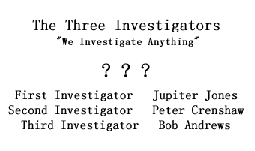
The Three Investigators The genre of kid detectives is a pretty rich one, with the Hardy Boys, Nancy Drew, and others.  However, my favorite as a kid was The Three Investigators.  The Three Investigators, as the card says, were Jupiter Jones, Peter Crenshaw, and Bob Andrews.  I never read any Hardy Boys or any of the others, but these stories really captivated me as a kid.  I think there was something about these seemingly normal boys and their adventures solving mysteries and crime.  It helped that their were stationed out of Jupiter’s aunt and uncle’s junk yard, where they had built a secret headquarters out of an RV left in the yard.  Jupiter also invented lots of other little devices with the junk in the yard, like communicator devices and such. And they were sponsored, so to speak, by Alfred Hitchcock (though, at the time, I’m not sure I really realized who he was).
I don’t remember any of the adventures all that well now.  I just remember waiting with anticipation for the next book to come out.  Looking back, there were some 44 books published (according to this Wikipedia article), many more than I ever read (though I probably read 15-20 of them, I imagine).  I remember that they seemed plausible (to a young kid) and they seemed intelligent.  The boys did things on their own, using their own ingenuity and smarts, and in a way that seemed believable.

According to that Wikipedia article, the series is still hugely popular in Germany and a movie was even made, though one review said it wasn’t too good.  It seems like perfect material for a TV show for young kids/pre-teen audience.  Now, some of the stuff is a bit dated (who needs some special communications device when you have a cell phone).  So, it would need updating, but with a clever writer, I’m sure the concept can be modernized.

The original author was Robert Arthur, who’s daughter runs a website in dedication to her father, with a lot of information about the series (including the addition 40-odd books written in Germany).  Another site with cover scans and other information is T3I.

Anyways, just wanted to share this bit of nostalgia from my childhood.

The Death of Captain America

Just over a year ago, in March 2007, I posted about the death of Captain America, about how there was so much negative reaction at a story that many people hadn’t read yet, that I thought as long as the story was good, that is all that matters.  Though, I also hadn’t read it at the time.

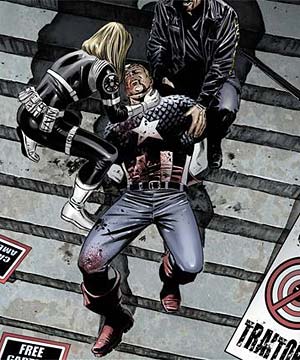
Well, I finally got the trade paperback “The Death of the Dream,” which collects the issues of Captain America in which he is killed and the issues just following.  The first issue is about the assassination of Cap, while the rest follow the supporting cast and their reaction to Cap’s death.  The cast includes Sharon Carter, Cap’s girlfriend; Tony Stark (aka Iron Man); Bucky (Cap’s WWII sidekick); and the Falcon, one of Cap’s most trusted partners.  It also follows Cap’s long time nemesis, the Red Skull, and his plans for destroying America.

As I said, I hadn’t read the comic when I first posted.  I just said that, as long as the story is good, that should be what matters.  And, Ed Brubaker and Steve Epting do indeed deliver on a good story.  The Red Skull and his crew have infiltrated America’s most powerful spy organization, S.H.I.E.L.D., to such a degree that the S.H.I.E.L.D. director, Tony Stark, has no idea who to trust.  And the Red Skull’s daughter, Sin, leads a team of terrorists/assassins that are shocking in their brutality.  All of this goes on while the main characters cope with Cap’s death and how to go on with their lives.  Their rage distracts them from the Skull’s plans, as they look in other places for meaning and vengence.  And when they do start to confront the Skull, they do so recklessly, with the expected bad results.

I’ve not been a huge Captain America fan, though I have followed a few arcs in the past.  Cap is best, to me, when he is a street level hero, fighting as a soldier, against the hidden forces that try to undermine the society around him, rather than a cosmic hero fighting bigger-than-life supervillains.  And that is precisely the level of characterization we get here.

This trade paperback collects a set of issues in the middle of Brubaker and Epting’s run, after they’ve reintroduced Bucky to the Marvel Universe and just as they begin exploring life post-Cap.  I enjoyed this collection enough that I will definitely seek out the rest of their run (as fast as my pocketbook allows me to).

Truly Astonishing

I’ve been reading comics for quite a while now, since I was maybe 10 or so.  Pushing 30 years of off and on following the story lines.  My favorite, overall, has been the X-Men.  I started with them around issue 150, with the first Brood storyline.  It was when Claremont was writing and Cockrum was drawing.  I don’t know if it was the general tone of them being a group of outcasts — which, at the time, was somewhat novel — or what exactly, but the resonated with me.  The stories since then haven’t always been the best and I’ve stopped reading over periods of time, but I’ve at least checked the review sites and spoiler sites to keep abreast of the story lines (which is pretty damn hard these days, with as much saturation the X-Men have right now).

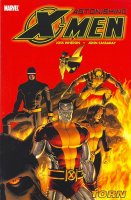
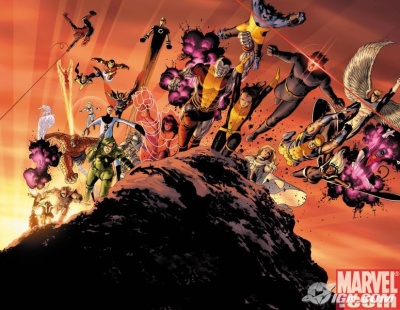
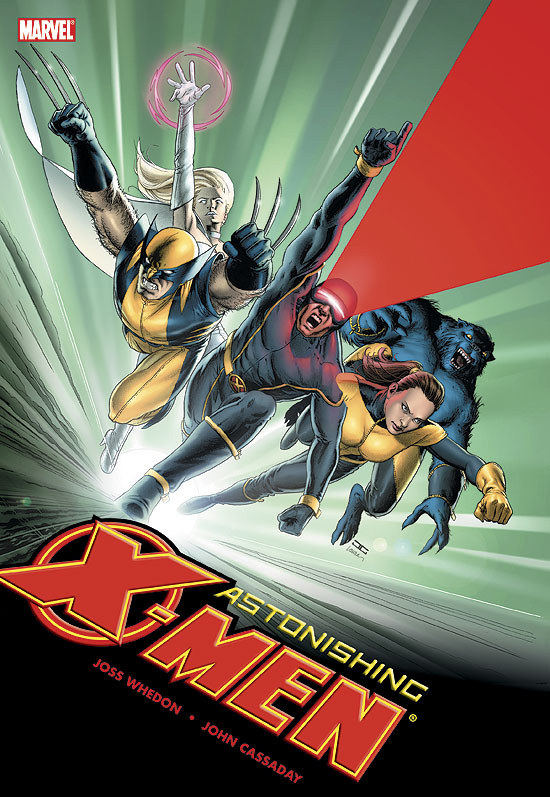
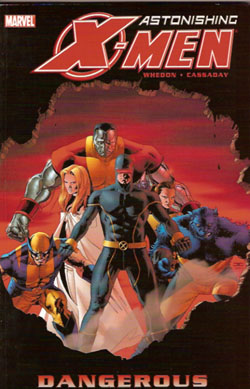
So, I was pretty excited to hear that Josh Whedon and John Cassaday were going to do an arc.  Whedon is best known for creating Buffy the Vampire Slayer and Cassaday has a reputation for very realistic and very amazing art.  They had a 25 issue run, including a special giant sized issue, and I just finished got and finished the last trade paperback collecting the final issues.  All I have to say is that it was a truly astonishing ride.

Warning, Spoilers May Follow

First, they brought back one of my personal favorite X-Men, Colossus.  I’ve always thought he had one of the coolest looks.  He was killed off trying to find a cure for his sister, I believe (though that was during one of the periods where I drifted away from the books).  So, he has been gone for a while.  I personally don’t mind that they brought him back.  Some people get upset at these things, but I think, as long as the story is good, that is all that matters.  I also, incidentally, like that Whedon and Cassaday came on for one very specific arc, told their story, and then finished.  While I like the continuity and history comics universes have, I also think there should be more freedom to tell stand alone stories that may or may not be part of continuity.  Just so long that the story is good.

Anyways, this story is good.  And they brought back Colossus.  And, they potentially killed one of my other favorite characters…

Warning, Very Big Spoiler Does Follow!

Kitty Pryde joined the team just shortly before I started reading X-Men those 30 years ago.  She was a young kid, having just discovered her powers.  Besides the ability to walk through walls, she was also a genius.  She personified in a character a lot of what the readers of the book were probably like.  While I’m not one of those fanboys who think she is the ideal woman or something, she was one of my favorite characters, and one that has probably grown and evolved the most during the last 30 years (it is really remarkable, in the end, how little some characters change).

At the end of this arc, Kitty saves the world, but is unable to save herself.  She is last seen hurtling through space in a gigantic bullet (yeah, that sounds weird, and maybe is weird, but that is what happens).  She is never actually seen as dead, but I can’t see how they will get around this one.  She is stuck in this bullet traveling at very fast speeds through space.  She has to eat (unless I missed some special aspect of her powers) and so will starve soon.  Even then, her body will be light-years from Earth.  I’m sure she will come back, they all do (even Bucky did!) but this one will be hard to do in a “believable” manner.

The story itself harkens a bit to that original Brood storyline in that the X-Men have to deal with a hostile alien race in deep space.  They often do that.  It is one of the cool aspects of the X-Men.  They are a very Earthy team, embodying a lot of the politics of the 60s in their concept (with civil rights, racism, etc), but they also have these star-spanning adventures that completely remove them from that political setting.  I’m not sure that this story is necessarily my favorite, or near the top, but it is very good.  And the art is just amazing.  The only thing I found a bit annoying was some of the dialog near the end, with all the “darlings” etc.  It just seemed a bit out of character.

Anyways, I’m going to have to go back and reread the entire arc in one sitting and catch some of the details I’m sure I missed, and put the whole thing together in one go (reading a 25 issue arc over pushing three years means you forget a lot).  Whedon and Cassaday do the franchise proud and tell an exciting and entertaining story.  That is all I can ask and hope for.

Who is doing the lying in Obama’s Lies?

I got an email the other day, listing 50 lies about Obama. Actually, there seem to be variants of this list. The one I got was called “Obama’s Not Exactlies” but, in searching the internet about it, I saw variants called “Obama’s Lies”. The list was a compilation of supposed claims by Obama that the author deemed false, with the truth about each lie. The list contained such claims as:

  • Father Was A Goat Herder – NOT EXACTLY, he was a privileged, well educated youth, who went on to work with the Kenyan Government.
  • My Grandmother Has Always Been A Christian – NOT EXACTLY, she does her daily Salat prayers at 5am according to her own interviews. Not to mention, Christianity wouldn’t allow her to have been one of 14 wives to 1 man.
  • I Was A Professor Of Law – NOT EXACTLY, you were a senior lecturer ON LEAVE.

And so on. Most of the claims in the list are either false, or intentional misreadings of Obama’s words, or misinterpretations. For example, for the items listed above (this information is from Snopes.com, which is a great site for debunking urban legends and internet hoaxes; I strongly recommend that people check this site out before forwarding any email):

  • Father Was A Goat Herder – LIAR, he was a privileged, well educated youth, who went on to work with the Kenyan Government.
    These attributes are not mutually exclusive: Barack Obama’s (biological) father was all of these things at different times in his life, as Obama described in his book, Dreams from My Father:

[My father] was as African, I would learn, a Kenyan of the Luo tribe, born on the shores of Lake Victoria in a place called Alego. The village was poor, but his father — my other grandfather, Hussein Onyango Obama — had been a prominent farmer, an elder of the tribe, a medicine man with healing powers. My father grew up herding his father’s goats and attending the local school, set up by the British colonial administration, where he had shown great promise. He eventually won a scholarship to study in Nairobi; and then, on the eve of Kenyan independence, he had been selected by Kenyan leaders and American sponsors to attend a university in the United States.

  • My Grandmother Has Always Been A Christian – LIAR, she does her daily Salat prayers at 5am according to her own interviews. According to the New York Times: “I am a strong believer of the Islamic faith,” Ms. Obama, 85, said in a recent interview in Kenya.’ Not to mention, Christianity wouldn’t allow her to have been one of 14 wives to 1 man.
    The author seems to be unaware that Barack Obama, like most people, has two sets of grandparents. Obama was speaking of his maternal grandmother, Madelyn Dunham, not his paternal grandmother.
  • I Was A Professor Of Law – LIAR, you were a senior lecturer ON LEAVE.
    Barack Obama was indeed a professor at the University of Chicago’s Law School, a fact verified by that institution itself:

The Law School has received many media requests about Barack Obama, especially about his status as “Senior Lecturer.”
From 1992 until his election to the U.S. Senate in 2004, Barack Obama served as a professor in the Law School. He was a Lecturer from 1992 to 1996. He was a Senior Lecturer from 1996 to 2004, during which time he taught three courses per year. Senior Lecturers are considered to be members of the Law School faculty and are regarded as professors, although not full-time or tenure-track. The title of Senior Lecturer is distinct from the title of Lecturer, which signifies adjunct status. Like Obama, each of the Law School’s Senior Lecturers has high-demand careers in politics or public service, which prevent full-time teaching. Several times during his 12 years as a professor in the Law School, Obama was invited to join the faculty in a full-time tenure-track position, but he declined.

I don’t mind that people don’t like Obama. If they don’t like his policies, that is fine. Even if they don’t like his personality, that is fine. That is part of the American system. That is why there is a choice. They can vote for John McCain. But, to base their views of someone like Obama on what seems to me to be fear and hate goes too far for me. The reasons for choosing one candidate vs another should be based on analysis of the policies of those candidates, of who they would choose as advisers, and of who they are. Not based on a list of distortions and falsehoods about the candidate. We, as Americans, have a responsibility to do better than this, and deserve better than this as well.

Blah, blah, blah… I've got the blahs.