The Umbrella Academy

Sometimes, stories are interesting just for their weirdness.  Not to say that is the only thing I liked about Umbrella Academy, but it is definitely the main thing that attracted me to it. 

The story is about a group of kids, born at the same moment to women who weren’t pregnant.  Of the 40+ kids born, only 7 are known to survive, collected by an eminant scientist and raised as his own.  It turns out, these kids are special, with very special powers.  We don’t learn too much about the kids or the motivations of their “father”.  However, ten years later, when the Eiffel Tower is attacking Paris, the kids come to save the city, using their powers to defeat “Robot Zombie Gustav Eiffel”, one of many odd and interesting characters (though we learn next to nothing about him).  The main story, however, takes place yet another 20 years later when the kids are reunited after a death in the family.

One interesting aspect of the story is that the different characters are never really described.  There are hints as to their history and personalities, but there is no exposition on who they are, what their powers are, or what events lead to the current situation, for the most part (there are hints here and there, but they are more dropped than expoused upon).  We learn about the characters from their interactions and from their actions, which is an interesting approach.  We are just dropped into the middle of their lives.  This is very different from the main stream books where every issue we have to have a synopsis of what happened over the last 100 issues.  Here, you learn as you go, watching the heroes in real time.  One character barely uses her powers at all (it is only in a supplementary story where it was clear what her powers are), and another is mysteriously absent in the final arc of the story.  We know something bad happened to him, but what exactly, we never learn.

I won’t go into the details of the plot, but it is definitely odd.  And involves the desctruction of the world, naturally (as most good comic stories do).  But, really, the most interesting thing about the story is not the story itself, but the characters and the world they live in, which is only hinted at.  We know, for example, there are Martian Apes, but we don’t know more.  We know there are aliens, but we don’t know more.  We know that there were 40+ kids born on that fateful day, but we only know about these 7.  Are there others? 

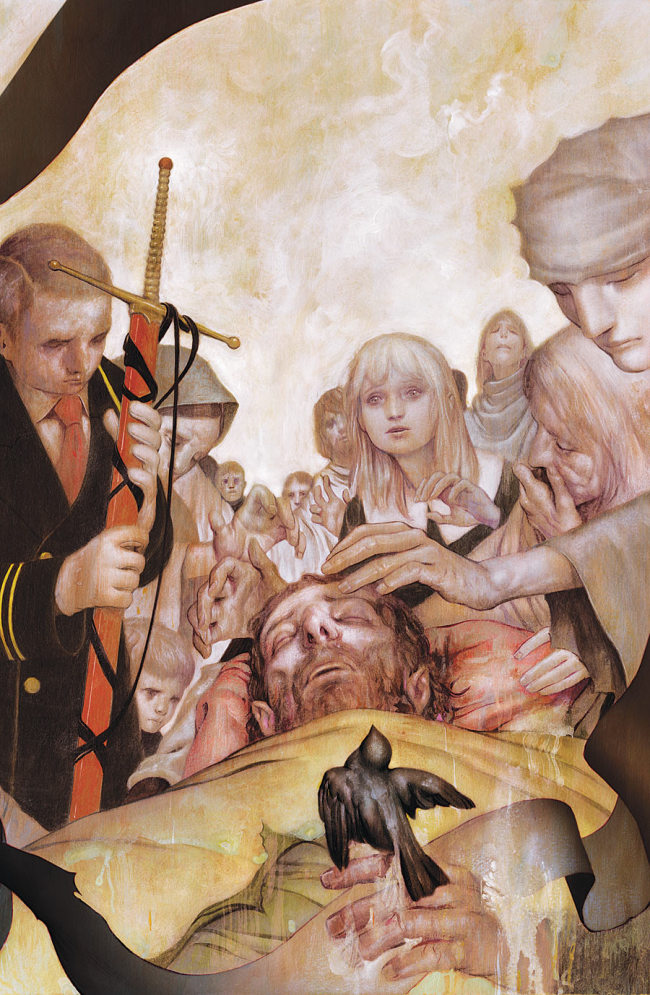
For those wanting a self-contained (6-issue), well-told story, I recommend this.  The art fits the story telling nicely, being somewhat cartoony, but that is appropriate in that a realistic style would not capture the utter strangeness of this world. 
Greatness and Excitement, Delayed

I haven’t been following the Olympics religiously, but I’ve enjoyed what I’ve caught.  While in Seattle, I stayed up too late watching NBC’s coverage until midnight, messing up my sleep schedule for the next day.  And, while I’m not gah-gah over Phelps, I’ve found his chase for 8 golds exciting enough and interesting enough to tune in.

So, the other day, I was heading to the store, with ESPN radio in the back ground.  In their SportsCenter update, they mentioned how Phelps had won gold number 6.  Cool, I thought.

I got home maybe 30 minutes later, and NBC was announcing that Phelps’ race was coming up in about 30 minutes.  What, I thought?  Was I confused?  Did I mishear ESPN?  I checked the official swimming results and, sure enough, he had raced and won.  It’s just that NBC hadn’t shown it yet.

It turns out, NBC is showing the Olympics on the west coast (Pacific and Mountain time zones) via tape delay.  The east coast gets it live, but we don’t.  And maybe that wouldn’t bother me at all, except for the fact that they paste live on every damn screen and Costas says “live from the water cube” or “live from the national indoor stadium” every other line.  Never once do they tell us that the broadcast is tape delayed.  I had no idea until I stumbled on it.

It seems particularly dishonest.  NBC should be saying “tape delayed” somewhere on the screen if, in fact, that is what it is.  To say “live” with no clarification is down right lying.

It seems that NBC negotiated hard with Beijing to have the crucial events (gymnastics, swimming, etc) at a time that was prime-time in the US so they could show them live.  Then, they don’t.  Why not show them live and show us more stuff?  At midnight, we’d get stuff on the west coast that the east coast guys didn’t really have a chance to see and they would see stuff in prime time that was on while we were still at work.

Even more annoying, to me, is that, even though it is tape delayed, we get all the damn filler and fluff.  And then they choose to show synchronized diving.  Is that the most exciting event on during that time?  Definitely not to me, and I’m guessing not the majority.

In the end, NBC can do whatever the hell they want, but they should be honest with what they are showing.  If it isn’t live, live shouldn’t be shown on the screen anywhere.

Numbers of the Beasts

Excerpted from A Dictionary of Fabulous Beasts, by Richard Barber and Anne Riches and Numbers, by David Wells.

Number: 0.7404…

pi/sqrt(18)

How closely can identical spheres be packed together?  The obvious way is to arrange one layer on a plane so that each sphere touches 6 others, and then arrange adjacent layers, so that each sphere touches 3 others in each layer (12 in all) and so on.  However, no mathematician has been able to prove this ‘obvious’ fact.

If that were the closest packing, the density would be this number.

‘Many mathematicians believe, and all physicists know, that the density cannot exceed pi/sqrt(18).’ [Rogers]

Beast: Amphisbaena

A two-headed creature, sometimes shown with feathers, but described as a snake by Pliny and by Lucan in his description of the terrors of the African desert in the Pharsalia.  When one head was asleep, the other remained awake, particular while hatching eggs; in this case the head on duty woke up the other one when it was time for it to take over.  Curiously enough, it proves to be a real animal, a limbless lizard which can move both backwards and forwards, and which rears its tail if frightened, pretending that it is a second head.

Fables 10: The Good Prince

Anymore, I only read a few comics series religiously. I was reading Whedon’s Astonishing X-Men series, but he has moved on and I’m not sure I’ll continue (though Ellis is a tremendous writer). I’ve followed the Ultimates series, which is pretty darn good. But the two series I keep closest tabs on is Powers by Bendis and Fables by Willingham.

Fables is by far my favorite series right now.  The premise is pretty simple: what if all of the characters from all of our fables existed in the real world?  And what if they were real people, in the sense that they have to live like we do in the real world?  And what if they were in the middle of a big war for control of the various worlds in which they live?  (In the Fables universe, each group of fables — the European fables, the Arabian fables, etc — inhabit distinct worlds that are, nevertheless, connected.)  Characters such as Snow White, the Big Bad Wolf, Little Boy Blue, Red Riding Hood, Hansel and Grettle, Gepetto and Pinochio, inhabit this fictional universe, interacting with one another and fighting for their survival.

I just picked up Fables #10, The Good Prince, which is the most recent collection of the Fables comic book.  This collection focuses on Flycatcher, otherwise known as Prince Ambrose.  He is one of the harder characters to identify, but I believe he is the frog that was turned into a prince upon being kissed by a princess.  His life is a tragic one, and for most of the series up to now, he has been a janitor working in the Fables’ government office in the United States.  However, he comes to the forefront in this tale and does his part in the war against the Adversary, that mysterious entity that has waged war on all Fables (we now know who the Adversary is, but for those of you who haven’t read this series but may, I refrain from spoiling it for you).

The art in this collection is a little hit-and-miss for me, but it does an adequate job of conveying the story.  But, really, the story is why I am here.  The story, as with most of the Fables collections, is outstanding.  An epic tale of redemption and perseverence, Flycatcher makes amends for his past failings.  I won’t say any more, but I would highly recommend this series to anyone who has an interest in fairy tales and just damn good story telling.

For more on Fables, including spoilers, check out this Wikipedia article.

Beasts and Numbers

A little while ago, I found a couple of books in a local used book store that I thought were pretty cool and that I thought I’d post little tidbits from, from time to time.

The first book is A Dictionary of Fabulous Beasts, by Richard Barber and Anne Riches.  The second is Numbers, by David Wells.

Beast: Aigamuchas:

A creature which lived in the Kalahari desert with eyes on the top of its feet and thin pointed teeth as long as a man’s finger.  If these creatures wanted to know what was happening behind them they went on hands and knees with one foot lifted so that they could see backwards.  They hunted men as if they were zebras and ate them.

Number: 5.256946404860…

The approxximate ‘volumes’ of the unit radius ‘spheres’ in dimensions from 1 upwards are:

dim.1 dim.2 dim.3 dim.4 dim.5 dim.6 dim.7
2 3.1 4.2 4.9 5.264 5.2 4.7

The volume is a maximum in 5 dimensions, and declines thereafter.  If however the dimension is regarded as a real variable, able to take non-integral values, then the maximum volume occurs in ‘space’ of this dimension, 5.256… The volume is then 5.277768… compared to the volume in 5 dimensions of 5.263789… [David Singmaster]

(More information about n-spheres can be found here.)

Blah, blah, blah… I've got the blahs.