Energy and the Future

One of the biggest challenges for our planet is energy. As more countries become industrialized and the people of those countries become more wealthy, they will need more energy. The problem is compounded by things like global warming, where we have to be careful how we get our energy. We can’t just burn fossil fuels indefinitely, we have to think of other ways of supplying our energy needs.

About a month ago, a colleague gave a talk at work on an energy workshop he attended. All of the talks from that workshop can be found at http://rael.berkeley.edu/files/apsenergy/ but my colleague gave a nice overview of the workshop and I thought I’d share some of the highlights here, as I think that both they were very interesting but also because I think this is such an important topic.

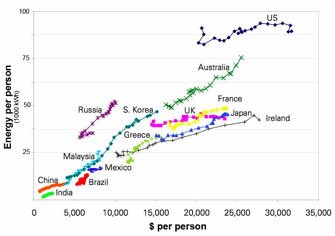
  • THE SCALE OF THE ENERGY PROBLEM:image0221.gif
    • The scientific consensus is that there is at least a 9/10 chance that global warming is due to green house gases released by human burning of fossil fuels. Thus, future generations will need to find cleaner ways to produce energy.
    • They will need much more energy than we do.
    • If you look at trends in energy use vs per capita GDP, there is a direct correlation: as nations grow wealthier, they use more energy.
    • The world currently uses about 15 terrawatts of power. It is estimated that by 2050, assuming there are 9 billion people then (as opposed to 6 billion now), the world will need 50 terrawatts.
    • If everyone used as much power as the average US citizen, 9 billion people would need 100 terrawatts. We currently use twice as much power per person as Western Europe and nearly 30 times as much as the average Indian.
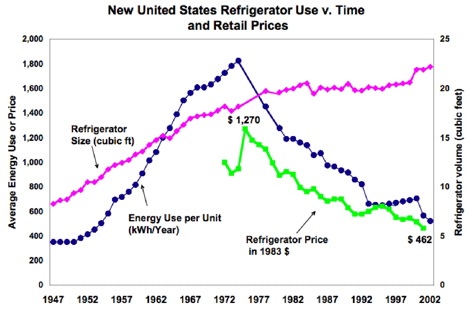
    • MITIGATING ENERGY SHORTAGES:refrigerator-use-versus-time-and-price.jpg
      • There are two main ways to mitigate energy shortages: government regulation and make more energy.
      • In the US, because of the decreased value of the dollar, we effectively pay $1300 more per year for oil than Europeans.
      • Government regulation can help mitigate energy use and even lead to better products.
      • In the 1970s, as a response to the energy crisis, California, regulated the efficiency of refrigerators (in 1978)
        • Over time, refrigerators became cheaper (green curve) and larger (purple curve) while also becoming more efficient (blue curve), which reversed the previous trend.
        • As a result of these and other regulations, California energy use per capita leveled off in the 1970s, while it has continued to rise in the rest of the US.
      • A similar experience is seen in car performance as a result of CAFE standards. Overall fuel economy has increased, while horsepower also increased and acceleration time has decreased.
        • Some vehicles are excepted from CAFE standards, as they are viewed to have other advantages. Examples are SUVs which are thought to be safer. However, the overall risk of some fatality, to either the driver of the SUV or the other cars, is higher for SUVs than smaller cars.
        • More efficient use of energy will also help.
          • Better system designs (such as radiative floor heating and radiative ceiling cooling) can lead to 50-85% energy savings.
          • But you have to be careful. Electric cars are more efficient than gas powered cars, until you consider the source of the electricity. If it is a coal fired power plant, is it more efficient?
      • SOURCES OF ENERGY:
        • There are many sources of energy, of various renewabilities and cleanliness.
          • Solar is renewable and clean
            • Solar includes light, wind, biomass, tides, as these all ultimately convert solar energy to electricity in someway or another.
            • Solar from light costs about 2-3 times as mainstream sources right now.
            • It is difficult to build large-scale solar farms as, after you exclude areas with low light intensity, environmentally sensitive land, too steep of land, and non-contiguous land, there isn’t too much land left.
            • Wind-power is best on coasts where wind speeds are high. This also correlates to high population areas.
            • There are mechanical problems with bearings and such in the large wind-mills (larger than a 747!)
          • Hydroelectric is mostly renewable but somewhat environmentally unfriendly
          • Nuclear is non-renewable and somewhat clean/dirty depending on your perspective
            • A 1 gigawatt power plant burns 3.2 kg of uranium per day (or 7 pounds/day)
            • Waste is nasty, but contained
            • Many concerns with nuclear, including safety, proliferation, waste, and economics
          • Coal is non-renewable and dirty
            • A 1 gigawatt power plant burns 7 million kg of coal per day (or 8000 tons/day)
            • Much more fuel than a nuclear power plant
            • A lot of waste is just pumped into the atmosphere
          • What can we get from each (remember, we need an additional 35 terrawatts by 2050)?
            • Biomass – about 7-10 terrawatts, assuming all arable land used for biofuel production (i.e. fish for dinner)
            • Nuclear – about 8 terrawatts, assuming we build a 1 gigawatt power plant every 2 days
            • Fossil fuel – plenty, assuming we build 5 1 gigawatt power plants every 2 days and figure out how to deal with green house gases
            • Wind – about 2 terrawatts, if we build windmills on all land with average wind speeds greater than 18 mph
            • Hydro – about 1-2 terrawatts, if we dam every remaining river on the planet
            • There is no silver bullet, we will need contributions from multiple solutions to solve the problem
      • SOLVING THE PROBLEM
        • To solve the problem will require many large scale efforts.
        • To keep green house gas emissions at current levels for the foreseeable future, we would need to do each of the following:
          • 2 billion cars at 60 mpg instead of 30 mpg.
          • 25% reduction in electricity use in homes and businesses.
          • CCS (carbon capture and sequestration) at 800 GW coal plants.
          • 1 million 2MW windmills.
          • 80×100 square miles of photovoltaics (e.g. on house tops).
          • 80×100 square miles of concentrated solar power (solar farms).
          • 700 GW nuclear power.
        • The size of the problem is enormous and demands immediate action and investment.

      What the?

      Can someone explain to me why this makes sense?

      http://www.bloomberg.com/apps/news?pid=20601087&sid=aZLIe0lJLHt8&refer=home

      The Democrats introduce a bill to increase taxes on oil, and a separate bill to give credits to renewable/sustainable energy. The Republicans defeat the first, saying that it would increase energy prices and compromise US energy security and defect the second, saying there is no way to pay for it.

      If you pass both, you have a way to pay for the second! And the second helps increase US energy security! How are we going to solve any of our problems if we don’t get past short-sited, profit-only perspectives and try to do something new? I just don’t understand!

      A choice to be poor?

      Last Friday, NPR had a story about John Edward’s new war on poverty.  In that segment, they had a commentary by a guy from rural Kentucky about the economic state of the area.  His point was that the part of Kentucky he is from has been experience a depression for quite some time, that while the country as a whole is worried about a recession, some parts of the country have been experiencing very difficult times for a while now.

      He said there were no jobs where he is.  But that his family has been in the area for 100 years or more and that he doesn’t want to leave the area.  Which got me to thinking, isn’t it his choice then to be poor?  Clearly, there isn’t much economic opportunity in his part of Kentucky.  But he sticks it out there nonetheless.  However, he could easily move to another part of the country where there is greater economic opportunity and maybe turn his life around.

      I understand the romanticism attached to his ancestors’ home.  But, it seems to me, sometimes, you have to move past that if you want to have a future.  You have to move past the past of your ancestors and think of your future.

      I can only relate to the experience of my dad in this.  He grew up in a rural part of the Basque region of Spain where the majority of people lived by substinance farming.  There were some industrial jobs, such as a local paper mill, but they had to travel by bus 30 minutes to get there.  My dad’s family lived in the house where he was born for several hundred years, maybe upwards of 300-400.  However, my dad realized that there wasn’t much economic opportunity there and, at the age of 18, left Spain to come to the United States, a land where he knew nothing of the language nor customs of the people.  He took work as a sheepherder, a grueling job that found him alone, or with possibly one other herder, in the mountains for months at a time.  Eventually, though, through hard work and a willingness to improve his lot, he found better and better opportunities until he was owner of a small trucking business hauling hay in the southern Idaho region and the surrounding areas.

      The point is, my dad realized that there was no economic possibilities where he grew up and he made a choice, a huge sacrifice, to improve his place in life.  This seems to me to be the embodiment of the American dream.  He was never successful beyond his wildest dreams, but he made a life for himself that was better than he could have imagined back in Spain.

      So, while I sympathize with the guy in Kentucky, I also think it is his choice to live in such hard economic conditions.  And I find it odd that we seem to romanticize this attitude, this behavior, while, in some sense, demonizing those immigrants coming to America to try and better their life.  Again, these guys, both the legal and illegal, sacrifice a huge amount to try to improve their economic situation.  They are the American dream.  I wonder what the ancestors of the guy in Kentucky would think, if they could look in on their descendants.  Those ancestors made the sacrifice, moving west to create a new life, giving up the comfortable situation they may have been in for the promise of something better.  Would they be proud that the children of their children are staying on the homestead, or would they want those descendants to embrace the same spirit and move on and find their own future?

      Obama and Clinton: why the divide?

      A friend of mine, a McCain supporter, asked why there was such a divide in the Democratic party, especially if Democrats were so happy with Clinton I’s administration. Why isn’t everyone supporting Clinton II?

      I thought this a very interesting question and thought I’d share my perspective (one that is from an admitted Obama supporter).

      It can’t be the policies. To me, the difference in policies between Clinton and Obama are relatively minor. Some differences in how they might approach world leaders, how they would “ensure” universal health coverage, etc. But, the overall goals are similar.

      The reason that there is such a divide right between Clinton and Obama supporters seems to be:

      • the historic nature of both candidacies: in either case, the Democratic nominee will be a historic choice, either the first woman or the first African-American. And, if the political markets are still accurate, the nominee is likely to become the next president. This is a historic time and some people I’m sure would like to see one historic outcome over the other.
      • the personality of the candidates: Clinton is viewed as a seasoned veteran and Obama as an agent of change. Whether you agree or not, this is how a majority of their supporters view them.
      • the deficiencies of the other candidate: conversely, many Clinton supporters think Obama is full of hot air and Obama supporters think Clinton is just like all other traditional Washington politicians.

      I’m sure there are others, but these seem to be the biggest things to me.

      My own personal feeling: I started off pretty neutral on the two, figuring either is significantly better than what the other party would produce, though, admittedly, I had a slight preference for Obama. Over the course of the primary, though, I’ve really begun actively disliking Clinton, for a number of reasons:

      • her “experience from day one” schtick: I think this is way over played and is essentially meaningless. What experience does she have that makes her qualified for being president? A few more years in the Senate? Being First Lady? If that mattered, then I should be an expert massage therapist and my wife a materials scientist. I think this was a line of attack she thought would differentiate her from Obama, but I think it is nothing but slight of hand.  And, it isn’t clear that there is any experience a candidate could have that guarantees success as president.
      • the appearance that she is willing to say anything to get elected: her campaign brought up doubts that Obama was a Muslim and the whole gas-tax holiday was nothing more than a ploy to get votes. It is a horrible idea and she likely knows it, but she thought it would get her votes. This extended so far that she actively ignored or dismissed the advice of economic experts, saying she knows more than they. This is exactly the attitude of Bush that has gotten us into so much trouble on a number of fronts.
      • her assertion that she is in tune with middle America: this is something that also annoyed me about Edwards. What do they know about middle America? They are both rich, neither has had to do any blue collar work in a long while, if ever. Edwards may have come from a blue collar background, but does he have any personal experience with it? Clinton almost certainly does not.
      • she was willing to prey on our fears: her spot of an emergency at 3AM was nothing but playing on our fears. I feel that is exactly what Bush has done for 8 years, not built on our hopes and dreams, but put us in fear of what might happen next and used that fear to implement a number of bad policies. Clinton seems willing to do the same.

      I know people have issues with Obama, especially that he seems to have no substance, that he is just words. Maybe. I’m not so sure. But, even if this is so, words are important for inspiring people. If he can get people interested in government, interested in the future of America again, and not just pandering to fear, I am willing to give him a shot. He can’t be any worse than what we’ve had the last 8 years. I’m willing to give a guy a chance who discusses the possibilities of America, of what we might become, rather than our fears, and what might happen if we don’t do as he says.

      Gas Tax Holiday: A horrible idea

      I’ve been out of it a while. Still trying to get into a rhythm with Rose. So, the blog has been a bit neglected of late. And, I haven’t been paying attention to the news all that much. I know Obama has had a bit of a hard time recently, with the Rev. Wright stuff and his “bitter” comment.  But, I hadn’t heard much about the debate over the gas-tax holiday he is having with Clinton.  I have to say, what I read and saw yesterday, it seems like a horrible idea to me.  I’m all with Obama on this one.

      Why is it such a bad idea?

      • How much does it really save each person?  It doesn’t seem like much.  The $0.18 per gallon is how much the price has gone up in just the last couple of weeks.  I know some people are just getting by, but is this going to make all the difference?  I’d be surprised.
      • What does it cost the government?  If taxes are down, the government has less to spend.  They have to cut something.  They’ve already cut back on science funding, on funding for the arts, on social programs.  What are they going to cut this time?  I’m sure it will hurt at least some people a lot more than they’ll get back from the holiday.
      • It encourages bad behavior.  Are we really concerned about the environment?  Then we should encourage using less gas, not more.  Most people would save a lot more money if they just carpooled to work.
      • Clinton and McCain are ignoring the experts.  Most economic experts agree that this is an extremely bad idea.  As Slate Magazine points out, by completely ignoring these experts and saying that she knows what is best, she is acting exactly like Bush has acted all these years.  Who do you trust on these issues, expert economists, or a lawyer from New York/Arkansas?

      To me, it is so obvious that this is a bad idea, that the only conceivable reason Clinton is for it is because it will win votes.  Not because she really thinks it is a good idea.  She knows people will go for the quick fix, will vote for her to save a few bucks.  She is pandering, and that is the only reason she can be doing this.

      At the beginning of the campaigns, I preferred Obama a bit but thought Clinton would be fine too.  As time goes on, I really am finding her less and less likable, less and less appealing as a candidate.  I want a president who finds good people, knowledgeable people, who surrounds him/herself with such people, who listens to those people, distills their expertise, and makes decisions.  We’ve had a cowboy that did whatever he wanted for 8 years.  Do we want a cowgirl that does the same?

      Blah, blah, blah… I've got the blahs.