Rant

Expectations and Drive

1

On the way to work yesterday, I heard a story on NPR about India.  They were discussing how there is such a fine line between rich and poor in that country, and were interviewing an Indian man who is very poor.  He and his wife scrape every penny they can from their earnings for tuition for their three year old daughter.  “I pray every day that she can lift her family out of poverty,” he said.

My first reaction was to feel sorry for this little girl who has all of these expectations on her before she even knows anything about the world.  Her family is essentially placing all their hope on her, that she can find success enough for the whole family.  This is common enough throughout the world, and similar stories have played themselves here in the United States.  It’s certainly a large burden placed on her little shoulders.

However, as I thought about it more, I looked at it from the other side.  This man and his wife are doing everything they possibly can to ensure their daughter has a brighter future, a better life than they did.  They work hard to give her the opportunities that they didn’t have.  And, while there is a great burden on her, it is only because her family loves her so much to do all they can to make her life the best that they can possibly make it.  They have a drive and desire to better her life.

And I wondered about the US and how it just doesn’t feel like we have that drive any more.  We are content with what we have.  We have good lives, especially in comparison to this Indian family, but we don’t have the drive to be any better.  My generation is possibly the first in the US that is overall worse off than our parents.  We don’t have the ambition to make something better of ourselves.  We are content to be where we are.

My dad, and my mom’s grandparents, came to this country to better themselves and their lot in life.  They gave up everything they knew, all that was comfortable, to go to a foreign land where they didn’t speak the language, to engage in work that they knew little about, all for the promise of a better life.  And, while my mom and dad didn’t place any undue burdens on me, didn’t push me to be anything more than what I wanted to be, they worked hard to ensure I had the chances to do exactly that, be what I wanted to be.

I look around and I see families that have no desire for a better life, no desire to improve their lot.  Their life was good enough for their parents and their grandparents before them, and it will be good enough for their children.  I think that, to some extent, that’s why education is not as highly valued here as I would hope.  Parents don’t care all that much.

I’m very proud of how hard my parents worked to give me the best chances in life that they could.  And, while that little Indian girl has some very large expectations placed on her, it’s only because her family wants what’s best for her too.  I wish we all had a bit of that drive, a bit of that want to better ourselves, to better our lives.  It is that kind of drive that made the US the great nation that it is and I fear that maybe we’ve lost it.

Opportunity in America

1

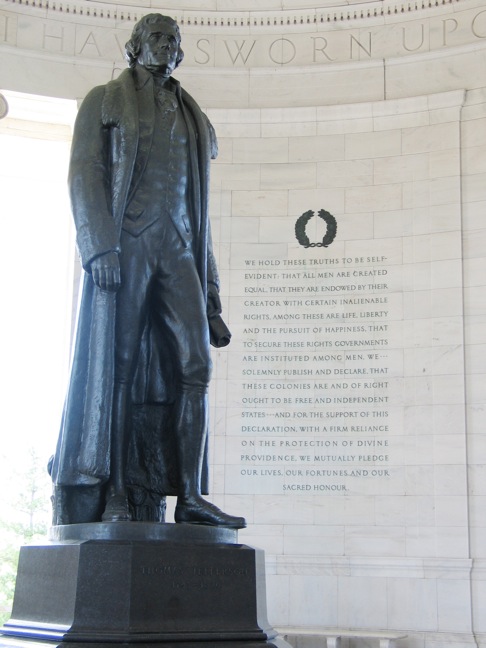
During the health care debate, one thing that has been a talking point is that the people who are on the lower end of the economic ladder are there at least primarily due to faults and errors of their own.  This is an inherent assumption of the American Dream:  “Life, liberty, and the pursuit of happiness.”  Everyone has the ability to pursue their own happiness and, the implication is, if they do not obtain it, it is a result of their own failings, primarily a lack of effort.

At the same time, however, it seems to me that some amount of failure has to be built in to the system.  That is, the system cannot sustain itself if everyone is successful in realizing their dreams, of obtaining their happiness.  There has to be some, even a majority of us, that fail in becoming doctors, lawyers, or whatever they dreamed of in their youth.  We can’t all be at the top of the economic ladder, or better said pyramid.  For the economy, for society function, we need people who end up in those jobs that none of us want, that we don’t aspire to, but are sometimes forced into by circumstances.  We need the sanitation workers, the slaughter house workers, the assembly line workers.  They are absolutely crucial to our system functioning.  But, I dare say, these are typically not jobs we aspire to, jobs that were part of our dream when we were “pursuing our happiness.”

Any individual can pursue their happiness, to varying degrees of ability, opportunity, and circumstance.  But, most of us have to fail.  Most of us have to give up on those dreams in order to survive.  The economic pyramid has to be bottom heavy to function, and none of us aspires to be at the bottom.

I understand that our system in no way guarantees that we obtain happiness, just that we are able to pursue it.  However, that most of us must fail, suggests to me that we who do succeed are not entirely free from any responsibility for those who do fail.  We depend on them, we require them, for a functioning economy.  Therefore, it seems that we should realize that failure to obtain our happiness is not entirely on our own shoulders, but is also a part of the system.  It will happen to most of us, the system ensures that.  As a society, we have some responsibility to make sure those people have some basic standards of living, including health care.

Black and White and Grey All Over

0

The country is politically very polarized, seemingly more so than ever.  You can see it in the town hall meetings, in the blue vs red electoral maps, and in the very people we hang out with.  For instance, an application has been going around Facebook which shows statistics about your friends.  It is very interesting to see that most people’s friends are very strongly either Democrat or Republican.  There aren’t many people with a relatively even split.  So, not only do we limit our news to sites and channels that we agree with, but we surround ourselves with people we agree with, locking our viewpoints even more rigidly on one side or another.

There has been a lot written about this already.  I’ve read, for example, that people who are religious tend to see more connections between seemingly unconnected events, while less religious people do not.  This is in effect a function of brain chemistry and wiring.  And, there does seem to be a correlation between how religious you are and which party you more strongly identify with.

I also wonder if it might also have something, at least a small part, to do with the stories we tell as a culture.  The cartoons I used to watch as a kid always pitted the “good guys” against the “bad guys”.  But, in retrospect what seems to define most of these stories is that the bad guys had no motivation, they are simply bad, or evil.  For example, the bad guys in “GI Joe” are Cobra.  Their only motivation is to rule the world, but they never say why.  They are just evil.  The same with Skeletor in “He-Man”.  And the Decepticons in “Transformers”.  Even in the “Smurfs”, Gargamel is an evil old man, who doesn’t seem to have any real reason for why he is after the Smurfs (except he wants to eat them).  Each story needs a bad guy, and that bad guy is simply bad.  The universes in which these stories take place are completely black and white.  There is no grey.  This is perhaps epitomized in the games that were popular at the time, such as Dungeons and Dragons and the like, and the fantasy novels that fleshed out these types of worlds.  Evil is an inherent part of the fantasy genre, where evil exists explicitly and simply to destroy.  Again, there is no grey.

Our religions, at least how they are interpreted today, also embody this dichotomy:  God is good, Satan is evil.

I wonder how much these black and white views of the universe, or even those universes in which our stories take place, color our perspectives of the real world.  If everything is black and white, good and evil, are those that disagree with us necessarily bad or evil, since we ourselves certainly are not?  Does that mean, if I’m a Democrat, that the Republicans are bad, and vice versa, leading to the polarization we see today?  Or are our stories a reflection of deeper down hard wiring within our brain to view the world in black and white?  Is that a survival mechanism, an evolutionary advantage that helps us more easily determine friend from foe?

I personally do not believe in absolute good nor evil.  I do not believe that there is some ultimate source for either.  Rather, I think that both good and evil are defined by society, by the norms that society creates within which to moderate itself.  And those norms are typically a result of instincts evolved over many generations.  I think that those we typically consider evil — those that live far outside societal norms — have different brain wiring that does not inhibit their base instincts as much as the general populace.  That is, I think it is essentially a different brain structure that makes it so that these people do not see good and bad in the same way as the rest of us.  Unlike the movies and books, I don’t think anyone views themselves as evil, not in an evil for evil’s sake way, hysterically cackling while committing their foul deeds.  Rather, they view the world differently, most of the time, and cannot distinguish right and wrong in the same way.  Either that, or they are like the rest of us, but get caught up by the situation, the power, the moment, to commit “evil” acts but either in the heat of the moment or for some perceived greater good.

Priorities

0

The other day, listening to ESPN Radio on the way to work, they had an auction to raise money for the V Foundation.  I don’t know much about it, but it’s something started by Jimmy Valvano, a I believe college basketball coach who was diagnosed with cancer and started this to fight back.  This was in the mid 90s, maybe 94 or 95.  The talk show guys mentioned how, since the foundation started, it has raised $80 million for cancer research.

The next segment was Sports Center and it was reported that some player (don’t remember the sport) had either just signed or was in negotiations for a contract worth $60 million over how ever many years, something like 5.

$80 million over 15 for cancer research and $60 million over 5 for one guy to throw a ball around.  It sometimes feels like our priorities are really screwed up.

To be fair, this $80 million isn’t the whole amount devoted to cancer research in the last 15 years, just what this one foundation has raised.  And the $60 million isn’t the player’s fault.  It’s mine as much as anyone’s, as I’m into the whole professional sports thing, watching the games, playing fantasy football, and owning a couple of jerseys.

But, still…

Airplane woes

0

After the news of the crashes of the planes going from Brazil to France and from France to Comoros, it seems one should be greatful whenever their flight arrives at its destination and that “minor” inconveniences that result in “just” delays are not so important in the big scheme of things.  And that is probably true.  But, when we returned from Idaho to Santa Fe via Las Vegas, our delay in Vegas was so bizzare that I feel it is worth sharing.

We were on a direct flight between Boise and Albuquerque, stopping in Vegas but we didn’t have to get off.  We got there a little early because of favorable winds, I think, but when we landed, our gate was “broken” (that was the word they used) which caused a delay as they found us another gate.  That took maybe 15 minutes or so.  At the new gate, they unloaded the Vegas passengers and loaded up a full plane of people flying to Albuquerque and beyond.

And now the, to me, really bizarre part.  We just stayed there, for nearly two hours, at the gate, just waiting.  For what?  No one said for maybe one hour, when they finally explained it to us.  It seems that they are doing construction at the airport in Vegas, so the number of runways is reduced.  It also seems that, depending on the wind direction, either one or the other of the two runways in service are used.  Originally, we were to use one runway, which was fine, but then the wind shifted and we were then supposed to use the other runway.  But, that runway has less clearance — it heads into some mountains — so the plane needs to be more powerful than on the other runway.  Our plane, fully loaded, didn’t have the power to safely clear the mountains — it was overweight.  So, they unloaded passengers who were only going through Albuquerque and about 2000 pounds of fuel.  This took about 2 hours total.  All of this was complicated, somehow, by the temperature, which was 110 F.

Through all of this, the flight crew was great.  One of the pilots explained this to us, for which I was very greatful (I much rather be informed about what is going on than be kept in the dark) and one of the flight attendants even ran back to the concourse to get us some fresh milk for our daughter (who, incidentally, did very well considering she was cramped in the plane for an extra 2 hours).  So, I really commend the crew.

What I don’t understand is the company and the airport.  It seems to me that in a place like Vegas, this can’t be a rare occurance, that it gets hot, that the wind shifts, and that a flight is oversold and is at full capacity.  And yet it took 2 hours to diagnose and fix the situation?  It just doesn’t make sense to me.  I wonder how often this does happen and if it always takes this long for them to fix the problem.

Go to Top