Nexus by Mark Buchanan

By now, everyone has heard about the six-degrees of separation thing, how we are all connected to Kevin Bacon by about 6 other people.  Turns out, there is nothing special about Kevin Bacon — each of us is connected to pretty much everyone in the world by about 6 or 10 other people.  In a world with 6 billion people, how can this be possible?  That is where the theories of complex networks and, in particular, small world networks come in.

In Nexus, Mark Buchanan gives an introduction to this new field (many of the seminal discoveries have occurred within the last decade).  He describes how these networks are ubiquitous in nature (e.g. the networks of streams comprising a river system), social networks (the 6-degrees thing, among others) and networks created by humans (the internet and the electricity grid, as two examples).  It turns out that there are two types of small world networks, called egalitarian and aristocratic.  Buchanan discusses how such networks arise naturally.  In particular, the aristocratic networks, characterized by special nodes that have an especially high number of links to other nodes, occur via a “rich get richer” process, in which nodes that already have a lot of links or friends or what have you are more likely to get even more.

There were a number of intriguing points in this book.  For example, when he discusses river systems, it turns out that all river systems follow the same distribution of land they drain versus the number of streams in the river system that drain that amount of land.  They follow a power law distribution.  That is, if 100 streams in a given river system each drain 50 square miles of land, then 50 streams will drain some constant times 50, and 25 streams will drain that constant times that constant times 50.  There is a power law association between the number of streams that drain a given area of land and the size of that area.  Even more interesting, just assuming the most simplest of assumptions, this distribution can be generated in a computer.  All they assume, given a random topology of land (not even a real landscape), is that water flows straight down hill.  They neglect so many seemingly important features (erosion, for example) that it seems impossible that it would represent anything about real river systems.  But, it does.

Another feature that has such a power law distribution is the amount of wealth held by a given percentage of the population.  Known as the Pareto principle, it basically is the observation that in most countries in the world, regardless of type of government or economy, about 80% of the wealth is owned by 20% of the people.  And, as you look at the number of people who own 90% of the wealth, it is a constant factor of 20%, and so on.  This, to me, is amazing.  Furthermore, again in simple computer experiments in which you allow people to exchange wealth in one of two ways — they can either (a) buy something from someone else, involving direct transfer of wealth, or (b) they can invest their money with some random rate of return — this Pareto distribution is reproduced.  This is true even if you assume that all players have the same skill in investing.  It all comes down to random luck and the rich get richer principle.  As someone gets lucky and wins on their investment, they in turn have more money to invest.  Think about the implications: the distribution of wealth in most countries might be mostly due to random luck.  Sure, government policy (e.g. taxes, etc) would change the slope of the distribution, or the power in the power law, and skill might as well, but that this distribution can be obtained without any of that suggests that the wealthy are wealthy not because they worked harder or were smarter or anything like that, it is just pure random luck.  If this is true, what does that mean about how we view the wealthy’s role in society?

This book had a number of intriguing points such as this that really make you look at the world in a different way.  These small world networks are so pervasive (they even occur in the sexual relationships of people — there are some people who have so many sexual partners that they essentially connect everyone within a few links of one another; this has implications on how you might treat, e.g., sexually transmitted diseases) that understanding how they come about and what they teach us about how the world works is absolutely essential.  Knowing that we are all connected so intimately and what that means for how we interact is fascinating.

I highly recommend this book to anyone who is interested in how people, atoms, computers, rivers — so many different things — interact with one another.

For more information about small world networks, see this Wikipedia article.

Short Stories, Light and Dark

I just finished two collections of short stories, chosen seemingly at random.  I basically picked these up because their covers intrigued me, having heard nothing about them.  Also, I’m a fan of short stories as they are often a quick read but can contain very powerful statements about the human situation.

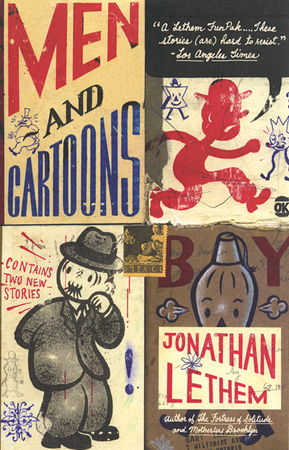
These two collections are very different.  The first, Men and Cartoons by Jonathan Lethem, is an exploration, in some sense, of the superhero genre, though some of the stories touch more on science fiction than pure superheroics.  But, more than that, these are just devices for Lethem to explore human personalities.  In some cases, the protagonists aren’t even human, like in Interview with the Crab, in which a crab, who starred in a sit-com as a youngster, is interviewed in his later years about his fame and fortune.  Super Goat Man is about one near-hero, a guy who really has no powers except he looks a bit like a goat, and how he never lives up to being a hero.

All of these stories explore different quirks of people.  At times, I felt the stories were a little flat, though there were definitely times, like in The Spray and The Shape We’re In, which describes a cell’s adventures in a human body, when I wondered how the hell he came up with this stuff. Some of the stories are definitely inventive and pretty way out there, making the overall collection well worth the read, even if in a couple of cases, I was growing a little bored.

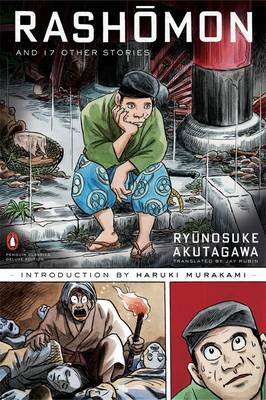
The second collection is Rashomon by Ryunosuke Akutagawa.  I was intrigued by the title as I had seen the movie Rashomon by Akira Kurasawa in college, a movie which I really enjoyed and highly recommend.  It wasn’t clear to me there was a connection, but I picked it up anyways.  And, indeed, there is a connection.  Though, it is a little convoluted, as Akutagawa’s story Rashomon has little to do with the movie.  It is rather In a Bamboo Grove that inspired the movie Rashomon.  I enjoyed most of the stories in this collection.  They start out with his fiction, usually set in feudal Japan, and explore the human experience by putting people in odd situations.  In a Bamboo Grove describes a death from multiple perspectives, giving each person’s take on what happened, including the victim.  Hell Screen is about a painter who is commissioned to paint a screen with the Bhuddist hell depicted on it and the events that occur to complete the painting.  The later stories move into more modern territory, but no less odd events.  One describes a man who dies at the wrong time and is returned to life with the legs of a horse as his had already rotted.  The last few stories are more autobiographical and describe Akutagawa’s descent into madness (he ultimately committed suicide).  While I think it is very hard to convey the despair that someone must go through in such a state.  I’ve read Plath’s The Bell Jar and just didn’t feel the anguish she was trying to convey.  I feel it a little bit more here, as Akutagawa describes the random things that end up tormenting him.  In all the stories, Akutagawa has a unique perspective and is inventive in his subjects.  This is another collection that I enjoyed and would recommend.

Superbowl XLIII – A good game, disappointing ending

Another Superbowl, another Steelers appearance.

I have a running bet with my brothers and, if the Steelers won (again), I’d owe (again).  So, of course, I was rooting against the Steelers.  And, I don’t dislike the Cardinals, so I was all for the Cards winning.

The game started out alright, with the Cards stopping the Steelers on a couple of drives.  I mean, one of those stops was necessary after that running into the holder penalty, which seemed a bit ticky-tacky, but still, the Card defense was pretty impressive.  And stopping Big Ben at the goal was pretty damn impressive.  The team as a whole had too many penalties, started the game off sloppy.  But, they were still in it, holding the Steelers to just 10 points and starting to come alive offensively.  First they got the one touchdown to the tight end, and then, after getting that tipped interception, were about to score again to finish the first half ahead.  Then, Warner throws that interception, returned for a TD, the longest play in the history of the Superbowl (not sure how many times I heard that).  Not the best way to end the first half, and a bit disappointing that no one on the offense can tackle worth a damn.

The second half got really exciting as the Cards mounted a comeback.  Two TDs to Fitzgerald, one of them for 64 yards as he blew by the secondary, made it a game and put the Cards ahead.  And the Steelers were getting sloppy too, with the holding penalty in the end zone for the safety, the personal foul for hitting.  It looked like the Cards might actually win.  The left the Steelers only a couple of minutes to try to tie the game.  But, for some reason, the Card D decided they didn’t need to defend Holmes any more.  First the first down.  Then the TD.  And the game is over.  Maybe not quite.  The Cards had one more chance, but it ends in a maybe-somewhat-controversial fumble call.

Overall, I thought it was a good game.  A little sloppy at times, with too many penalties, the stupid kind.  But, the Cards played, overall, a better game, I thought.  If it wasn’t for that interception return, they would have likely won the game.  I think the Steelers did just enough to win, but the Cards also shot themselves in the foot more than a few times with all those penalties and the int.  They definitely showed that they deserved to be on the same field as the Steelers, in contrast to what all the pundits claimed.  And the Steelers didn’t dominate like some feared.  So, while the game, I thought, was overall very good and very exciting, I was still disappointed with the outcome.

Someday, maybe the Vikings will be on the other side of the trophy.  Someday.  The dream of the fan lives on.

Eastern Travels, Part II

Finally, I’m getting to the second half of my travels of last October!

After the conference in Beijing, I flew to Perth, Australia, to visit a collaborator.  This guy, Nigel, had recently visited us and we are trying to get some joint work going on nuclear waste forms, materials for storing nuclear waste.  He had just moved from Sydney to Perth, which is a shorter hop from Beijing, so that was convenient.  Even more so, there are other Uberuagas actually living in the Perth area.  They are from my dad’s home town of Munitibar, and grew up in a house just across the way from my dad.  Having a name like Uberuaga, they are likely related, likely distant cousins, but I haven’t quite figured out what the relationship actually is.  In any case, it was another nice convenience of flying to Perth.

Flying from Beijing to Perth, I had a stop in Hong Kong.  I didn’t get to see anything of Hong Kong, but did have a panic in the airport as I couldn’t find a piece of equipment I was supposed to have on me.  I really was in a cold sweat, as the last thing I wanted to do was lose government property, especially with all the negativity we’ve had recently about that kind of thing.  Fortunately, I found it, but not without more that a few moments of true panic.

Nigel got me a place to stay very close to the water.  The photos are from near my room.  Perth is separated by a river and I was on the side opposite down town.  A great view!  Unfortunately, I had caught a cold in Beijing, so I wasn’t the most adventurous explorer during my time in Australia.  But, I did get together with the Uberuaga clan — two brothers and their families — who treated me to a great Aussie barbie.  That was on Sunday.

On Monday and Tuesday, Nigel and I discussed work we’d been doing and some new directions we could take the collaboration.  We have, in my opinion, some really good ideas; now we just need to convince a funding agency.  One night, I went to dinner with Nigel and some colleagues of his.  I had a sampler plate, which had a number of things, including kangaroo.  I can’t really say it had much of a distinctive taste, but it didn’t taste bad either.  I guess in some parts of Australia, kangaroos are like we think of armadillos in Texas.

Wednesday, I took some time to do some shopping.  I wanted to get Lisa an opal, so I searched for a shop.  It took me a while to find something, especially as they tend to open a bit later — 10 — so I had a bit of a walk.  I was also looking for some souvenir boomerangs, but didn’t find anything I really liked.  The lady at the opal shop was pretty sweet, though I also thing she was in full saleswoman mode.  She told me how great a deal I was getting and how the young American sailors who came through were always so polite and such.  In the end, I think I did get a pretty good deal, as foreigners who are taking opals out of the country don’t have to pay tax and she gave me an extra discount off the sticker price.  Not entirely sure why, but I was happy to get it.

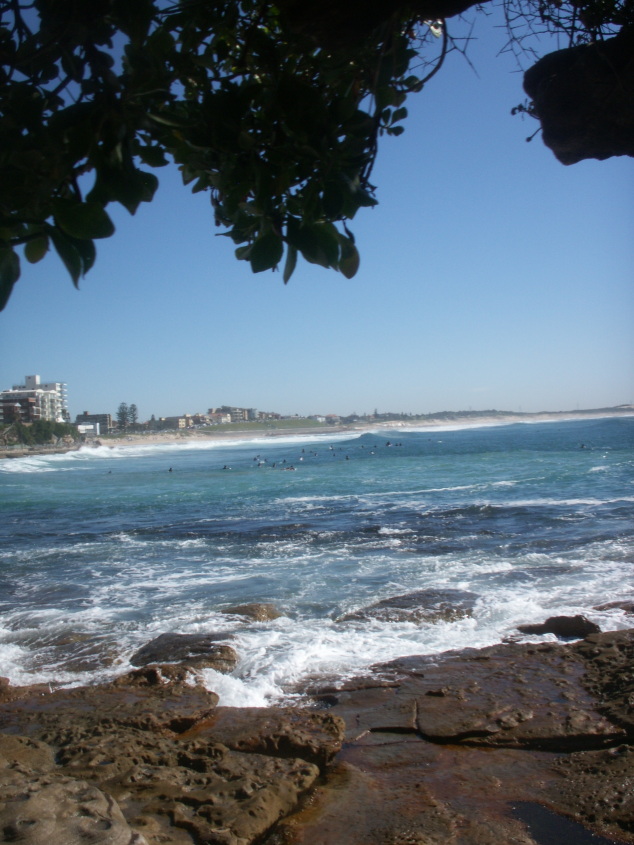
That night I flew to Sydney.  The next day, I was supposed to meet with some folks from the Australian Nuclear Science and Technology Organization, sort of Australia’s version of us.  Karl, my host there, picked me up at the airport, which was an adventure in itself as he lost track of his car in the parking garage.  But, we soon were on our way.  The hotel they put me up in there was on the beach, a famous surfing beach that I forget the name of.  The next day, I got a tour of ANSTO and met a lot of good people.  I gave a seminar there (and in Perth too, actually) on the work we are doing.  I think there is some potential for new collaborations with these guys.  That night, Thursday, we had dinner at Karl’s place.

Friday, I walked around the beach near the hotel.  I never made it to downtown Sydney.  I was still feeling the effects of the cold a bit so didn’t venture too far.  But, I saw a lot of kids, young kids, trying to catch some waves, learning to surf.  That was cool.

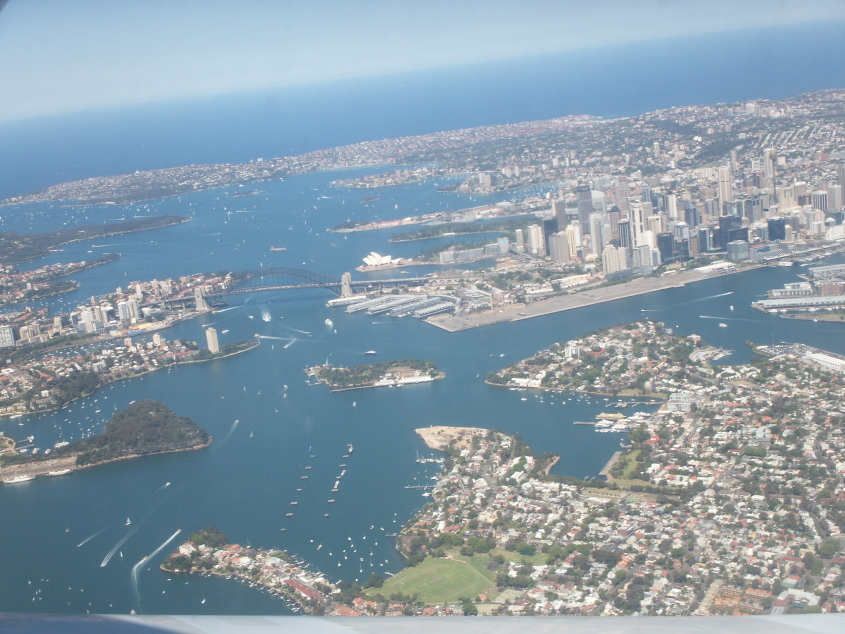
About mid-day, I got on a plane and came home, after about two weeks away.  As the plane was passing over Sydney, I snapped the photo at right.  You can see the Sydney Opera House there.  Sydney looks like a cool city.  I’ll have to go back. But, it was good to get home, back to my family.  Two weeks is getting to be a long time to be away from home.

Blah, blah, blah… I've got the blahs.