It’s been a bit quiet around here lately, primarily due to life and work getting in the way. Work has included a couple of trips in the last few months which have made posting on the blog a bit difficult, trips to China, Australia, and Boston. I meant to post my thoughts on my Eastern travels months ago, in October when I went, but I just haven’t gotten to it until now. Hopefully, I remember enough to have something to say here. 🙂
 I went to Beijing for a week for a conference (on Computer Simulations of Radiation Effects in Solids — COSIRES) and then to Australia for a week as well to visit a colleague there. I’ll write a second post on Australia; first, Beijing.
So, I went to Beijing for a scientific conference, so most of the week was spent working (listening to talks and giving a few myself) so I didn’t see as much of China as I would have liked. I left the US on a Friday and arrived in Beijing on Saturday. I went with a postdoc that is working with me who is from China, and his father — along with a few of his friends — picked us up. They drove us around Tiananmen Square and then took us to dinner, where I had the first of several Peking Ducks for the week. Part of the meal also included duck heart (which I neglected to try) and what was Mao’s favorite dish, pork braised in brown sauce. In reality, it seemed like pork fat, so I only tried a small piece. This was probably the oddest thing I tried while in China, including the frog we ate the next day.
I wanted to buy a couple of souvenirs for friends and family and so the next day we went to a shopping mall, a bit far from our hotel (well, we had to take a taxi to get there, so it wasn’t within walking distance is all I really know). It was pretty push, very upscale. I was looking for a small piece of jade for my daughter, nothing very fancy. So, we looked at the various displays from seemingly different companies. We settled on one eventually, looking at the various pieces. Immediately, the prices jumped out at me. I was looking for a simple piece, a piece shaped like a donut and not much bigger than a quarter. The cheapest piece like this was maybe $500, though most were at least $1000 and some as high as $10,000 or more. The price of a car! With the help of my postdoc’s dad, the lady behind the counter searched in a bin she had underneath and found, eventually, after a bit of searching, a piece that was about $100. The whole store was like this, filled with luxury goods such as watches and perfumes that I couldn’t imagine buying. I quickly realized that China is actually a very capitalistic society, regardless of the form of government it has. It was also clear that there must be a huge disparity between those who have and those who do not, as the average farmer from the country-side likely couldn’t afford the $100 piece I’d just purchased, much less the other pieces that were clearly out of my reach.
After that, the rest of our week was spent attending the conference, which was, overall, quite good. These conferences are primarily an opportunity to meet with colleagues and collaborators from around the world on a semi-regular basis, to get an update on what they are working on, and to potentially establish new collaborations. As I go to more and more of these, and I see the same people each time, I enjoy them more and more. Each night was spent in the hotel bar, which had a pool table. We stayed until the wee hours of the night, drinking beers and challenging each other to games of pool, usually broken up by country (the Yanks vs the Brits, the Finns vs the Yanks, and so on). We then had to get up betw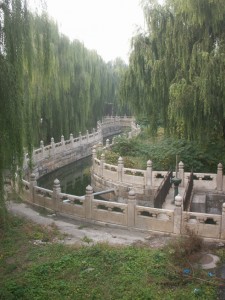 een 6 and 7 the next morning to make the next round of talks. This got harder and harder as the week went on. 🙂
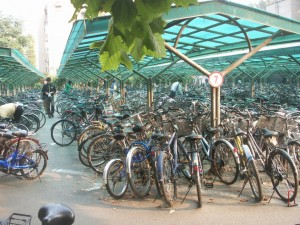
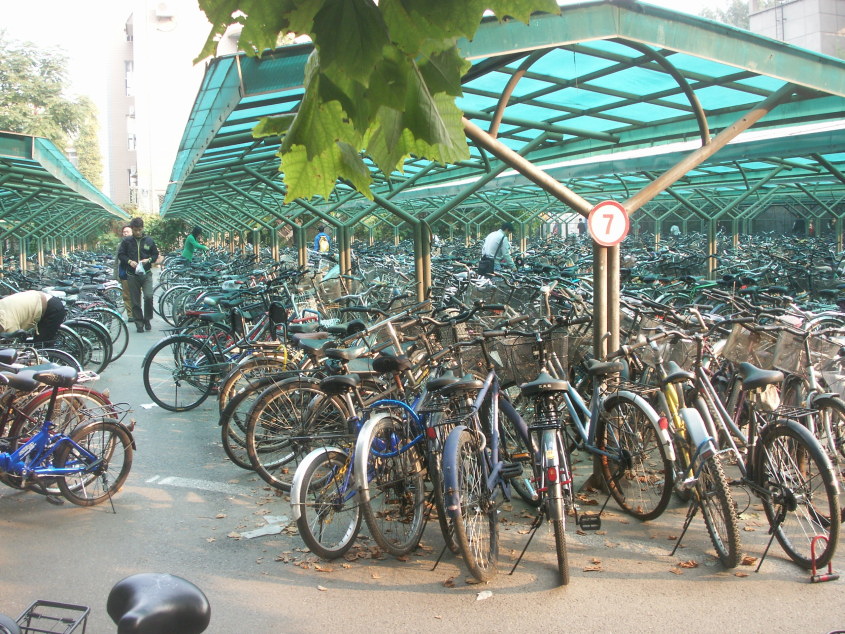
The conference was held at Beihang University, which was a pretty big campus. It was odd in that there were lots of younger kids also on campus, playing ball and such on the fields. The most memorable part to me was the bicycle parking lot, as this epitomized everything you hear about China. While there are a lot of cars on the road (and it is amazing to me that there aren’t accidents every block), there are still a lot of bikes on the road. They dodge and weave amongst the cars, seemingly taking their lives in their hands with every turn.
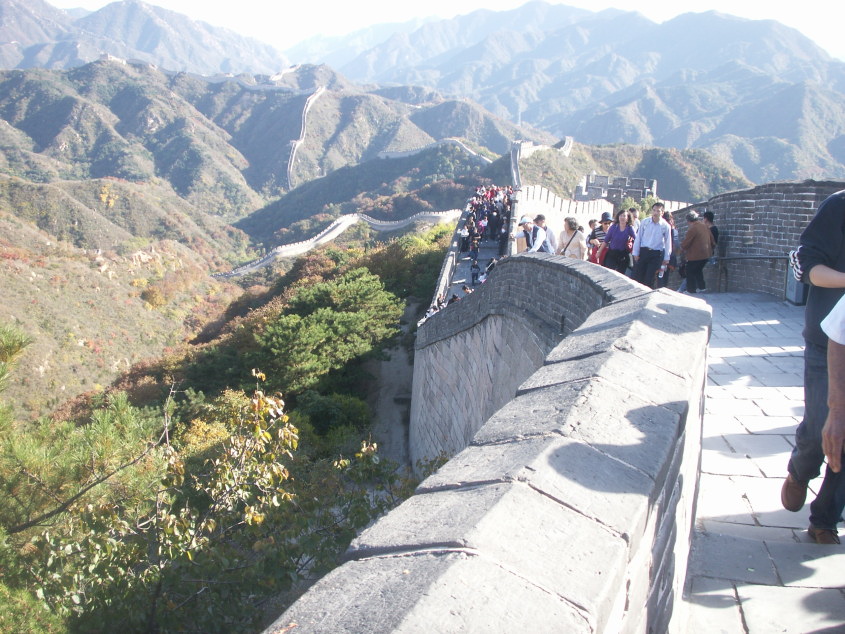
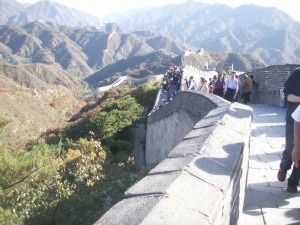 As with most of these conferences, there was an outing. And, in China, there is no bigger draw than the Great Wall. We spent a couple of hours there (once you catch a bus at noon to get there, spend nearly 2 hours on the road to the Great Wall, and then have to be back for dinner, it doesn’t leave a lot of time). We all scattered our separate ways, exploring the Wall in our own ways. I went off with my postdoc, just hiking as far as we could in our 2 hours. We hiked up about 45 minutes, pushing ourselves a bit (which, in my case, isn’t saying a whole lot since I’m not in the best of shape). It was a spectacular view. But, it was also amazing how crowded the whole thing was. Some places, the pathway was only one person wide, but two rows of people were trying to push past one another. And they weren’t polite about it. It was still amazing, however, to think about the effort that went into building the Wall, and how many people died during its construction. Supposedly, when someone died, they just tossed the body over the side and kept working.
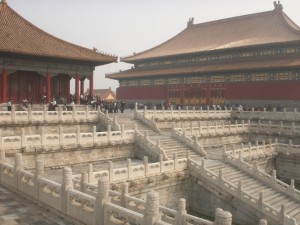
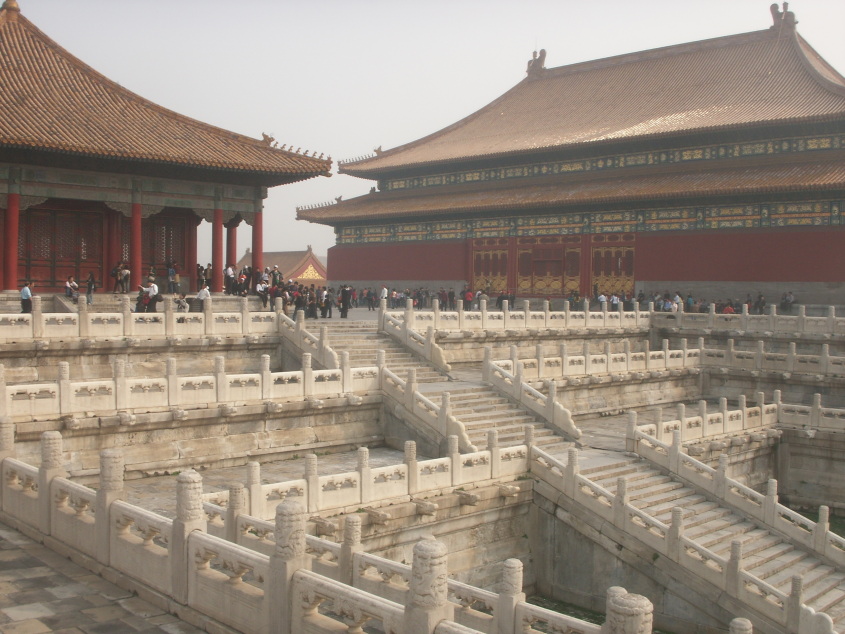
The last day of the week, Friday, the conference ended after half a day and some of us decided to go to the Forbidden City. Now, this was impressive. The City is immense and no photo can do it justice. We spent the afternoon just traversing from one end to the other, checking out the various side buildings and gardens and such. But, there were so many buildings, so many parts to the City. My understanding is that the City was built to house the Emperor and his 1000 concubines. The only other men allowed were eunics, to ensure that the concubines were not sullied by any man besides the Emperor. Anyways, the buildings were being refinished, prettied-up, so to speak. It made it feel a bit more like a tourist trap, like it was being Disneyfied just a bit. Even so, it was still such an amazing place. Amazing that such a place could be built for one man.
The next day, I flew to Australia. But, I will write about that another day.
Like this:
Like Loading...
 On the way back home from Idaho, Lisa and I began listening to the audio version of Barack Obama’s Dreams from My Father. We aren’t done yet, so I’ll wait until giving my thoughts of his story, but there was one thing that jumped out at me.
 Finally, after a year of carrying it around in my bag and half starting it, I just finished reading James Surowiecki’s The Wisdom of Crowds. I have to say, I found this one of the most interesting books I’ve read in a long time.