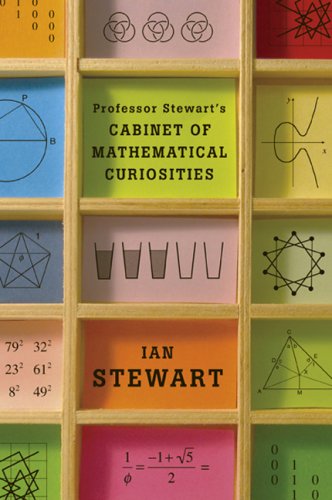
Professor Stewart’s Cabinet of Mathematical Curiosities by Ian Stewart

I picked this up randomly at a bookstore in Santa Fe, intrigued by the thought of delving into a little bit of math.  And that is just what this is.  Professor Stewart’s Cabinet of Mathematical Curiosities, by Ian Stewart naturally, is a tour de force of many of the most interesting corners of math, both historical and modern, covering each just a little bit.  Each topic is never given more than a couple of pages, though some of the topics do join together.  He covers everything from regular polyhedra (Platonic solids) to Fibonacci numbers to the shape of oscillations on a drum head to complexity science.  He gives just enough to tantalize, to intrigue, to whet the appetite.  The history of math is also scattered throughout with brief mentions of many of the important mathematicians.  Finally, there are lots of exercises and puzzles for the interested reader which, I admit, I was not — after so many years of school, I’m hard pressed to do anything that appears like homework.  But, the solutions are in the back of the book and offer further insight into the mathematical topic at hand.

There were two concepts that particularly caught my attention, mostly because I hadn’t heard of them before and they are so interesting.  The first is Benford’s Law.  Imagine you are working at a company and you decide to cook the books a bit, creating false transactions.  You might think that the numbers associated with the transactions should essentially be random, that, for example, the number of transactions starting with 1 (like $10224) should be about the same as starting with 2 ($221) and so forth.  In reality, this isn’t true.  If you look at the distribution of house numbers in a city, or the size of islands in the Bahamas, or the GDP of the nations of the world, numbers starting with 1 are more common than 2 which are more common than 3, and so on.  This fact is Benford’s Law, and it is used today to catch embezzlers and others who don’t realize that the distribution of these numbers isn’t random, but follow this pattern.  Wikipedia, naturally, has a nice article about Benford’s Law.

Ok, the second example I’ve heard about but it is presented in a very nice way.  That example is Penrose tiles (here is the Wikipedia article about those).  If you think about tiling the plane, like say tiling your bathroom floor, there are three shapes you can use that will let you completely tile the floor: (equilateral) triangles, squares, and hexagons.  These, in turn, give you patterns that have 3, 4 or 6-fold symmetry (if you rotate your view direction by 120, 90, or 60 degrees, the pattern will look the same).  It was thought that 5-fold symmetries are impossible:  you can’t tile a floor with pentagons.  However, Roger Penrose showed that if you use two shapes, a kite and a dart, you can tile the floor and get a 5-fold symmetry.  What’s more, the resulting pattern is not completely periodic.  It has short range, but no long range order.  Why does this all matter?  Well, symmetries are crucial for understanding crystal structures:  atoms arrange themselves in patterns that are the three dimensional equivalent of these 2-D patterns.  Again, no one thought that 5-fold symmetry could exist, but on the surface of chemical compounds, “quasi-crystals” can form, which exhibit the same patterns that Penrose tiles do.  Very cool!

This book offered lots of glimpses into many unfamiliar corners of math, and as such was very interesting.  He describes each topic at a level that the basic idea can be gleaned by those who have little or no math background.  I highly recommend this book to anyone who has even a vague interest in math.

One final note: in the previous book I discussed, The Golden Ratio by Mario Livio, he claimed that the nautilus shell followed the logarithmic curve.  Stewart says that isn’t so:  the shell is wound tighter than a logarithmic curve would dictate.
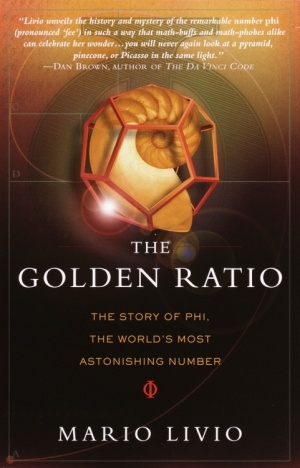
The Golden Ratio and Understanding the Universe

When you stop and think about it, it is truly astonishing how well we can describe the universe around us using mathematics.  That equations as simple as F=ma and E=mc^2 can describe so much of what we observe is really amazing.

The Golden Ratio by Mario Livio is essentially an examination of one of the most remarkable numbers to be discovered as a pretext for ultimately exploring the question why do mathematics work so well.  The golden ratio, known from the time of the ancient Greeks, is a pretty simple concept: take a line (defined by points A and B) and divide it (at point C) such that the length of the entire line over the length of the longer portion of the division is the same as the length of this longer portion over the shorter portion.  That is, if the longer portion is CB and the shorter is AC, then AB/CB=CB/AC.  A pretty simple concept and definition.  It turns out, this has many profound consequences.  This golden ratio, normally dubbed phi by mathematicians, is one of the first irrational numbers discovered and is, in some sense, the most irrational of all.  It shows up in many branches of math, especially geometry, and has been observed in nature in the patterns formed by petals on flowers, the seeds in sunflowers, the shape of certain seashells, and the shape of galaxies.  It is ubiquitous in nature.  Why should that be so?  That is the real point of Livio’s book.

Livio spends a lot of time on the history of phi, how it was discovered, how it was understood, and what it means to math and science.  When he is focusing on the role of phi in science, the book is wonderful.  There were many very interesting insights that I was unaware of that were real gems to discover.  Livio also spends a lot of time on the supposed role the golden ratio played in art, poetry, music, and architecture, including the constrution of the pyramids of Egypt.  His goal is to debunk those who claim that the golden ratio was an instrumental part in many such works, and he does so convincingly.  Unfortunately, I found this a huge distraction and very uninteresting.  I would much rather that he had filled those pages with more discussion of how the golden ratio is found in nature and science.  I understand that he felt a need to determine where the golden ratio is really to be found, but I felt it was over done.

Ultimately, the fact that the golden ratio, and by extension math as a whole, figures in so much of what we see around us leads Livio to examine why that is so.  He describes two alternative views.  First, that the universe is objectively Platonic; that humans are discovering the laws of the universe and those are written in the language of math.  Any civilization in the universe would uncover the same mathematical laws.  The second view is that math is a human language, a human construct, and we are using it to interpret our observations of the universe.  Civilizations with different formulations of mathematics would have a different view of how the universe works.  Livio falls somewhere in the middle, and, to be honest, I did not overly understand his reasoning for his position.

It is an interesting question.  I guess I would tend a bit more towards the Platonic view.  I think that it is just too striking that our math and physics can not only describe but predict what is happening around us so well.  I once had a chat with a fellow grad student at the UW physics department that was about this.  His point, as far as I could understand, is that maybe we create the reality around us via our investigations and our interpretations of our observations.  Essentially, that there is no objective reality, that reality is created by the observer.  Thus, as we develop our math, we view the universe through that math and thus shape it to conform to our math.  This “the observer shapes reality” perspective seems like an extreme view of the Copenhagen interpretation of quantum mechanics.  I definitely wouldn’t go so far as this.  But, it is an interesting question.

Airplane woes

After the news of the crashes of the planes going from Brazil to France and from France to Comoros, it seems one should be greatful whenever their flight arrives at its destination and that “minor” inconveniences that result in “just” delays are not so important in the big scheme of things.  And that is probably true.  But, when we returned from Idaho to Santa Fe via Las Vegas, our delay in Vegas was so bizzare that I feel it is worth sharing.

We were on a direct flight between Boise and Albuquerque, stopping in Vegas but we didn’t have to get off.  We got there a little early because of favorable winds, I think, but when we landed, our gate was “broken” (that was the word they used) which caused a delay as they found us another gate.  That took maybe 15 minutes or so.  At the new gate, they unloaded the Vegas passengers and loaded up a full plane of people flying to Albuquerque and beyond.

And now the, to me, really bizarre part.  We just stayed there, for nearly two hours, at the gate, just waiting.  For what?  No one said for maybe one hour, when they finally explained it to us.  It seems that they are doing construction at the airport in Vegas, so the number of runways is reduced.  It also seems that, depending on the wind direction, either one or the other of the two runways in service are used.  Originally, we were to use one runway, which was fine, but then the wind shifted and we were then supposed to use the other runway.  But, that runway has less clearance — it heads into some mountains — so the plane needs to be more powerful than on the other runway.  Our plane, fully loaded, didn’t have the power to safely clear the mountains — it was overweight.  So, they unloaded passengers who were only going through Albuquerque and about 2000 pounds of fuel.  This took about 2 hours total.  All of this was complicated, somehow, by the temperature, which was 110 F.

Through all of this, the flight crew was great.  One of the pilots explained this to us, for which I was very greatful (I much rather be informed about what is going on than be kept in the dark) and one of the flight attendants even ran back to the concourse to get us some fresh milk for our daughter (who, incidentally, did very well considering she was cramped in the plane for an extra 2 hours).  So, I really commend the crew.

What I don’t understand is the company and the airport.  It seems to me that in a place like Vegas, this can’t be a rare occurance, that it gets hot, that the wind shifts, and that a flight is oversold and is at full capacity.  And yet it took 2 hours to diagnose and fix the situation?  It just doesn’t make sense to me.  I wonder how often this does happen and if it always takes this long for them to fix the problem.

Toys

A couple of comments on toys…

My wife’s dad has a nice woodworking shop, which he uses to make great bowls and boxes.  He let me play with the lathe a little bit.  I thought tops would be a relatively easy thing to make so I took a stab.  I had a basic idea in mind when I started, but as I turned the wood, something else developed.  The one on the left was my first attempt.  It was sort of what I had in mind as a more traditional top, but then I put different grooves and such as I went along.  I wasn’t really thinking well, though, and separated it from the lathe before sanding it.  It turns out it is a lot easier to sand something like this if you keep it on the lathe and let it spin as you sand it.  Same with finishing.  My father-in-law had a finish that you apply as the lathe is spinning.  It heats up a wax that is part of the finish that makes the finish deeper and more even.  With those things in mind, I made the second top, which is somewhat simpler in overall design, except for the depression at the top.  It is also wider, with more mass distributed further from the top axis, which I think is why it likely spins a lot longer than the first one.

I made these for my daughter, who I think is a little bit too young to really care.  Her cousin, though, who is 3 and a half, really enjoyed watching them, even if she couldn’t get them to spin.  It makes me want to get a lathe.  It seems there are lots of cool things you can do with just that one tool.
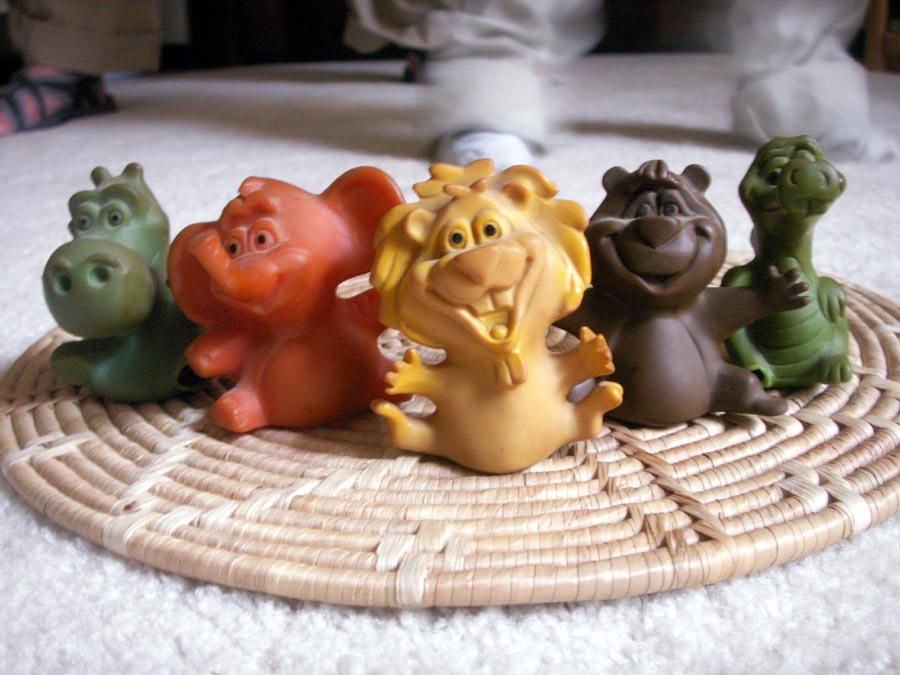
At left are are a couple of finger puppets I got from my godmother when I was a kid.  I don’t remember playing with them, but I remember them being around when I was older.  Some of them, especially the alligator, are a little worse for wear, but overall they’ve held up very well, considering they are maybe 35 years old or so and have not been treated in the most kind manner (after all, I was a kid!).  I just find them great.  The expressions are awesome (a buck-tooth lion?!?) and while the coloring is simple — all solid for each one — the shapes are very nicely designed.

I don’t know much about these.  All they say on the bottom are “Made in Japan,” something you don’t see on toys very often any more.  I don’t know if Japan used to be a bit like China is now, the maker of all things like this.  I’m really curious to know more about them.  Were they part of some bigger set?  Were they some sort of promotional item?  Anyone know?

They just seem so great in their simplicity, the kind of thing that we just don’t see much of any more.  Sure, they are plastic, but they don’t make any noises, they don’t take any batteries (my daughter was trying to squeeze them, either trying to get them to squirt like her bath toys or make noises like some of her stuff animals).  I just really like what they represent to me of a somewhat simpler time when toys left something to the imagination.  I hope that my daughter enjoys them when she is a little bit older (those are her feet in the background, next to my wife’s).

Star Trek, reimagined

Hollywood has a hard time coming up with new things, it seems, and they are constantly revisiting old ideas that were successful in the past.  It seems that most of the time the retoolings of those past shows, whether for the big or small screen, are pretty spectacular failures or, at best, luke warm, middle-of-the-road outings.  However, Star Trek follows in the vein of the recent Battlestar Galactica and is a truely great and fitting tribute to the original.

Lisa and I saw the new Star Trek today, the first movie I’ve seen in the theater since our daughter was born.  I wasn’t sure exactly what to expect, but I’d heard good things and was excited.  That said, I’m not a huge trekkie and definitely not a big fan of most sci fi, as I’ve mentioned before.  I tend more towards fantasy.  The sci fi I do enjoy tends to be the gritty, dark stuff, like Battlestar Galactica or Neuromancer.  Star Trek definitely does not fit in this vein, as it is an essentially optimistic universe.  However, I did enjoy the original series, with Kirk, Spock, McCoy, and the others.  And the movies that featured that cast.  However, the later series felt flat to me.  I never much liked The Next Generation or Voyager, though I found Deep Space 9 enjoyable enough.

I’m not sure exactly what about the first series I enjoy, but maybe it was the younger point of view I watched it from.  Or, the fact that it didn’t take itself so seriously.  The first series had more than its share of camp.  But, the adventures the crew had were also outrageous, encountering Apollo and the other Greek gods and being transported to the past in the era of gangsters.  I think it was that swashbuckling attitude that I enjoyed.  The sci fi was just a vehicle for entertaining stories.  It wasn’t the story itself.  The later series, in my mind, got too serious, took the sci fi too far and made it the focal point of the story.

The new movie does the original series proud.  There are flashy sci fi elements there just for the sake of being there (such as the police on their hover jets), but overall, they serve to advance the story.  As in the original, it is the characters that drive the story and all of the major originals are there.  We learn how they all meet one another and the side characters, such as Uhura, Chekov, and Sulu, are all given more prominent roles and thus personalities than in the original show.

The plot is, for the most part, strong, though I found the focus on Spock a bit of a stretch, though maybe these kinds of vendettas are all to common in our own world.  Even though you know that everyone will survive, there is still the suspense of how will they survive, how will they get out of their current jam.

And there are lots of nods to the original series, most obviously the signature lines of each character, but others as well that I’m sure I missed (Lisa pointed out that the only time Pike was seen in the original series, he was in a wheel chair).

I also liked how time travel was dealt with in the story.  Instead of paradoxes and the such, it just led to an alternative time line.  That means the creators are free to go in a completely different direction than all that came before, essentially rebooting the franchise.  Some might feel this is a cop-out, but I think it is a great way of building on what came before without being burdened by it and having the freedom to tell those stories they wish.

Finally, the special effects are spectacular and, like all of the good Star Trek movies, the villain is a real menace.  How far he goes for his revenge is just amazing, and it is also a shock how far the creators went in showing how bad the bad guy really is.

One funny, personal moment.  Lisa commented, during the scene where young Spock is being talked to by his dad after being in a fight, that he looked like I did when I was a kid.  Later, when Spock does his signature eye brow raise, she made the further point that that I do the same thing and that maybe I have a lot in common with Spock.

In the end, I highly recommend Star Trek.

Blah, blah, blah… I've got the blahs.