Priorities

The other day, listening to ESPN Radio on the way to work, they had an auction to raise money for the V Foundation.  I don’t know much about it, but it’s something started by Jimmy Valvano, a I believe college basketball coach who was diagnosed with cancer and started this to fight back.  This was in the mid 90s, maybe 94 or 95.  The talk show guys mentioned how, since the foundation started, it has raised $80 million for cancer research.

The next segment was Sports Center and it was reported that some player (don’t remember the sport) had either just signed or was in negotiations for a contract worth $60 million over how ever many years, something like 5.

$80 million over 15 for cancer research and $60 million over 5 for one guy to throw a ball around.  It sometimes feels like our priorities are really screwed up.

To be fair, this $80 million isn’t the whole amount devoted to cancer research in the last 15 years, just what this one foundation has raised.  And the $60 million isn’t the player’s fault.  It’s mine as much as anyone’s, as I’m into the whole professional sports thing, watching the games, playing fantasy football, and owning a couple of jerseys.

But, still…

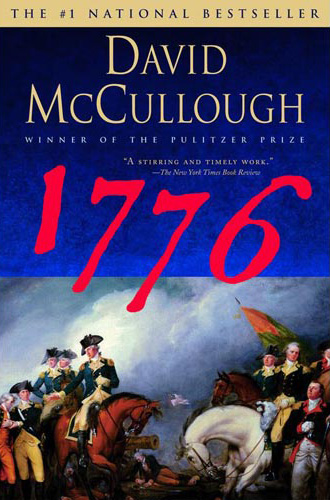
1776 by David McCullough

War ends up being so pivotal in so many developments in history and, yet, the more I read about the most crucial wars in our country’s history, the more I am amazed by how much of the outcome was due to incompetence, bad decisions, or just plain luck.

David McCullough’s 1776 describes the events of that decisive year in the outcome of the Revolutionary War.  Starting with the Siege of Boston, which began in 1775, McCullough takes us through the events that lead to the British abandoning Boston and eventually taking New York.  The year ends with two stunning American victories at Trenton and Princeton, victories that occurred at such a low point in morale in the army that, had they not happened, the war may have gone a completely different way.

McCullough is a master at describing the events on the ground.  Drawing from a huge number of primary sources, especially letters and diaries, he shows us the conditions the average soldier dealt with, including marching in freezing weather with rags covering their feet and hauling cannon through mud and across rivers.  You get a sense for how difficult it was, especially considering that moving the army occurred entirely by foot — there were no transports of course.

In particular, we get great insight into the thinking of the important players, such as Washington, Greene, and Knox, as well as some of the British commanders.  It is amazing that Washington, leading the entire army to determine the future independence of the United States, was only 43 years old in 1775.  I myself, as I write this, am 38.  Jefferson was only 32 and John Hancock, president of the Second Continental Congress, was 38 himself.  Amazing to think how young these leaders were!  Washington is the particular focus, as McCullough tries to uncover the thinking of this most central man.  As the Americans lost battle after battle in New York, due in no small part to the indecisiveness of Washington, and as soldiers left the army as their enlistments ended, Washington begins to fret for the outcome of the war and his reputation as a general.  Even so, he perseveres, keeping up appearances for his soldiers and pushing them to perform.  While Washington may not have been the most brilliant tactical mind of his day, his determination to succeed definitely was the key reason the Revolution itself eventually succeeded.

It is even more astonishing, though, to consider how the weather, how decisions by the British to not pursue the fleeing American army, made such huge outcomes.  More than once, storms masked the movement of the Americans, in a way that had the weather been good, the Americans may not have been able to execute their plans.  The British, on more than one occasion, also stopped in what could have been a complete rout of the Americans, a defeat that would almost assuredly have ended the war with a British victory.  I find it truly astonishing how the outcome of such important events depends on these little details.

I’ve read one other history of the Revolutionary War, The Glorious Cause by Robert Middlekauff.  Middlekauff covers the entire war, including the build up to the war and the aftermath, ending with the writing of the Constitution.  While I remember the book being very good, it’s been a while since I read it, and with my memory like a sieve, I remember very few details, unfortunately.

1776 is a nice, high level overview of the events on the ground.  It is written in a very casual style, with copious footnotes, but those are all relegated to the back (even the numbers are omitted in the text, something which I actually regret).  The reading is fast and easy, but also very vibrant, giving a great sense of the spirit of the times.  I greatly enjoyed this book.

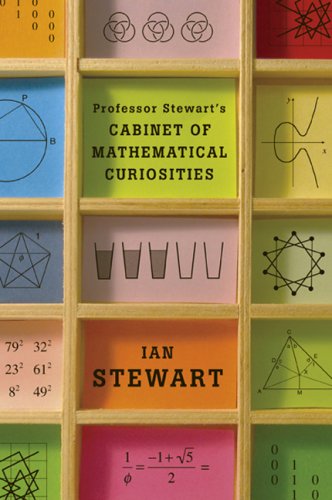
Professor Stewart’s Cabinet of Mathematical Curiosities by Ian Stewart

I picked this up randomly at a bookstore in Santa Fe, intrigued by the thought of delving into a little bit of math.  And that is just what this is.  Professor Stewart’s Cabinet of Mathematical Curiosities, by Ian Stewart naturally, is a tour de force of many of the most interesting corners of math, both historical and modern, covering each just a little bit.  Each topic is never given more than a couple of pages, though some of the topics do join together.  He covers everything from regular polyhedra (Platonic solids) to Fibonacci numbers to the shape of oscillations on a drum head to complexity science.  He gives just enough to tantalize, to intrigue, to whet the appetite.  The history of math is also scattered throughout with brief mentions of many of the important mathematicians.  Finally, there are lots of exercises and puzzles for the interested reader which, I admit, I was not — after so many years of school, I’m hard pressed to do anything that appears like homework.  But, the solutions are in the back of the book and offer further insight into the mathematical topic at hand.

There were two concepts that particularly caught my attention, mostly because I hadn’t heard of them before and they are so interesting.  The first is Benford’s Law.  Imagine you are working at a company and you decide to cook the books a bit, creating false transactions.  You might think that the numbers associated with the transactions should essentially be random, that, for example, the number of transactions starting with 1 (like $10224) should be about the same as starting with 2 ($221) and so forth.  In reality, this isn’t true.  If you look at the distribution of house numbers in a city, or the size of islands in the Bahamas, or the GDP of the nations of the world, numbers starting with 1 are more common than 2 which are more common than 3, and so on.  This fact is Benford’s Law, and it is used today to catch embezzlers and others who don’t realize that the distribution of these numbers isn’t random, but follow this pattern.  Wikipedia, naturally, has a nice article about Benford’s Law.

Ok, the second example I’ve heard about but it is presented in a very nice way.  That example is Penrose tiles (here is the Wikipedia article about those).  If you think about tiling the plane, like say tiling your bathroom floor, there are three shapes you can use that will let you completely tile the floor: (equilateral) triangles, squares, and hexagons.  These, in turn, give you patterns that have 3, 4 or 6-fold symmetry (if you rotate your view direction by 120, 90, or 60 degrees, the pattern will look the same).  It was thought that 5-fold symmetries are impossible:  you can’t tile a floor with pentagons.  However, Roger Penrose showed that if you use two shapes, a kite and a dart, you can tile the floor and get a 5-fold symmetry.  What’s more, the resulting pattern is not completely periodic.  It has short range, but no long range order.  Why does this all matter?  Well, symmetries are crucial for understanding crystal structures:  atoms arrange themselves in patterns that are the three dimensional equivalent of these 2-D patterns.  Again, no one thought that 5-fold symmetry could exist, but on the surface of chemical compounds, “quasi-crystals” can form, which exhibit the same patterns that Penrose tiles do.  Very cool!

This book offered lots of glimpses into many unfamiliar corners of math, and as such was very interesting.  He describes each topic at a level that the basic idea can be gleaned by those who have little or no math background.  I highly recommend this book to anyone who has even a vague interest in math.

One final note: in the previous book I discussed, The Golden Ratio by Mario Livio, he claimed that the nautilus shell followed the logarithmic curve.  Stewart says that isn’t so:  the shell is wound tighter than a logarithmic curve would dictate.

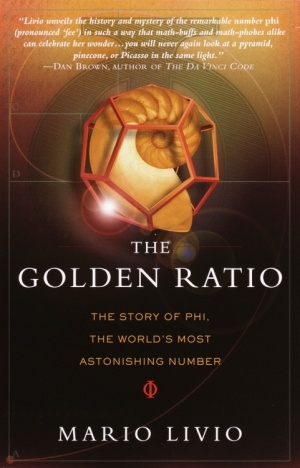
The Golden Ratio and Understanding the Universe

When you stop and think about it, it is truly astonishing how well we can describe the universe around us using mathematics.  That equations as simple as F=ma and E=mc^2 can describe so much of what we observe is really amazing.

The Golden Ratio by Mario Livio is essentially an examination of one of the most remarkable numbers to be discovered as a pretext for ultimately exploring the question why do mathematics work so well.  The golden ratio, known from the time of the ancient Greeks, is a pretty simple concept: take a line (defined by points A and B) and divide it (at point C) such that the length of the entire line over the length of the longer portion of the division is the same as the length of this longer portion over the shorter portion.  That is, if the longer portion is CB and the shorter is AC, then AB/CB=CB/AC.  A pretty simple concept and definition.  It turns out, this has many profound consequences.  This golden ratio, normally dubbed phi by mathematicians, is one of the first irrational numbers discovered and is, in some sense, the most irrational of all.  It shows up in many branches of math, especially geometry, and has been observed in nature in the patterns formed by petals on flowers, the seeds in sunflowers, the shape of certain seashells, and the shape of galaxies.  It is ubiquitous in nature.  Why should that be so?  That is the real point of Livio’s book.

Livio spends a lot of time on the history of phi, how it was discovered, how it was understood, and what it means to math and science.  When he is focusing on the role of phi in science, the book is wonderful.  There were many very interesting insights that I was unaware of that were real gems to discover.  Livio also spends a lot of time on the supposed role the golden ratio played in art, poetry, music, and architecture, including the constrution of the pyramids of Egypt.  His goal is to debunk those who claim that the golden ratio was an instrumental part in many such works, and he does so convincingly.  Unfortunately, I found this a huge distraction and very uninteresting.  I would much rather that he had filled those pages with more discussion of how the golden ratio is found in nature and science.  I understand that he felt a need to determine where the golden ratio is really to be found, but I felt it was over done.

Ultimately, the fact that the golden ratio, and by extension math as a whole, figures in so much of what we see around us leads Livio to examine why that is so.  He describes two alternative views.  First, that the universe is objectively Platonic; that humans are discovering the laws of the universe and those are written in the language of math.  Any civilization in the universe would uncover the same mathematical laws.  The second view is that math is a human language, a human construct, and we are using it to interpret our observations of the universe.  Civilizations with different formulations of mathematics would have a different view of how the universe works.  Livio falls somewhere in the middle, and, to be honest, I did not overly understand his reasoning for his position.

It is an interesting question.  I guess I would tend a bit more towards the Platonic view.  I think that it is just too striking that our math and physics can not only describe but predict what is happening around us so well.  I once had a chat with a fellow grad student at the UW physics department that was about this.  His point, as far as I could understand, is that maybe we create the reality around us via our investigations and our interpretations of our observations.  Essentially, that there is no objective reality, that reality is created by the observer.  Thus, as we develop our math, we view the universe through that math and thus shape it to conform to our math.  This “the observer shapes reality” perspective seems like an extreme view of the Copenhagen interpretation of quantum mechanics.  I definitely wouldn’t go so far as this.  But, it is an interesting question.

Airplane woes

After the news of the crashes of the planes going from Brazil to France and from France to Comoros, it seems one should be greatful whenever their flight arrives at its destination and that “minor” inconveniences that result in “just” delays are not so important in the big scheme of things.  And that is probably true.  But, when we returned from Idaho to Santa Fe via Las Vegas, our delay in Vegas was so bizzare that I feel it is worth sharing.

We were on a direct flight between Boise and Albuquerque, stopping in Vegas but we didn’t have to get off.  We got there a little early because of favorable winds, I think, but when we landed, our gate was “broken” (that was the word they used) which caused a delay as they found us another gate.  That took maybe 15 minutes or so.  At the new gate, they unloaded the Vegas passengers and loaded up a full plane of people flying to Albuquerque and beyond.

And now the, to me, really bizarre part.  We just stayed there, for nearly two hours, at the gate, just waiting.  For what?  No one said for maybe one hour, when they finally explained it to us.  It seems that they are doing construction at the airport in Vegas, so the number of runways is reduced.  It also seems that, depending on the wind direction, either one or the other of the two runways in service are used.  Originally, we were to use one runway, which was fine, but then the wind shifted and we were then supposed to use the other runway.  But, that runway has less clearance — it heads into some mountains — so the plane needs to be more powerful than on the other runway.  Our plane, fully loaded, didn’t have the power to safely clear the mountains — it was overweight.  So, they unloaded passengers who were only going through Albuquerque and about 2000 pounds of fuel.  This took about 2 hours total.  All of this was complicated, somehow, by the temperature, which was 110 F.

Through all of this, the flight crew was great.  One of the pilots explained this to us, for which I was very greatful (I much rather be informed about what is going on than be kept in the dark) and one of the flight attendants even ran back to the concourse to get us some fresh milk for our daughter (who, incidentally, did very well considering she was cramped in the plane for an extra 2 hours).  So, I really commend the crew.

What I don’t understand is the company and the airport.  It seems to me that in a place like Vegas, this can’t be a rare occurance, that it gets hot, that the wind shifts, and that a flight is oversold and is at full capacity.  And yet it took 2 hours to diagnose and fix the situation?  It just doesn’t make sense to me.  I wonder how often this does happen and if it always takes this long for them to fix the problem.

Blah, blah, blah… I've got the blahs.