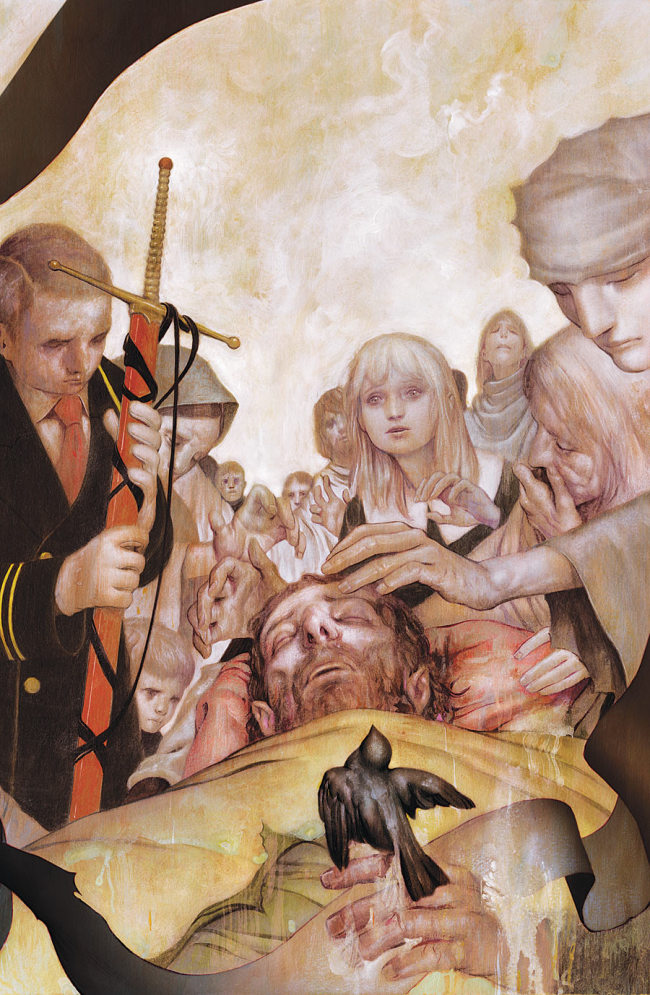
Fables 10: The Good Prince

Anymore, I only read a few comics series religiously. I was reading Whedon’s Astonishing X-Men series, but he has moved on and I’m not sure I’ll continue (though Ellis is a tremendous writer). I’ve followed the Ultimates series, which is pretty darn good. But the two series I keep closest tabs on is Powers by Bendis and Fables by Willingham.

Fables is by far my favorite series right now.  The premise is pretty simple: what if all of the characters from all of our fables existed in the real world?  And what if they were real people, in the sense that they have to live like we do in the real world?  And what if they were in the middle of a big war for control of the various worlds in which they live?  (In the Fables universe, each group of fables — the European fables, the Arabian fables, etc — inhabit distinct worlds that are, nevertheless, connected.)  Characters such as Snow White, the Big Bad Wolf, Little Boy Blue, Red Riding Hood, Hansel and Grettle, Gepetto and Pinochio, inhabit this fictional universe, interacting with one another and fighting for their survival.

I just picked up Fables #10, The Good Prince, which is the most recent collection of the Fables comic book.  This collection focuses on Flycatcher, otherwise known as Prince Ambrose.  He is one of the harder characters to identify, but I believe he is the frog that was turned into a prince upon being kissed by a princess.  His life is a tragic one, and for most of the series up to now, he has been a janitor working in the Fables’ government office in the United States.  However, he comes to the forefront in this tale and does his part in the war against the Adversary, that mysterious entity that has waged war on all Fables (we now know who the Adversary is, but for those of you who haven’t read this series but may, I refrain from spoiling it for you).

The art in this collection is a little hit-and-miss for me, but it does an adequate job of conveying the story.  But, really, the story is why I am here.  The story, as with most of the Fables collections, is outstanding.  An epic tale of redemption and perseverence, Flycatcher makes amends for his past failings.  I won’t say any more, but I would highly recommend this series to anyone who has an interest in fairy tales and just damn good story telling.

For more on Fables, including spoilers, check out this Wikipedia article.

Beasts and Numbers

A little while ago, I found a couple of books in a local used book store that I thought were pretty cool and that I thought I’d post little tidbits from, from time to time.

The first book is A Dictionary of Fabulous Beasts, by Richard Barber and Anne Riches.  The second is Numbers, by David Wells.

Beast: Aigamuchas:

A creature which lived in the Kalahari desert with eyes on the top of its feet and thin pointed teeth as long as a man’s finger.  If these creatures wanted to know what was happening behind them they went on hands and knees with one foot lifted so that they could see backwards.  They hunted men as if they were zebras and ate them.

Number: 5.256946404860…

The approxximate ‘volumes’ of the unit radius ‘spheres’ in dimensions from 1 upwards are:

dim.1 dim.2 dim.3 dim.4 dim.5 dim.6 dim.7
2 3.1 4.2 4.9 5.264 5.2 4.7

The volume is a maximum in 5 dimensions, and declines thereafter.  If however the dimension is regarded as a real variable, able to take non-integral values, then the maximum volume occurs in ‘space’ of this dimension, 5.256… The volume is then 5.277768… compared to the volume in 5 dimensions of 5.263789… [David Singmaster]

(More information about n-spheres can be found here.)

Without the Hot Air

I recently posted about a talk I saw about meeting our global energy needs in the future.  To me, one of the frustrating things about the whole conversation is that there aren’t hard numbers comparing one scenario to another.  For example, I’ve heard that if we cover all of New Mexico in solar cells, we could meet the energy demands of the entire nation.  However, I’ve not heard how much that would cost and how that compares to say building new nuclear power plants.
Clearly, I’m not the only one with this frustration.  And someone has done something about it. David J.C. MacKay, Professor of Natural Philosophy in the Department of Physics at University of Cambridge, is working on a book to answer precisely these questions.  As he says, we need “numbers, not adjectives” in trying to decide how to both meet our energy needs and to reduce our green house emissions.  On his website, Without the Hot Air, he presents a draft of a book in which he compares the possible energy sources available to Great Britain with the energy consumption they are currently using.  I’ll admit I haven’t read his book, yet, but I went through some of his slides and his executive summary, also available on his website.  The upshot:  Britain cannot generate the power it currently uses from renewable sources available only within Britain.  And that is if, for example, all land in GB was used for power generation of one sort or another, which, as he points out in his slides, would make a lot of people unhappy (he shows protests against off-shore wind farms, where the protestors bemoan the destruction of scenary).

And, as opposed to a lot of people who bemoan our current situation (i.e. Al Gore), Dr. MacKay gives concrete plans that embody different policies (such as a Green plan which uses no coal or nuclear to an Economic plan that relies heavily on nuclear) to solve Britain’s energy problem.  These rely upon two things: increasing energy production, which in the case of Britain seems to involve getting power from other countries that can produce more renewable energy, and decreasing energy consumption.  Both are key to a solution to the problem.

One interesting side tidbit I saw in his slides: I guess one reason people don’t like windmills is that they kill birds.  He compares the number of birds killed in Denmark, which has a much higher number of windmills than GB, by windmills and cars and the number killed in GB by cats.  The number killed by cars dwarfs those killed by windmills, and the numbers killed by cats are many orders of magnitude greater than either.  Just an interesting tidbit.

Anyways, without hard analysis like Dr. MacKay’s and the corresponding realistic look at possible solutions, we will never solve the energy problem.  A prime example is biofuels.  Biofuels are touted as a great advance in addressing the problem.  However, everything I’ve read suggests biofuels are, at best, a distraction and will not help in any significant way.  That they are so highly touted by politicians and the like just distracts us from real solutions.

Some other links I found on Dr. MacKay’s site: his blog, where he discusses energy claims in the media and other aspects of energy consumption and Sandy Polak’s site, which discusses ways to reduce your carbon footprint that are realistic.

(The figure is from Dr. MacKay’s website.)

The Three Investigators

The Three Investigators The genre of kid detectives is a pretty rich one, with the Hardy Boys, Nancy Drew, and others.  However, my favorite as a kid was The Three Investigators.  The Three Investigators, as the card says, were Jupiter Jones, Peter Crenshaw, and Bob Andrews.  I never read any Hardy Boys or any of the others, but these stories really captivated me as a kid.  I think there was something about these seemingly normal boys and their adventures solving mysteries and crime.  It helped that their were stationed out of Jupiter’s aunt and uncle’s junk yard, where they had built a secret headquarters out of an RV left in the yard.  Jupiter also invented lots of other little devices with the junk in the yard, like communicator devices and such. And they were sponsored, so to speak, by Alfred Hitchcock (though, at the time, I’m not sure I really realized who he was).
I don’t remember any of the adventures all that well now.  I just remember waiting with anticipation for the next book to come out.  Looking back, there were some 44 books published (according to this Wikipedia article), many more than I ever read (though I probably read 15-20 of them, I imagine).  I remember that they seemed plausible (to a young kid) and they seemed intelligent.  The boys did things on their own, using their own ingenuity and smarts, and in a way that seemed believable.

According to that Wikipedia article, the series is still hugely popular in Germany and a movie was even made, though one review said it wasn’t too good.  It seems like perfect material for a TV show for young kids/pre-teen audience.  Now, some of the stuff is a bit dated (who needs some special communications device when you have a cell phone).  So, it would need updating, but with a clever writer, I’m sure the concept can be modernized.

The original author was Robert Arthur, who’s daughter runs a website in dedication to her father, with a lot of information about the series (including the addition 40-odd books written in Germany).  Another site with cover scans and other information is T3I.

Anyways, just wanted to share this bit of nostalgia from my childhood.

The Death of Captain America

Just over a year ago, in March 2007, I posted about the death of Captain America, about how there was so much negative reaction at a story that many people hadn’t read yet, that I thought as long as the story was good, that is all that matters.  Though, I also hadn’t read it at the time.

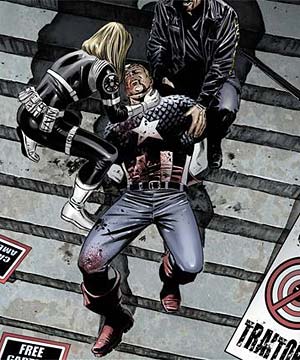
Well, I finally got the trade paperback “The Death of the Dream,” which collects the issues of Captain America in which he is killed and the issues just following.  The first issue is about the assassination of Cap, while the rest follow the supporting cast and their reaction to Cap’s death.  The cast includes Sharon Carter, Cap’s girlfriend; Tony Stark (aka Iron Man); Bucky (Cap’s WWII sidekick); and the Falcon, one of Cap’s most trusted partners.  It also follows Cap’s long time nemesis, the Red Skull, and his plans for destroying America.

As I said, I hadn’t read the comic when I first posted.  I just said that, as long as the story is good, that should be what matters.  And, Ed Brubaker and Steve Epting do indeed deliver on a good story.  The Red Skull and his crew have infiltrated America’s most powerful spy organization, S.H.I.E.L.D., to such a degree that the S.H.I.E.L.D. director, Tony Stark, has no idea who to trust.  And the Red Skull’s daughter, Sin, leads a team of terrorists/assassins that are shocking in their brutality.  All of this goes on while the main characters cope with Cap’s death and how to go on with their lives.  Their rage distracts them from the Skull’s plans, as they look in other places for meaning and vengence.  And when they do start to confront the Skull, they do so recklessly, with the expected bad results.

I’ve not been a huge Captain America fan, though I have followed a few arcs in the past.  Cap is best, to me, when he is a street level hero, fighting as a soldier, against the hidden forces that try to undermine the society around him, rather than a cosmic hero fighting bigger-than-life supervillains.  And that is precisely the level of characterization we get here.

This trade paperback collects a set of issues in the middle of Brubaker and Epting’s run, after they’ve reintroduced Bucky to the Marvel Universe and just as they begin exploring life post-Cap.  I enjoyed this collection enough that I will definitely seek out the rest of their run (as fast as my pocketbook allows me to).

Blah, blah, blah… I've got the blahs.