30,000,000,000 miles and counting

Earlier this month, there was a report on NPR about how much we (Americans) have driven this year compared to last year.  The result: due to increased gas prices, we have driven 30 billion miles less than last year so far.  And use of public transportation is on the rise, maxing out in a lot of places. It took prices at $4 per gallon to force us to change our habits.  And now, our public transportation system is at the edge of what it can handle.

It is unfortunate that we have little to no foresight.  If, in the 90s, when the economy was booming and everyone was just a bit better off, we had just taxed gas a bit higher and invested all that money in public transportation development, we would be in very good shape today.  Or, going back to the energy crisis of the 70s, if, after gas prices spiked and started to fall, if we had taxed gas somewhere between the high and the low, it wouldn’t have felt so hard and we would have 40 years of money to develop public transport.

But we never have any foresight.  It is always about the here and now; our immediate future, not the long-term consequences of our actions; our personal self-interests rather than the interests of the “greater good”.  I wonder if this is a consequence of our democratic system:  politicians have to focus on 2, 4 or 6 year cycles, so they have to do things that have results on that kind of time scale.  They can’t plan so easily for longer term results as that will have little impact on the next election cycle.  Or maybe that is a consequence of us, the electorate.  Maybe we can’t see past today, can’t see what we will need tomorrow and elect people who plan longer term.  I don’t know.  All I know for sure is that, with some foresight, we would be in a much better place today than we are.

Truly Astonishing

I’ve been reading comics for quite a while now, since I was maybe 10 or so.  Pushing 30 years of off and on following the story lines.  My favorite, overall, has been the X-Men.  I started with them around issue 150, with the first Brood storyline.  It was when Claremont was writing and Cockrum was drawing.  I don’t know if it was the general tone of them being a group of outcasts — which, at the time, was somewhat novel — or what exactly, but the resonated with me.  The stories since then haven’t always been the best and I’ve stopped reading over periods of time, but I’ve at least checked the review sites and spoiler sites to keep abreast of the story lines (which is pretty damn hard these days, with as much saturation the X-Men have right now).

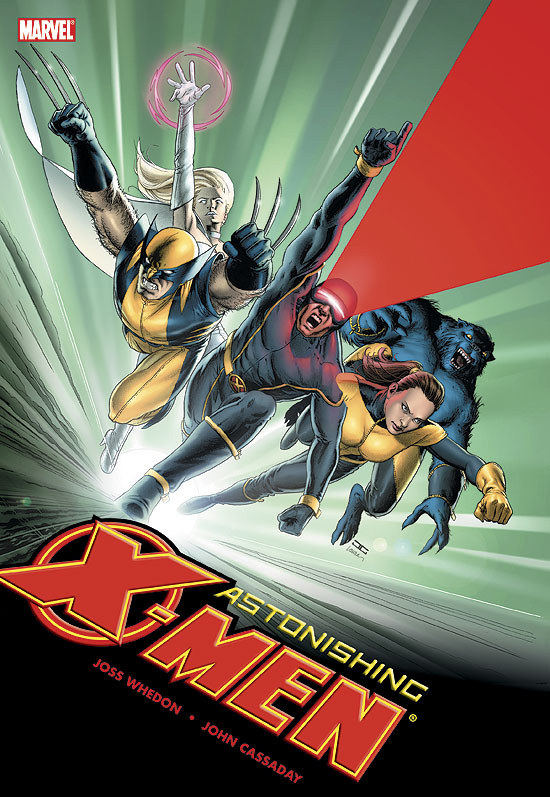
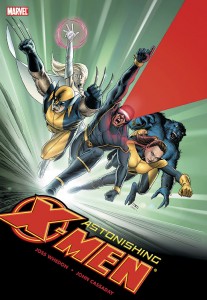
So, I was pretty excited to hear that Josh Whedon and John Cassaday were going to do an arc.  Whedon is best known for creating Buffy the Vampire Slayer and Cassaday has a reputation for very realistic and very amazing art.  They had a 25 issue run, including a special giant sized issue, and I just finished got and finished the last trade paperback collecting the final issues.  All I have to say is that it was a truly astonishing ride.

Warning, Spoilers May Follow
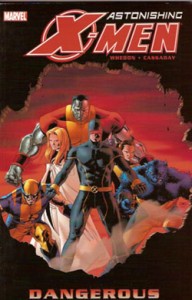
First, they brought back one of my personal favorite X-Men, Colossus.  I’ve always thought he had one of the coolest looks.  He was killed off trying to find a cure for his sister, I believe (though that was during one of the periods where I drifted away from the books).  So, he has been gone for a while.  I personally don’t mind that they brought him back.  Some people get upset at these things, but I think, as long as the story is good, that is all that matters.  I also, incidentally, like that Whedon and Cassaday came on for one very specific arc, told their story, and then finished.  While I like the continuity and history comics universes have, I also think there should be more freedom to tell stand alone stories that may or may not be part of continuity.  Just so long that the story is good.

Anyways, this story is good.  And they brought back Colossus.  And, they potentially killed one of my other favorite characters…

Warning, Very Big Spoiler Does Follow!

Kitty Pryde joined the team just shortly before I started reading X-Men those 30 years ago.  She was a young kid, having just discovered her powers.  Besides the ability to walk through walls, she was also a genius.  She personified in a character a lot of what the readers of the book were probably like.  While I’m not one of those fanboys who think she is the ideal woman or something, she was one of my favorite characters, and one that has probably grown and evolved the most during the last 30 years (it is really remarkable, in the end, how little some characters change).

At the end of this arc, Kitty saves the world, but is unable to save herself.  She is last seen hurtling through space in a gigantic bullet (yeah, that sounds weird, and maybe is weird, but that is what happens).  She is never actually seen as dead, but I can’t see how they will get around this one.  She is stuck in this bullet traveling at very fast speeds through space.  She has to eat (unless I missed some special aspect of her powers) and so will starve soon.  Even then, her body will be light-years from Earth.  I’m sure she will come back, they all do (even Bucky did!) but this one will be hard to do in a “believable” manner.
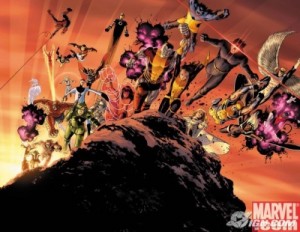
The story itself harkens a bit to that original Brood storyline in that the X-Men have to deal with a hostile alien race in deep space.  They often do that.  It is one of the cool aspects of the X-Men.  They are a very Earthy team, embodying a lot of the politics of the 60s in their concept (with civil rights, racism, etc), but they also have these star-spanning adventures that completely remove them from that political setting.  I’m not sure that this story is necessarily my favorite, or near the top, but it is very good.  And the art is just amazing.  The only thing I found a bit annoying was some of the dialog near the end, with all the “darlings” etc.  It just seemed a bit out of character.

Anyways, I’m going to have to go back and reread the entire arc in one sitting and catch some of the details I’m sure I missed, and put the whole thing together in one go (reading a 25 issue arc over pushing three years means you forget a lot).  Whedon and Cassaday do the franchise proud and tell an exciting and entertaining story.  That is all I can ask and hope for.

Who is doing the lying in Obama’s Lies?

I got an email the other day, listing 50 lies about Obama. Actually, there seem to be variants of this list. The one I got was called “Obama’s Not Exactlies” but, in searching the internet about it, I saw variants called “Obama’s Lies”. The list was a compilation of supposed claims by Obama that the author deemed false, with the truth about each lie. The list contained such claims as:

  • Father Was A Goat Herder – NOT EXACTLY, he was a privileged, well educated youth, who went on to work with the Kenyan Government.
  • My Grandmother Has Always Been A Christian – NOT EXACTLY, she does her daily Salat prayers at 5am according to her own interviews. Not to mention, Christianity wouldn’t allow her to have been one of 14 wives to 1 man.
  • I Was A Professor Of Law – NOT EXACTLY, you were a senior lecturer ON LEAVE.

And so on. Most of the claims in the list are either false, or intentional misreadings of Obama’s words, or misinterpretations. For example, for the items listed above (this information is from Snopes.com, which is a great site for debunking urban legends and internet hoaxes; I strongly recommend that people check this site out before forwarding any email):

  • Father Was A Goat Herder – LIAR, he was a privileged, well educated youth, who went on to work with the Kenyan Government.
    These attributes are not mutually exclusive: Barack Obama’s (biological) father was all of these things at different times in his life, as Obama described in his book, Dreams from My Father:

[My father] was as African, I would learn, a Kenyan of the Luo tribe, born on the shores of Lake Victoria in a place called Alego. The village was poor, but his father — my other grandfather, Hussein Onyango Obama — had been a prominent farmer, an elder of the tribe, a medicine man with healing powers. My father grew up herding his father’s goats and attending the local school, set up by the British colonial administration, where he had shown great promise. He eventually won a scholarship to study in Nairobi; and then, on the eve of Kenyan independence, he had been selected by Kenyan leaders and American sponsors to attend a university in the United States.

  • My Grandmother Has Always Been A Christian – LIAR, she does her daily Salat prayers at 5am according to her own interviews. According to the New York Times: “I am a strong believer of the Islamic faith,” Ms. Obama, 85, said in a recent interview in Kenya.’ Not to mention, Christianity wouldn’t allow her to have been one of 14 wives to 1 man.
    The author seems to be unaware that Barack Obama, like most people, has two sets of grandparents. Obama was speaking of his maternal grandmother, Madelyn Dunham, not his paternal grandmother.
  • I Was A Professor Of Law – LIAR, you were a senior lecturer ON LEAVE.
    Barack Obama was indeed a professor at the University of Chicago’s Law School, a fact verified by that institution itself:

The Law School has received many media requests about Barack Obama, especially about his status as “Senior Lecturer.”
From 1992 until his election to the U.S. Senate in 2004, Barack Obama served as a professor in the Law School. He was a Lecturer from 1992 to 1996. He was a Senior Lecturer from 1996 to 2004, during which time he taught three courses per year. Senior Lecturers are considered to be members of the Law School faculty and are regarded as professors, although not full-time or tenure-track. The title of Senior Lecturer is distinct from the title of Lecturer, which signifies adjunct status. Like Obama, each of the Law School’s Senior Lecturers has high-demand careers in politics or public service, which prevent full-time teaching. Several times during his 12 years as a professor in the Law School, Obama was invited to join the faculty in a full-time tenure-track position, but he declined.

I don’t mind that people don’t like Obama. If they don’t like his policies, that is fine. Even if they don’t like his personality, that is fine. That is part of the American system. That is why there is a choice. They can vote for John McCain. But, to base their views of someone like Obama on what seems to me to be fear and hate goes too far for me. The reasons for choosing one candidate vs another should be based on analysis of the policies of those candidates, of who they would choose as advisers, and of who they are. Not based on a list of distortions and falsehoods about the candidate. We, as Americans, have a responsibility to do better than this, and deserve better than this as well.

Energy and the Future

One of the biggest challenges for our planet is energy. As more countries become industrialized and the people of those countries become more wealthy, they will need more energy. The problem is compounded by things like global warming, where we have to be careful how we get our energy. We can’t just burn fossil fuels indefinitely, we have to think of other ways of supplying our energy needs.

About a month ago, a colleague gave a talk at work on an energy workshop he attended. All of the talks from that workshop can be found at http://rael.berkeley.edu/files/apsenergy/ but my colleague gave a nice overview of the workshop and I thought I’d share some of the highlights here, as I think that both they were very interesting but also because I think this is such an important topic.

  • THE SCALE OF THE ENERGY PROBLEM:image0221.gif
    • The scientific consensus is that there is at least a 9/10 chance that global warming is due to green house gases released by human burning of fossil fuels. Thus, future generations will need to find cleaner ways to produce energy.
    • They will need much more energy than we do.
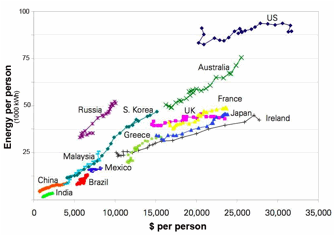
    • If you look at trends in energy use vs per capita GDP, there is a direct correlation: as nations grow wealthier, they use more energy.
    • The world currently uses about 15 terrawatts of power. It is estimated that by 2050, assuming there are 9 billion people then (as opposed to 6 billion now), the world will need 50 terrawatts.
    • If everyone used as much power as the average US citizen, 9 billion people would need 100 terrawatts. We currently use twice as much power per person as Western Europe and nearly 30 times as much as the average Indian.
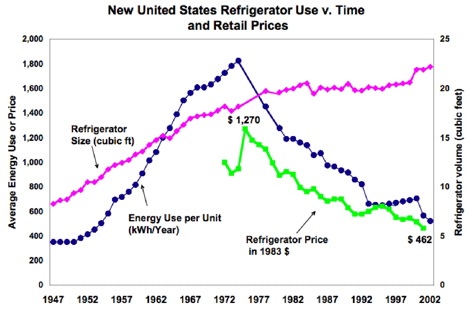
    • MITIGATING ENERGY SHORTAGES:refrigerator-use-versus-time-and-price.jpg
      • There are two main ways to mitigate energy shortages: government regulation and make more energy.
      • In the US, because of the decreased value of the dollar, we effectively pay $1300 more per year for oil than Europeans.
      • Government regulation can help mitigate energy use and even lead to better products.
      • In the 1970s, as a response to the energy crisis, California, regulated the efficiency of refrigerators (in 1978)
        • Over time, refrigerators became cheaper (green curve) and larger (purple curve) while also becoming more efficient (blue curve), which reversed the previous trend.
        • As a result of these and other regulations, California energy use per capita leveled off in the 1970s, while it has continued to rise in the rest of the US.
      • A similar experience is seen in car performance as a result of CAFE standards. Overall fuel economy has increased, while horsepower also increased and acceleration time has decreased.
        • Some vehicles are excepted from CAFE standards, as they are viewed to have other advantages. Examples are SUVs which are thought to be safer. However, the overall risk of some fatality, to either the driver of the SUV or the other cars, is higher for SUVs than smaller cars.
        • More efficient use of energy will also help.
          • Better system designs (such as radiative floor heating and radiative ceiling cooling) can lead to 50-85% energy savings.
          • But you have to be careful. Electric cars are more efficient than gas powered cars, until you consider the source of the electricity. If it is a coal fired power plant, is it more efficient?
      • SOURCES OF ENERGY:
        • There are many sources of energy, of various renewabilities and cleanliness.
          • Solar is renewable and clean
            • Solar includes light, wind, biomass, tides, as these all ultimately convert solar energy to electricity in someway or another.
            • Solar from light costs about 2-3 times as mainstream sources right now.
            • It is difficult to build large-scale solar farms as, after you exclude areas with low light intensity, environmentally sensitive land, too steep of land, and non-contiguous land, there isn’t too much land left.
            • Wind-power is best on coasts where wind speeds are high. This also correlates to high population areas.
            • There are mechanical problems with bearings and such in the large wind-mills (larger than a 747!)
          • Hydroelectric is mostly renewable but somewhat environmentally unfriendly
          • Nuclear is non-renewable and somewhat clean/dirty depending on your perspective
            • A 1 gigawatt power plant burns 3.2 kg of uranium per day (or 7 pounds/day)
            • Waste is nasty, but contained
            • Many concerns with nuclear, including safety, proliferation, waste, and economics
          • Coal is non-renewable and dirty
            • A 1 gigawatt power plant burns 7 million kg of coal per day (or 8000 tons/day)
            • Much more fuel than a nuclear power plant
            • A lot of waste is just pumped into the atmosphere
          • What can we get from each (remember, we need an additional 35 terrawatts by 2050)?
            • Biomass – about 7-10 terrawatts, assuming all arable land used for biofuel production (i.e. fish for dinner)
            • Nuclear – about 8 terrawatts, assuming we build a 1 gigawatt power plant every 2 days
            • Fossil fuel – plenty, assuming we build 5 1 gigawatt power plants every 2 days and figure out how to deal with green house gases
            • Wind – about 2 terrawatts, if we build windmills on all land with average wind speeds greater than 18 mph
            • Hydro – about 1-2 terrawatts, if we dam every remaining river on the planet
            • There is no silver bullet, we will need contributions from multiple solutions to solve the problem
      • SOLVING THE PROBLEM
        • To solve the problem will require many large scale efforts.
        • To keep green house gas emissions at current levels for the foreseeable future, we would need to do each of the following:
          • 2 billion cars at 60 mpg instead of 30 mpg.
          • 25% reduction in electricity use in homes and businesses.
          • CCS (carbon capture and sequestration) at 800 GW coal plants.
          • 1 million 2MW windmills.
          • 80×100 square miles of photovoltaics (e.g. on house tops).
          • 80×100 square miles of concentrated solar power (solar farms).
          • 700 GW nuclear power.
        • The size of the problem is enormous and demands immediate action and investment.

      What the?

      Can someone explain to me why this makes sense?

      http://www.bloomberg.com/apps/news?pid=20601087&sid=aZLIe0lJLHt8&refer=home

      The Democrats introduce a bill to increase taxes on oil, and a separate bill to give credits to renewable/sustainable energy. The Republicans defeat the first, saying that it would increase energy prices and compromise US energy security and defect the second, saying there is no way to pay for it.

      If you pass both, you have a way to pay for the second! And the second helps increase US energy security! How are we going to solve any of our problems if we don’t get past short-sited, profit-only perspectives and try to do something new? I just don’t understand!

      Blah, blah, blah… I've got the blahs.