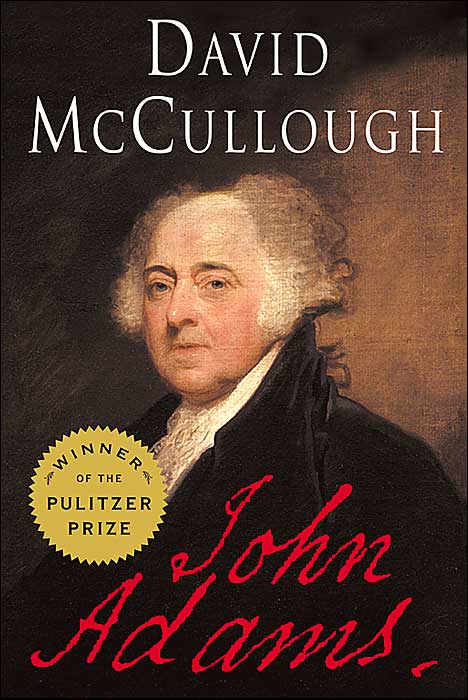
John Adams by David McCullough

7190999Of the founding fathers, the three that probably stand out are George Washington, Thomas Jefferson, and John Adams.  Of these, however, John Adams is probably the one we learn the least about, this in spite of the fact that, of all of the founding fathers, “we” probably know the most about him, a result of his prodigious letter writing and the diaries he kept.

It’s a shame, really, as Adams is both a very important and very interesting character.  While Washington certainly merits his place as the father of our country, he is also rather dull, comparatively, having not written his private thoughts.  Jefferson is a very interesting character in his own right, a man full of contradictions, embodying both the highs and lows of the human essence.

In contrast, it can be said that Adams is the picture of integrity, the one word that maybe defines his career over all others.  He was also loyal to an extreme.  Compare his behavior as Vice President to Washington with that of Jefferson’s as Vice President to Adams.  Even when Adams disagreed with Washington, his loyalty to the administration meant he wouldn’t undermine Washington’s efforts.  Jefferson so disagreed with what Adams tried to do, on the other hand, that he actively tried to derail Adams’ administration.

Adams’ long and distinguished service to his country — beginning as a delegate to the Continental Congress, through years as a diplomat in Paris and London trying to secure first the finances to support the Revolutionary War and then to secure the peace, and finally as first Vice President and then President — are admirably covered by David McCullough in his excellent biography of John Adams.  McCullough quotes extensively from letters to and from Adams, as well as letters written by his wife Abigail, Adams’ diaries, and newspapers of the time to really bring both the era and Adams to life.  In fact, there were times where he spent relatively lengthy sections on, for instance, Abigail’s opinions of French or London society, which felt at times tedious.  However, by the end of the book, when Adams’ family members start to pass away, these moments actually hit the reader as, by that time, you are so emotionally invested in these people.  The tediousness of those sections is more than made up for by the impact on the reader near the end.

One of the most fascinating aspects of the narrative is the relationship between Adams and Jefferson, which has been of much discussion.  Here it comes alive, from the respect they shared at the Continental Congress to their blossoming friendship in Europe to the disintegration of that friendship during their years in the Federal government, only to finally be renewed in their later years.  That such a strong bond of friendship could be nearly destroyed by politics is dismaying to watch, especially considering the role that Jefferson — a boyhood idol of mine — played.  That these two men could at least partially reconcile their differences should speak volumes to us today.

Another very interesting aspect of the era, related to the relationship between Adams and Jefferson and the politics of the time, is how nasty those politics were.  We are often dismayed at how politics is practiced in our day and age.  In terms of pure nastiness, however, it does not compare to the politics of the founding of our country.  That a great man like Jefferson could attack his one-time friend Adams so strongly and do so hiding behind others is borderline shocking.  And Jefferson’s behavior pales in comparison to men like Alexander Hamilton who actively subverted Adams’ own cabinet.  Maybe there is a lesson here, that, in spite of how bad things seem to be now, our country has survived worse times and will do so again.

Adams’ life is a fascinating subject and McCullough does a wonderful job of bringing it, well, to life.  After reading McCullough’s account of Adams’ life and career, I have a new-found and deep respect for Adams, both as a man and a politician.  I highly recommend this book.

Photos: Snowy Graveyards

It has been snowing the last few weeks and it always makes Santa Fe look like a magical place to me, especially the graveyards scattered throughout the city.  I went to two of them, the main cemetery of the city and another big one that is nestled between the School for the Death and the Odd Fellows hall.  This last one is very interesting as there is the main graveyard that is enclosed in a fence and then another bit that is outside the fence (you have to drive all the way around) and is not enclosed but contains a number of headstones, include the “Lucy Jackson” one.  There are branches lying around and old buckets full of stuff.  Not sure if people are dumping things or someone is trying to clean it up.  In either case, it is just one of many around town that are just there, part of the scenery.

More tops

100103_7882TopsOver Christmas break, Lisa’s dad let me use his lathe again, and I made a few more tops.  I made 4 in all, but two of them we gave to friends before we snapped a picture.  In any case, here are two of the new ones with the old ones.  One of them, the one on the right in the first picture,100103_7887Tops I also gave to a friend, Bob.

The handles aren’t quite as polished as I would like and the tips that they spin on aren’t as smooth as I would like to give the whole top a nice smooth look, but overall they turned out alright and do a decent enough job of spinning.  I was maybe a little aggressive trying to by fancy by carving out towards the inside of the volume, which made it a bit difficult to sand them properly, so that is why in the second photo the third top has a bit of a rough edge.  I started to lose a little patience with the sanding.  But, still, they look good, were relatively easy to make, and were fun to make too.

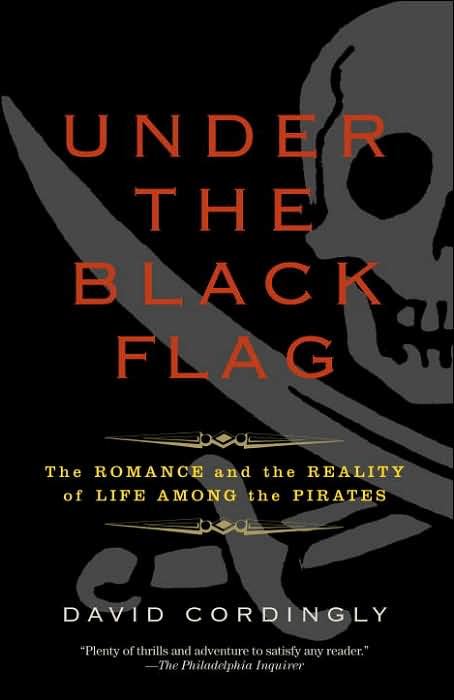
Under the Black Flag by David Cordingly

cordingly-under the black flagEvery age seems to have it’s iconic figures, those who end up defining that age, symbolizing it, from the knights of the medieval period to the gunslingers of the wild west.  We romanticize these figures, overlooking their shortcomings and glorifying them to the point that they are barely recognizable from the real thing.

And so it is with pirates, those symbols of the Age of Discovery and Exploration, when the West was newly “discovered” by Europeans.  Pirates operated all over the world, from the Indian Ocean to China.  But, it is those that sailed the Caribbean and the American coast that really capture our modern-day imagination.  And they are the focus of David Cordingly’s Under the Black Flag: The Romance and the Reality of Life Among the Pirates.  Cordingly describes the pirate life as it really was: nasty, brutal and usually short, even for the most successful pirates.  These were ruthless men who attacked merchant vessels, fishing boats, and even coastal towns in search of plunder.  They tortured crew members in order to find out where treasure was stashed, often in some very graphic ways.  They spent their money on drink, gambling, and women, often within weeks or months of winning it.  The authorities that hunted them down were equally vicious, making examples of captured pirates by executing them and displaying their bodies in chains.

Cordingly does a wonderful job of both describing the life of the pirates, their motivation, their modus operandi, and the effort to eradicate them.  His goal is two-fold: to give us a realistic picture of the real pirates as well as determine how we’ve come to romanticize such a vile group of men.  He discusses the pirate in literature and film and how those media led to our modern day romantic pirate. Most of what we now associate with pirates — walking the plank, buried treasure, the educated man turned pirate — are more fiction than reality.

He also goes into a number of smaller details, such as the existence of women pirates and the size of a typical pirate haul.  All of these details give a very nice overview of what pirates really were, who they really were, and what they really did.

There are a couple of things I wish he had included.  He discusses the different types of ships that both pirates and the authorities used and for someone like me who knows nothing about ships, it would have been nice to have some illustrations showing the size and shape of these ships.  Also, while he does touch on a number of the most notorious pirates, including Henry Morgan, Blackbeard, Captain Kidd, and Calico Jack, these are scattered throughout the book and no really coherent picture emerges of most of these men.  A chapter devoted to brief bios of the major pirates would have been an appreciated addition.

Overall, however, this is a very entertaining book that gives a lot of real information about a very interesting subject.  Highly recommended to anyone interested in the reality behind the fictions of the pirates.

Opportunity in America

During the health care debate, one thing that has been a talking point is that the people who are on the lower end of the economic ladder are there at least primarily due to faults and errors of their own.  This is an inherent assumption of the American Dream:  “Life, liberty, and the pursuit of happiness.”  Everyone has the ability to pursue their own happiness and, the implication is, if they do not obtain it, it is a result of their own failings, primarily a lack of effort.

At the same time, however, it seems to me that some amount of failure has to be built in to the system.  That is, the system cannot sustain itself if everyone is successful in realizing their dreams, of obtaining their happiness.  There has to be some, even a majority of us, that fail in becoming doctors, lawyers, or whatever they dreamed of in their youth.  We can’t all be at the top of the economic ladder, or better said pyramid.  For the economy, for society function, we need people who end up in those jobs that none of us want, that we don’t aspire to, but are sometimes forced into by circumstances.  We need the sanitation workers, the slaughter house workers, the assembly line workers.  They are absolutely crucial to our system functioning.  But, I dare say, these are typically not jobs we aspire to, jobs that were part of our dream when we were “pursuing our happiness.”

Any individual can pursue their happiness, to varying degrees of ability, opportunity, and circumstance.  But, most of us have to fail.  Most of us have to give up on those dreams in order to survive.  The economic pyramid has to be bottom heavy to function, and none of us aspires to be at the bottom.

I understand that our system in no way guarantees that we obtain happiness, just that we are able to pursue it.  However, that most of us must fail, suggests to me that we who do succeed are not entirely free from any responsibility for those who do fail.  We depend on them, we require them, for a functioning economy.  Therefore, it seems that we should realize that failure to obtain our happiness is not entirely on our own shoulders, but is also a part of the system.  It will happen to most of us, the system ensures that.  As a society, we have some responsibility to make sure those people have some basic standards of living, including health care.

Blah, blah, blah… I've got the blahs.