
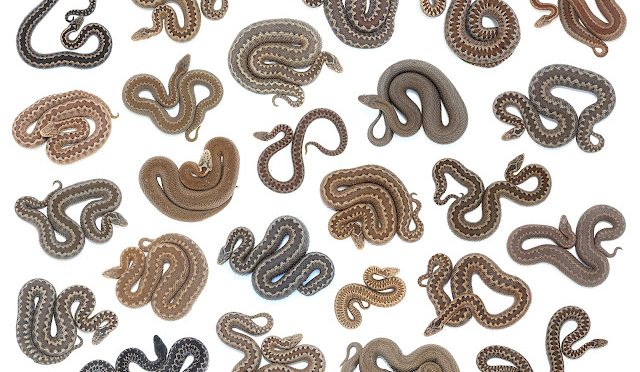
My mom tells a story of my dad where they were out in the countryside working, spending the night camping in the field. Somehow, my dad became aware of a rattlesnake nearby and freaked out, dousing the whole area with gas and lighting it on fire to kill the snake. My mom said it was because he was deathly afraid of snakes because of a “red snake” he knew about in the Basque Country.
I admit, I was a bit skeptical about this existence of this “red snake,” so I asked, and indeed it is a thing: the sugegorri – literally “red snake” – is a viper native to the Basque Country.
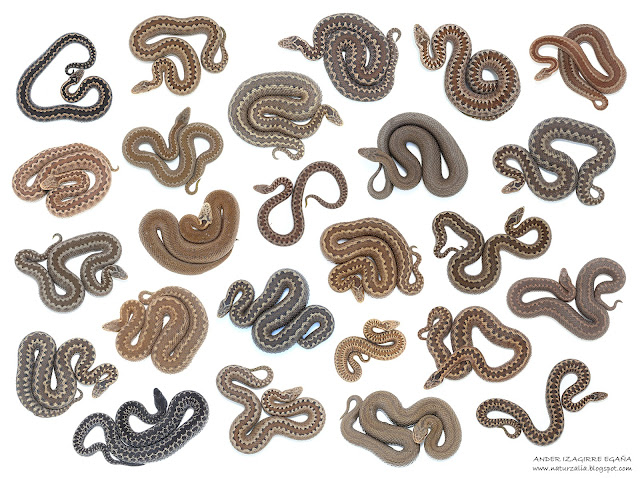
- There are three types of vipers that are native to the Basque Country and, more generally, the Atlantic coastal regions nearby: the Cantabrian viper (Vipera seoanei), on the Atlantic side; the aspis viper (Vipera aspis aspis), in the Pyrenees themselves; and the Lataste viper (Vipera latastei), in the south. The latter is rare.
- Sugegorri – literally red snake – is both a general term for a class of vipers and more specifically to the Cantabrian viper, though there are two subspecies of snakes that fall in this class: Vipera seoanei seoanei and Vipera seoanei cantabrica.
- The sugegorri is polymorphic, meaning it can take on various colors and patterns. Typically, males, which can be smaller than females, are white and blue-barred, with strong black markings. Females are brown or reddish. The belly is blue or black; sometimes with white spots. The tail is yellow, orange and red underneath. There are some very dark, almost black, specimens.
- Various beliefs were associated with snakes and, more specifically, vipers in the Basque Country. For example, in Bedaroa, they thought that a viper would return to the scene of the crime, so to speak, after biting someone, so the people would go to the spot the next day to kill it. In places like Karrantza, Sara, and Gernika, they thought that vipers didn’t bite, but rather stung people with their tongues. The gathering and/or hiding of certain herbs could protect against snake attacks. Or one should carry garlic, but never cheese.
- Some believed that the common slow worm, a legless lizard, protected men from snakes by warning them when they were sleeping in the countryside. Sometimes they would do this by wiggling their tail in the sleeping man’s ear. However, they would only warn men, whom they considered friends – they didn’t warn women.
- The bite of the viper was considered very dangerous, with people in Erroibar saying that if you were bit by a viper, you would die within an hour.
- An interesting side note… in Basque, the verb “to die” is hil. However, in some places, for snakes and other animals, other words are used to say “to die.” Examples include akaatu (used for harmful animals), akabau, galdu (used for the violent death of a snake, literally meaning lost), kalitu, and amaitu (meaning finished).
- The ultimate snake is the herensuge. Some beliefs suggest that all snakes descend from the herensuge. In some places, it was thought that vipers came from snakes and could eventually turn into a dragon.
A full list of all of Buber’s Basque Facts of the Week can be found in the Archive.
Primary sources: Most are linked directly in the post.
Share this / Partekatu hau:

Discover more from Buber's Basque Page
Subscribe to get the latest posts sent to your email.