
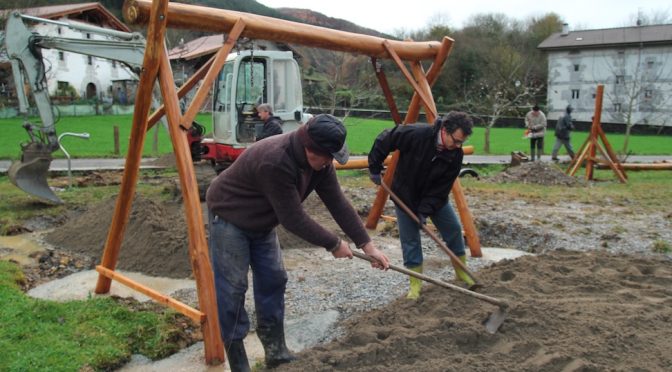
The more I learn, the more I realize how much I don’t know about Basque culture. When she accepted her award for her dedication to Basque culture at the Zortziak Bat symposium, Meggan Laxalt Mackey emphasized the role of auzolan – community work or more broadly collaboration – in her work. I hadn’t heard of that concept before, but it is central to Basque culture. It embodies the collective spirit, of working together to make your community better.
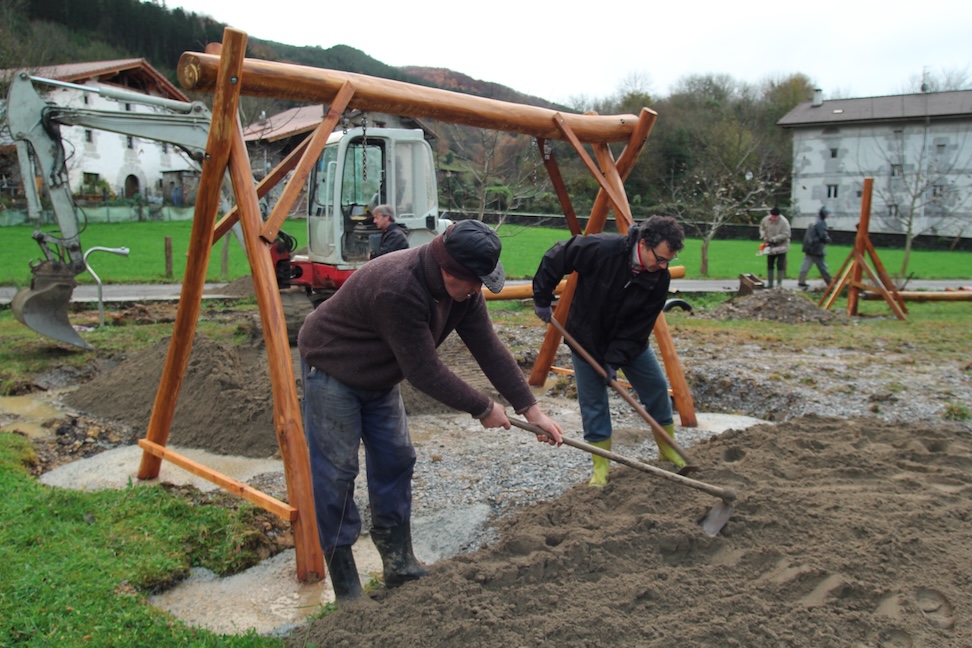
- Auzolan, or the related Bizkaian concept of lorra, is the concept of communal work, or performing work that benefits the community. In the Basque Country, this has manifested itself in many ways, from the building of churches to the maintenance of forest trails. While the concept of auzolan was defined by custom in the Basque Country, in more recent times it has been codified into law in some places.
- Auzolan promotes community solidarity and cohesion. As described by Prof. Xabier Barandiaran, the concept of auzolan reflects “the individual’s responsibility to the community and their service to others, fostering solidarity and forms of social organisation that prioritize community interests over individual ones.”
- To decide what work the neighborhood would focus on, either the town council or a simple local meeting would convene. Two types of auzolan could be planned: big or small, reflecting what tools would be needed to do the work: just hoes and shovels for a small job or carts and the like for a bigger job.
- Often, auzolan would happen in September though a special auzolan might also happen in the spring. The committee would alert everyone in the neighborhood as to the time and place of the work and, if they couldn’t participate, they had to send an alternate. If the work was on public land, the city would provide food and supplies while if it was on private land, the owner would. People weren’t paid for their time – participating in the auzolan was viewed as an obligation of living in the community; it was mandatory.
- The actual work associated with auzolan was often a community improvement effort, to construct or maintain roads, parks, fountains, or other things that would benefit the community as a whole. However, in some cases it could be directed to specific people that needed extra help, such as a widow or sick farmer.
- Today, the concept has expanded to include collaboration more broadly, especially collaboration carried out freely and voluntarily, and to actions that benefit a neighborhood, town, or region voluntarily without receiving money.
- The idea of communal work for the benefit of the community is not unique to the Basque Country and was common in medieval European societies. Indeed, the Asturians have a similar concept called andecha. Modern ideas associated with crowdsourcing certainly have a similar spirit. The Mondragon cooperative is one example originating from the concept of auzolan.
A full list of all of Buber’s Basque Facts of the Week can be found in the Archive.
Primary sources: Estornés Zubizarreta, Idoia; Garmendia Larrañaga, Juan. Auzolan. Auñamendi Encyclopedia, 2025. Available at: https://aunamendi.eusko-ikaskuntza.eus/en/auzolan/ar-16620/; Auzolán, Wikipedia; Auzolan, Wikipedia;
Share this / Partekatu hau:

Discover more from Buber's Basque Page
Subscribe to get the latest posts sent to your email.
The concept of Auzolan in nothing new and not unique to the Basque culture. I remember Basque people and non Basque working together for the community and helping their neighbors. Let’s look at the food banks in the past few days. It is Auzolan under another name.
The U.S. just signed agreements with 2 countries about rare earth. What does it mean this rapprochement between the American Basque and the Basques from the “old” country? Is it something new and why?
The Basques have been coming to the Americas, using Juan de Onate to NM as a timeline, in 1598. Even before in Mexico when Cristobal de Onate conquered the Chichimecas Indians. As a reward for is exploits, the Spanish crown gifted him a vast land grand near Zacatecas, Mexico. Prior to joining the military in Spain, Cristobal de Onate had experience in geology and probably knew about the potential of “rare earth” in the Pyrenees. While he lived in Zacatecas, Mexico, he opened mines after mines and became the fifth reaches man in the Americas.
There is rare earth and rare minerals in the Pyrenees. Is this rapprochement between American Basque and Spanish Basque an excuse for another ” rare earth” or rare minerals agreement? Going to the moon is stroll in the atmosphere but what is beyond Mars? and we have to go conquer that too. and it takes rare minerals for what ever usage.
What about the French Basque? what will they think about this?. Will the issue turns into another Gaza strip? Politicians do not care about the Basque culture, dances, music bands. They want to line their pockets with as much money as they can get.
What will happen if this scenario comes to be: drill baby, drill. Bomb the hell out of the Pyrenees and said good bye to the beautiful Spanish Basque region. It is not a country because it is not a sovereign state. The last time the Basques were united was during the period of 999 to 1035. 4+3=1.
This may happen and with the financial support of the American Basque. The Basque region of Spain and France will turn into another Gaza but I will not be around.
Have a good day.
Monique Durham
I forgot to mention that I am of Basque ancestry from France and Spain. I was raised over there. Both Basque regions are my home–not the home of American Basques. Monique Durham,