
by Evan Madill
What do Escape Rooms, Surfing, and John Adams all have in common?
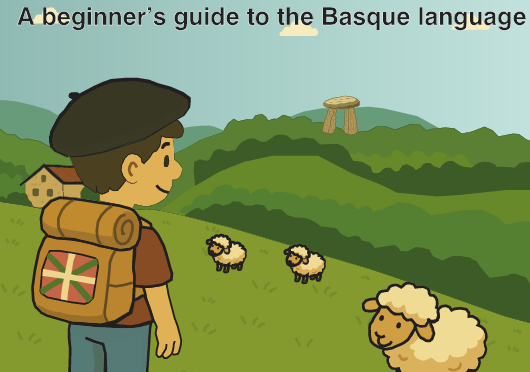
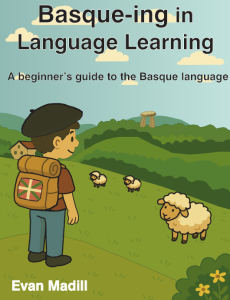
These themes are all used to teach Basque, in my new book, Basque-ing in Language Learning.
My journey as a beginner of Euskara was difficult. In my experience of studying many languages, Basque was the only one where I truly felt frustration. My learning journey began with Beginner’s Basque by Wim Jansen. I struggled to understand articles and suffixes that appeared at the end of words. These patterns were different from any other language I had seen. Furthermore, Wim Jansen’s book didn’t even include the notorious NOR-NORI-NORK agreements! But I had to use this book as it was one of few resources available to me as a beginner.
But this scarcity of learners’ resources was to be expected. Euskara, Europe’s only surviving pre-Indo-European language has less than 1 million native speakers. Nestled between Spain and France, this language has survived multiple empires. Euskara was even banned for several decades by Francisco Franco’s regime. Basque is a language isolate, meaning it has no living relatives.
Of course, this uniqueness doesn’t mean that linguists haven’t tried to find links to other languages. Theories have been made connecting Basque to the Georgian language of the Caucasus, the Iberian language of pre-Roman Spain, and one paper even tries to identify it as a Celtic language. Some theorize that an ancestor of Basque was spoken by the earliest hunter-gatherers who spread through Europe after the Ice Age. Others believe that it was spoken by the earliest farmers that spread from Anatolia (explains the Georgian connection?) or from the later megalithic culture that built Stonehenge. Out of experience, I suggest not trying to figure out the origin of Basque to avoid the headache. It is better to save your energy for learning the language and guaranteeing its survival.
One day, I realized somebody needs to do something about the lack of resources for learning Basque. So I set out to write the beginner’s guide I wish I had. And then I had an idea—what if it was funny? What if it was casual and sarcastic? Most language learning books are dry and boring. The closest thing to fun language learning is our green avian friend—but even that falls short.
In the process of writing my book, creative ideas popped into my brain, seemingly out of nowhere. When writing the chapter on numbers, I created an escape room scene where the players needed to know important dates in Basque history. A bonus chapter on dialects was written using historical fiction stories of John Adams’s journey through Basque Country, the Labourd witch trials, and more. Other lessons were taught using aspects of culture, mythology, and reference to notable surfing locations in the Basque country. Eventually, it was finally finished, and a fun, casual guide to the Euskara existed—the first of its kind (to my knowledge).
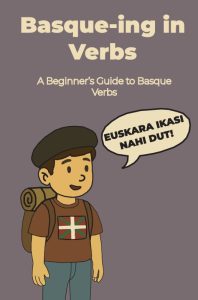
Then I had the idea to write another book. When I was a child, the CDC spent hundreds of millions of dollars to fund the slogan “VERB: It’s what you do.” The phrase that stuck with me, although I had no idea the purpose was to encourage kids to be more active. Verbs are the backbone of any language—but in Basque, they’re a whole different beast. So, I wrote Basque-ing in Verbs.
This time, there would be no stories or sarcastic jokes, just straightforward instruction. A short, concise introduction to Basque verbs. The Nor-Nori-Nork agreements are covered in more detail and explained in an understandable way. The goal was to be different than Basque-ing in Language Learning, ditch the stories, and cultural references, and just focus on delivery of knowledge.
A title like Basque-ing in Language Learning leaves room for a sequel, which would be appropriately named Basque-ing Longer in Language Learning. This part is where you, the reader, assist in writing the book. If there is an aspect of Basque language and grammar that confuses you or that you’ve always struggled with, leave a suggestion in the comments. Share which aspect of learning Basque has beaten you up the most?
Both books are available on Amazon in both Kindle and paperback.
Basque-ing in Language Learning
Share this / Partekatu hau:

Discover more from Buber's Basque Page
Subscribe to get the latest posts sent to your email.
Greetings, It such a great idea!! You may consider looking up some Basque museums, big and small and organizations on both sides of the border, France and Spain.
Because it is in English and Basque the books would be appealing to young and older children. My little nieces, 10 and 11 are learning English in school and Basque from Basque playmate.
You may want to visit in the future. I can only speak for the French Basque area, but when I visit every year (except for this year), I notice of great sense of community of Basque from both side of the border, crossing over working, playing, sharing good and bad time together.
Your work is much appreciated.
Monique Durham
Kaixo Monique!
The French Basque dialects are very fascinating. The xuka verb forms in Zuberera are very cool. The French Basque Country has had quite the survival story after the French Revolution. I find it ironic that Napoleon’s nephew created a catalogue of Basque dialects.
I do want to visit the Euskadi in the near future (as well as all of northern Spain). But I would like to distribute more on the French side of the border, as there are much less speakers than Spain. However, local dialects ought to be maintained and not replaced by Batua.
In the dialect chapter of the book, there is a story of an arms smuggler from Gipuzkoa who smuggles weapons into France to help his brethren after the War of the Pyrenees. This character could possibly get his own book about dialects. Maybe call it “Basque-ing in Shadows”. There is a lot of interesting history here.
But all in all, I am happy that you appreciate my work. I am pleasantly surprised in how many people enjoy it and want to learn Basque. The goal was to take a “hard” language and make it palatable and fun.
Milesker!
Evan