
Even as recently as the early 1990s, when I lived in Donostia for a year, Bilbao seemed this dirty place that wasn’t really worth a visit. I think in that whole year, I only visited a couple of times at most. However, the city transformed itself from a relic of industry to a modern and vibrant destination. Now, I can’t imagine a visit to the Basque Country without a stop in Bilbao. Though there are many factors that, together, led to this transformation, the symbolic heart of it all has to be Frank Gehry’s Guggenheim Museum.
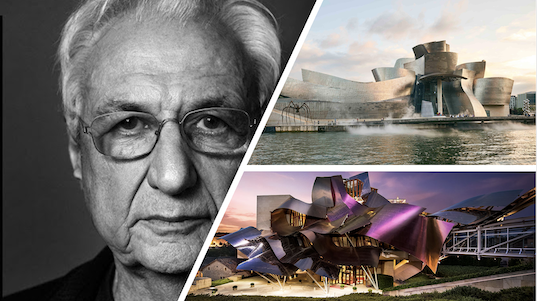
- Frank Owen Gehry was born in Toronto, Canada, on February 28, 1929. His mother, Sadie Thelma, had immigrated from Poland while his father, Irving Goldberg who was born in New York City, was the son of an immigrant from Russia. Both of his parents were Jewish. Gehry’s grandfather owned a hardware store and he often played with scraps of materials, building cities with his grandmother. In 1954, urged by his wife and fears of rising antisemitism, Frank changed his surname from Goldberg to Gehry.
- The family moved to California in 1947 and after some aborted attempts at various pursuits including chemical engineering, Gehry settled on architecture, graduating from the University of Southern California in 1954. After a stint in the Army, he attended Harvard on the GI Bill, but became disillusioned and dropped out, returning to California. In 1957, he designed his first building – a private home. From there, his career took off.
- In 1997, the Guggenheim Museum in Bilbao opened. At the time, it faced significant criticism, particularly as an example of architectural imperialism. However, the building itself was hailed as a masterpiece of architecture, called “the greatest building of our time.” The curves of the building were intentionally designed to capture the light and the central atrium was designed with views of the estuary and the surrounding hills.
- The museum has been credited with helping revitalize the city. Other cities have tried to replicate the “Bilbao effect” with unique architecture. However, Gehry himself downplayed the role of the museum, instead saying it was a collective effort and crediting the overall urban plan of the city and Basque government that his building was only one part of.
- The Guggenheim isn’t the only building in the Basque Country that Gehry designed. He also designed the Marqués de Riscal Hotel, situated in the wine country of Araba, in the town of Elciego. Built between 2003-2006, the hotel’s design employs similar methods and elements that Gehry used in the Guggenheim. In both buildings, Gehry used flowing structures of titanium to capture the light and to give the buildings their unique flowing forms.
- Gehry fell in love with the Basque Country. In 2014, the city of Bilbao built a bridge connecting Deusto and Zorrotzaurre which they named after Gehry. He was in the city for laying the cornerstone and during his visit he said “I fell in love with patxaran, txakoli, hake, and pil-pil. I love you all, I love Bilbao, and I will be back.” He felt that the Basques he worked with were particularly trustworthy, saying “When the Basques say something, you don’t have to get it in writing. They keep their word in a way that I’d never seen before.”
- Gehry died on December 5, 2025, at his home in Santa Monica, California. He was 96.
A full list of all of Buber’s Basque Facts of the Week can be found in the Archive.
Primary sources: Frank Gehry, Wikipedia; Guggenheim Museum Bilbao, Wikipedia; Marqués de Riscal Hotel, Wikipedia
Share this / Partekatu hau:

Discover more from Buber's Basque Page
Subscribe to get the latest posts sent to your email.