
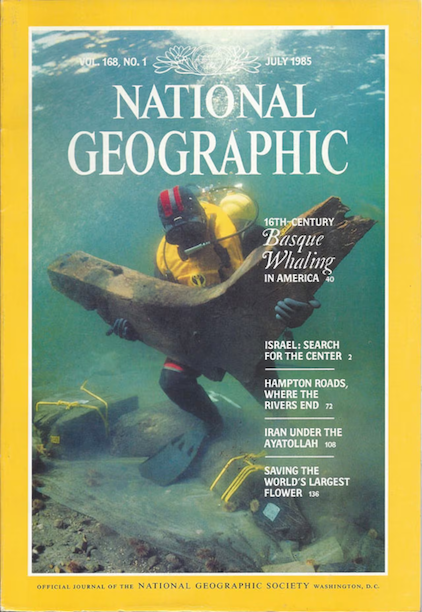
One of my first exposures to the broader history of the Basque Country and the unique role Basques played in the history of the Americas was through National Geographic magazine. Before that, what little I knew was through osmosis from dancing and festivals. I didn’t really know much about Basques beyond having Basque parents. That article on the history of Basque whaling in America was a revelation and maybe, in some ways, sparked the flame that ultimately led to this page.
- The Basques arrived in Labrador by at least the early 1500s, though some claims by various historians place Basque activities in the area even earlier, perhaps as early as 1372. The earliest documented records we have with any certainty, as described by Selma Barkham, put the Basques in the waters of what is now Canada by 1511.
- They establishing a post where they processed the whales they hunted in the area. These Basque whalers gave the region its name, Terranova, or New Land in Latin. One whaling station, called Butus, used red tiles brought from Europe in the building construction, giving the bay, now called Red Bay, its name (though some sources say the bay is named after the nearby red cliffs). Before that, it had been called Balea Baya, or Whale Bay, by the Basques. Because of this historical significance, Red Bay was named a UNESCO World Heritage Site in 2014.
- The first ships were after cod and whale meat, not oil. In 1530, the French-Basque ship La Catherine d’Urtubie returned to France with some 4500 cod and 12 barrels of whale meat. However, it wasn’t long after that that whale oil became the prized commodity.
- In 1565, one Basque ship, the San Juan, sunk in the waters off of Labrador, more specifically off of Saddle Island in Red Bay. Working on a tip by Selma Barkham, Robert Grenier (who died on January 3, 2026) and his team raised the wreck in 1978 and that is what is pictured on that cover of National Geographic. This led to a reevaluation of the role of Basque mariners in the history of North America.
- At least 16 different whale processing stations have been found in Red Bay, along with a cemetery that contained more than 140 people. At its peak, the area hosted about 1000 workers and saw 11 ships in its harbor, ready to bring cargo back to Europe. From Red Bay and surrounding areas, 15,000 barrels of oil were produced and sent back, worth more than the plunders from the Caribbean. However, we don’t really know much about all of this activity because the Basques never wrote things down, perhaps to keep their economic activity a secret.
- Basque whaling in the area declined in the 1600s and ended formally in 1697 when Spanish Basques were banned from the region and later in 1713 when the Treaty of Utrecht banned all Basques from the Gulf of Saint Lawerence.
A full list of all of Buber’s Basque Facts of the Week can be found in the Archive.
Thanks to Terryl Asla for sending a link that inspired this post.
Primary sources: History of Basque Whaling, Wikipedia; Red Bay, Newfoundland and Labrador, Wikipedia; Labrador, Wikipedia; Basque Whaling in Labrador in the 16th Century by Jean-Pierre Proulx
Share this / Partekatu hau:

Discover more from Buber's Basque Page
Subscribe to get the latest posts sent to your email.
Greetings,
It must be difficult for the Americans Basques to understand the complicated European history and the place their ancestors held in that history.
Regarding the writing of Pierre de Lancre –it is tedious to read in the French of that period but fascinating. I take notes, track back, find articles that I will share with the readears of this blog. “Pierre de Lancre, Pedro de Valencia: Two visions of the Trial of Logrono” . it is in French, translated in English. I read in French and I presume that the translation is correct.
Author: Renaud Cazalbou, https://doi.org/10.4000/ilcea.14590.
Bubber’s Blog of June 29, 2025. “Love of Dance” , according to Lancre’s writing, the dancer and dances came from Italy.
Monique Durham
Greetings,
” Wool, Whaling and the Red Bay Burial: Resurecting a Sixteenth-Century Basque Waling Cap” PieceWork Magazine, January-February 2014. M. Elaine Mackay.
Introduction:
For four hundred years, the oldest known European clothing exsisting in North America lay buried inthe damp, peaty soil of Red Bay, Labrador, a community in the northeastern corner of Canada. Three sets of clothing unearthed from a burial excavation of a sixteenth-century whaling station represent an astonishing and extensive collection of early clothing.
The ship in question may have been the San Juan.
Excellent historical content based on the research of Selma Barkham and Rebert Grenier and others. There are photograths courtesy of Parks Canada.
PieceWork issue maybe available in digital format from PieceWork magazine, published by LongThreadMedia.
The whaling cap is not difficult to knit. It is not a cap as we think a cap is. It is like a long sock–the edge of the cap can be rolled over and over to protect the head and ears from extreme cold.
Monique Durham