
by Sancho de Beurko Association
From Family Memory to National Recognition
For decades, the story of Basques and Basque Americans who served in the United States Armed Forces during World War II lived quietly within families and local communities — preserved in fading photographs, personal letters, and stories shared at kitchen tables, yet largely absent from the public historical landscape.
Today, that story is finally beginning to take physical form.
The Basque American community has officially announced both the location and the conceptual design of the National Basque World War II Veterans Memorial — the first national memorial in the U.S. dedicated exclusively to honoring WWII veterans of Basque origin.
The Memorial is a project of North American Basque Organizations, Inc. (N.A.B.O.), developed in close collaboration with the long‑term historical research initiative Fighting Basques: Memory of WWII, led by the Basque homeland association Sancho de Beurko. Together, these efforts seek not only to commemorate the past, but to bring into public view a long-overlooked chapter of American and Basque history.
A national fundraising campaign launched in 2024 supports both the continued historical research and the construction of the Memorial, with completion envisioned by the end of 2026.
The Legacy of the “Fighting Basques”
Years of archival research, oral history, and sustained collaboration with families have now made it possible to identify more than 2,150 men and women of Basque origin who served in the U.S. Armed Forces during WWII, including members of the U.S. Merchant Marine.
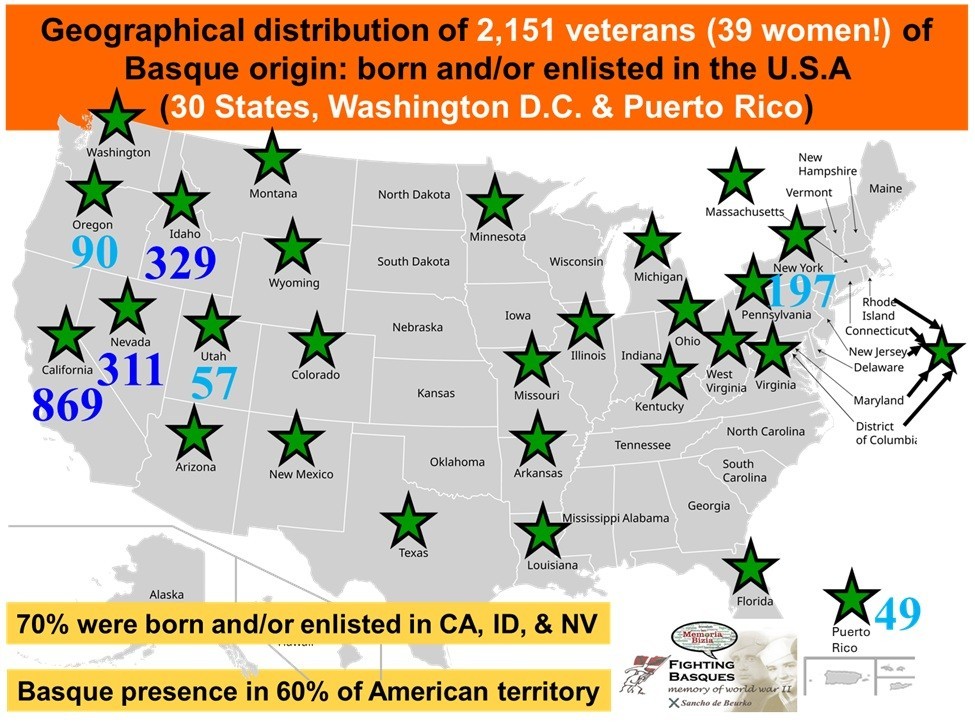
At the time of their enlistment, these veterans lived in thirty U.S. states, as well as Washington, D.C., and Puerto Rico — covering nearly 60% of the United States’ territory. They served in every branch of the U.S. Armed Forces and in every theater of operations worldwide.
The majority were American born: approximately 85% were citizens by birth, mostly the children or grandchildren of Basque immigrants. Yet more than 260 veterans were born in the Basque Country itself, and others came from Basque communities across ten different countries, from Argentina and Mexico to the Philippines and the United Kingdom. Over half of these emigrants were not U.S. citizens when they enlisted.
Their paths to service were diverse, but their commitment was shared. Together, they represent an extraordinary and still underrecognized contribution to the history of World War II.
Gardnerville, Nevada: A Meaningful Home
After an intensive year-long process of research, site visits, and deliberation, N.A.B.O. has announced that the Memorial will be built in Gardnerville, Nevada, at Heritage Park, located in the town’s historic downtown.
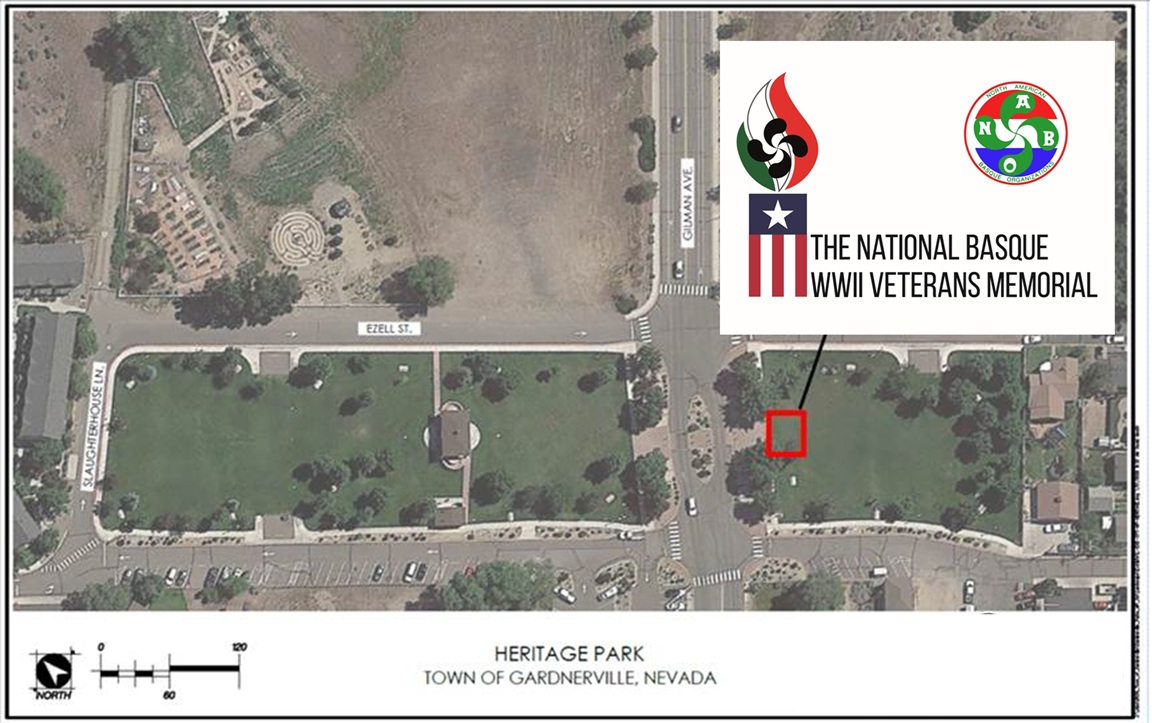
This location is deeply meaningful. Rooted in a rich immigrant past, Gardnerville has long been — and continues to be — an important center of Basque American life in Nevada. Founded in 1879, the town later became one of the state’s most significant sheep-raising hubs, sustained by a dense network of boardinghouses, hotels, bars, and restaurants that served generations of Basque sheepherders and their families.
Today, Gardnerville remains home to an active and engaged Basque community. With just over 6,200 residents, the town represents nearly 2% of Nevada’s Basque population and hosts the Mendiko Euskaldun Cluba. Since its founding in 1981, the club’s events and annual festivals have been widely attended, drawing participants from across the state and beyond, and serving as a regional reference point for Basque culture.
The Town of Gardnerville has also expressed its support for the Memorial project, recognizing its historical, cultural, and educational value for the community and working collaboratively with the organizers as the initiative moves forward.
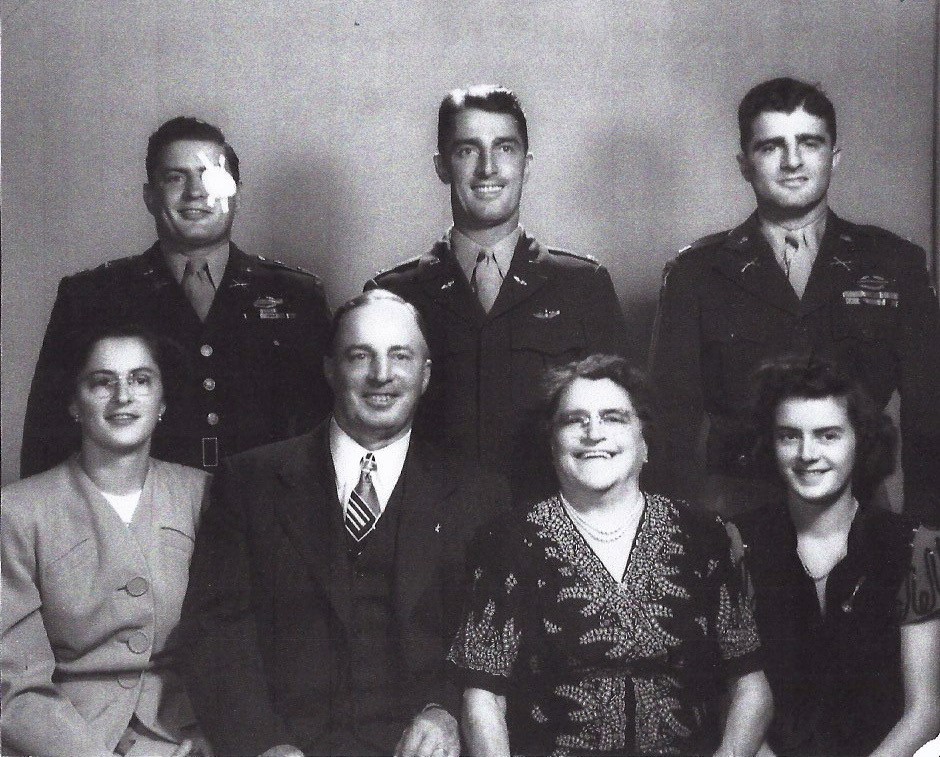
Gardnerville is also closely linked to families whose wartime service became legendary—such as the Etchemendy brothers, often described as the most decorated group of brothers in Nevada. Born in Gardnerville to Basque immigrant parents, their names will soon return home, permanently engraved at the Memorial.
Bizi leku: A Place to Live, A Place to Remember
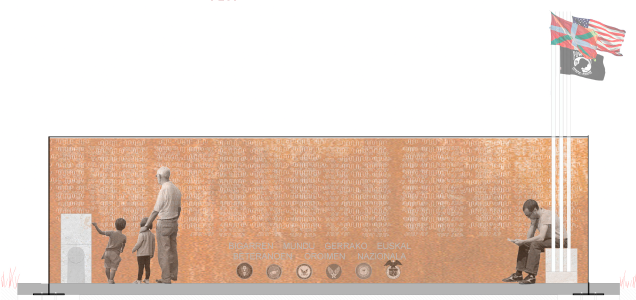
The Memorial’s conceptual design, titled Bizi leku — Basque for “The Place to Live” — was created by Basque architect Maider Bezos Lanz (BZS Architecture).
Constructed in Corten steel, the design evokes themes of migration, settlement, and belonging. It reflects the experience of adopting a new homeland while maintaining deep cultural roots—a defining feature of the Basque American story.
“Echoes of two wars, 1936-1945” aims to disseminate the stories of those Basques and Navarrese who participated in two of the warfare events that defined the future of much of the 20th century. With this blog, the intention of the Sancho de Beurko Association is to rescue from anonymity the thousands of people who constitute the backbone of the historical memory of the Basque and Navarre communities, on both sides of the Pyrenees, and their diasporas of emigrants and descendants, with a primary emphasis on the United States, during the period from 1936 to 1945.
THE AUTHORS
Guillermo Tabernilla is a researcher and founder of the Sancho de Beurko Association, a non-profit organization that studies the history of the Basques and Navarrese from both sides of the Pyrenees in the Spanish Civil War and in World War II. He is currently their secretary and community manager. He is also editor of the digital magazine Saibigain. Between 2008 and 2016 he directed the catalog of the “Iron Belt” for the Heritage Directorate of the Basque Government and is, together with Pedro J. Oiarzabal, principal investigator of the Fighting Basques Project, a memory project on the Basques and Navarrese in the Second World War in collaboration with the federation of Basque Organizations of North America.
Pedro J. Oiarzabal is a Doctor in Political Science-Basque Studies, granted by the University of Nevada, Reno (USA). For two decades, his work has focused on research and consulting on public policies (citizenship abroad and return), diasporas and new technologies, and social and historical memory (oral history, migration and exile), with special emphasis on the Basque case. He is the author of more than twenty publications. He has authored the blog “Basque Identity 2.0” by EITB and “Diaspora Bizia” by EuskalKultura.eus. On Twitter @Oiarzabal.
Josu M. Aguirregabiria is a researcher and founder of the Sancho de Beurko Association and is currently its president. A specialist in the Civil War in Álava, he is the author of several publications related to this topic, among which “La batalla de Villarreal de Álava” (2015) y “Seis días de guerra en el frente de Álava. Comienza la ofensiva de Mola” (2018) stand out.
“Bizi leku is conceived as a welcoming space,” explains Bezos Lanz. “A symbolic home that brings together all the names engraved on its surfaces, allowing them to coexist in peace and dignity — united by shared history and memory.”
The Memorial is envisioned not simply as a list of names, but as a living place of remembrance — one that honors individual lives, family histories, service, and sacrifice. A complementary digital memorial will provide access to biographies and educational resources, extending its reach far beyond the physical site.
Looking Ahead: A Shared Responsibility
The National Basque WWII Veterans Memorial seeks to preserve the memory of an entire generation while offering visitors — Basque and non‑Basque alike — a space for reflection, learning, and gratitude.
“As a community, we are creating a permanent national place to remember, honor, and thank Basque veterans who proudly served during World War II,” says historian Dr. Pedro J. Oiarzabal, director of the Fighting Basques project. “It represents a long-overdue public recognition and a place of pride, service, and belonging — one that connects individual stories to our shared history, much like the National Monument to the Basque Sheepherder dedicated in Reno, Nevada, in 1989.”
The Memorial’s dedication is planned for no later than December 2026, coinciding with two significant anniversaries: the 85th anniversary of the U.S. entry into World War II and the 250th anniversary of American independence.
Yet this Memorial is not only about the past. It is about how memory is carried forward — through care, participation, and collective commitment — so that these stories remain present and meaningful for future generations.
The National Basque WWII Veterans Memorial will take shape through shared remembrance and community involvement. As the fundraising campaign continues, each contribution — large or small — helps transform memory into a lasting public space of recognition and gratitude.
In this way, the Memorial becomes more than a site or a structure. It becomes a place where history remains alive—because a community chooses to remember, together.
Share this / Partekatu hau:

Discover more from Buber's Basque Page
Subscribe to get the latest posts sent to your email.
Greetings,
A suggestion to the readers of this blog. Forward this information to your Basque family on both side of the border. Spread the word. Some family may take the initiative to send it to a newspaper.
Monique Durham