Basque Fact of the Week: A Sheepherder Basqlish Dictionary

Nearly none of the young men and women who immigrated to the United States from the Basque County to herd sheep in the American West had any knowledge of English. This wasn’t much of a problem as they typically worked with other Basques. However, encounters with the dominant language of their new home were unavoidable and sometimes represented concepts that they didn’t have a Basque word for, so they simply transliterated the English word into Basque spelling. This leads to an interesting collection of “Basqlish” words.

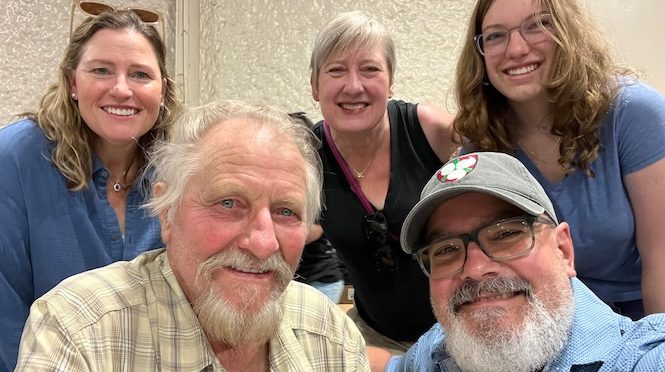
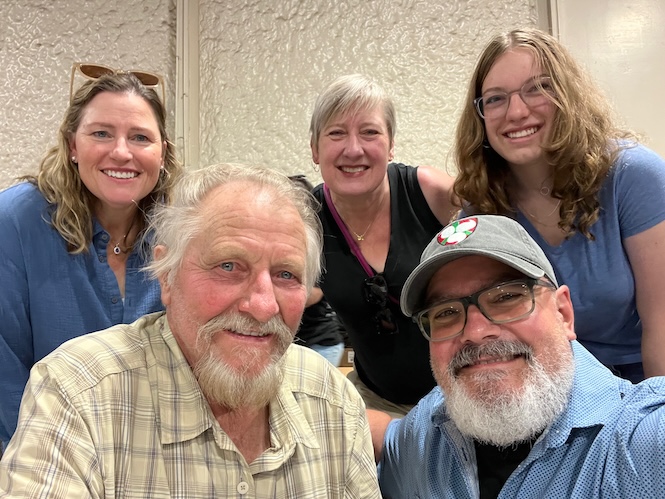
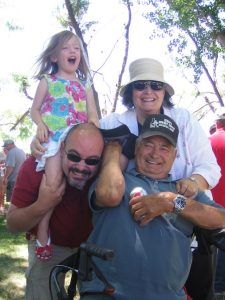
Joxe and me with his daughter and my family at Jaialdi.
  • Joxe Mallea-Olaetxe, who has done extensive research on Basque arboglyphs, has uncovered a number of transliterations of English words to Basque. Some of these will be familiar to those who had a Basque parent – you can almost hear their accent coming through. He shared these with me after I wished him Happy Thanksgiving.
  • Here are a few of Joxe’s favorites. The English equivalent is hidden in white text next to each Basqlish word – just highlight the text to reveal the English word. But, before you do, can you guess what the word is? I only got about half of them…

aizkrime
anburgesa
esprinkola
estorra
foki
grinjouse
karrue
kukia/kukije
morojona
mubije/mubia
paia/paije
pikapa
sanabitxe
saniskibi
sizpaka
taia/taije
troka
txip
uintxila
xata
zereala

A full list of all of Buber’s Basque Facts of the Week can be found in the Archive.

Primary sources: Joxe Male-Olaetxe, private communication.

Calling all Basque Merchants

Seasons greetings! Gabon Zoriontsua! We are in the heart of the holiday season and people are looking for that special gift for their Basque loved ones. Diana Echeverria had a great suggestion of creating a list of merchants and businesses that are either Basque owned or sell Basque-themed products. If you have such a business and would like to be listed in the Merkatua page, let me know and I’ll be happy to add you. I just ask that the business is either Basque owned or sells Basque-themed products.

Eusko-Folklore by José Miguel de Barandiaran. Series 3, Part 3: Traditions and Legends: Lurpeko Eremuetan/Subterranean Regions

Over 100 years ago, in 1921, José Miguel de Barandiaran began publishing a series of articles under the banner of Eusko-Folklore. His work was interrupted by the Spanish Civil War but in 1954 he resumed publishing what he then called his third series of articles. These appeared in the journal Munibre, Natural Sciences Supplement of the Bulletin of the Royal Basque Society of Friends of the Country. While various writings of Barandiaran have been translated to English, I don’t believe these articles have. As I find this topic so fascinating, I have decided to translate them to English (with the help of Google Translate). The original version of this article can be found here.

Traditions and Legends: Lurpeko Eremuetan (In the Subterranean Regions)

Once they were on a long journey, and those traveling had many beliefs about the Lady of Amboto. They had to pass through the Atxorrotx cave in Escoriaza, and as they crossed it, a gust of wind came upon them and carried them to the far side. When they left, they said that [it] was the Lady of Amboto.

(Communicated in 1935 by José Aramburuzabala, from Escoriaza).


Some shepherds lived in Atxorrotx; but every day they were missing a couple of sheep. They thought the thieves had them stored in the Atxorrotx cave. They went there; but they couldn’t get inside at all, no matter how hard they tried. Then they went to a priest and told him their story and asked the priest for advice.

He gave it to them, and they returned to the cave, and, unnoticed, they went all the way to the bottom and saw nothing but a pile of bones. That year, the Lady of Amboto had changed her residence, and instead of living in Kurtzebarri, she lived in Atxorrotx, and she gathered sheep to eat them.

(Reported by José Aramburuzabala in 1935.)


In Amboto, there lives a very beautiful lady, who used to pass Kurtzebarri every day, throwing fire and making a lot of noise. As she crossed the sky, she combed her long blond hair. That lady combed her hair with a beautiful comb, making a pir-pir sound with it. But a wicked young woman stole it. But, since the Lady of Amboto was clever, she noticed this and went to the young woman’s house and told her to return the comb and leave it in Kurtzebarri’s cave; otherwise, she would turn it into fire. Then the young woman, frightened, took the comb that made the pir-pir sound and left it in the place that the Lady of Amboto had shown her. The next day they went to the cave; but the comb wasn’t there, because the Lady of Amboto had taken it.

(Communicated in 1935 by José Aramburuzabala, from Escoriaza),


IN AZPEITIA

A shepherd was tending sheep in Burumendi. He was thirsty and was looking for water. He approached a cave when he saw a young lady elegantly dressed, and that lady asked him: “What are you doing, little man?”

“Here I am, looking for water, because I’m thirsty.”

“Water? Do you mean cider?”

And she brought him cider in a beautiful jar.

“This is really good cider. Where did the apple come from that made it?”

“This was made with apples given to no (thrown away) by the owner of the Montes de Icazteguieta house.”

The man was amazed. What is given to no, no takes, goes the proverb.

(Told in 1925 by José María Aguirrezabala, from Azpeitia, and reported by Mr. Rezola in the same year.)


IN CERAIN

In Cerain there is a baserri named Euzkitza. There, one day, as a furious storm had broken out, the mother asked a daughter to close the attic windows. The girl refused. Then her mother cursed her, saying the devil would take her. The girl went up to close the windows; but she didn’t come down. The devil had taken her.

Now she resides sometimes in Aizkorri, sometimes in Aralar, and sometimes in Amboto. In Aizkorri, she once brought a ram to her cave. The shepherds went to ask for the ram. She was sitting on the ram, and another young woman was combing her hair. The shepherds had entered and poured blessed wax, and so they recovered the ram and took it out of the cave.

(Reported by Mrs. Jauregia, from Cerain, July 4, 1954.)


IN ZALDIVIA

In a house in Beasain, a husband and wife lived with seven children. The wife was very wicked and refused to go, under any circumstances, to make any presentation at the temple, despite her husband’s insistence.

On one occasion, the husband told her: “Whether you like it or not, you must go this time.”

And having tied the woman to the cart, the man was heading toward the church. But the woman, answering to her husband, “You insist in vain, yes; even if you want to, you won’t take me,” she cried out, adding “The devil take me.”

And as she asked, the demons took her, breaking the chains and the ropes, leaving the cart empty. But they didn’t admit her to hell, and from then on, she has wandered from Murumendi to Aizkorri and from here to Aralar.

In Murumendi (1), she has often been seen combing her hair. At dusk, she moves from one mountain to another, spewing fire and flames.

(1) Murumendi is a mountain above Isasondo. Mari is supposed to live in one of its chasms.

(Reported in 1935 by José María Suquia, from Zaldivia.)


Many people from Amézqueta and Abalcisqueta would go to see the Lady of Muru (2). And when they entered the chasm where the lady was, they would always find her combing her hair. And they had to go to her with blessed candles. The lady had many things made of gold. One of the times they went there, someone quietly stole a gold vessel from her; and later, upon returning home, she put her hand inside the vessel and found a toad inside.

(2) Naiñarri is one of the mountains in the Aralar mountain range. It contains the chasm called Marizulo, where the genius Mari also spends time.

(Reported in 1935 by José María Suquía, from Zaldivia.)


IN LAZCANO

In Murugüen (3), Beasain, there was a woman, mother of seven children. Possessed as she was, (possessed by devils), she did not go to church. Since she could not do so in any other way, once her husband brought her tied up in a cart along the church road. But when she arrived at the edge of the church, she said to her husband: “Matías de Muru, seven children for the world, and none for heaven.”

(3) Murugüen, baserri of Beasain.

Having said that, she flew into the air, and today she still lives, and many see her on certain nights as she passes from Murumendi to the Aizkorri cave, and from Aizkorri to Murumendi.

There is a shepherd who has seen her outside the cave combing her hair with a rake.

(Reported in 1935 by Anastasio Arrinda, from Lazcano.)


IN REGIL

The Lady of Murumendi passes many times, at least in winter: sometimes in the air; other times, however, on the road with loud clattering chains.

(Communicated in 1935 by Juan Galarraga).


IN AMEZQUETA

Mari was from a house called Iraregui. That house is below the Txindoki. On a certain feast day, Mari didn’t want to go to mass, and her mother told her: “Let’s go to mass.”

“I’m not going,” she replied, and she didn’t go.

Her mother told her: “Stay there! By the time I get back from mass, may the devil from hell take you!” And when the mother returned, Mari was missing. The devil from hell had taken her to the Txindoki chasm.

A short time later, having appeared to her relatives, she told them: “The devil has me tied up with a chain; but if you do what I tell you, I can free myself. Look: place those blessed rosaries in the house on top of the walnut tree in the doorway, beat it, and take the nuts to Rome.” Her relatives replied that this was madness and did nothing. On another occasion, she also appeared to the relatives and instructed them to make a small altar and place it in that Txindoki chasm. They made the altar; but they did not make the small hollow in front of it, (1) and that is why Mari was not freed or saved. Sometimes she emerges, in fire and flame, from that Txindoki chasm and heads toward San Miguel (2).

(1) Space intended for the relics of saints.
(2) San Miguel, sanctuary in the Aralar mountain range.

(Reported in 1930 by Ignacio Altuna, from Amézqueta).


In the forest of the baserri called Zubiñ de Ugarte in Amézqueta lies Azari-zulo, a place of rest for when the Lady of Aralar is moving from house to house. They say that this Lady is an evil daughter, cursed by her mother. “May the devil take you!” she had told her.

And she immediately (turned) into fire and flame, she hid.

She lives in three caves. One in Aralar; another time in Aizkorri and in Burumendi. Terrible thunder and lightning occur at night when this witch moves from one mountain to another.

Two strong men, loaded with saints (medals) and scapulars, once went to the chasm where this witch was, in order to find out what she was. And they found her combing her hair, with two golden candlesticks in front of her.

When she saw those men, she went to the back of the cave, abandoning the candlesticks. And the men hid the two candlesticks in their bellies and carried them home. But by the time they had arrived home, the golden candlesticks had been turned into toads.

(Communicated in 1931 by J. Arandia, from Amézqueta).

José Miguel de Barandiaran

Basque Proverb of the Week: Proverb #42

Bat eman eta bi hartu, gure etxean ez berriz sartu.

Giving one and taking two, don’t come back to our house.

Image generated by Buber using Gemini.

These proverbs were collected by Jon Aske. For the full list, along with the origin and interpretation of each proverb, click this link.

Basque Fact of the Week: The Ateak Ireki Program, Opening Doors to the Basque Country

I spent the 1991-92 school year in the Basque Country, trying to learn Basque and learning a bit more Spanish. It was my first time to the Basque Country and it really opened my eyes as to what life was like in the Basque Country. I had learned something about the traditional culture, primarily dance, when I was a kid, but I hadn’t realized that the Basque Country, like everywhere, was a modern, vibrant place that was continuously evolving. All that to say that the exchange program that I participated in was, literally, life-changing. Ateak Ireki is a new cultural exchange program with the goal of exposing young Basques in the diaspora to the life and culture of the Basque Country today. If you are interested, registration for summer 2026 ends soon.

Ateak Ireki participants, photo from the Ateak Ireki website.
  • Ateak Ireki means “Open Doors” in Basque and the program has the primary goal of giving young Basques in the diaspora the chance to experience life in the Basque Country first hand. For three weeks, these youngsters spend time with families in the Goierri region in southern Gipuzkoa (where incidentally Mutiloa, the town my great grandfather Blas Telleria was from, is).
  • The program hopes to strengthen ties between the Basque Country and the Basque diaspora. Participants learn about traditional aspects of Basque culture including language, dance and literature but also network with local and business leaders to help establish new professional connections.
  • Participants live with a local family that speaks primarily Basque at home (though knowledge of Basque beforehand is not a requirement). Each family also has someone at home of a similar age to each participant and each also has an English speaker at home. All this to make each participant feel as welcome as possible while they also get an immersive experience.
  • Registration for the summer 2026 program is open until December 7. Participants must be between 18 and 25 years old, become a member of the North American Basque Organization after being accepted, and participate in all activities. There is also opportunity for chaperones.
  • The program is inspired by the cultural exchange program between Boise and Oñati that occurred in the 1970s. That program, spearheaded by Pat Bieter and Jon Bilbao, was instrumental in giving the Basque diaspora of Idaho and by extension the American West a huge boost. Many of the leading figures of the Basque diaspora of the United States participated in that program.

A full list of all of Buber’s Basque Facts of the Week can be found in the Archive.

Primary sources: Ateak Ireki

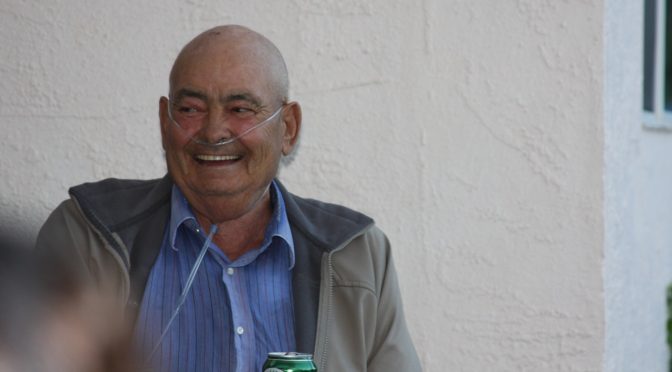
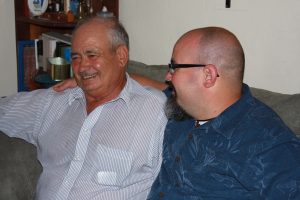
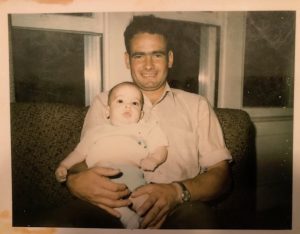
Remembering Dad by Telling His Stories

Dad died ten Thanksgivings ago. I miss you dad.

In 1997, dad got a heart transplant. This was after more than a couple of heart attacks and his heart was a mess. He and mom had gone down to Salt Lake to see if they could help him, but he was turned away. I don’t know all the reasons but I think it was mostly about money – how to pay for his treatment. The next place they tried was the Medical School at Seattle, which did agree to help, so that is where they went.

Going to Seattle turned out to be the perfect situation, at least as perfect as going somewhere to wait for a heart transplant could be. I was living in Seattle at the time, in the middle of grad school, so while dad lay in his oh-so-comfortable hospital bed, mom could stay with me. I lived in suburbia and had a few roommates. I gave mom my bedroom and I slept on a mattress in the living room. I know it must have been frustrating for my roommates to have an extra housemate and for me to be treating the living room as my bedroom, but they were patient enough with us. Most days, I’d drive mom down to the hospital where she would spend the day with dad and the multitude of doctors consulting and treating him while I worked on my research, trying to understand defects in silicon. At the end of each day, I’d swing by to spend some time with dad before taking mom “home.”

Dad lay in that bed for about three months. He had a catheter that went up his leg and pumped a balloon in his heart – that little balloon kept him alive for those three months. But because the catheter was critical to keeping him alive, he couldn’t bend that leg. I don’t think he got out of that bed until the day he had his surgery. We had waited quite a long time, and gone through a few scares – more than once, dad got an infection that not only threatened his life, but prevented any surgery as he had to be as close to perfectly healthy as he could be to accept a new heart. Everyone was tired, especially mom and dad. At one point the doctor said “It’s spring and the motorcycles are coming out – we’ll get a heart soon.” And they did, though it was because of a car crash, not a motorcycle…

Even after his surgery and after he was discharged, dad still had lots of doctor appointments. At the beginning, he’d have to come back up to Seattle every three months or so. So, we shifted the arrangement. Mom typically stayed home in Idaho while dad would drive up to see his doctors. He’d either crash at my place or with my aunt in Gig Harbor. I’ve probably never cooked as much as I did during dad’s visits. We’d try to have some Basque friends over that I had made through the Seattle Basque Club and make various dishes, such as leek and potato soup or dad’s specialty, tortilla.

Eventually, things got more difficult financially and dad had to spend more time in Washington. For a while, he lived halftime with me and my high school buddy Dan, spending two weeks with us and two weeks in Idaho, but eventually that had to change, partially because I finally graduated. My aunt fixed up a space over their garage and that became dad’s apartment.

As I’ve written before, dad didn’t have many hobbies so staying with me was a bit rough for him. He was alone much of the day when he wasn’t with his doctors and didn’t have much to do. I expect he watched a lot of TV, but he also spent time just sitting in the front yard. In a few months, he got to know the neighbors infinitely better than I ever did over five years! He would also go across the street and pick plums off the neighbor’s tree. I always found that weird, that they weren’t ours and we didn’t have any permission to take them, but he would just say that they were falling on the ground and rotting, so why not take them and do something with them? He was always practical like that. For him, it was a bigger “crime” to let the food go to waste than to offend the neighbor. But, the neighbors never complained, as far as I knew. And we had some excellent plums.

As a grad student, things were tight and so it was a crowded house – I got another roommate, Gontzal, to try to reduce costs. But it all worked out in the end and I got to know dad a little better. And help him out some. He had to take insulin as all of the medication he was on – he had pills to stop his body from rejecting his heart and other medicine to fight infections his body could then no longer fight on its own – messed up pretty much everything with his body, and sometimes I’d help give him his shots. The pills also contributed to dad getting gout, which was the most painful thing he ever had to deal with.

With the encouragement of my then-girlfriend (and now wife) Lisa, I got a few stories out of him. I got to know a little bit more about the life he had before I came along, both in the Basque Country and in the United States. I would put my little recorder on the table or dash in front of him and he would complain to turn it off, he didn’t want to be recorded. But, I just left it on and recorded as much as I could. I could have done more, learned more, with this golden opportunity, but as happens all-too-often, I got distracted by my own things and just life in general. But, I did learn some and that’s more than I had before.

Thanks to Lisa Van De Graaff for encouraging me to record dad and his stories when I could. Lisa took some of the photos featured on this post.

Basque Proverb of the Week: Proverb #41

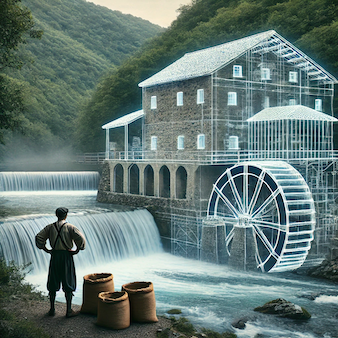
Balizko errotak, irinik ez.

An imaginary mill produces no flour.

Image generated by Buber using ChatGPT.

These proverbs were collected by Jon Aske. For the full list, along with the origin and interpretation of each proverb, click this link.

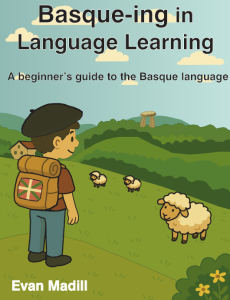
Basque-ing in Language Learning by Evan Madill

by Evan Madill

What do Escape Rooms, Surfing, and John Adams all have in common? 

These themes are all used to teach Basque, in my new book, Basque-ing in Language Learning.

My journey as a beginner of Euskara was difficult. In my experience of studying many languages, Basque was the only one where I truly felt frustration. My learning journey began with Beginner’s Basque by Wim Jansen.  I struggled to understand articles and suffixes that appeared at the end of words. These patterns were different from any other language I had seen. Furthermore, Wim Jansen’s book didn’t even include the notorious NOR-NORI-NORK agreements! But I had to use this book as it was one of few resources available to me as a beginner.

But this scarcity of learners’ resources was to be expected. Euskara, Europe’s only surviving pre-Indo-European language has less than 1 million native speakers. Nestled between Spain and France, this language has survived multiple empires. Euskara was even banned for several decades by Francisco Franco’s regime. Basque is a language isolate, meaning it has no living relatives.

 Of course, this uniqueness doesn’t mean that linguists haven’t tried to find links to other languages. Theories have been made connecting Basque to the Georgian language of the Caucasus, the Iberian language of pre-Roman Spain, and one paper even tries to identify it as a Celtic language. Some theorize that an ancestor of Basque was spoken by the earliest hunter-gatherers who spread through Europe after the Ice Age. Others believe that it was spoken by the earliest farmers that spread from Anatolia (explains the Georgian connection?) or from the later megalithic culture that built Stonehenge. Out of experience, I suggest not trying to figure out the origin of Basque to avoid the headache. It is better to save your energy for learning the language and guaranteeing its survival.

One day, I realized somebody needs to do something about the lack of resources for learning Basque. So I set out to write the beginner’s guide I wish I had. And then I had an idea—what if it was funny? What if it was casual and sarcastic? Most language learning books are dry and boring. The closest thing to fun language learning is our green avian friend—but even that falls short. 

In the process of writing my book, creative ideas popped into my brain, seemingly out of nowhere. When writing the chapter on numbers, I created an escape room scene where the players needed to know important dates in Basque history. A bonus chapter on dialects was written using historical fiction stories of John Adams’s journey through Basque Country, the Labourd witch trials, and more. Other lessons were taught using aspects of culture, mythology, and reference to notable surfing locations in the Basque country. Eventually, it was finally finished, and a fun, casual guide to the Euskara existed—the first of its kind (to my knowledge).

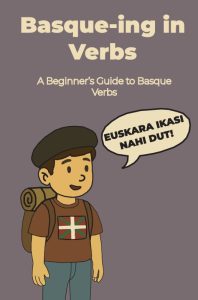
Then I had the idea to write another book. When I was a child, the CDC spent hundreds of millions of dollars to fund the slogan “VERB: It’s what you do.” The phrase that stuck with me, although I had no idea the purpose was to encourage kids to be more active. Verbs are the backbone of any language—but in Basque, they’re a whole different beast. So, I wrote Basque-ing in Verbs. 

This time, there would be no stories or sarcastic jokes, just straightforward instruction. A short, concise introduction to Basque verbs. The Nor-Nori-Nork agreements are covered in more detail and explained in an understandable way. The goal was to be different than Basque-ing in Language Learning, ditch the stories, and cultural references, and just focus on delivery of knowledge.

A title like Basque-ing in Language Learning leaves room for a sequel, which would be appropriately named Basque-ing Longer in Language Learning. This part is where you, the reader, assist in writing the book. If there is an aspect of Basque language and grammar that confuses you or that you’ve always struggled with, leave a suggestion in the comments. Share which aspect of learning Basque has beaten you up the most?

Both books are available on Amazon in both Kindle and paperback.

Basque-ing in Language Learning

Basque-ing in Verbs

Basque Fact of the Week: Rising Star Jacob Elordi

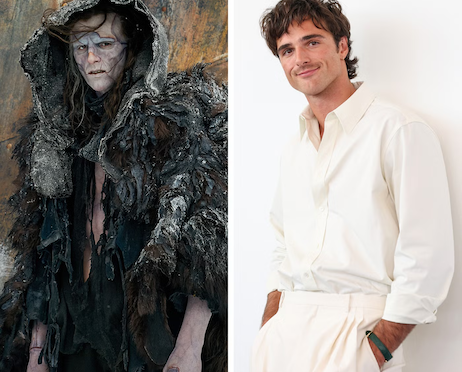
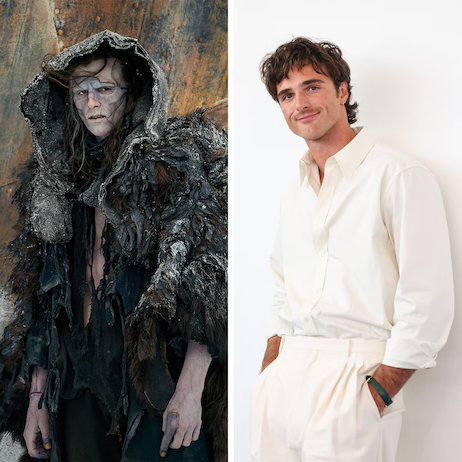
It is always cool to see Basque names on the big screen. Whenever we sit through the credits of a movie, I tend to scan the names to see if any Basque names pop out to me. So, it’s even cooler when the Basque name is also the star of the movie. Jacob Elordi has been getting a lot of buzz and his career has really taken off in the last couple of years. The son of a Basque immigrant, Elordi grew up in Australia before making his way to Hollywood. His most recent film is Frankenstein, directed by Guillermo del Toro, in which Elordi plays the creature.

Incidentally, I just saw Frankenstein and really enjoyed it.

Jacob Elordi after his transformation into Frankenstein’s monster. Photo from Elle.
  • Jacob Nathaniel Elordi was born on June 26, 1997, in Brisbane, Australia. He comes from a working class family. His father John is a house painter and his mother Melissa is a stay-at-home mom and waitress. John was born in the Bizkaian province of Marikina-Xeimen while John’s father, Joaquin, was born in Ondarroa. Jacob has three older sisters.
  • Joaquin had immigrated to Australia to escape Franco’s dictatorship. He originally worked in the sugar cane fields until he saved enough money to bring his mother and his son, John, to Australia. John was eight years old at the time.
  • Elordi says that he was inspired to become an actor by Heath Ledger. He started acting in musicals at his school at the age of 12. He was interested in rugby until he hurt his back when he was 14, which pushed him from athletics to acting. It was when he was 15 and reading Waiting for Godot in drama class that he really decided acting was his passion. His father initially discouraged Jacob’s acting ambitions, saying that “acting is a one-in-a-million kind of situation.” Jacob replied by saying “Well, why can’t that one be me? Why can’t I be that one in a million?”
  • Elordi’s first Hollywood role was as an extra in 2017’s Pirates of the Caribbean: Dead Men Tell No Tales. He started gaining fame in 2018 as part of Netflix’s The Kissing Booth. He was about to give up on his Hollywood dream – he had been sleeping in his car and on friends’ couches – when he was cast in HBO’s Euphoria.
  • After that, his career began to take off. In 2023, he played Elvis Presley in Priscilla and starred in Saltburn, for which he received a BAFTA nomination for best supporting actor. Most recently, he starred as the titular monster in Guillermo del Toro‘s Frankenstein. His performance in this and other recent films has earned him praise. For Frankenstein, he spent 10 hours a day in make-up to complete his transformation.
  • Elordi has made his pride in his Basque ancestry very clear. When a Wikipedia article about him listed his ancestry as Spanish, he said he wasn’t of Spanish but Basque descent, and his grandfather would strangle him if he heard that.

A full list of all of Buber’s Basque Facts of the Week can be found in the Archive.

Primary sources: Jacob Elordi Reveals What Kind of Dad He Wants to Be by Brahmjot Kaur, E News; Jacob Elordi, Wikipedia; Jacob Elordi, the Giant of Generation Z by Gerardo Elorriaga, Todo Alicante; Inside Jacob Elordi’s 10-Hour Transformation Into Frankenstein’s Creature by Emma Fraser, Elle

“’Francisco Franco is Still Dead:’ Songs in Celebration” by Begoña Echeverria

Begoña Echeverria
b.echeverria@ucr.edu
November 20, 2026

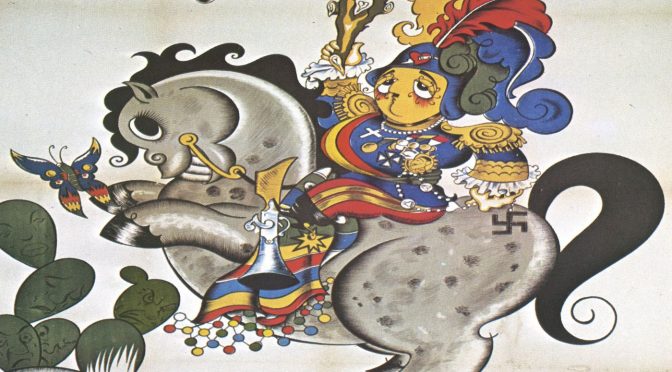
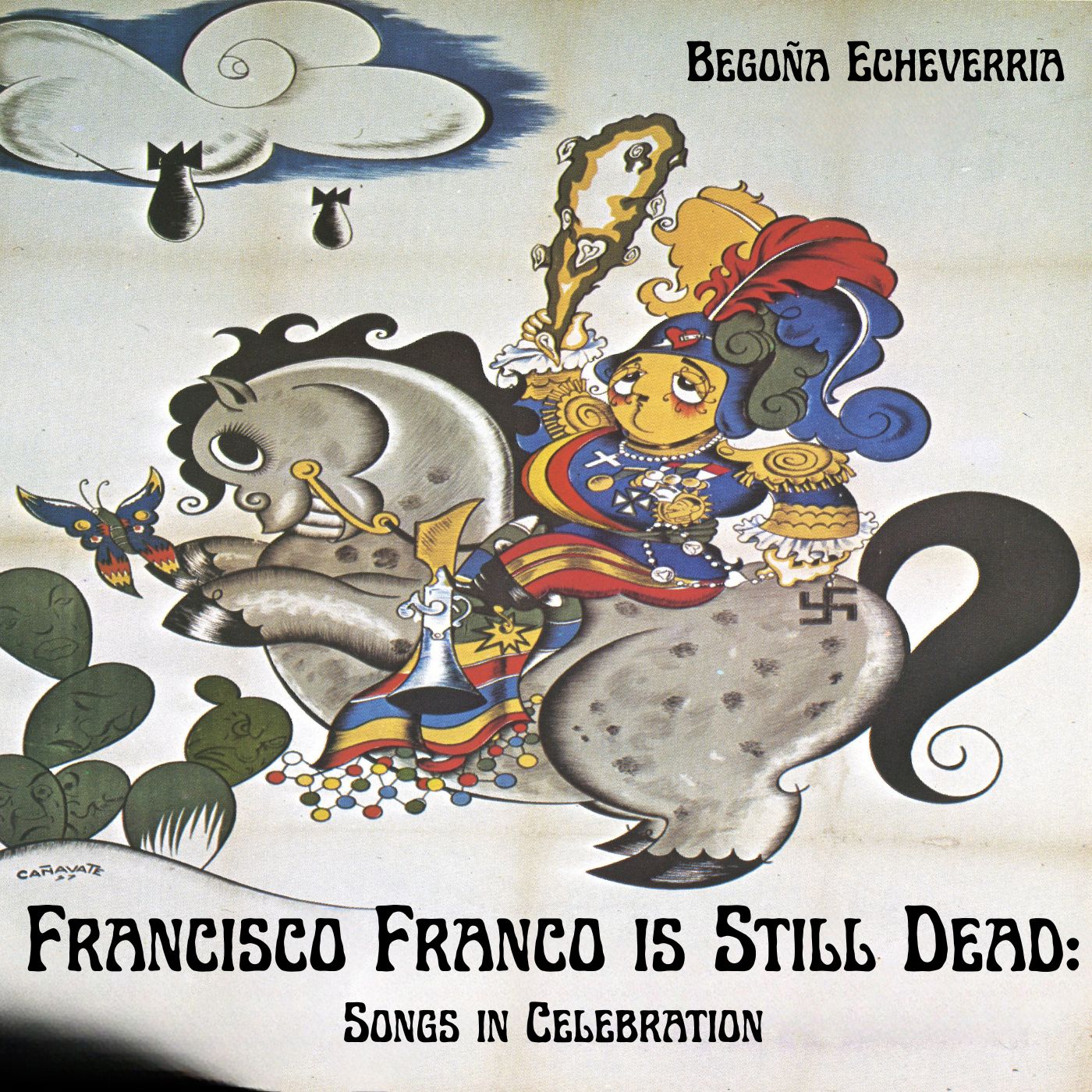
S.E. El generalísimo. Cañavate. Junta Delegada de Defensa de Madrid, Delegación de Propaganda y Prensa: 1936-1939.

I first heard of Francisco Franco from Chevy Chase’s iconic sketch on “Saturday Night Live.” Riffing on repeated NBC news reports on the dictator’s supposedly imminent death for weeks before, “Weekend Update” host Chevy Chase announced Franco’s death, then quoted President Nixon praising Hitler as “a loyal friend and ally of the United States. He earned world-wide respect for Spain through firmness and fairness” – as a photograph of Franco grinning alongside Hitler is displayed. Watching the show on a little black-and-white TV in the kitchen with my mother, Pilarcho, I chuckled at the skit, as my mother held her fist in the air in triumph and scoffed. 

That was 50 years ago. On November 20, 1975, dictator Francisco Franco—or  El Caudillo por la Gracia de Dios, the Head of the Spanish State and the Head of the Government by the Grace of God, his preferred title—was finally dead. I recall no discussion of this momentous event with my mother after the skit was over. Ama did not elaborate on who Franco was, or why she was happy he was gone. And it would be decades before I would broach the subject again, not because I was afraid to or uninterested. It just never occurred to me. It was as if that gesture of defiance was all that my mother needed for closure. Perhaps that’s true. But when I did get curious about this dark chapter in Spanish and Basque history, when Franco ruled from 1939-1975, Ama didn’t have that much to say. No specifics, anyway. Maybe that’s not unusual. Like many immigrants, perhaps my mother had decided not to dwell on the more unsavory aspects of her country of origin. Or maybe Ama didn’t say much about Franco because his oppression didn’t impinge on her daily life. Possibly her life was not very different from that of her mother and grandmother before her, so there may not have been noticeable interruptions to her life experiences that she could attribute to the dictatorship. As a girl, she worked alongside her family on the baserri; as a young woman, she worked as a maid at a hotel/restaurant. Then she married my father, moved to America, and started a family. Never did she complain (at least to me) about the “traditional” strictures placed upon her.

The daughter of Basque immigrants to southern California, Begoña Echeverria is the Faculty Director of University Honors at UC Riverside and Associate Dean in the Division of Undergraduate Education. She has produced scholarly and creative works on Basque identity and culture. These include the monograph “Witches” and Wily Women: Saving Noka Through Basque Folklore and Song, the historical novels The Hammer of Witches and Apparitions, the play “Picasso Presents Gernika,” and four CDs with NOKA. With Annika Speer and Jacqueline Postajian, she is co-writer of the short film “Children of Guernica.”

And yet.

I wonder what Ama’s life would have been like had she not grown up during the Franco regime. For his triumph in the Spanish Civil War reversed policies of the short-lived Second Democratic Republic (1931-1936) that greatly expanded women’s rights. Alongside men, they were given the right to a free public education, the right to vote and the possibility of (civil) divorce for the first time. But the opportunities came to an abrupt end when Franco won the war on April 1, 1939. Rather than a democratic republic aspiring to expand the rights of women, “True Catholic Womanhood” reigned supreme. Women were extorted to focus on raising patriotic children for the Fatherland, to sublimate their own aspirations to support those of their men, and discouraged from pursuing university educations.[1]

Whether Ama ever felt the lack of prospects ushered in by Franco’s policies and politics, she did not let on. But I sometimes feel anger on her behalf – and on behalf of all the girls and women of Spain, in the Basque Country and beyond – for the freedoms and opportunities denied them by Franco and his minions. I channeled these feelings into lyrics I wrote for “Ama” in my play, “Picasso Presents Gernika.”  As readers of this blog likely know, Franco allowed Hitler—with assistance from Mussolini—to bomb Gernika on April 26, 1937. It was the first aerial bombing of a civilian target, and understandably, parents sent their children abroad for safe-keeping: 20,000 in all.[2]

In the 1990s while living in Donostia, I met a British woman whose father had been among the 4,000 children evacuated to England, along with his brother. Eventually, their mother called for the brother to return to Spain, but not my friend’s father. He never learned why. Based on this story, in my play a mother sends her son and daughter to England after the bombing of Gernika. She eventually calls her son home, but leaves her daughter Andrea (“woman,” in Basque) in England, believing her daughter will have a better life under a democracy than a dictatorship. It is only at the end of the play that Andrea learns this. Below is an English version of lyrics I originally wrote in Basque. 

1. He Let Them Bomb Gernika
Music and Fiddle: Belinda Thom
Lyrics & Vocals: Begoña Echeverria
Instruments, Production, & Mixing: Mario Verlangieri

He let them bomb Gernika
The bombs they killed my husband
I was left a poor widow
Me and my children

England sent El Habana
To sail our children away
I sent away my son and daughter
Will I ever see them again?

Oh, Blessed Mother
I leave my children in your arms
Protect them, and keep my children strong
Oh, Blessed Mother
Protect my children, keep them strong
Until they can come home

Franco killed our democracy
World War II began
England feared for its own children
And wanted to send ours back home

Franco took away our rights
Specially from girls and women
I called my son home, but left my daughter
Will you have a better life out there?

On February 20, 2022, “Picasso Presents Gernika” was staged at United Nations headquarters in New York City to commemorate World Refugee Day. It was the first and only time a live performance was staged in the venue, which can be viewed here: https://webtv.un.org/en/asset/k15/k15cv08mlb. Along with my co-writers Annika Speer and Jacqueline Postajian, I am working on a short film, “Children of Guernica,” which explores Andrea’s trauma and the healing she receives from her work as an art therapist for refugee children. (I invite you to consider making a tax-deductible donation toward the making of this film. Shooting begins in December and we hope to complete the film in 2026, funds permitting: https://creative-visions.networkforgood.com/projects/243481-children-of-guernica-s-fundraiser.)

Picasso famously proclaimed that he would not allow Guernica to be exhibited in Spain so long as Franco ruled as dictator. Almost as famously, he did not live long enough to see this happen: he died two years before Franco. But Picasso did experience Franco’s effrontery with regard to Guernica: In 1969, Franco called for the mural to be “returned” to Spain, as if the mural belonged to him.[3] Perhaps more insidiously, soon after allowing Gernika to be bombed, Franco falsely claimed that the Spanish Republican government – which included Communists and Basques – had destroyed Gernika. Franco’s war against truth soon turned to political violence against select groups of individuals. As suggested in “He Had Them Bomb Gernika,” Franco wasted no time in stripping women and girls of political rights they had briefly been bestowed during the Second Republic. But Franco’s political violence against women was particularly brutal. For decades, the Franco regime stole babies born to women he considered his political enemies – telling them their babies had died in childbirth – and gave the babies to his supporters. This was discovered when a reporter for the Spanish newspaper El Pais visited the grave of his sister, who – he had been told – had died decades before as a baby. He found the grave empty. (These and other violations of human rights committed by the Franco regime are investigated in the 2017 documentary, “The Silence of Others.”)

Franco never forgot that the Basque provinces of Gipuzkoa and Bizkaia allied with the democratic forces against him during the Spanish Civil War, and welcomed the chance to humiliate his Basque adversaries. On September 18, 1970, he presided over the Basque World championship for pilota in Donostia (San Sebastian), as if he had done nothing wrong. Incensed at Franco’s appearance at the Basques’ de facto national sport, Joseba Elosegi set himself on fire and threw himself from the second balcony, yelling “Gora Euskadi askatua!” (Long live a free Basque Country!). After seventeen days in a coma, Elosegi was sentenced to seven years in prison. (https://es.wikipedia.org/wiki/Joseba_Elósegui). 

These instances, a few among so many, inspired the following song:

2. Francisco Franco You’re A Bad Bad Man
Lyrics & Vocals: Begoña Echeverria
Music based on “Death Don’t Have No Mercy In This Land” by Blind Gary Davis, adapted by Mario Verlangieri and Begoña Echeverria
Instruments, Production, & Mixing: Mario Verlangieri

Francisco Franco you a bad bad man 
You said, “Hitler baby can I give ya a hand?”           
You can try out your bombs on the Basque land 
Francisco Franco you a bad bad man 

Francisco Franco a conscience you lacked 
You said was the Reds behind the attack 
But hey, Pablo baby, gimme Guernica back 
Francisco, a conscience you did lack 

Francisco Franco took away our rights 
Wrapping yourself up in Vatican white 
You said baby girl, with you I got no fight 
But, Francisco, you took away our rights 

Francisco Franco you ain’t got no shame 
You came just to watch a pilota game 
I was so incensed, I set myself aflame 
Francisco Franco ain’t you got no shame? 

Francisco Franco: oh, the lies that you spread  
I had me a baby, ya told me it was dead 
But ya gave it away, so it wouldn’t be Red 
Francisco Franco: oh, the lies that you spread 

Francisco Franco, asto pitua zen

Conclusion

Writing and singing these songs has been a cathartic experience for me. Even though my mother rarely mentioned Franco or complained of the privations his policies imposed upon her, I take retroactive umbrage in her stead, as she is no longer with us.  And rejoice that Francisco Franco is STILL dead.

Beharrik.

Works Cited


[1] Morcillo, Aurora. True Catholic Motherhood: Gender Ideology in Franco’s Spain. Northern Illinois University Press: Dekalb, 2000.

[2] Legarreta, Dorothy.  The Guernica Generation: Basque Refugee Children of the Spanish Civil War. University of Nevada Press: Reno, 1984.

[3] “Franco Favors the Return Of Picasso and ‘Guernica.’” New York Times. October 28, 1969.