
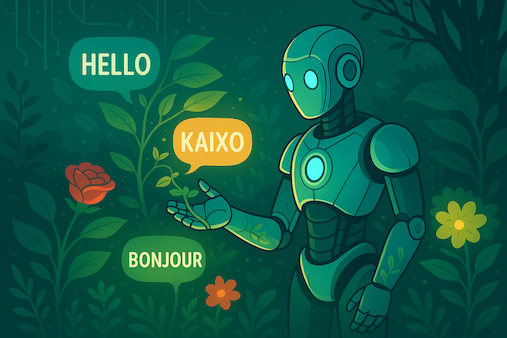
In researching my “Basque Facts of the Week,” I rely pretty heavily on Google Translate. While I can get the gist of an article written in Spanish, the details often elude me. And the situation for Euskara is even worse – while I have a rudimentary understanding of the language, I certainly can’t understand a typical Wikipedia entry. Tools like Google Translate open up a new world that I can explore as so many things related to the Basque people, culture, and history are simply not available in English.
Google Translate and tools like it are powered by artificial intelligence – AI – algorithms. And language tools like these are proving reasonably successful for majority languages like English where there is a huge body of work to draw upon. After all, at their core, these algorithms are “simply” recognizing patterns and the more data you have, or examples of a language, the better you can recognize those patterns. However, for minority languages such as Euskara, the situation isn’t nearly as strong.
Forbes has a nice article on the various activities going on in the Basque Country to improve the utility of these types of tools for Euskara. For example, Vicomtech, a research foundation headquartered in Bilbo, has developed their own Euskara translation tool called Itzuli. Euskorpora, another nonprofit, is developing a high-quality collection of Euskara samples, called the Basque Language Digital Corpus. This is to provide the best quality database for training tools like Itzuli. (Incidentally, the article also gives a nice snapshot of the current health of Euskara – I recommend reading it.)
Why are such tools important? As one example, television programs can be automatically transcribed so as to capture the content for other types of media or, for example, those who are hearing impaired. In principle, they could be automatically translated as well, effectively dubbing foreign language content in real time. When representatives sit at the European Parliament, these types of tools can translate speeches and comments from some arbitrary language to Euskara, allowing those representatives to participate in their native language. All of this goes toward helping to ensure the vitality of the language.
AI is certainly a controversial topic. It has the power to transform our lives, to automate tasks that are tedious for humans or to recognize patterns in seas of data that are hard for humans to pull out. In my own field of materials science, we use these algorithms to discover new materials and to understand the factors that impact the performance of a material. The dream is to ask the computer to create a material that would have the properties needed for a given application. However, at the same time, it threatens some areas of human endeavor. By mining the collective human output of writing and art, for example, it can be used to generate images and texts seemingly out of nowhere, but really from that reservoir of human creativity. While it opens the door to the masses to be able to generate such content, it threatens those who really push the frontiers of art and literature. Again, in my own field, it does seem that AI is threatening to take away from fundamental understanding, replacing it with simple pattern recognition.

However, I do wonder if AI will in the end be a possible boon for the survival of minority languages like Euskara. When I first went to the Basque Country and told my dad and grandpa, both of whom spoke Basque as their first language, that I wanted to learn Euskara, they both wondered why, as Spanish would be much more useful in the world – so many more people speak Spanish, wouldn’t that, pragmatically, be better to learn? I tried to tell them that it wasn’t because of the utility that I wanted to learn Basque, and while I think they both were somewhat pleased that I took this interest in their mother tongues, the utilitarianism in them still thought it was not the smartest thing to do. Learn a language that is useful, not one only a few people speak.
With AI and the advent of automatic translation services, I don’t have to care what language might be most useful, but rather which languages might be most interesting. I can afford to learn that minority language that only a “few” people speak instead of some less interesting (to me) language that is more “useful.” I don’t have to choose between utility and personal interest. Basque is fascinating to so many people because it is unique. If I don’t have to worry about communicating with people in Spanish or English or Chinese, I can learn a language simply because I want to.
On the flip side, a native Basque speaker wouldn’t have to be so concerned with learning a more global language to get by in the world. In the scientific world, the lingua franca is English. I’m lucky to have English as my first language as it makes writing about and presenting my work that much easier, but it is certainly an extra hurdle for those that don’t speak English as their first language or at all. Automatic translation tools, if they were mature enough, would enable people to work in whatever language they wanted, whatever language they grew up with, and still communicate with the rest of the world. You could imagine a time when someone could write a scientific paper in Euskara and I would be able to understand it completely with the help of these types of tools. They wouldn’t suffer because they chose to write in their minority language – they would still get their results out to the rest of the world.
Would this help with the survival of the language? It seems to me it should. If you didn’t have to learn a second language just to communicate with the rest of the world, if you didn’t have to live your professional life in another language, if you didn’t have to learn a lingua franca just because you needed it, you could live your life completely in your preferred language. You wouldn’t have to choose. Every aspect of your life could be lived in Euskara and you wouldn’t ever have to have a second language to function. Think of the Babel Fish in Douglas Adams‘ The Hitchhiker’s Guide to the Galaxy. Everyone is able to communicate with everyone regardless of what language they are communicating in. A people’s collective effort could be completely done in their own language, they wouldn’t have to trade time with another language, devoting precious resources to a second language that detracts from the health of their first language.

This of course comes with some drawbacks. Americans are already criticized for typically only knowing one language. This criticism often originates from the idea that only knowing your mother tongue indicates you are less worldly, that you haven’t explored other cultures, that you have a narrow world view. There is a hypothesis – linguistic relativity – that says how we think is defined by the language we think in. If you think in different languages, you naturally see things in different ways. If all of us only ever thought and spoke in one language, whatever it might be, perhaps our ability to understand one another at a more fundamental level would be lost.
However, it seems that the benefit for minority languages would outweigh this consideration. As a speaker of a majority language where I live, I never have to choose how to express myself. But a minority language speaker always does. Should I write in Basque to do my part in boosting the language, or should I write in Spanish or English so that the greatest number of people can understand me? I never have to make this choice, but speakers of minority languages like Basque have to all the time. If we had robust and fast translation tools, those people could write in Basque but I’d still be able to understand what they wrote. I’m sure some nuance would be lost, but I would get the majority of the meaning.

Recent history has pointed to the development of multiple lingua francas, a consolidation of the number of languages spoken around the world. This certainly aids in communication, but it comes at the cost of linguistic and – if you believe the hypothesis of linguistic relativity – intellectual richness. AI tools may reverse this trend, making it unnecessary to have a lingua franca at all, allowing us all to communicate with whomever we choose without giving up our own language.
In the end, all new technologies come with both pros and cons and AI is no different. Whether AI based tools ultimately help minority languages like Euskara survive or not is unclear. I can certainly see that they might help, but whether they do or not likely depends on how they are implemented and used. However, giving minority language speakers the ability to conduct all aspects of their life in their native language certainly does seem like a positive.
Share this / Partekatu hau:

Discover more from Buber's Basque Page
Subscribe to get the latest posts sent to your email.
“Artificial”-“Intelligence”
IS
NEITHER
Mila ezker Blas!
Indeed it is an interesting article requiring good work.
I enjoyed my time reading it.
With sentiments of great esteem
Joseba
Beautifully and insightfully written
Greetings, AI or not, one needs and must do what they believe it the right approach according to their thinking. AI may or may not be the answer, but it is worth trying.
Languages change about every 20 years. Languages reflect the society we live in.
I hope that older texts written in the Basque language have survived so that the new generation can read it and compare it with the Basque spoken today.
Monique
Great work as always Buber. However, none of my family in Bizkaia write, no matter how educated, they say few words only. When there I have to speak in Spanish., and when communicating online as well. My Amuma used to get so upset because her family never wrote to her. So, I recorded them and when she heard it she was so happy.
Keep on keeping on with your excellent writing. Eskerrik Asko
Greetings, There are schools in the French Basque country that teach all subjects in Basque only. Some school teach in French and Basque. In many restaurants menus are written in French and Basque. I hear Basque spoken. My nieces go shopping in Spanish Basque stores and vice versa with the Spanish Basque. Basques work along the French or the French Basques. It is the normal daily grind along with the fiestas
Maybe because it is on the border. Monique