
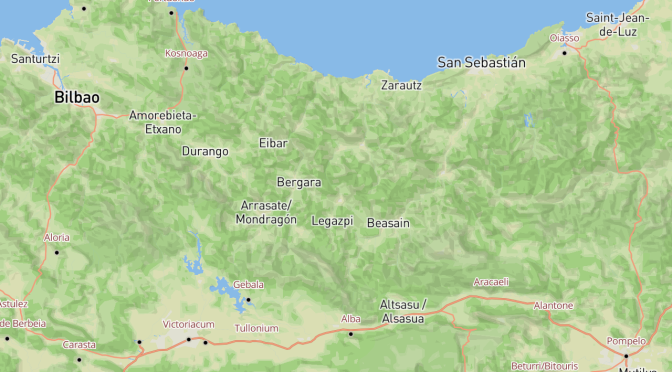
We don’t know much about the early history of the Basques. While discoveries such as the Hand of Irulegi reveal more than ever, there is still a lot that is shadowed in the mists of time. The Basques have never recorded their own history – what we know is typically from the pens of neighbors or other observers. This includes the Romans. The Romans certainly conquered much of the Iberian peninsula, including parts of the modern day Basque Country. Indeed, Pamplona is named after the Roman general Pompey. Much of what was written back then is through the lens of the conqueror and, even worse, by people who had only heard of the Basques but never visited the region.
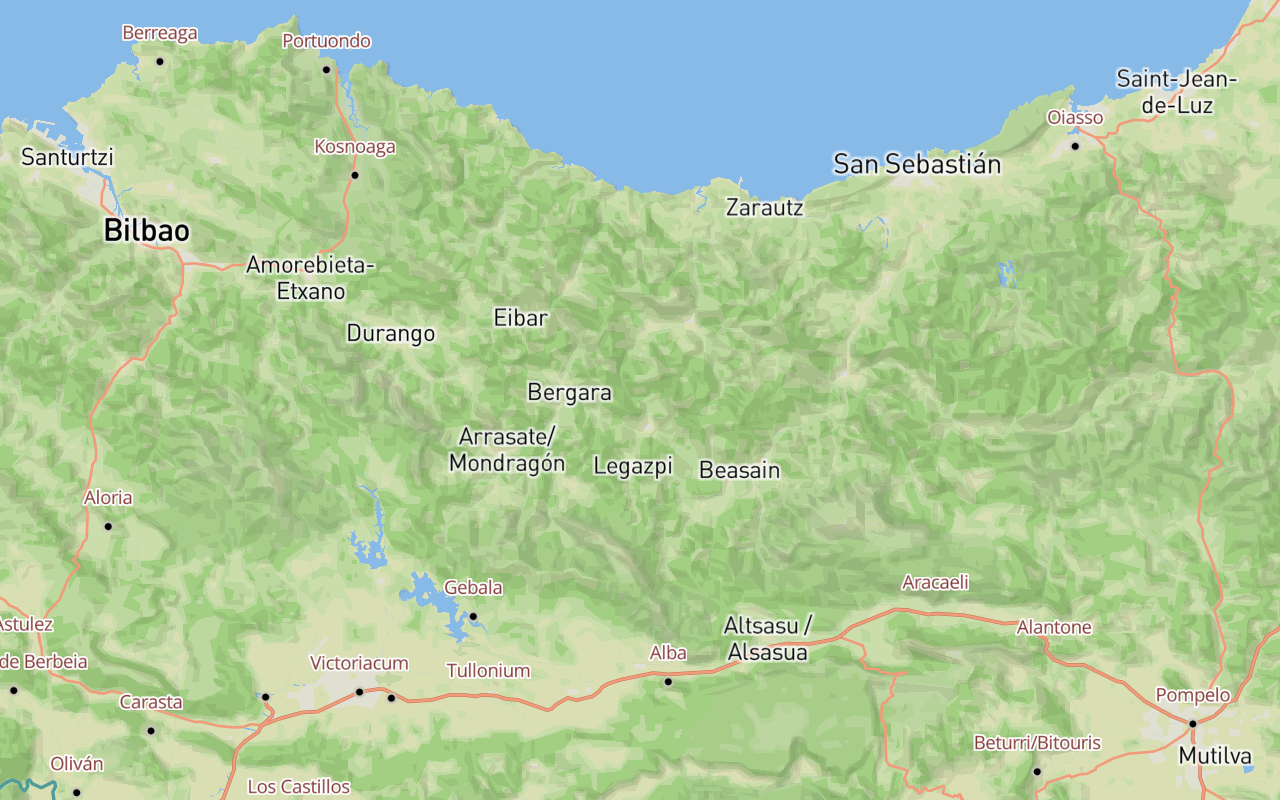
- The website Itiner-e has put together a map of all of the roads of the Roman Empire. Nature calls it a “Google Maps” for Ancient Rome. It is quite interesting. If you zoom in on what is today the Basque Country, you can see a few roads around the periphery, but the interior is completely devoid of any Roman roads. This highlights how the Romans had very little activity in the region.
- A lot of what we know about the Basques during the time of the Romans comes from Roman historians. Strabo, in particular, wrote about the Basques in his Geographica, an atlas of the world known to the Romans. Though, many of the places he wrote about he never visited, he was just repeating what others had said.
- To Strabo and the Greek and Roman worlds, people in the far regions, particularly those in the mountains, were barbarous: “All the mountain dwellers are austere, they usually drink water, sleep on the ground and let their hair reach very low, like women, but they fight by girding their foreheads with a band. They eat mainly goats, and they sacrifice a goat to Ares. They also make hecatombs of every kind in the Greek way, as Pindar says: they sacrifice a hundred of everything.”
- He goes on: “They also have gymnastic, hoplite and equestrian competitions, with boxing, running, skirmishing and combat in formation. The mountaineers, for two thirds of the year, feed on oak acorns, letting them dry, grinding them and making bread with them that keeps for a while. They also know beer. They drink wine on rare occasions, but what they have is quickly consumed at feasts with relatives. They use butter instead of oil. They eat sitting on benches built against the wall and they sit in order of age and rank. The food is passed around in a circle, and at the time of drinking they dance in a circle to the sound of flute and trumpet, but also jumping and crouching, and… women also dance together with men holding hands.”
- “…those who live far inland use the barter of goods, or cut off a silver flake and give it. Those condemned to death are thrown off a cliff and parricides are stoned beyond the mountains or rivers. They marry just like the Greeks. The sick, like the Egyptians of old, are exposed on the roads so that those who have suffered from it can give them advice about their illness…..”
- “This, as I have explained, is the way of life of the mountaineers, and I am referring to those who mark the northern flank of Iberia: Calaic, Asturians and Cantabrians up to the Basques and the Pyrenees; because the way of life of all of them is similar.”
A full list of all of Buber’s Basque Facts of the Week can be found in the Archive.
Primary sources: Estrabón y su mención a los pueblos del norte de la Península Ibérica by María Cruz González Rodríguez, Euskonews; Brughmans, T., de Soto, P., Pažout, A. and Bjerregaard Vahlstrup, P. (2024) Itiner-e: the digital atlas of ancient roads. https://itiner-e.org/
Share this / Partekatu hau:

Discover more from Buber's Basque Page
Subscribe to get the latest posts sent to your email.
Speaking of maps. While researching the provenance of the Churro sheep, I came across few articles that may be of interest. In the bibliography of the article, Cattle and sheep from the Old to New Spain: Historical Antecedents, Karl W. Butzer. Source: Annals of the Association of American Geographers, Vol. 78. No.1 ( March 1988) pp.29-56.
Another one. ” Patterns of Spanish Immigration to the New World (1493-1580) Special Studies No.34 Pub. Date Apr 1973
On p. 7. ” After reading Oviedo we are not surprised to find the Basques leading the remainder with 15 (10%).—” Oviedo specifically tell us that they and their other clannish countrymen spoke ” vascuence” among themselves” I believe he was speaking about the Basques. I have noted in old documents, the interchanged of V and B. Author: Boyd-Bowman, Peter.
There is more info. Got to go and fix supper. Monique Durham