
The Basques weren’t the first to explore the seas… or were they? The Basques didn’t invent boats… or did they? The Basques aren’t aliens from outer space… or are they?
Seriously, the Basques played an important part in the development of shipbuilding and seafaring. We know that they were outstanding navigators, but their contributions go beyond that, to also improving ship technology. As a sort of nexus between northern and southern Europe, they fused technologies to make things even better.
- Baiona was a hub of shipbuilding expertise, and this is one factor that drove innovation. Even by 1131, Baiona was building ships, an activity that only increased when Aquitaine became English in 1154 and the King of England gave the citizens of Baiona fishing and whaling rights in 1170.
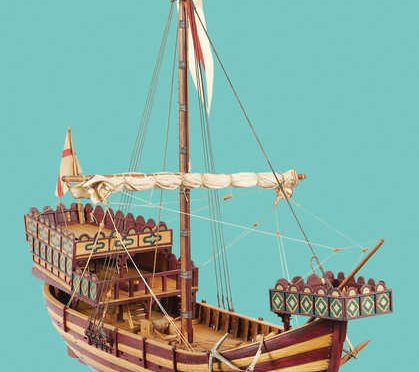
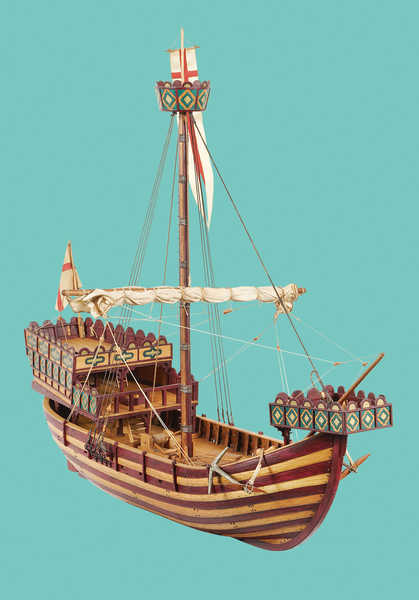
- In the 1100-1200s, the Basques began building cogs, also called cocas, which were inspired by northern cog-designed ships. In contrast, in the Mediterranean ships called caravels were more common.
- One of the innovations that came from all of that activity was the Bayonne rudder. Northern ships tended to use a stern rudder, one that was in the back of the boat, but Mediterranean boats had a quarter rudder, or one that emanated from the side. The stern rudder was a significant improvement for maneuverability and also allowed for larger ship designs.
- These boats also employed another Northern European technology in how the hull was made. In the Mediterranean, people used the carvel technique in which the panels were mounted flush against one another. This led to a tighter seal against water but also required greater skill and time to make the interlocking plates. The Basques adopted the clinker technique used in the North in which the planks were overlaid on top of one another, much like roofing tiles. This was faster and required less precision.
- Basque or Bayonnese cogs also were flatter in the hull so that they were better at transporting horses and thus better for military action where soldiers and their mounts had to be transported. They could also hold more cargo and thus had an advantage for trade.
- The Basques employed a combination of iron nails and wooden treenails. Treenails were used in the north but were bad in the warmer souther waters where iron nails were used more. The Basques used both – iron for strength and treenails for flexibility.
- Basques also used a unique technique to shape their wood. They would shape the oak trees as they grew so that they had the form needed for the ship. This reduced joints and made elements stronger. This technique, called ipinabarres, also allowed people to better manage forest resources.
- The strong Basque – or more specifically Baiona – shipbuilding tradition led to Basque shipwrights being recruited to places like England to build ships. The English were commissioning ships to be built in Baiona by as early as the 1200s. And, by 1294, Basques were in London building ships.
- Basque innovation continued through the centuries. In the 1700s, for example, Antonio de Gaztañeta brought scientific principles to shipbuilding, which not only standardized design but also reduced waste. He redesigned the hull such that ships-of-the-line, the biggest ships at the time, had greater stability without sacrificing speed.
- Albaola is a “sea factory” that is trying to revive the traditional shipbuilding practices of the Basques by reconstructing the San Juan, which was a whaling boat that sunk off the coast of Labrador.
A full list of all of Buber’s Basque Facts of the Week can be found in the Archive.
Primary sources: Zwick, Daniel: “Bayonese cogs, Genoese carracks, English dromons and Iberian carvels: Tracing technology transfer in medieval Atlantic shipbuilding”, Itsas Memoria. Revista de Estudios Marítimos del País Vasco, 8, Untzi Museoa-Museo Naval, Donostia-San Sebastián, 2016, pp. 647-680; Guided pollards in the Basque Country (Spain) during the Early Modern Ages by Alvaro Aragón Ruano
Share this / Partekatu hau:

Discover more from Buber's Basque Page
Subscribe to get the latest posts sent to your email.