
It seems inconceivable today, but in the late 1500s, the rulers of what is now Spain thought they could conquer China and then the rest of Asia with an army of 10,000 to 20,000 soldiers. They thought they could persuade Japan to join them. What’s more, this army was going to be primarily Basque. Leaders often overreach, thinking they are invincible, their ambitious getting the better of themselves (and, unfortunately, all of those around them); but this plan seems even more foolhardy than most.
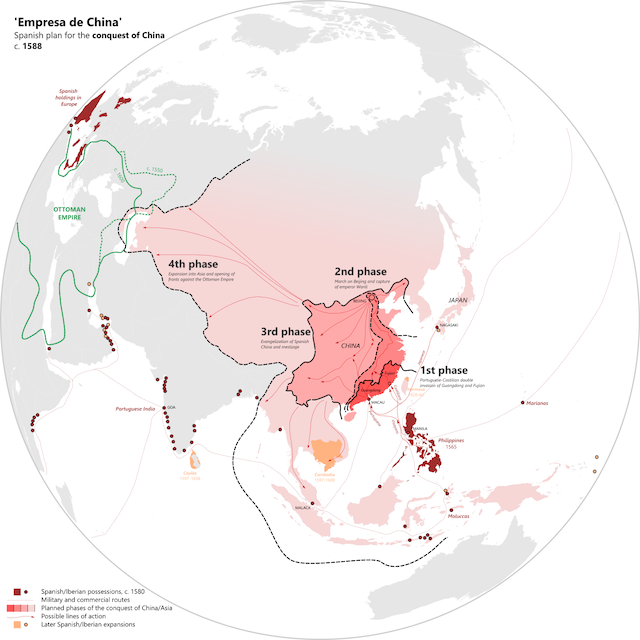
- In the late 1580s, a plan was devised by Spanish leaders to invade China. The goals were to Christianize the nation, plunder its wealth, and establish a base of operations from which Spain could conquer other parts of Asia. There were even plans for Spanish soldiers to mix with Chinese women and to establish encomiendas using local labor, much as they did in the Americas.
- Versions of this plan had been floated before. Hernán Cortés made such a proposal in 1526. Martin de Rada, one of the first missionaries to visit China, suggested such a plan in 1575, though he did not advocate the use of force, but rather “persuasion and evangelization.” Francisco de Sande, governor of the Philippines from 1575 to 1580, thought a force as small as 4,000-6,000 could take China.
- The one that actually took hold – the Empresa de China or Chinese Enterprise – was pitched by diplomat Alonzo Sánchez. A Jesuit missionary, Sánchez had been to the Philippines and saw an opportunity to expand Spanish and Christian influence. He was able to get a version of his plan to King Philip II who, with his Council of State, began developing the plan. Amongst others, Basque Juan de Idiáquez y Olazábal helped Sánchez get his plan in front of the king. The Bishop of Manila and another Basque, Domingo de Salazar, also advocated for the plan.
- Spain reasoned that, because of the ease with which they had conquered the Americas and the Philippines, China would be similarly easy. From a Spanish perspective, China was a wild place which, while densely populated, didn’t have a military spirit. They thought that a small force of some 15,000 soldiers could take China, aided by popular resurrection once the Spanish came.
- Of the soldiers that were part of the planned contingent, some 12,000 were meant to be Basque. Sánchez made this specific recommendation. There was no reason given for this suggestion, though one can speculate that the great reputation of Basques as navigators – such as Juan Sebastián Elkano, Miguel de López de Legazpi (founder of Manila), Andrés de Urdaneta (López de Legazpi’s navigator who discovered the return route to America from the Philippines), and Martín de Goiti (explorer of the Philippines) – made them desirable for this mission. Other soldiers from Japan and Portugal were also part of the plan.
- The plan was derailed by the defeat of the Spanish Armada when it tried to invade Britain in 1588 and subsequently abandoned.
A full list of all of Buber’s Basque Facts of the Week can be found in the Archive.
Primary sources: Los 12.000 vizcaínos que debían conquistar China para Felipe II by Javier Muñoz, El Correo; Empresa de China, Wikipedia; El plan más meticuloso y ambicioso de Felipe II para el Imperio Español: conquistar China con ayuda de Japón by Alejandro Alcolea, Xataka
Share this / Partekatu hau:


Discover more from Buber's Basque Page
Subscribe to get the latest posts sent to your email.
Interesting!! Greetings– ” Cortes floating the idea”–I vaguely remember something like that in the fourth or fifth letter of Cortes. “Hernando Cortes, Five Letters 1519-26”. Translated by J. Bayard Morris. Publisher, Robert M McBride & Company.
Monique Durham
PS: Lancre’s letter is a bear to read but I am almost done!
I read Munoz article–it makes more sense now. Portugal was a sovereign nation 250 years or so before Spain when they expelled the Moors.
The first Portuguese voyage to China was made under the command of Jorge Alvares in the summer of 1513.
When King Sebastian of Portugal died, Felipe II, took the portuguese throne from his mother and crowned himself King of Portugal, Felipe I.
From 1580 to 1640 Portugal was under the dominion of Spain. Portugal was a wealthy country during that time and Felipe I needed money for the conquest of the Americas and beyond. And the Jesuits went to China.
History repeats itself over and over.
Monique Durham