
Death and taxes, the only things that can’t be avoided. Death eventually claims us all and it is no wonder then that people develop special beliefs around death. People develop special rituals around those who have died and the handling of their body. In the Basque Country, there are also beliefs and rituals connected with the soul of the dead, both to help them in their journey and to prevent them from being trapped on Earth. Many ancient Basque beliefs and traditions were ultimately either transformed or replaced by Christianity.
- As might be expected, a serious illness was seen as a presage of death. That said, such illnesses were often attributed to God, as a punishment for sins. Or, alternatively, as the result of the evil eye or malevolent spirits that constantly swarmed everywhere, spreading disease and agony. And, as I’ve written about before, various animals also foretold death.
- When someone died, their eyes and mouth had to be closed quickly, otherwise they might draw others to their “side,” or to the realm of the dead.
- It was believed that demons, evil spirits, or even the devil himself lurked around the death bed and could tempt people to say blasphemous things. In Christian times, this led some people to putting into their will language that protected them: “And if, through weakness, the severity of my illness, or the persuasion of the evil enemy, I should say or utter anything against the Holy Faith, I hereby renounce it and declare that it is not, nor will it ever be, my intention, but rather to always remain in the Holy Faith…”
- While a sudden death was taken to be a sign of damnation, of God not giving the person time to prepare, a prolonged death was also viewed negatively. In some places, an oil lamp was lit and it was thought that the person would die when the oil ran out. Or if someone continued to suffer, it was because their soul was trapped and they couldn’t escape the room, so a window might be opened.
- When someone was deathly ill, if a domestic animal died (a cow in Bermeo, a hen in Gorozika), it was taken as a good sign, as the animal took the place of the person.
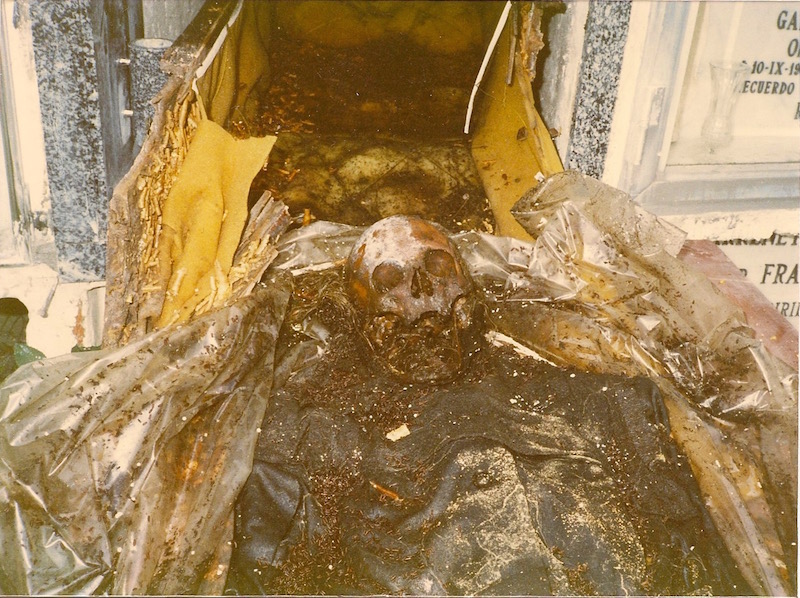
- When someone had died, it was the task of the women to prepare the corpse. In old times, the body was simply wrapped in a sheet or shroud, called a hil-mihise – people were not buried in a coffin. People would make their own shrouds, many years in advance of their own death, in preparation.
- Another ancient tradition was tying the body’s hands and feet with rope, more recently with ribbons. Originally, this may have been done to restrict the dead from returning as an apparition.
- As in many places, bodies were buried with items. Today these are often religious in nature – crucifixes or rosaries. However, in past times, weapons and coins might have been buried with the dead. In any case, these items were thought to be useful for the dead in the afterlife.
- While the body was being prepared and was on display in the house, in some places mirrors were covered with a black cloth. It was thought that if one looked into a mirror with the body in the house, they might see witches or even the dead him or herself.
- Finally, death was associated with impurity. So, when someone died, their mattress would be burned. Or a bundle of straw was burned while a prayer was recited. In some places, the stables also had to be purified. And yet in others brandy and herbs were burned.
A full list of all of Buber’s Basque Facts of the Week can be found in the Archive.
Primary sources: Madariaga Orbea, Juan. Muerte. Auñamendi Encyclopedia. Available at: https://aunamendi.eusko-ikaskuntza.eus/en/muerte/ar-82465/
Share this / Partekatu hau:

Discover more from Buber's Basque Page
Subscribe to get the latest posts sent to your email.