
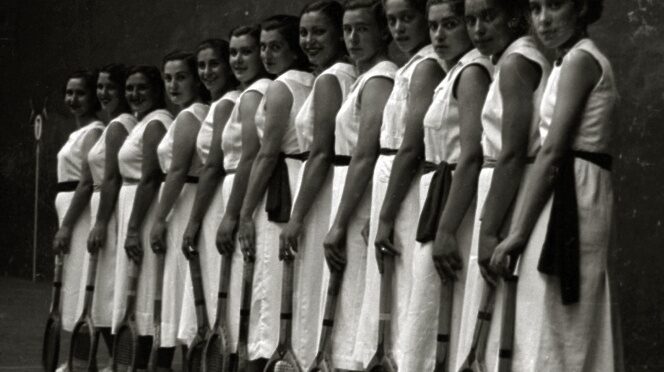
While women have played sport for as long as humans have existed, it is only recently that that they have had the opportunity to play professionally, to make sport a career. In the early 1900s, women, primarily from the Basque Country, pioneered a professional league of racket ball that at one time dominated the professional sports world of Spain. These women, often from rural areas, were able to establish a lucrative life. However, stigmas associated with playing professional sport often led to their stories being erased.

- While the idea of professional women’s racket ball had precedent, it didn’t take off until Luciano Berriatua and former pelota player Ildefonso Anabitarte created a school and league for the sport. The first fronton with a cadre of permanent professional players opened in Madrid in 1917. It was a huge success, particularly because of the high quality of play and the ease the sport made it to gamble on matches.
- The game was adapted from the traditional pelota played in frontons across the Basque Country. Women used a strung racket much like a tennis racket but the ball was the heavier leather ball often used in pelota. To withstand the heavier ball, the racket was double strung.
- To ensure the high quality, women trained for a year before becoming professionals. They had to foot the bill for the training and lodging themselves. This devotion to quality mean that matches were highly competitive and full of drama, attracting an adoring and dedicated public.
- At one time, the number of professional women racket players was greater than the number of men playing professionally – in excess of 700 women were playing in 1943. At its peak, it was the most watched sport in Spain.
- After the Spanish Civil War, women playing professional sports was discouraged and bans were pursued in some cases. It was deemed unfeminine to play sport. In Spain, to play professionally, one had to obtain a license from the government. Franco’s government stopped issuing these licenses in 1944. New licenses weren’t granted until 1957.
- This led many women to leave Spain and instead play in places like Mexico, Brazil, and Cuba.
- These women were pioneers, not only for women’s professional sport, but professional sport more broadly. They were the first athletes to contribute to Social Security and had rights recognized even before men’s soccer players. They made significant money for the time – their salaries met or exceed that of the highest government officials – and were at the top of the professional sporting world.
- The stigma associated with playing professional sports meant that many of these women never talked about their experiences. They had already had to endure hardship in leaving their families to play, something many of their families disapproved of. And they rarely spoke about it even with their spouses. There were accusations that these women paraded themselves on the fronton for the enjoyment of men and thus, while they were pioneers in their field, they were somehow viewed as anti-feminist. Indeed, a leading Catholic magazine of the time wrote “We have a collection of unfortunate women who exhibit themselves in public for a salary, to promote, to a larger extent, the fatal vice of gambling among men.”
- Further, their relationship with Basque nationalism is complicated. While they were pioneers of professional sport, and played a variant of Basque pelota, they were viewed as something outside of tradition: their sport wasn’t a true Basque sport. And men dominated the story of Basque nationalism with little room for women. This plus the stigma associated with women playing sport meant that much of their history was lost until recently, with new efforts to promote their pioneering role in women’s sport and society more broadly. The site Raketistak has profiles of players and history of the sport, while this Youtube video has interviews with some of these women.
A full list of all of Buber’s Basque Facts of the Week can be found in the Archive.
Primary sources: Erraketista, Wikipedia; González Abrisketa, Olatz. “Basque women on court: The success, repression, and oblivion of professional racket pelota players in Spain, 1917–1980.” The International Journal of the History of Sport 35, no. 6 (2018): 554-574.