
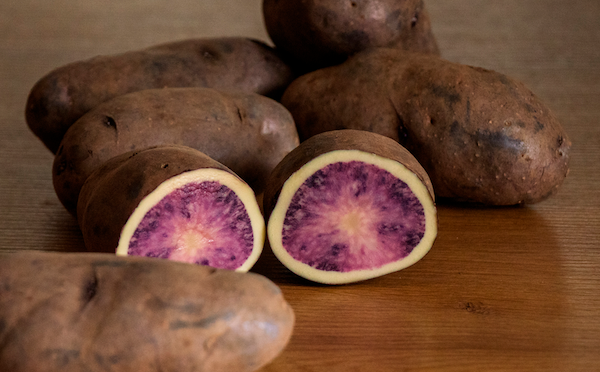
This one will maybe resonate more for those from Idaho. Idaho is famous for potatoes and there his a lot of research in the state devoted to the potato – for example at the University of Idaho. Other places also have such efforts, including in the Basque Country where the Experimental Potato Farm of Iturrieta has been developing new types of potatoes since the 1930s. Their most recent potato, called Atsegiñe, promises to impact the potato chip industry with a purple potato that is great for frying.
- Iturrieta is an experimental farm in the province of Araba. It was first mentioned in the historical record around 1563, but by then the village had already been abandoned. It is also the home of many megalithic monuments, attesting to an even older history.
- In 1933, the Spanish government decided it needed to increase the agricultural productivity of the province of Araba. At the time, potato yields in Spain had declined over many years. Then, it wasn’t clear why – people simply said that “the soil got tired” – though now we know that it was because of potato viruses.
- One José María Díaz de Mendívil led the effort to improve agricultural output. Iturrieta was chosen as the location for an experimental farm dedicated to improving potatoes because of its higher altitude. The idea was that the higher altitude would lessen the chance of infection by viruses. In fact, Díaz de Mendívil and others had toured the country researching potato production and realized that higher altitudes helped with potato cultivation. Iturrieta sits at just over 3000 feet. The farm’s development was suspended due to the civil war but began operation in 1948. Officially called Estación de la mejora de la patata it is better known as the Granja de Iturrieta, or the Iturrieta Farm.
- The original farm had 41 varieties of potatoes collected from all over Europe. Over the course of its history, the farm has led to several new varieties of potatoes. The first, called Eminencia, was developed in 1950 though that variety has since been lost. By the 1970s, the farm had developed some 15 varieties of potatoes that then dominated the Spanish market.
- Since 2022, the farm has been operated by NEIKER, the Basque Institute for Agricultural Research and Development. They continue to develop new strains of potatoes, including Beltza in 2021 and Edurne in 2023.
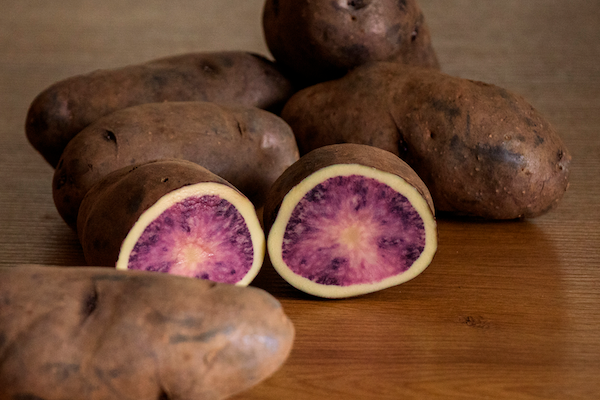
- Most recently, the Iturrieta Farm and NEIKER developed the Atsegiñe potato. Meaning pleasant or tasty in Euskara, the Atsegiñe potato is special in that it is a bicolor purple potato that can be used for colored potato chips, for example, and that it retains its crispiness without the same amount of sugar, which means that it also retains its flavor more after frying. It also has a high amount of antioxidants. Finally, it is also more resistant to blight and viruses.
- Since the farm was created, a few other things have popped up around it, including a church, a monument to the potato grower, and even a txoko where they prepare, amongst other things, potatoes…
A full list of all of Buber’s Basque Facts of the Week can be found in the Archive.
Primary sources: Atsegiñe, the bicolor Basque potato with 30% more antioxidants by Luis Lazaro Leo, Modernet Digital; Iturrieta, Wikipedia; Un breve repaso a la historia no escrita de la patata de siembra en España by Amaia Ortiz Barredo, Interempresas; Entre Iturrieta y el valle de Arana by Txema G. Crespo, El País