
This one is a bit technical and maybe the Basque connection is a little loose, but (nerd alert!) I think this is fascinating. Crowd dynamics or simulation is a field in which scientists try to understand how collections of people move and how that movement changes when conditions change. Think of crowds and how they might move normally on a sunny day versus when a tragedy strikes. It is very hard to study the second case as these are unexpected events. However, understanding them is critical for emergency response as it allows responders to better anticipate how the crowd will react in an emergency and public space designers how to design better spaces to mitigate the potentially dangerous consequences of out-of-control crowds. How does the Basque Country come into this? Well, the Running of the Bulls in Iruña (Pamplona) provides an excellent model for such crowds.
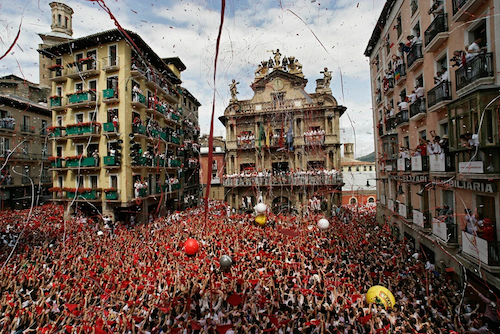
- The Running of the Bulls is a unique situation in which people are fleeing from something, in this case the bulls of course. Understanding the way that crowds of people flee from danger is important for designing escape routes and managing crowds in emergencies. Further, in these situations, there is a high degree of competitiveness – people trying to outrun their neighbor to safety. However, it is quite hard to characterize the motion of such crowds as they are often unplanned, spontaneous events and, typically, there are more pressing concerns including the safety of the people. The Running of the Bulls affords a somewhat controlled and, importantly, repeated event in which such dynamics can be studied.
- Two studies by Iker Zuriguel of the University of Navarra and his colleagues analyze the crowd dynamics of people at the running of the bulls. The first study, published in the Proceedings of the National Academy of Sciences in 2021, analyzed the dynamics of the crowd by considering the individual and collective velocities of the runners. A key concept in the study of crowd dynamics is the speed-density relationship. In normal situations, as the density of people increases, the pace at which the crowd moves slows. We are all familiar with this, as it happens all the time in our daily lives. It comes about because we are trying to avoid contact with others and thus have to slow down. However, as the density of the crowd decreases, we are all able to walk at our preferred pace.
- The Running of the Bulls offers some challenges to the normal assumptions in crowd dynamics because there is a moving threat – the bull – that causes people to act differently. In particular, as a bull comes into the field of view of the runners, both the density and the velocity of the crowd increase. In some ways, this makes sense as people start running from the bull and into one another. But it is a very different behavior than what we experience when there is no threat. And, how fast a given runner wants to run changes with time. There is no default level that they would go if no-one else was there – it depends on if the bull is there or not.
- However, there is a maximum in the speed-density relationship in that as the density gets high enough, the speed doesn’t get any faster. And this is because falls play an important role in mitigating the speed of the crowd. As people fall, they cause pileups and slow down everyone around them.
- In a second paper published in 2025 in Nature, some of the authors follow up on the first study to consider the dynamics of massive crowds compared to smaller ones. They essentially derive a model of crowds that ignores the individual “properties” of each person and instead considers the collective behavior. This is what physicist do to describe fluid flows, for example, where they ignore the individual properties of, for example, water molecules and instead describe the collective.
- Much like a physicist would do for fluids, the researchers considered the state of the crowd by considering how the density and speed of people varied with time and with position in the crowd. So, they essentially average out the behavior of individuals and turn them into a “field” that describes the local properties of the crowd.
- One of the most interesting observations is that, when the crowd becomes dense, even before the bulls are released, groups of hundreds of runners move in concert, though they have not communicated at all with one another. Different groups move in different ways, but each cluster moves together, as if they are tied together somehow.
- What’s more, the speed oscillates. That is, groups of people speed up and slow down with a frequency in time that is very regular. There is nothing to guide them or set this frequency, it comes about naturally in the crowd. The frequency in this case is about 18 seconds. Every 18 seconds, groups speed up and then slow down. Further, this motion is a swirling of groups of people within the crowd. It isn’t just them moving back and forth, but moving through the crowd. These oscillations arise because of the confinement of people: the smaller the space they are packed in, the bigger the oscillations.
- Why does this matter? The authors suggest that the frequency of motion of crowds could be monitored in real time and that as they reach a critical value, that might signal that a dangerous crowd behavior might be about to occur, such as a stampede.
A full list of all of Buber’s Basque Facts of the Week can be found in the Archive.
Primary sources: Gu, François, Benjamin Guiselin, Nicolas Bain, Iker Zuriguel, and Denis Bartolo. “Emergence of collective oscillations in massive human crowds.” Nature 638, no. 8049 (2025): 112-119. Parisi, Daniel R., Alan G. Sartorio, Joaquín R. Colonnello, Angel Garcimartín, Luis A. Pugnaloni, and Iker Zuriguel. “Pedestrian dynamics at the running of the bulls evidence an inaccessible region in the fundamental diagram.” Proceedings of the National Academy of Sciences 118, no. 50 (2021): e2107827118.
Thanks to my colleague Anton Schneider for pointing me to these papers.