
by Sancho de Beurko Association
Pedro J. Oiarzabal and Guillermo Tabernilla are the principal investigators of the research project “Fighting Basques: Basque Memory of World War II” of the Sancho de Beurko Elkartea in collaboration with the North American Basque Organizations (NABO). The present article derives from the “Fighting Basques” project.
Oiarzabal received his Doctorate of Political Science-Basque Studies from the University of Nevada, Reno. Over the last two decades, his work has focused on research and consulting on public policies (citizenship abroad and return), diasporas and new technologies, and social and historical memory (oral history, migration and exile), with special emphasis on the Basque case. He is a member of Eusko Ikaskuntza.
Tabernilla is a researcher and founder of the Sancho de Beurko Elkartea, a non-profit organization that studies the history of the Basques of both slopes of the Pyrenees in the Spanish Civil War and in World War II. Between 2008 and 2016 he directed the catalog of the “Iron Belt” for the Heritage Directorate of the Basque Government. He is author, along with Ander González, of Basque Fighters in World War II (Desperta Ferro, 2018).
In recent weeks, one family contacted Sancho de Beurko, a nonprofit historical association based in the Basque Country and responsible for the “Fighting Basques” research project, asking about relatives lost during World War II. Beyond a few names and fragmented recollections, very little about them had survived within the family over the decades.
What followed became an unexpected reminder of how the past can suddenly reappear years later — reconnecting people with stories, places, and lives that had slowly faded over time.
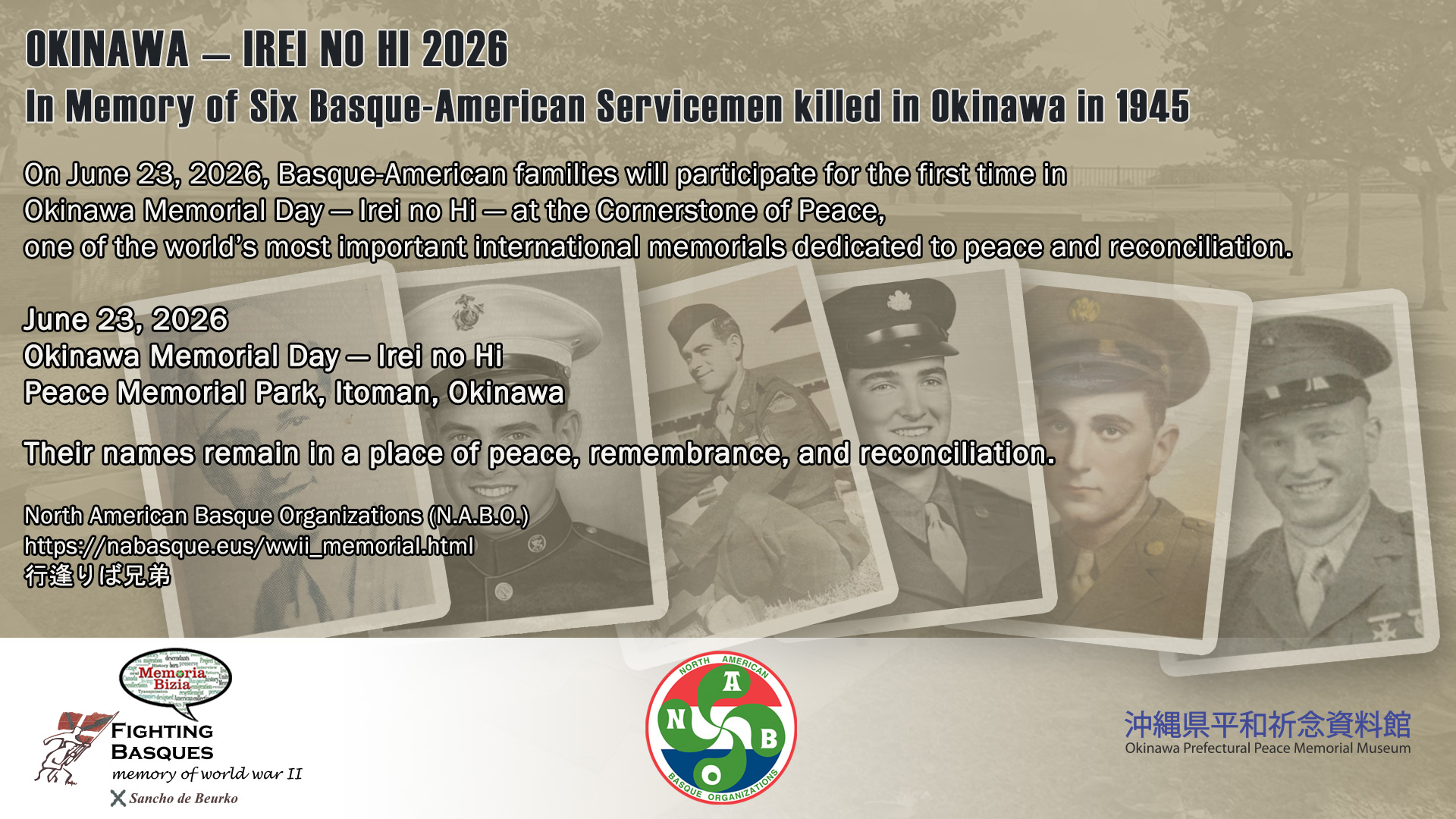
That same process will soon bring to Okinawa (Japan) relatives of six Basque-American servicemen who died during and after the Battle of Okinawa, who will participate for the first time in Okinawa Memorial Day — Irei no Hi (慰霊の日) — on June 23, 2026.
Dr. Pedro J. Oiarzabal, lead researcher of “Fighting Basques,” will attend on behalf of Sancho de Beurko Association and the North American Basque Organizations, Inc. (N.A.B.O.).
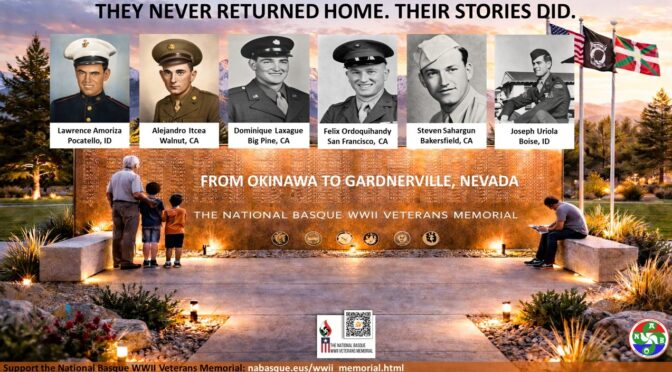
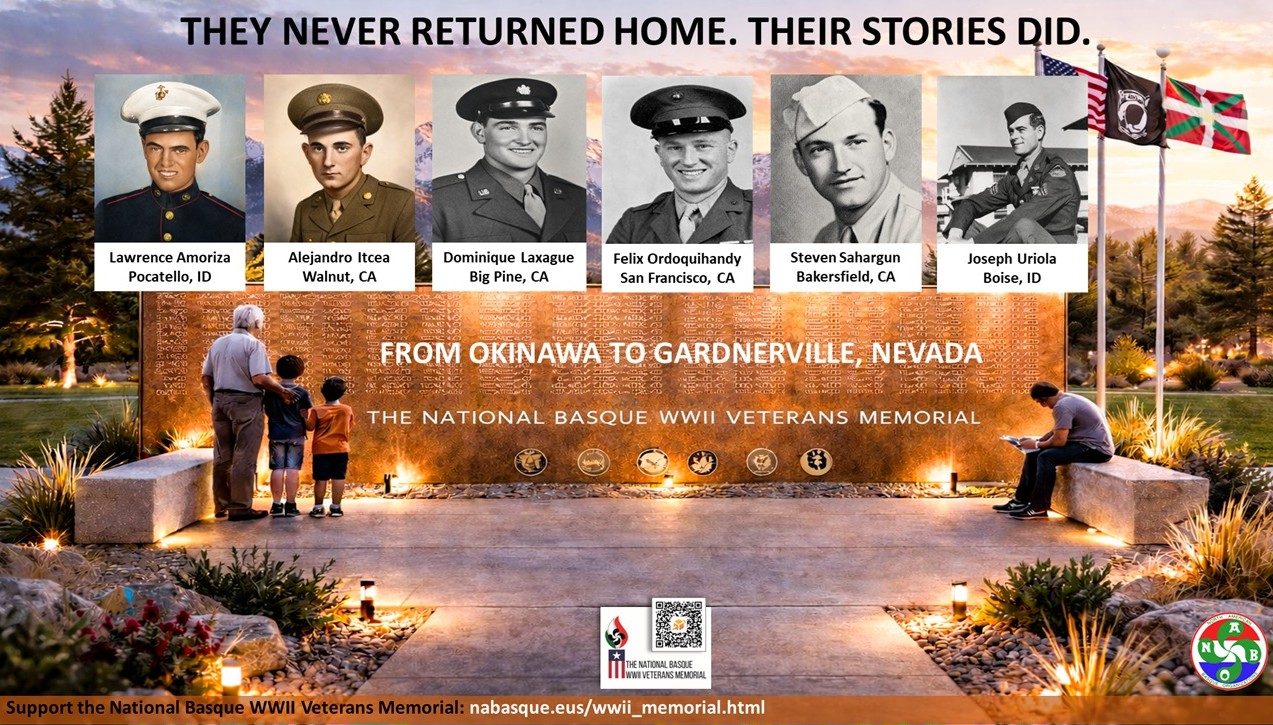
The six Basque-American servicemen connected to Okinawa were: Lawrence Amoriza, Alejandro Itcea, Dominique Laxague, Felix Ordoquihandy, Steven Sahargun, and Joseph Uriola.
Eighty-one years after the battle, the journey represents far more than a commemorative trip. For the families, it is a chance to visit the place where their relatives’ lives ended abruptly, bringing personal history into direct contact with one of the most important sites of remembrance and reconciliation associated with World War II.
Held annually at the Cornerstone of Peace, Irei no Hi commemorates the end of the Battle of Okinawa — the final major campaign of World War II and one of its deadliest — and honors more than 240,000 people who perished during the campaign, including over 14,000 Americans and at least 100,000 Okinawan civilians whose names are memorialized at the site.
From Remembrance to Human Connection
The origins of this journey go back to December 2023, when Dr. Pedro J. Oiarzabal traveled to Okinawa on behalf of Sancho de Beurko and N.A.B.O. to pay tribute to Basque-American soldiers who died in the Pacific Theater during World War II.
That initial visit, carried out within the framework of the “Fighting Basques: Memory of World War II” research project, marked the beginning of an ongoing relationship with the institutions connected to Okinawa’s Peace Memorial Park and the Cornerstone of Peace.
Over time, what began as an act of remembrance gradually evolved into something much broader and more human.
People reconnected with relatives whose stories had vanished. Forgotten personal histories resurfaced. New connections also emerged between Okinawa, the Basque Country, and the Basque-American diaspora.
As part of this ongoing work, one of the six servicemen, U.S. Marine Corps Corporal Felix Ordoquihandy, whose name was not yet included at the Cornerstone of Peace, will be formally inscribed ahead of the June 23 commemorations. In addition, the inscription of another serviceman, U.S. Army Private First Class Alejandro Itcea, will be updated to ensure that his name is accurately represented at the memorial.
This year’s participation in Irei no Hi will also mark the first formal Basque presence at one of the world’s most important annual commemorations dedicated to peace, remembrance, and reconciliation. During their stay in Okinawa, Dr. Oiarzabal will also participate in gatherings and conversations centered on diaspora, historical memory, and the human connections that continue to emerge more than eight decades after World War II.
Six Young Lives
They were not a group brought together by design, but by circumstance — and by war.
Lawrence Amoriza, Alejandro Itcea, Dominique Laxague, Felix Ordoquihandy, Steven Sahargun, and Joseph Uriola.
Six Basque-American soldiers whose lives ultimately converged in Okinawa.
Five of them were sons of Basque immigrants who had arrived in the United States in the early decades of the 20th century to build new lives in the American West. The sixth was a grandson of immigrants. Their families came from both sides of the Basque Country — Bizkaia and Nafarroa in the south, Nafarroa Beherea and Zuberoa in the north.
They grew up in California and Idaho, in farming communities, ranches, and small towns shaped by migration and hard work.
Four served in U.S. Army infantry units. Two were Marines of the 5th Regiment of the 1st Marine Division — one of the most heavily engaged units in the Pacific.
Some had already seen combat across the Pacific — from the Aleutians to Kwajalein, Leyte, Tarawa, and Saipan. Joseph Uriola, from Boise, Idaho, had already fought in multiple campaigns and was awarded the Bronze Star for saving the life of a fellow soldier. Steven Sahargun, from Bakersfield, California, had taken part in some of the most intense battles of the war before arriving in Okinawa.
Felix Ordoquihandy, a Marine from San Francisco, survived fierce combat in the Pacific, including Okinawa, but did not die in battle. Instead, he died in a tragic accident at sea after the fighting had ended. His body was never recovered.
Others, however, arrived in Okinawa with no prior combat experience.
Dominique Laxague, Lawrence Amoriza, and Alejandro Itcea were part of a replacement sent directly from training into one of the most brutal battlefields of World War II.
For them, Okinawa was their first battle.
And their last.
On average, they were just over 21 years old when they died.
Among them were Lawrence Amoriza and Alejandro Itcea — two of the youngest and least experienced, whose stories help us understand the lives behind these six names.
Lawrence Amoriza
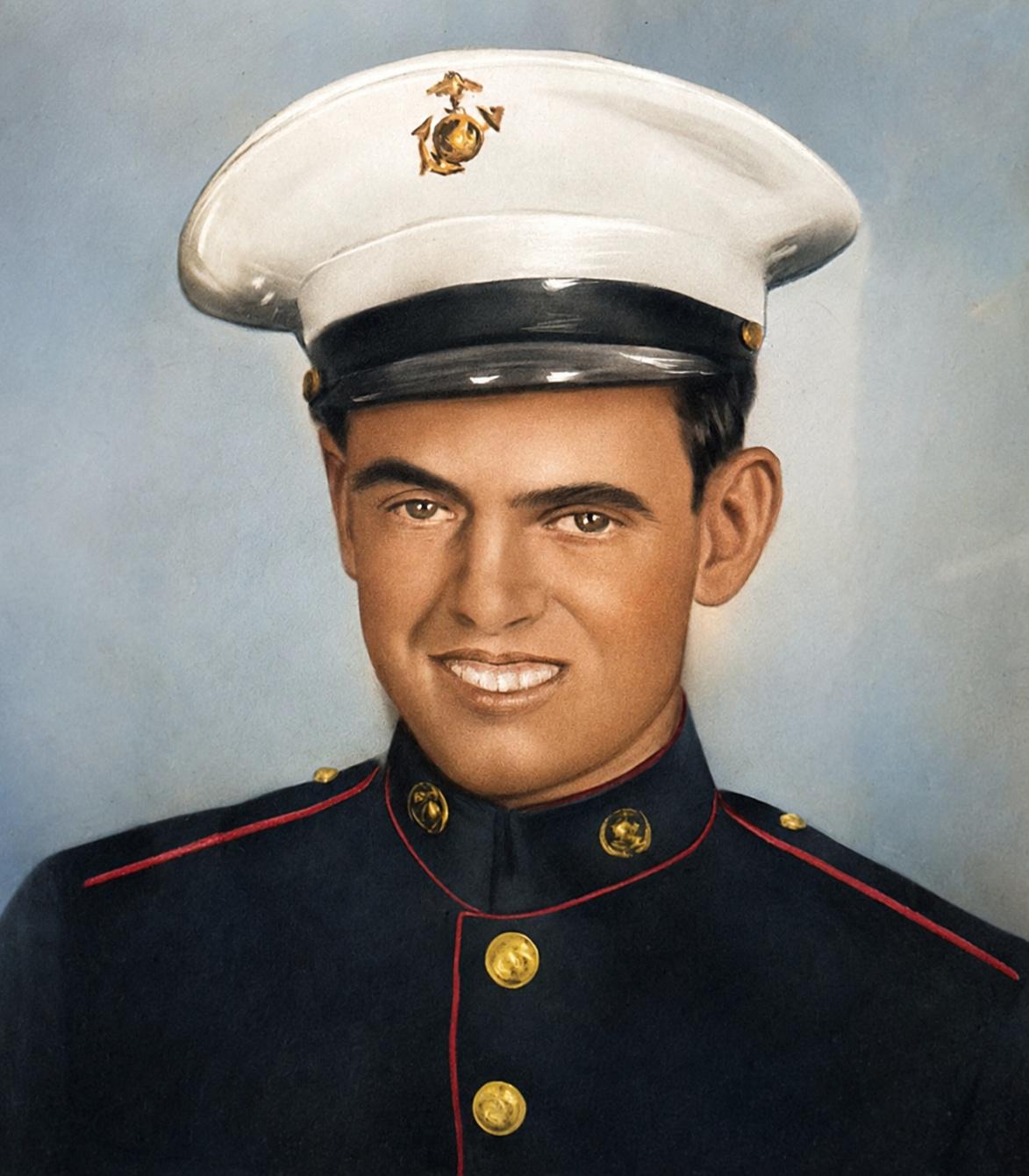
Lawrence Amoriza was born in 1925 in Pocatello, Idaho, to Basque immigrant parents from rural Bizkaia. His father, Tomás “Thomas” Amoriza Zubero, arrived in the United States in 1916 at the age of eighteen. His mother, Asunción Guerricagoitia Bengoechea, followed a few years later. Like many Basque families of that generation, they built their lives through agricultural labor — first as sheepherders, later as farm workers.
When Lawrence was still a child, his mother passed away. His father moved the family west to California, where they continued working the land.
By the early 1940s, Lawrence was already working alongside his father and siblings.
At 18, he was drafted into the U.S. Marine Corps. By April 1945, he was already in Okinawa, serving with the 1st Marine Division.
On May 1, 1945, Lawrence was killed in action while his unit was engaged in heavy fighting in the Awacha (Ahacha) Pocket, south of the town of Ahacha (安波茶).
He was 19 years old.
His brother, Thomas, had joined the U.S. Army Air Forces in 1943 and was honorably discharged in 1946. He would survive the war.
Alejandro Itcea
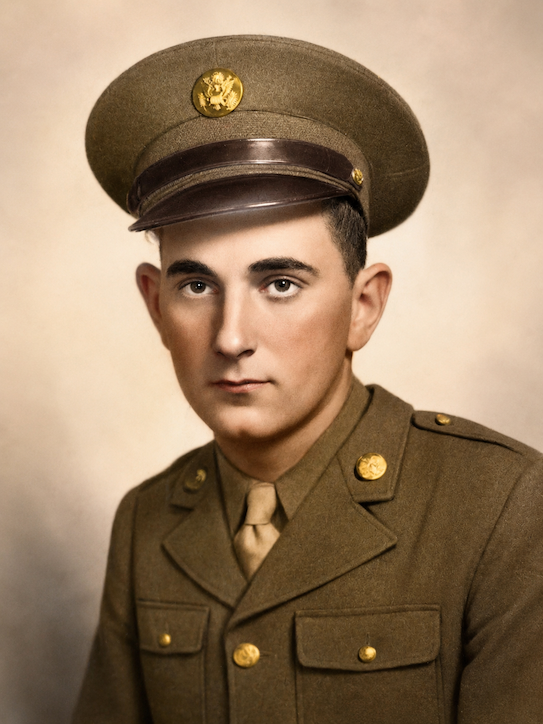
Alejandro Itcea was born in 1922 in Walnut, California, to Basque immigrant parents from Nafarroa. His father, Pablo Itcea Ariztia, arrived in the United States in 1911. His mother, Paulina Zualet Ithurria, followed in 1920.
Alejandro grew up working on the family’s cattle ranch and barley farm. He graduated from La Puente High School in 1942. He was engaged, and like many others of his generation, his life was soon interrupted by war.
In 1944, Alejandro enlisted in the U.S. Army.
Soon after, he was sent overseas — first to Hawaii, then to Saipan, and finally to Okinawa.
On May 30, 1945, after being wounded in combat during prolonged fighting under harsh conditions, Alejandro died of his injuries.
He was 22 years old.
Alejandro was posthumously awarded the Bronze Star.
What Remains After Okinawa
What will take place in Okinawa this June is not simply a commemorative event tied to the past.
In many ways, it reflects something much deeper: the enduring human need to reconnect names with lives, families with their past, and history with the people who continue carrying those memories forward across generations.
For the relatives of these six Basque-American servicemen, the journey to Okinawa represents far more than a formal ceremony. It means standing in the place where their loved ones spent the final moments of their lives — transforming distant family stories into something tangible and profoundly personal.
But Okinawa also speaks to something larger.
Over the past decade, the “Fighting Basques: Memory of World War II” research project, developed by Sancho de Beurko and carried out in collaboration with N.A.B.O., has identified more than 2,160 men and women of Basque descent who served in the U.S. Armed Forces and Merchant Marine during World War II.
The six servicemen connected to Okinawa are part of that much broader history — one shaped by migration, war, sacrifice, family separation, survival, and remembrance over time.
In that sense, Okinawa is not an isolated chapter. It is part of a much longer process centered on recovering, preserving, and bringing visibility to personal histories that risk disappearing over the years.
That same spirit continues today through the future National Basque WWII Veterans Memorial planned in Gardnerville, Nevada — the first national memorial in the United States dedicated to Basque and Basque-American World War II veterans.
Separated by thousands of miles, the Cornerstone of Peace in Okinawa and the future memorial in Gardnerville ultimately share the same essential purpose: ensuring that the lives behind war are never reduced to statistics, dates, or forgotten names.
As families prepare to gather in Okinawa in a few days, what remains most meaningful is perhaps not only the act of remembrance itself, but the realization that these stories continue to matter because they remain connected to real people and lived experiences.
Making the National Basque WWII Veterans Memorial a reality will ultimately depend on the continued support of families, organizations, institutions, and individuals committed to preserving the stories and legacy of this generation into the future.
Those interested in supporting the project can contribute here:👉 https://my.cheddarup.com/c/national-basque-wwii-veterans-memorial/items
Good to know our people defended Freedom and América as they saw it at the time, honestly and to the best of them.
All Americans, from all backgrounds defended America. Visit the American Cemetery in Normandy.
May they all rest in peace.
Monique