
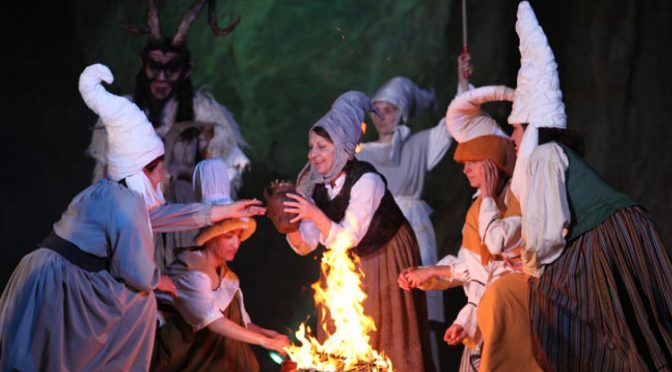
To me, one of the fascinating aspects of Basque history relates to witches. The Basque witch trials are infamous for how indiscriminate they were but also because they reveal how mob mentality can easily turn neighbors into enemies and outcasts into villains. Witches in the Basque Country represent this interesting transition between the autochthonous religion of the Basques and its supplantation by Christianity. Witches were a vestige of the old ways.
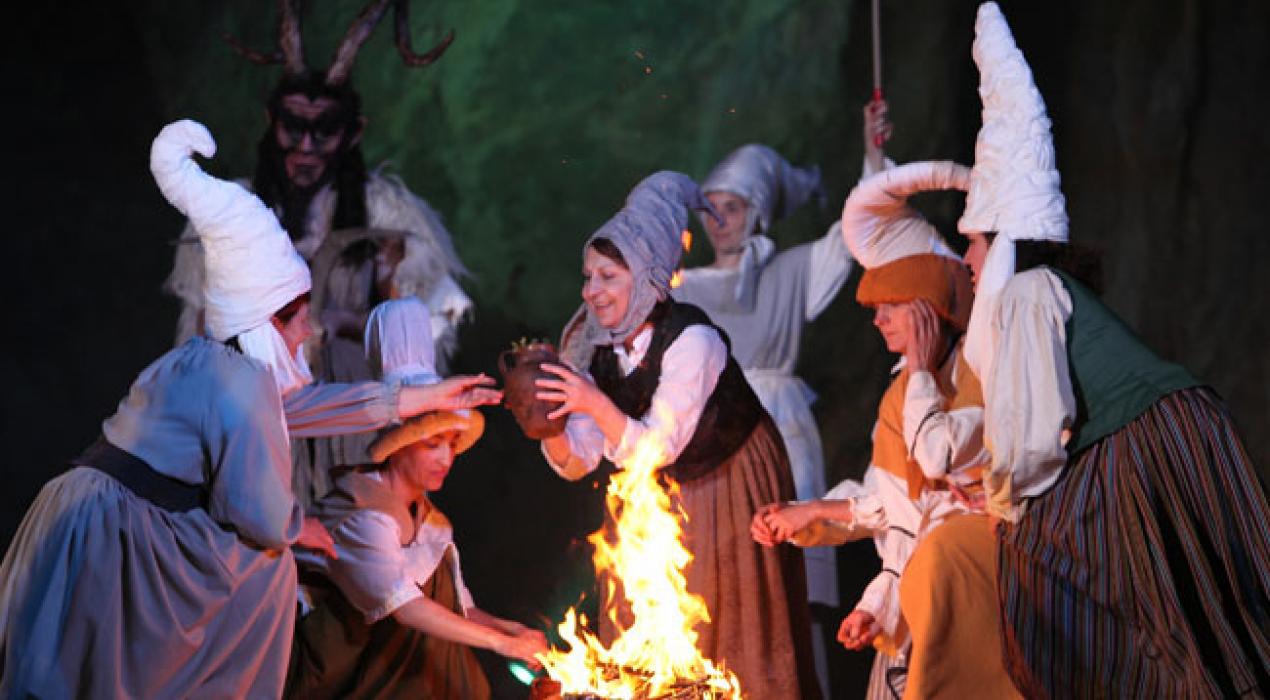
- The sorginak have two roles in Basque mythology. Originally, the attendants and assistants of Mari, the Basque mother goddess, were called sorginak.
- The other sense of sorgin is witch. Sorginak were men and women who practiced various activities that had their origins in pre-Christian times. These activities ranged from gathering and preparing medicinal herbs to casting spells to protect or damage crops. In this sense, they often performed white magic – making potions and casting spells that were meant to benefit people. As the Church and Christianity grew, these types of practices were fined but not punished more severely.
- Sorginak would gather together to worship Basque deities such as Mari and Akerbeltz, a black he-goat that was associated with fertility. These gatherings were called akelarreak.
- It wasn’t until later – sometime in the 13th or 14th centuries – that witchcraft was associated with black magic and demonology. Now, those same practices were punished much more severely, including death, often by burning at the stake. Thus, in 1329, Joan the Leper was accused of being a herbalist and necromancer and, with four other women, burned at the stake.
- Thus, practices that were maybe frowned upon but tolerated became associated with evil and the devil. Religious authorities, such as Pierre de Lancre, cast the gods that the sorginak might have worshipped as demons and agents of Satan. The resulting persecution of witches was devastating for the region. However, the acts they were charged with, as discussed by Emma Wilby in her book Invoking the Akelarre, grew out of the practices of healing and herbalism that were common in the Basque Country.
- Despite this, ancient practices in herbalism didn’t disappear. Martija de Jauregui was practicing what we would call traditional medicine in the late 1500s. In the 1700 and 1800s, healers and herbalists still practiced and in some cases were given contracts from the town councils to care for the neighborhood, animals, and fields of the town. Indeed, Basque military leader Tomas Zumalakarregi was being attended by such a healer when he died in 1835.
- We don’t fully know what the word sorgin means. -gin is a common Basque suffix meaning “one who does,” coming from the Basque verb egin, to do. Most scholars agree on this. Where there is less certainty is what sor- means. It may come from the Latin sorte, or luck, or from the Basque sortu, which means to create. So, alternatively, sorgin might mean fortuneteller or creator.
- In Zuberoa, other names for sorginak include belagile and sorsain. Belagile literally means herbalist, from the Basque words belar, meaning “herb,” and gile, meaning “one who works with.” In contrast, a sorsain, literally “protector of childbirth,” has supernatural powers. These two words highlight the origins of sorginak and witches in traditional health care.
A full list of all of Buber’s Basque Facts of the Week can be found in the Archive.
Primary sources: Sorginak, Wikipedia; Sorgin, Wikipedia; Estornés Zubizarreta, Idoia. Brujería. Auñamendi Encyclopedia, 2025. Available at: https://aunamendi.eusko-ikaskuntza.eus/en/brujeria/ar-33837/
Share this / Partekatu hau:

Discover more from Buber's Basque Page
Subscribe to get the latest posts sent to your email.
Greetings,
The writing of Pierre de Lancre is available for download. It is written in French– the French of that period and in Latin. I also read the interview of Emma Wilby. The writing of Lancre is available in translation.
I may be wrong but when I read the posts and the interview of Emma Wilby, I asked myself, not to defend lancre, if it is about the writing of Lancre? Lancre hardly mention the Basque region in his writing.
All in all , it is fascinating because it is so bizarre.
Monique Durham