
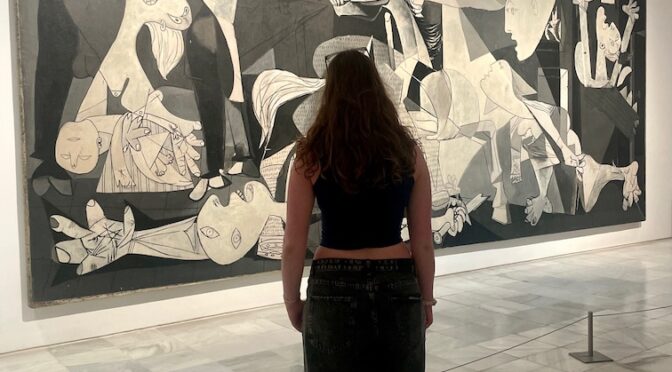
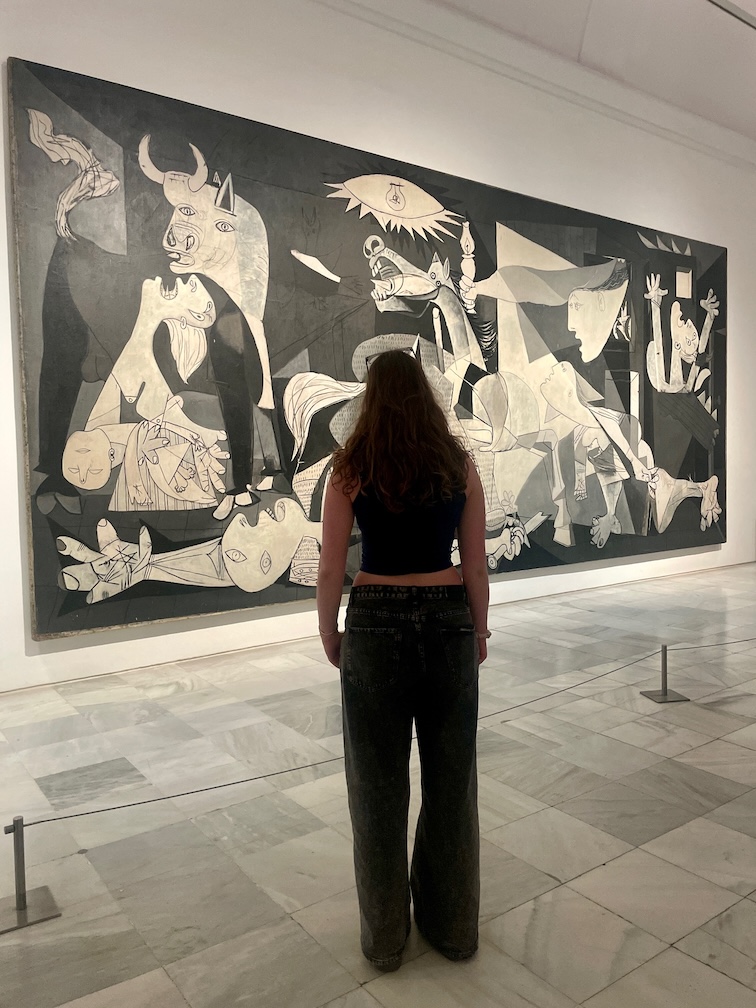
Today marks the 89th anniversary of the bombing of Gernika. Last month, in March, we made a quick trip to the Basque Country over spring break to visit my dad’s family and made of point of seeing Picasso’s Guernica. As we near the 90th anniversary of the bombing, the painting is once again in the news as the Basque government has requested that the painting be loaned to the Basque Country. This request has been denied, based on arguments that the painting is too fragile.
- Gernika sits at a crossroads, centrally located between the cities of Lekeitio, Nabarniz, Markina, Amorebieta, and Mungia and Bermeo. Every Monday, the city hosted a market and fair which would draw residents of nearby towns; more than 10,000 people typically attended the market. There were few military targets in Gernika: the bridge and the arms factory.
- At 4:30pm on April 26, 1937 – a Monday – planes from the German Condor Legion and the Italian Air Force began bombing the city. George Steer, a journalist who arrived in Gernika the day after the bombing, took accounts from the survivors and sent the first account of the bombing to the international press.
- Some air raid shelters had been established as a response to the bombing of Durango only about a month before. As church bells pealed out a warning of an air raid, people fled to find shelter, leaving their livestock in the market square. Two planes flew over and dropped bombs and incendiary devices. As the aircraft flew overhead, machine-gun fire strafed the people running in the streets.
- After that, nothing happened for about 15 minutes and the people began emerging from their shelters when another group of bombers flew overhead, dropping more bombs that then exploded. The streets filled with fire and smoke. Some of these bombs were one thousand pounds and penetrated through buildings and into basements and shelters. As the panicked populace again emptied to the streets to flee, more planes strafed them with more machine-gun fire.
- This continued until about 7:30pm, by which time nearly the entire city was ablaze. The Church of San Juan had a hole in its roof where a bomb had penetrated, setting the altar ablaze.
- The immediate aftermath of the bombing was a series of denials and accusations from both Franco and the German government. While they acknowledged that Gernika had been a military target, poor visibility led to some stray bombs that hit the city itself and that then the Basque “Reds” deliberately set the city ablaze. However, the discovery of Wolfram von Richthofen‘s diary (von Richtofen was commander of the Condor Legion), which were made public in the 1970s, confirmed the bombing and the tactics used. At the Nuremberg trials, Herman Göring said that Gernika was “a sort of test bed for the Luftwaffe” and that it was an experiment that “could not be conducted anywhere else.”
- The plans to bomb Gernika, while gestating for some time, were finalized in a meeting the day before, on April 25, in Burgos. It is hard to know precisely who was involved, but at least Richthofen and the Spanish fascist leaders Juan Vigón, Emilio Mola and Franco were involved in the planning. Richthofen and Italian general Vellani were at the Burgos meeting, though Mola was elsewhere.
- The number of people who died in the attacks is hard to pinpoint as there are many figures out there, but they range from a minimum of 153 to more than 1500. Xabier Irujo’s analysis points to the higher number, or even more than 2000 dead. The bombing received international attention as it was one of the first aerial bombardments of a civilian population. However, it wasn’t the first: several Basque towns had been bombed earlier in the war, including Munitibar and Durango.
A full list of all of Buber’s Basque Facts of the Week can be found in the Archive.
Primary sources: Castaño García, Manu; Editorial Auñamendi. Gernika-Lumo. Auñamendi Encyclopedia, 2026. Available at: https://aunamendi.eusko-ikaskuntza.eus/en/gernika-lumo/ar-57197/; Bombing of Guernica, Wikipedia