
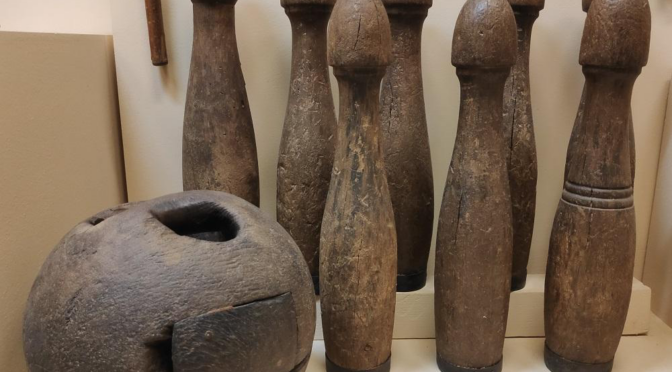
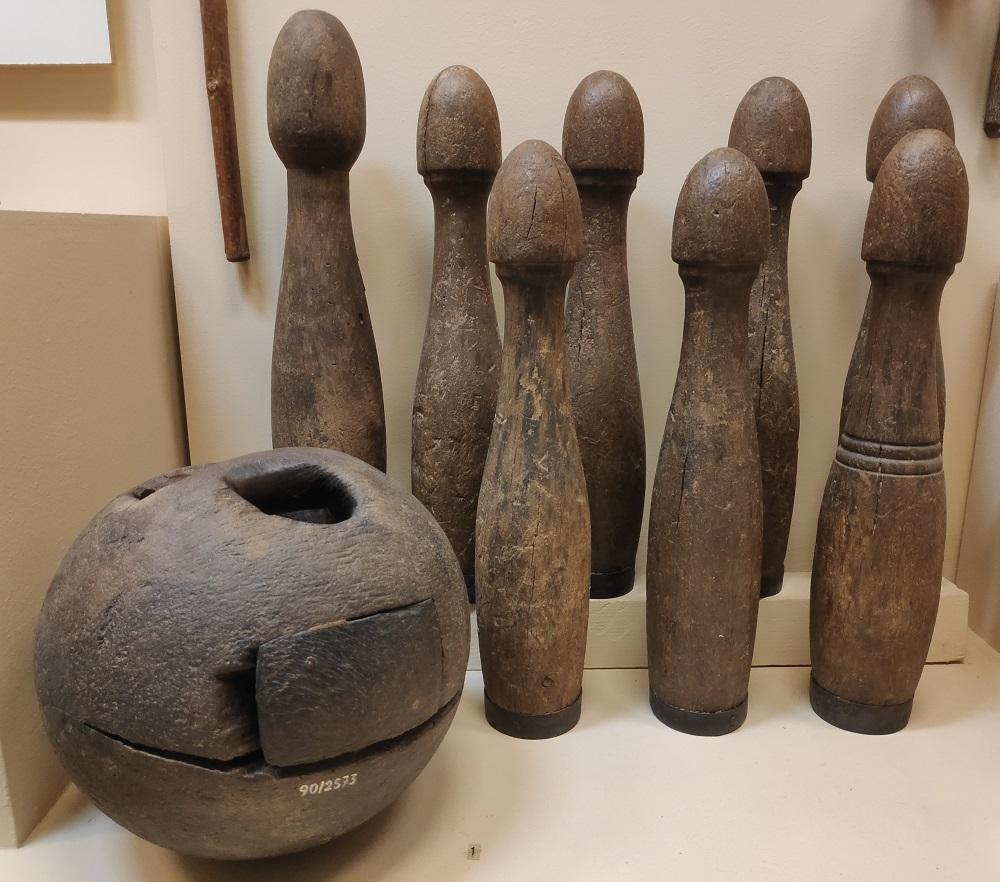
We were recently in Boise to celebrate my daughter’s high school graduation with her grandparents (Zorionak Rose!) and while there stopped by the Cyrus Jacobs/Uberuaga house – if you’ve never been there, it provides a great look into a Basque boarding house. In any case, there was a small exhibit on bola jokoa, or the Basque version of bowling (or skittles). Color me intrigued, I had to look a little deeper into the game.
- Bola jokoa is one of the few rural sports that isn’t directly inspired by the labors of the farm or the sea. Instead, it is an ancient game, dating back to at least ancient Egypt. Likely, it was invented independently several times around the world. In the Basque Country, it was often played on Sundays after Mass.
- Records attest to forms of bola jokoa being played at least since the Middle Ages in the Basque Country, though most of those mentions are negative, condemning the game. For example, in 1571, the city of Lekeitio banned bowling. Other places banned bowling in the streets or on certain feast days. However, the game was very popular and bowling alleys were common, often attached to sagardotegis or cider houses. The game also ignited passions. It was a popular betting sport and fights often broke out.
- As might be expected, back then, while there were formal rules written, oftentimes they varied significantly from region to region. The types of bowling pins, the nature of the ball, and even the layout of the alleys were different. Similarly, lots of different names are used for the different elements of the game. The pins are called, amongst other names, txirlo, birlo, pirla, pirle, birla, brila, and txirla while the alley itself is called bolatoki, bolaleku, karrejo or boladera.
- Over time, these different versions of bowling led to three modalities that are commonly played today. These are primarily classified according to the ball. The three-holed ball is much like what is found in bowling alleys across the United States with one hole for the thumb and two holes for fingers. The hand-holed balls have two holes, one for the thumb, and one for the rest of the fingers to fit into. And then there is a version with no holes, in which the ball is simply held.
- It wasn’t until the 20th century that the rules started to become standardized, though versions without formal rules are still played all across the Basque Country. The first tournament in the Basque Country was held in Vitoria-Gasteiz in 1945; players from all over Araba participated.
- The Euskal Herriko Bola Joko federazioa – or the Basque Country Bola Joko Federation – which was founded in 1986, officially recognizes 13 different variations of bola jokoa. Wikipedia lists some 28 versions played throughout the Basque Country. Not all of these are native to the Basque Country. Typically, only one type is played in a given place.
- Today, the game, perhaps like bowling in the United States, is not as popular as it once was. It is only played on special occasions. And many bowling alleys have disappeared.
A full list of all of Buber’s Basque Facts of the Week can be found in the Archive.
Primary sources: Bola jokoa/El juego de bolos, Juan José Zorrilla López; Bola joko (herri kirola), Wikipedia