
Before radar, satellites, and phones, people still needed to communicate important news, such as a whale off the coast or the approach of some enemy ship. The Basques set up a whole network of atalayas and señeros to alert each other. But, you had to be careful – you didn’t want the neighboring town to know you had just seen a large school of fish or a whale, you wanted to keep that to yourself. So this led to a sort of cat-and-mouse game in which you would put your watchtower so that you could see as much as possible but your signal station was hidden so only your town could see it.
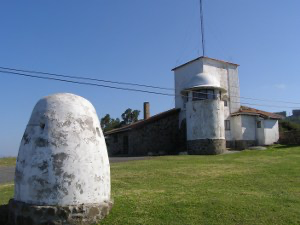
- Talaias (Euskara) or atalayas (Spanish) are the watchtowers. These are high points in the local terrain which served as lookouts. A watchman, a talaidxerue, was tasked with watching the horizon, primarily looking for schools of fish or whales. However, they also watched for commercial boats, particularly those that might need towed into port, and storms (before more advanced meteorological techniques were developed).
- A señero (Spanish) or señeroa/seinale-lekua (Euskara) was a place – a platform, facility, or simply a post – where signals could be sent. These worked in concert with the atalaya. When the talaidxerue saw, for example, a school of fish, he would alert the señero who would then send the message to the town or the boats in the sea. During the day, this was usually via smoke and at night by bonfire. Often, señeros were not standalone stations, but they were part of other, already existing structures or facilities, such as hermitages.
- Together, the talaiak eta señeroak or atalayas y señeros also helped with the local economy. They might direct foreign ships laden with goods to less saturated ports where better prices could be found.
- These watchtowers also competed in some sense with one another. They were placed such that they could see the greatest territory, the most ports and other watchtowers, so that they could gather the most information. However, at the same time, they tried to obscure their own location so that others could not benefit from their own information.
- While whaling is attested as far back as 1200 in Mutriku, the oldest mention of an atalaya dates to 1301 in Bermeo. This particular watchtower transmitted messages from other watchtowers such as in Matxitxako, Izaro and Ogoño. However it, like many other watchtowers, has faded with time and there is little left of most. All traces of this particular one have vanished, and most others have at most a few steps carved into the rock or a pedestal of sandstone to mark where they once stood.
- In the 20th century, these watchtowers evolved into large concrete structures, or maritime observatories.
A full list of all of Buber’s Basque Facts of the Week can be found in the Archive.
Primary sources: Los ojos del mar: atalayas y señeros del país vasco, Ondarea; Atalayas y Señeros, Urdaibai.org