
 In 1991, I went to Euskal Herria to learn Euskara. My dad is from Munitibar, and my mom’s grandparents were from Leikeitio (her grandma) and Mutiloa (her grandpa). While of course my dad was fluent in Euskara, my mom hadn’t had the opportunity to learn. Her dad, while born and raised in Oregon, also knew Euskara though he had never visited the land of his parents. Long story short, I didn’t learn any Euskara as a kid, so I thought to go to Euskal Herria and see what I could learn.
I attended the University Studies Abroad Consortium’s program in Donostia, where I took an intensive course in Euskara. My teacher was Nekane, an euskaldun-berri who did an admirable job of teaching her three students Euskara (though I could be, at times, a difficult student). (I’ve learned that Nekane passed away a few years ago.) She taught us Batua and every weekend I went to visit my dad’s family, in Ermua and Munitibar, where they speak Bizkaian. On evenings I wasn’t with family, struggling to apply my Batua to understand Bizkaian, I spent my time with other Americans in the program, who had gone to learn Spanish, and played foosball in the local bar.
So, I didn’t learn too much. I got some basics, some words, some phrases, but nothing that got me to the point of being able to hold a conversation. So, whenever I see any type of online course, I’m at least intrigued, hoping that I can try to improve. So far, I haven’t done anything yet, but I keep hoping.
This is a long segway to mentioning two new efforts for learning Euskara online. The first, provided by Gorka Bakero, is an English course he has developed and made into a PDF document. Gorka has also provided a forum for Euskara students to find one another and practice. Eskerrik asko Gorka!
The second is Ikasten.net. Ikasten.net is a part of Hiru.com, a resource for Euskara. Ikasten.net is an online course of sixty lessons. The course seems to be in Spanish, though I was unable to register as it asks for my “DNI” number, which makes me wonder if the site is for Spanish citizens only. I’m not sure. But if anyone knows more, I’d appreciate hearing about your experiences.
A few other courses (though badly organized) are on the Euskara page. If anyone else has a favorite online Euskara course, please share!

 Nothing beats a good hard cider. My understanding is that, before the invention of refridgeration and the ability to import from long distances, the Basques made their alcohol out of what they had at hand, apples. There is a lot of mystique surrounding the sagardotegiak, the places where sagardoa — hard cider — is made. For example, it is said that the txalaparta — the Basque percussion instrument comprised of a few wooden planks on which two players beat out rhythms — was originally used to announce that the current batch of sagardoa was ready for drinking from one valley to the next. The sagardotegi itself is a very special place. I visited one just outside of Donostia in 1992. We all stood at a bar-like table, where we were served steak cut up into bite-sized pieces, among other things. Every once in a while, someone would shout out a call, and everyone would get in line in front of one of the humongous wooden barrels. The tap is opened and a stream of cider flows out. One by one, we went up to the barrel and held our glass under the stream to get a frothy serving of cider. This happened several times during the night. The stuff is a bit bitter, it isn’t sweet at all, not like the typical “apple cider” most Americans would think of. It is definitely an acquired taste, but one that is definitely worth acquiring.
 Another Basque specialty is txakoli, a white, dry wine with a distinct taste. Unfortunately, while I’ve definitely partaken of txakoli, I never did acquire a taste for wine in general or txakoli in particular. So, I am not someone to comment on the uniqueness and intricacies of txakoli. So, instead, I’ll just point you to a few relevant links.
 Ahizpak. Sisters. Clearly a good description of Izar and Maite, two sisters who are immensely talented artists. Ahizpak is also the name of their joint studio, in which they showcase their work. Including sculpture, paintings, carvings, jewelry and more, they take their inspiration from their Basque heritage, incorporating Basque motifs such as the lauburu, Euskara, and dance. You will find them at any Basque gathering in Boise or the surrounding areas. You will also find their work at other events, contributing pieces for fundraisers for local businesses, such as the Basque Christmas tree they did for a hostipal in Boise.
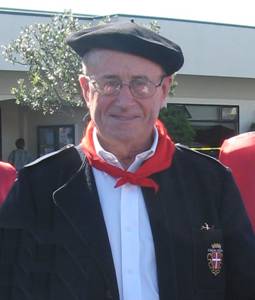 I only met him a few times, in Seattle, in Boise, in Homedale, but he made a lasting impression. Always with a smile and with his txistu at hand, Aita Martxel Tillous always added something special to any Basque gathering, even if it was a bunch of northwesterners gathered in a hay barn, doing their best to recreate something of the Basque Country in the countryside outside of Seattle. All who met him always remembered him.




 Andy Franco recently learned of his Basque roots and, since then, he has really immersed himself into all things Basque he could. A blacksmith, who owns Calico Forge in Nampa, Idaho, he was an integral part of the recent exhibit at the Basque Museum in Boise on Basque whaling. Andy forged the harpoons and other implements, including the lamps, that are part of the display. He has also contributed to local fundraisers, making some beautiful lauburus and other Basque-related items, some of which are also for sale at the gift shop at the Basque Museum.