
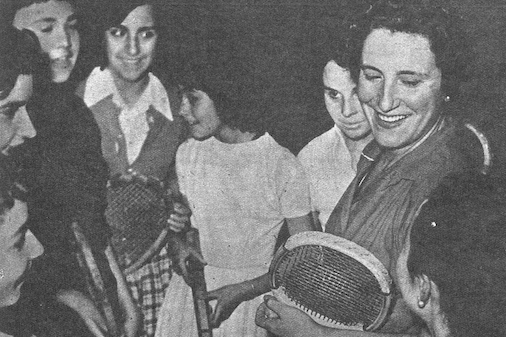
Last week I wrote about the women Erraketistak, professional racket ball players that were pioneers in the world of women’s sport. One of the very best to ever play was Maria Antonia Uzkudun, also known as Txikita de Anoeta. She began playing professionally at the age of 13 and had a stellar career that took her across Spain and to Mexico and Cuba until her retirement in 1967.
- Maria Antonia Uzkudun Amunarriz, professionally known as Txikita (or Chiquita) de Anoeta, was born in 1927 in Anoeta, Gipuzkoa. Not much is known about her childhood (or at least, I couldn’t find much). She was born in a baserri and as a child she played handball in her hometown. In fact, she always had a pelota – or ball – in her pocket so she could play whenever she got a chance. She was the youngest of 13 children.
- In 1941, at the age of 13, she was playing the pala variety of pelota – or better said, a version using a tennis-like racket instead of the wooden ones often seen – professionally, making her debut in the city of Salamanca. In fact, she falsified her vital records, lying about her age, so that she could begin playing, as the minimum age to play professionally was 14. This was only a few years before the Spanish government banned new licenses for professional women racket players.
- In Salamanca, she earned a monthly salary of some 1000 pesetas, which was remarkable considering that the average salary for a professional player was 300-400 pesetas. However, she only stayed in Salamanca for 6 months before moving to Madrid where she played much of her career. By 1946, she was making 500 pesetas per match.
- Her career took her around the world, playing all over Spain as well as in Mexico and Cuba. She ended her career in 1967 at the age of 40, retiring in Madrid, where she died in 2008.
- Txikita de Anoeta was considered one of, if not the, best players in the world. She played the back position, but sometimes played by herself against a pair of opponents.
- She rose to international fame. In Mexico, she was often called upon to present awards and prizes, ranging from horse races to literary awards. When she went to Mexico, she was met at the airport by a mariachi band – in the words of her daughter, she was “sort of a diva.”
- Despite the negative view Franco’s government had of women’s sport, she was still awarded the Medal of Sporting Merit. This was but one of many accolades she received. She was on the cover of many magazines and publications. She was so famous that a pasodoble was composed in her honor, which described her game as a blend of “grace with emotion.”
A full list of all of Buber’s Basque Facts of the Week can be found in the Archive.
Primary sources: “Ama de casa de día, raquetista de tarde”: la increíble historia de unas “adelantadas a su época” by Iñigo Corral, El Confidencial; Txikita de Anoeta pionera de la pelota vasca, Onda Cero; El debut de ‘la Messi de los frontones’ by Roberto Zamarbide, La Gaceta; Maria Antonia Uzkudun, Wikipedia