
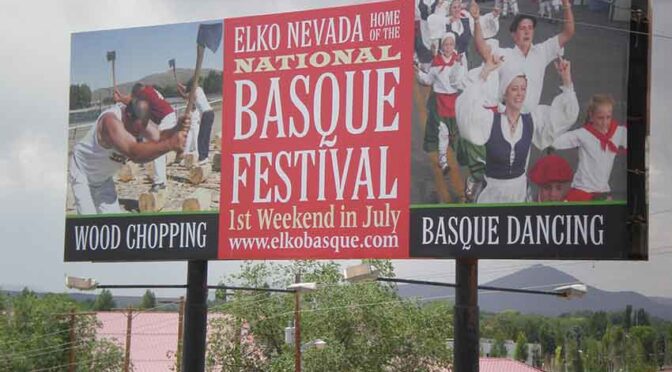
The season of Basque festivals in the western United States is upon us. All across the west, Basque clubs and communities hold celebrations of Basque culture and history, recognizing their ancestors who braved unknown lands to build a better life for themselves. Elko, Nevada, hosts one of the largest Basque festivals in the country, second only to Boise’s Jaialdi. It is also one of the oldest. If you are looking for Basque flavor this summer, check out Elko!
- Elko sits in the northeast corner of Nevada. At one time it was the eastern most part of the California-Utah portion of the first transcontinental railroad. Thus, its roots as a settlement date back to 1868. When the railroad crews left, the settlement remained and grew into modern day Elko. The city was officially incorporated in 1917. Today, Elko boasts a population of just over 20,000 people.
- Perhaps the first Basques in the region were Bernardo and Pedro Altube, two brothers from Onati, Gipuzkoa. Having already established themselves in California, they drove 3000 head of cattle to a new ranch in Independence Valley, near what is now Elko. Within a few years they operated one of the largest cattle ranches in Nevada. About the same time, Jean and Grace Garat also moved their cattle operations from California to Elko, creating the Y-Par Ranch.
- It was only in 1900 that the Altube brothers introduced sheep. Before that, Basques were cattlemen and women. However, it wasn’t long until the sheep industry exploded and by early 1900s there were one million sheep in Elko County. This afforded new opportunities for Basques who were prized as sheepherders. Ranchers such as John Taylor hired many Basques as sheepherders.
- It wasn’t long until other local ranchers complained about the Basque herders, how they over grazed, sent money home instead of investing it locally, and didn’t become citizens. This led some of these herders to buy land and become citizens.
- Basques also established ranching adjacent businesses such as boarding houses, hotels, and stores. For example, Pedro Jauregui and Guy Saval (Zabalbeascoa) built the Telescope Hotel which boasted a fronton. In 1910, Jauregui and his wife Matilde built the Star Hotel. The Overland Hotel was built in 1908 by Gregoria and Domingo Sabala. More hotels followed. And, in 1936, Joe Anacabe started Anacabe’s General Merchandise Store.
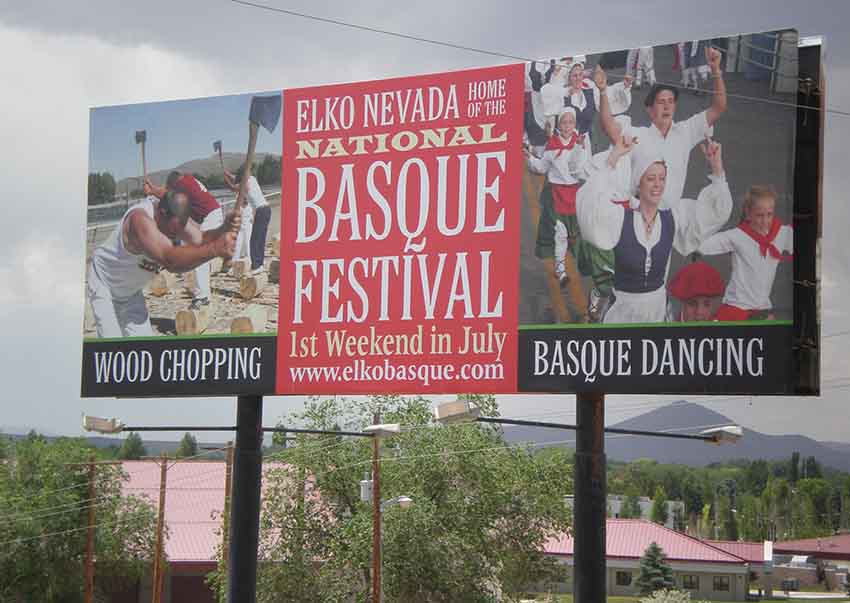
- Since 1963, Elko has hosted the National Basque Festival, though the very first festival was held in nearby Sparks. Like many Basque festivals, it features rural sport and weight lifting/carrying competitions, dancing, and food. This year they celebrate the 62nd anniversary of the festival, which will be held July 3-5. Organized by the Elko Euzkaldunak Club, it is one of the oldest and longest running Basque festivals in the United States.
- Elko Euzkaldunak Club, or the Elko Basque Club, itself started only a few years before. The first meeting of interested parties was in 1959. Elections were soon held and Johnnie Aguirre was elected the first president of the club. And it wasn’t long before they began organizing the celebrations that would become the National Basque Festival.
- In 1966, Joe Anacabe started the Elko Ariñak Dancers, a Basque dance group that still exists and continues to dance at festivals all over the country.
- Elko even had their own Basque-language radio program. Led by Jesús Lopategui, it shared news from the Basque Country and Basques from the United States, including notices of births, deaths, and marriages. They also transmitted Catholic masses in Basque.
A full list of all of Buber’s Basque Facts of the Week can be found in the Archive.
Primary sources: Elko Euzkaldunak Club; Elko, Nevada, Wikipedia; The Basques of the Great Basin: Elko, Nevada by Gloria Pilar Totoricagüena, Eusko Ikaskuntza