
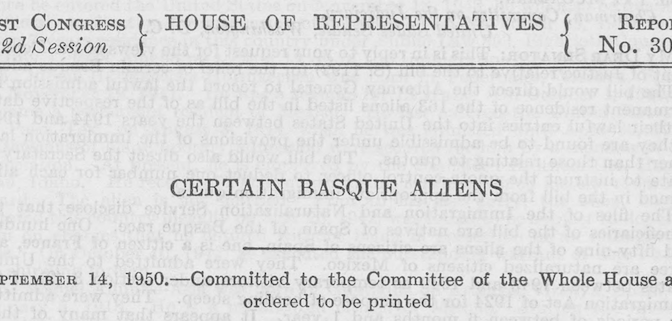
“Sheepherding is a lonely, monotonous occupation. Because of the long hours and arduous work, there are few applicants for that type of employment.” That was the reasoning that was given in petitions to relieve “certain Basque aliens” from deportation proceedings in 1948 and 1950. The reports that accompanied the bills introduced into Congress provide a wealth of detail about the individual and collective experience of many Basque sheepherders in the American West.
As Benito and Tomas Ysursa, who ran the Valencia Hotel and Dining Room, wrote in support of the 1952 bill, “the purpose of enabling certain Basque aliens who are illegally in this country to remain here. These Basque aliens included in the bill are all employed regularly and permanently in the sheep industry. We have been informed by several of their employers that they have urgent need for these men. Other sheepmen have told us that they could use additional Basque sheepherders, since there is a great shortage of competent sheepherders in the State of Idaho and that, on the whole, the great majority of the available skilled sheepherders are Basque. As a matter of fact, through experience, many sheepmen in southern Idaho prefer to hire almost exclusively sheepherders of Basque extraction.”
This one is a bit longer than usual…
- In a bill from 1948, three Basques were petitioned for relief from deportation. Gaspar Ybarzabal, Pedro Ybarzabal, Antonio Monasterio had all come to the United States as “deserting seamen.” At the time, Gaspar and Antonio were sheepherders while Pedro was working at a pool hall in Oregon. Pedro had been a sheepherder but on his doctor’s advice had taken a break and was doing more sedentary work until he recovered.
- The 1948 bill recommended the cancelation of deportation proceedings and the granting of permanent residency to those men in exchange for paying $10 in visa fees and an $8 “head tax.” It also called for a reduction in the corresponding immigration quotas.
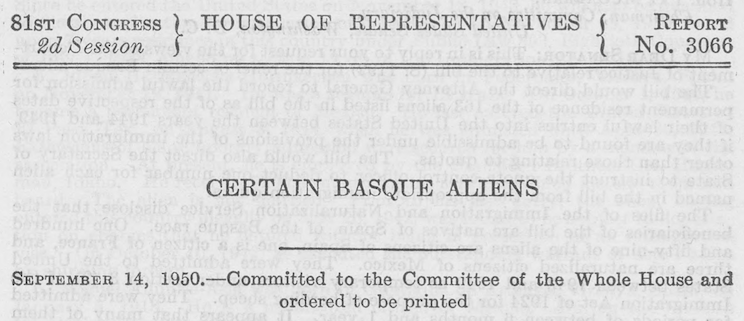
- In another bill introduced in 1950 and the accompanying report, a total of 152 Basque aliens were identified to be granted permanent residence. These Basques came to the US between 1943 and 1949 to herd sheep and most had overstayed their visa. Their original visas were only for 6-12 months, as compared to the 3 year contract my dad had when he first came. Many had simply failed to file the paperwork to extend their visas as they thought that the sheep-growers association that had brought them to the US would take care of that. As with the 1948 bill, this one called for the payment of the required visa fees and head taxes and reduced the Spanish quota for future immigrants.
- The original request was for 163 Basques, but some had either changed occupation so were no longer covered by this bill, had moved back to Spain, had married an American, or had died. Further, of these Basques, while 159 were Spanish citizens, one was French, and 3 were naturalized citizens of Mexico.
- This report is interesting as it goes into some detail about the lives of these Basques. Just a few examples:
- Most of these men had served compulsory military service in Spain and several had served longer in the military. Many were seamen, trading a life on the oceans for one in the rural western United States.
- Some fought in the Spanish Civil War, on either side. The reports call this war the Spanish Revolution.
- Most received about $200 per month plus room and board as sheepherders. Some received substantially less (as low as $100 per month) though some got more, up to $225. One herder, Jesus Labayen San Miguel, is reported to get $700 per month but I wonder if that was a typo.
- One man, Emilio Rebollar Ricondo, had started picking potatoes instead and was making $17 per day. Another, Antonio Monasterio-Lanuquiz, was a sheep camp tender because “he could not learn to herd sheep.”
- The report also says how much money some of these herders had saved, which was often only about $200, or one month’s salary, though some had more, up to $4000. Some still owed their employer hundreds of dollars for the expenses for bringing them to the US in the first place. In one case, this was $750 for passage and $500 for the Government bond, which was deducted from their wages. Some sent money back to Spain for their families, including one herder who had sent $760.
- These Basques entered the US through various ports, including El Paso, New Orleans, and most commonly New York.
- And, these herders were spread all over the western US, in places including Battle Mountain, Boise, Burley, Caldwell, Carson City, Castleford, Challis, Deeth, Duckwater, Elko, Ellensburg, Ely, Emmett, Eureka, Evanston, Fallon, Gardnerville, Gooding, Hagerman, Hammett, Homedale, Howe, Jiggs, Lincoln, Malad City, McDermitt, Mountain Home, Paul, Pocatello, Reno, Shoshone, Soda Springs, Sunset, Tuscarora, Twin Falls, Weiser, Winnemucca, Woods Cross, and Yakima.
- As might be expected, some of these herders left family behind in Spain. As part of the petition, it notes how some of these men wished to bring their families to the US.
- While many had no relatives in the US, several did and had come to work with family. For example, Alejandro Echeguia Juancorena and Tiburcio Juancorena-Irungaray both came to work on the ranch of their cousin John Urroz in Wyoming. One herder, Miquel Marizcurrena Ybarra from Sumbilla, Nafarroa, had eight cousins working in the US.
- The report also lists any infractions that the herder had made. In one case, Felix Larrucea-Lopategui of Ibarranguelua had been fined $13 in 1940 for “the illegal possession of grouse” and $5 in 1935 for “building of a camp fire in a restricted fire area.”
- The story of Teodoro Basabe is particularly interesting. Born in 1899 in Rigoitia, Bizkaia, he first came to the US in 1920 and remained here 1928. He came back a year later as a resident but then left again. He entered the US illegally in 1933 or 1934 and was deported – it isn’t clear if his residency had expired somehow or what. But then he came back yet again in 1934 to work in Yakima. He left one more time in 1946 and then came back in 1948 when he was part of this petition. He made $150 per month and had a wife and three kids back in Spain.
- Felipe Albizua-Calzada of Busturia, Bizkaia also has an interesting history. He first came to the US in 1924, landing in Norfolk, Virginia, as a seaman when he deserted his vessel. He worked 6 years in Waterbury, Connecticut in brass works before returning to Spain. He came back in 1943 and worked as a herder making $150 per month but had $1000 stashed in a bank in Yakima. He also spent 6 years as an English merchant marine, carrying provisions during World War II.
- One of the herders, Juan Belaustegui of Ibarranguelua, had been killed by lightning.
- Another, Juan Domingo Besoitiaturria Emandia of Amorebieta, had been employed as “a civilian fireman by the United States Army Transport Command” and had a brother serving as a priest in San Antonio.
- Another bill and report was generated in 1952, this time for 15 herders. Most of these had also been seamen that deserted their vessels, and many had boarded their ships with the intention of deserting once they got to the US. One, Vicente Galarza, had jumped ship in San Francisco and said that he was trying to avoid military service. Agustin Uriarte “was taken into custody on a complaint charging insanity. He was found to be suffering from a nervous breakdown.” Tomas Lanzoa had fled to France after the Civil War and claimed that when he returned to Spain he was forced to work in a labor camp for a year.
- The justifications these bills gave for petitioning that these Basques not be deported was that it was too difficult to find qualified sheepherders and that there as an “acute shortage.” If these Basques were forced to leave, the “sheep-growing
- industry would suffer substantial losses.”
- These bills discuss the complex issues associated with all of these Basques. Many had either overstayed their visas or had even come without a visa, such as the seamen that had deserted their ships. They were thus clearly illegally in the country. If they were allowed to stay as part of the quota of Spanish citizens allowed in the United States, they would have taken the spot of people waiting to immigrate legally. At the same time, many had adapted to the “American way of life” and thus were already part of the fabric of society, many having lived in the country for many years. Further, they were already established as valuable sheepherders, an occupation that was hard to fill. This left the government with a “problematical” question on what to do with these Basques.
- Some of these men were nearing eligibility to file for permanent resident status based on having lived in the United States for 7 years.
A full list of all of Buber’s Basque Facts of the Week can be found in the Archive.
Primary sources: Relief of certain Basque aliens. May 17 (legislative day, May 10), 1948; H. Rept. 81-3066 – Certain Basque aliens. September 14, 1950; H. Rept. 82-2373 – Certain Basque aliens. July 1, 1952
Amazing history: Years ago, I went to Ellis Island and found my father’s name in many entries from 1910 to the 1920s: a sailor, Cuba, Mexico, New York. Name of the city he came from, Bilbao, the ships, the money in the pocket… Then, the last entry: an address in Brooklyn. Perhaps an address used by many others; we love our homeland, but we tend to seek other lands.