
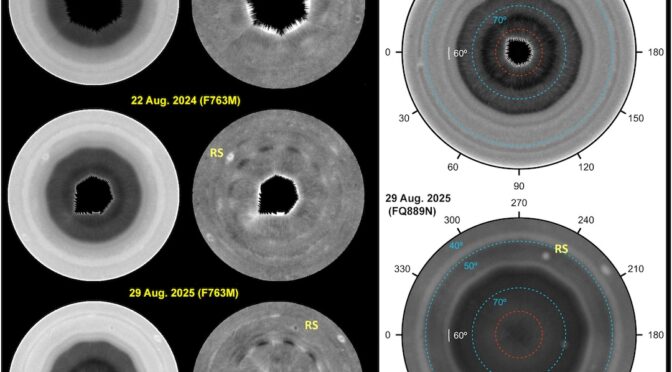
My Basque newsfeed blew up with the news that scientists have discovered an oddly shaped storm on the southern pole of the planet of Saturn. Many different news outlets highlighted this discovery that was led by a scientist from the University of the Basque Country. The universe continues to surprise us.
- Saturn has been a source of fascination since ancient times. However, it wasn’t until 1655 when Christiaan Huygens pointed his telescope at the planet that we discovered that the planet had rings. While Saturn isn’t the only planet with rings, it certainly has the most dramatic ring structure in our solar system.
- Since the 1980s, scientists have seen that the northern pole of Saturn exhibits a strangely-shaped storm. Shaped like a hexagon, with six sides, the storm is much larger than Earth – each side of the hexagon is 1200 miles longer than the Earth’s diameter. While we don’t fully understand how such a storm forms, several theories relate it to various behaviors of Saturn’s winds.
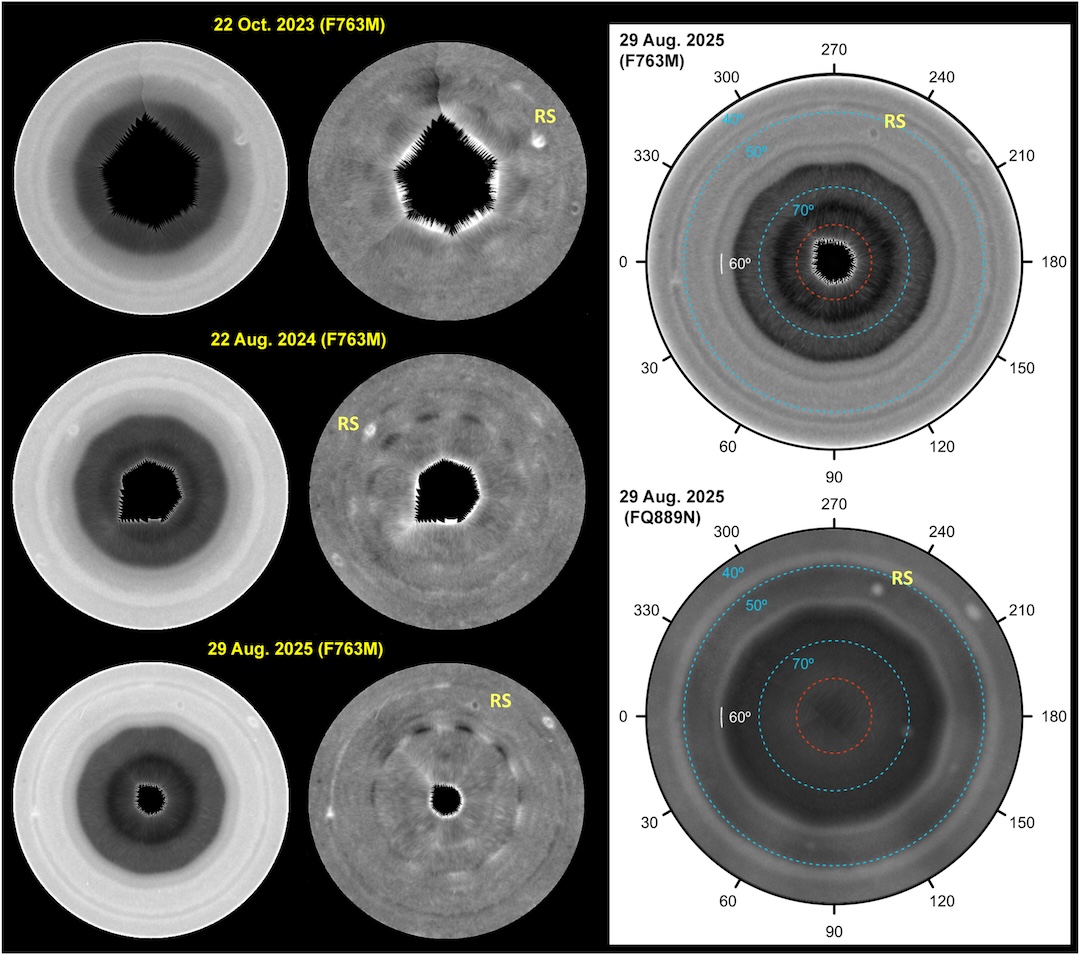
- However, nothing special had been seen on the South Pole until about 2023. Led by Agustín Sánchez-Lavega, a physicist at the University of the Basque Country, a team recently published their discovery of a decagon – a ten-sided – shaped wave on Saturn’s South Pole in the journal Science Advances. They found the strangely-shaped storm by looking at images taken by the Hubble Space Telescope and other ground-based telescopes in 2025 and found evidence that the storm was beginning to take shape back in 2023. But there was no evidence of the storm back in 2017 when the Cassini spacecraft was orbiting the planet.
- The southern storm is bigger than the northern one and is still growing, suggesting that its shape will continue to evolve in the coming years.
- Again, we don’t fully know why or how such a storm forms. Sánchez-Lavega says “It may be the result of an instability in the jet stream in which it is situated or a wave forced from deeper levels of the atmosphere.” More work is needed to understand exactly how and why such storms form.
- For his part, Agustín Sánchez-Lavega was born in Bilbo in 1954. He studied physical sciences at the then University of Bilbao which later became the University of the Basque Country. He joined the university as faculty in 1987 and has been studying the planets ever since. He has won the Premio Euskadi de Investigación and the David Bates Medal from the European Geosciences Union and been named a Fellow of the American Geophysical Union.
A full list of all of Buber’s Basque Facts of the Week can be found in the Archive.
Primary sources: A Mysterious Decagon Unexpectedly Appeared Around Saturn’s South Pole. The Ten-Sided Shape Seems to Be a Wave in the Atmosphere by Margherita Bassi, Smithsonian magazine; Scientists discover a mysterious wave shaped like a decagon in Saturn’s atmosphere by Adam Kovac, Scientific American; Saturn, Wikipedia