Basque Fact of the Week: In Basque Mythology, Before Humans, There Was a Race of Giants

Basques are known for the strong Catholic devotion. However, the Basques are also known to have converted to Christianity relatively late. Before, they had a mythology that was based on various supernatural beings. One of those was the Jentilak, or race of giants. These beings, immense in size, existed before humans, though maybe co-existed with humans, at least in some tales. They had enormous strength and were responsible for the construction of many massive stone features, including churches, castles, bridges, and dolmens. They were said to be more Christian than the Christians. They suddenly died when a black cloud appeared in the sky and they fled to bury themselves.
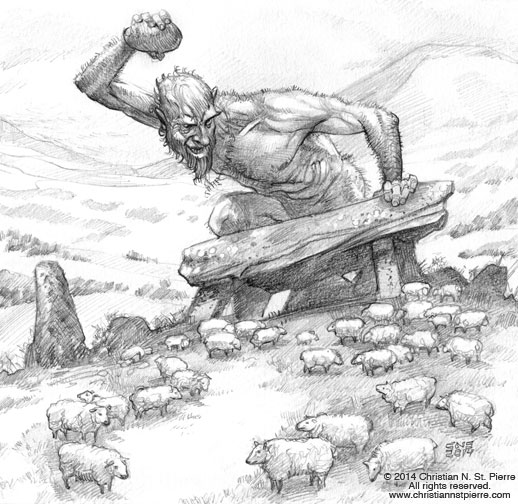
  • The Jentilak are part of a larger European tradition of giants (think of Jack and the Beanstalk in England). “Modern” influences have corrupted the nature of these beings in these stories, but, at least in the Basque Country, they were originally benign beings.
  • The Jentilak would play games, such as pilota, throwing massive stones through the air that still lie at the foot of some mountains. One rock, near Amil, a part of Motriko, becomes surrounded by water at high tides.
  • The wide-spread belief in these beings is reflected in a number of place-names, including Jentilbaratza, Jentilzulo, and Jentiletxea.
  • The jentilak died suddenly when the black cloud appeared, for no apparent reason (they were not punished, as in the Biblical flood, for past sins). Further, the race that succeeded them — humans — were not as kind nor “Christian” as they were. This has led scholars to interpret these myths as the foundation of religious rites of burial. As translated from the original article in the Enciclopedia Auñamendi: The Jentilak die and are buried under funerary monuments that perpetuate their memory (they die precisely to be buried) and in this way the humans who take them as models learn that they also have to act in the same way with their own deceased: burying them and guarding their memory. This is reflected in the fact that the main cultural obligation in the ancient pagan religion of the Basques consisted in the daily realization of offerings to the deceased of the house.
  • In time, the cloud was reinterpreted as a portent of the coming of Kixmi, or Christ. Olentzero, the Basque “Santa Claus,” was a jentil who, being nearly blind, could look at the cloud and understood its meaning.

Source: Hartsuaga Uranga, Juan Inazio; Hartsuaga Uranga, Juan Inazio. Gentiles. Enciclopedia Auñamendi [en línea], 2019. Available at: http://aunamendi.eusko-ikaskuntza.eus/es/gentiles/ar-62712/

Thanks to Lisa Van De Graaff for suggesting this topic as a Basque Fact of the Week. If you have a topic you’d like to suggest, just let me know!

Basque Fact of the Week: Simón Bolívar, the Liberator, had Roots in Bizkaia

Known as the Liberator, Simón Bolívar is a national hero to many South American countries. Under his leadership, Venezuela, Bolivia, Colombia, Ecuador, Peru, and Panama gained their independence from Spain. He also became president of what was then called Grand Columbia, encompassing the modern countries of Venezuela, Colombia, Panama and Ecuador. Inspired by the American and French revolutions, he envisioned a united Spanish America, though felt that it needed a stronger central government than the United States because of the more varied peoples. Though Bolívar dreamed of a united Spanish America, his dream failed, in part due to the political ambitious of others as well as the fear that he was establishing a dictatorship with him at the helm. He died in 1830 of tuberculosis, at the age of 47.

Statue of Bolívar in Washington, D.C., photo taken by Blas Uberuaga.
  • Simón Bolívar was born into a wealthy family in Caracas in what is modern day Venezuela in the year 1783. His ancestor, Simón de Bolívar, from the village of Bolibar in Bizkaia, left for Santo Domingo, in what is now the Dominican Republic, sometime around 1559. In 1569, Simón de Bolívar moved to Venezuela. The wealth of the family came from a large number of estates and plantations. Simón Bolívar, the Liberator, dedicating his personal wealth to the cause of liberation and revolution, died a poor man.
  • The Bolívar name comes from the small village of Bolibar (current spelling in Euskara) in the heart of Bizkaia. There is a museum dedicated to the history of Bizkaia in the Middle Ages and to Simón Bolívar himself. Bolibar is only kilometers away from where my dad was born, but I have yet to visit the museum. The name comes from the Basque words “bolu” (mill) and “ibar” (valley), meaning “valley of the mill.” The country Bolivia gets it’s name from Bolívar.
  • Bolibar, the village, is very close to the neighborhood of Zenarruza, famous for the Collegiate Church of Cenarruza, which was an important stop on the Camino de Santiago. Zenarruza is a name familiar to Idahoans, belonging to long-time Idaho politician Pete Cenarrusa.

Primary source: Wikipedia.

Basque Fact of the Week: The First Person to (Intentionally) Sail Around the World was Basque

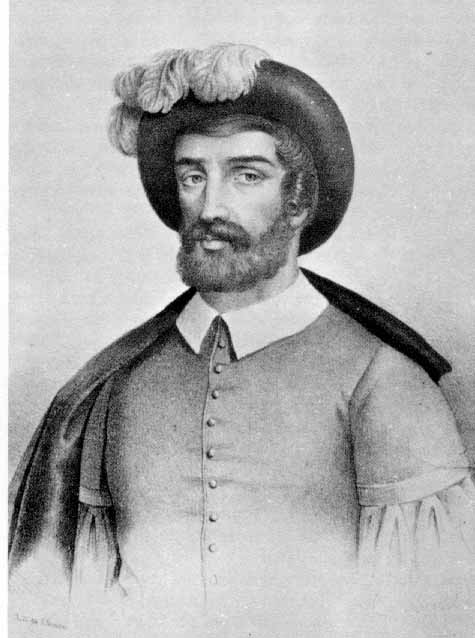
In the United States, at least when I was a kid, we learned that the first person to circumnavigate the globe — to sail around the world — was Ferdinand Magellan. In reality, however, Magellan died in the Philippines, and he never made it all the way. He left Spain with 5 ships but only one ship, the Victoria, returned successfully to Spain. After many changes of leadership, it was Juan Sebastián Elcano who was leading the ship and the expedition when it finally arrived. For his efforts, in addition to a monetary reward, he was awarded a coat-of-arms with the slogan “primus circumdedisti me.”

Image of Elcano, from Auñamendi Encyclopedia .
  • Magellan was essentially spurred on by Rajah Humabon of Cebu, one of the rulers of one of the islands in the Philippines, to attack his enemy Datu Lapu-Lapu, on the nearby island of Mactan. Magellan, who had already converted Rajah Humabon to Christianity, wanted to do the same to Lapu-Lapu but failed. In an ensuing battle, Magellan, attacking the island almost single handedly, confident in the superiority of European weaponry, was felled, initially struck by a bamboo spear.
  • Elcano was born on the coastal city Getaria, Gipuzkoa, in 1487. Before participating in Magellan’s expedition, Elcano was part of campaigns in Algiers and Italy. He got into some trouble for surrendering an armed ship to foreign powers. In his later life, he was persecuted for, seemingly, having many love affairs.
  • During the voyage, Magellan’s leadership was questioned and, along with others, Elcano participated in a mutiny against their leader. This was near the southern tip of South America, before they found the passage that would lead them to the Pacific Ocean that is now known as the Straight of Magellan. The mutiny was defeated. Elcano was spared and, after five months of hard labor, restored to a leadership position in the voyage.
  • Elcano may have been the first person to intentionally sail around the world, but he may not have been the first person to do it at all. Laurence Bergreen, author of Over the Edge of the World, notes that one of Magellan’s slaves, Enrique of Malacca, seems to have understood the language of the Philippine’s, suggesting he was originally from there. He may have made his way to Europe as a part of either the spice trade or dealings with Arabs. Thus, the expedition would have taken him near home and possibly made him the first person, though unintentionally, to sail around the world.

Random Bits of Basqueness

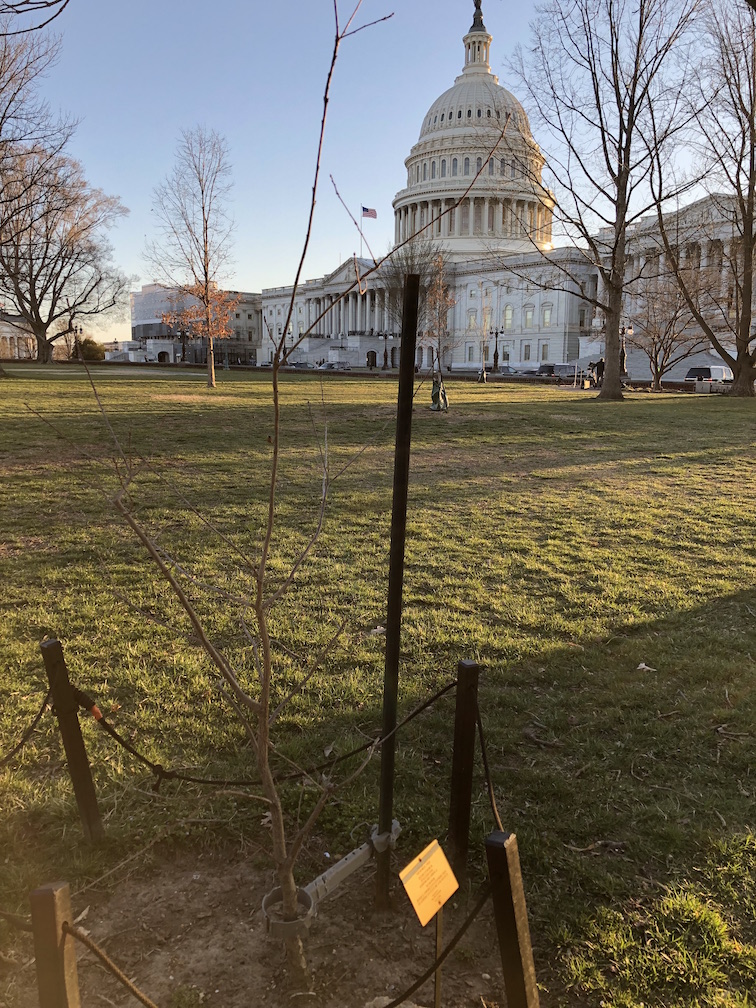
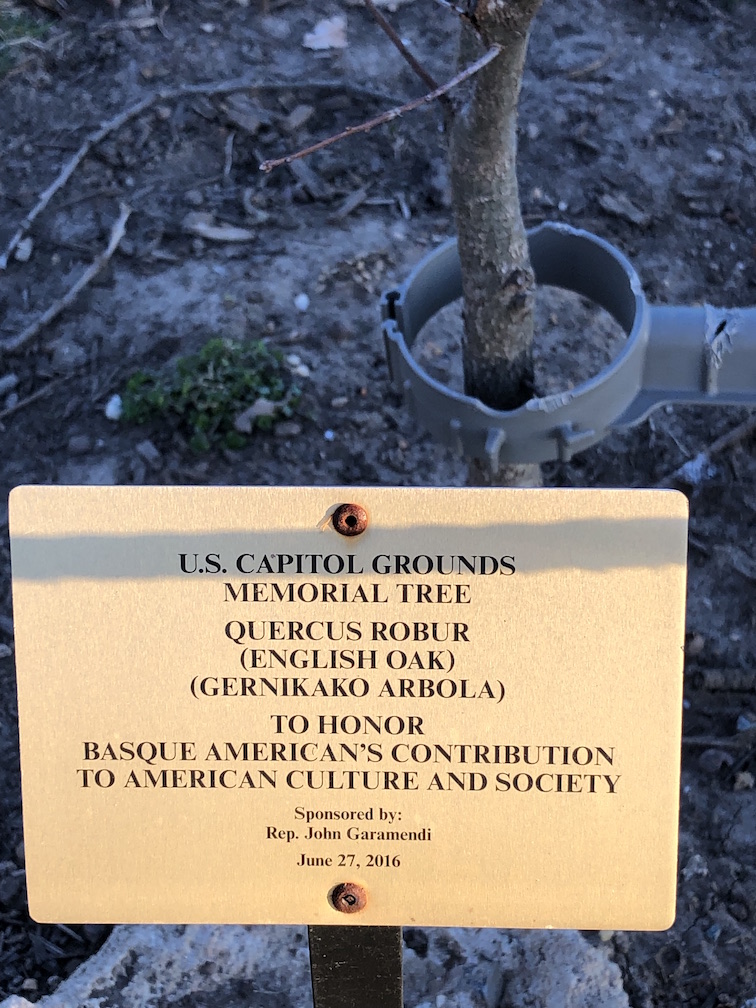
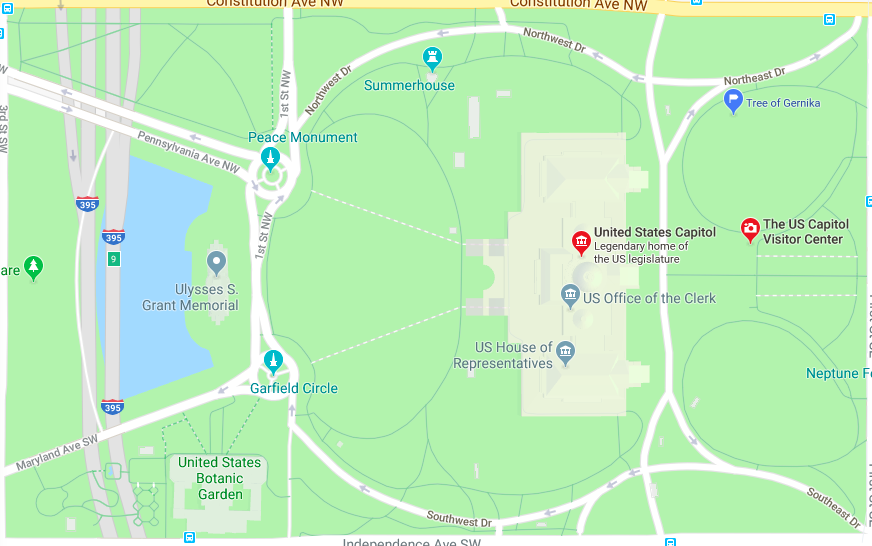
There is a sapling of the Tree of Gernika planted on Capitol Hill in Washington, DC. The planting was sponsored by Rep. John Garamendi in 2016. It took me a long time to find it, so here is a map for anyone else who wants to find it.

Basque Fact of the Week: Basques Immigrated to Wales

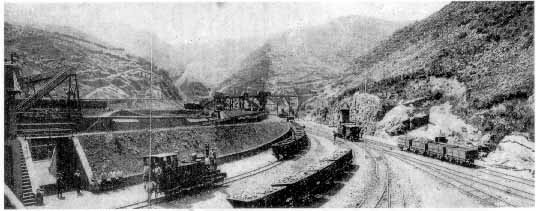
We are all familiar with the large waves of Basque migration to the Americas and Australia. But there was also a small group of Basques who immigrated to Wales, in the United Kingdom. They were recruited to the city of Dowlais, some 60 miles from Cardiff. They came to the region because of the steel industry, recruited because of their experience and expertise working in the Basque Country. A small neighborhood was established for them on Alphonso Street and their descendants are still a part of the community.

An Orconera station. Image from Auñamendi Eusko Entziklopedia.
  • Dowlais Ironworks, created in 1759, was, at one time, the largest steel maker in the UK and was the first to introduce the Bessemer process, a new way of making steel by blowing air through the molten steel, removing impurities. This led to an inexpensive way to mass produce steel.
  • Dowlais imported iron ore from Bizkaia because of the special make-up of those deposits. This led to a brisk trade between the two regions and the formation of a new company, Orconera Iron Ore Company Limited, an international conglomerate in 1873 that had the goal of “vertical integration” of steel-making, from the mines to the final product. The Basque investors were Ybarra Hermanos y Compañía.
  • The Orconera Company, and the mining industry more broadly, contributed to the social conflicts of Vizcaya and in the development of the socialist movement. Miners of Orconera staged strikes, which were put down by the military. Major strikes occurred in 1890 and 1910 over issues such as a 9-hour work day.
  • The Basques in Dowlais supported their brethren back in the Basque Country by sending money during the Spanish Civil War and helping the refugee children that escaped the war to the UK. They also became involved in the political life of Wales.

Primary source: Los ‘vascos de Dowlais’, emigrantes del carbón y el hierro en Gales, Deia, un reportaje de Óscar Álvarez Gila – Sábado, 2 de Marzo de 2019 – Actualizado a las 20:22h.

Random Bits of Basqueness

Did you know Zatarain was a Basque name? From Gipuzkoa, meaning either “over the vantage point” or “place where the elder grew.”

Random Bits of Basqueness

I first discovered this beer a few years ago during a trip to Florida, and found it again during our recent vacation….

Random Bits of Basqueness

An old Hagar the Horrible comic I found in the paper. Maybe not all that funny, except for where those arrows in his butt come from…

Basque Fact of the Week: Basque Improvisational Poetry

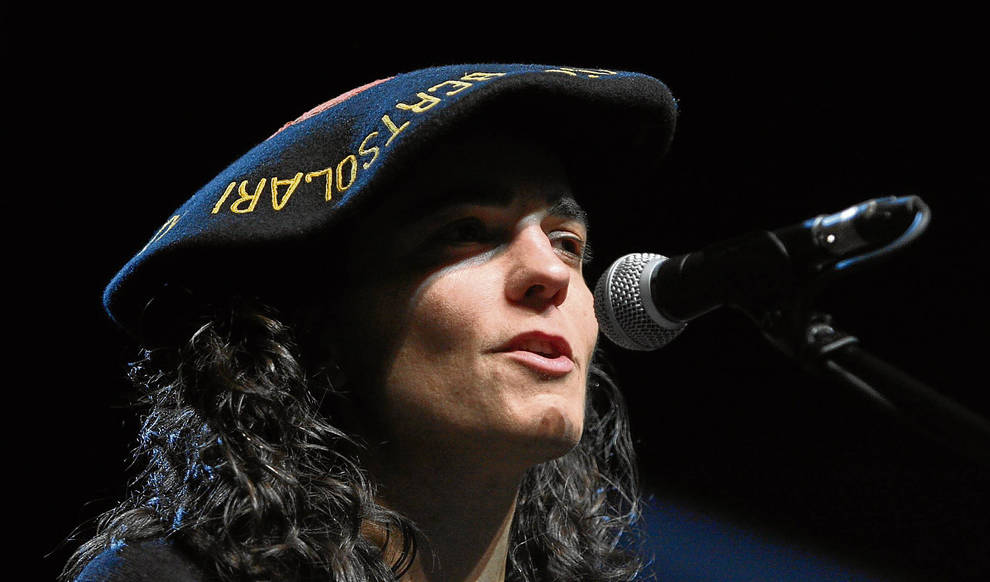
Bertsolaritza, or Basque Improvisational Poetry, is the art of composing, on the spot and impromptu, sung couplets about a given topic. A specific meter and rhyme must be followed. Competitions are held for the best bertsolaris, or singers of of these poems, but bertsolaris are also famous for singing impromptu at any gathering.

Image from GDKO Irratia.
  • While the exact origins of bertsolartiza are unknown, there is evidence that bertsos (the poems) were sung as far back as the 1400s, with mention in the Ancient Charter for Bizkaia, which calls out “the Women, known for being shameful, and agitators of peoples, [that] make couplets and songs in an infamous and libellous manner.”
  • The championships, the Euskal Herriko Bertsolari Txapelketa Nagusia, are held every four years. They started in 1936 but were suspended during the Spanish Civil War and the subsequent repression of Basque Culture during the Franco years.
  • The reigning champion, Maialen Lujanbio Zugaste, is the first woman to win the championship. In the first year she won, in 2009, her solo challenge was Maialen, you are a doctor. You’re observing two children suffering from cancer organising a wheelchair race in a hospital corridor. She had to compose a 42-line sung poem on the spot about this topic. Her poem can be found here.
  • Jon Lopategui Lauzirika, a famous bertsolari who won the championship in 1989, was born on this day in 1934. Not only was he one of the great bertsolaris, but he was known for his tireless work in teaching the art of bertsolaritza to the next generations.

A Tree of Gernika for School

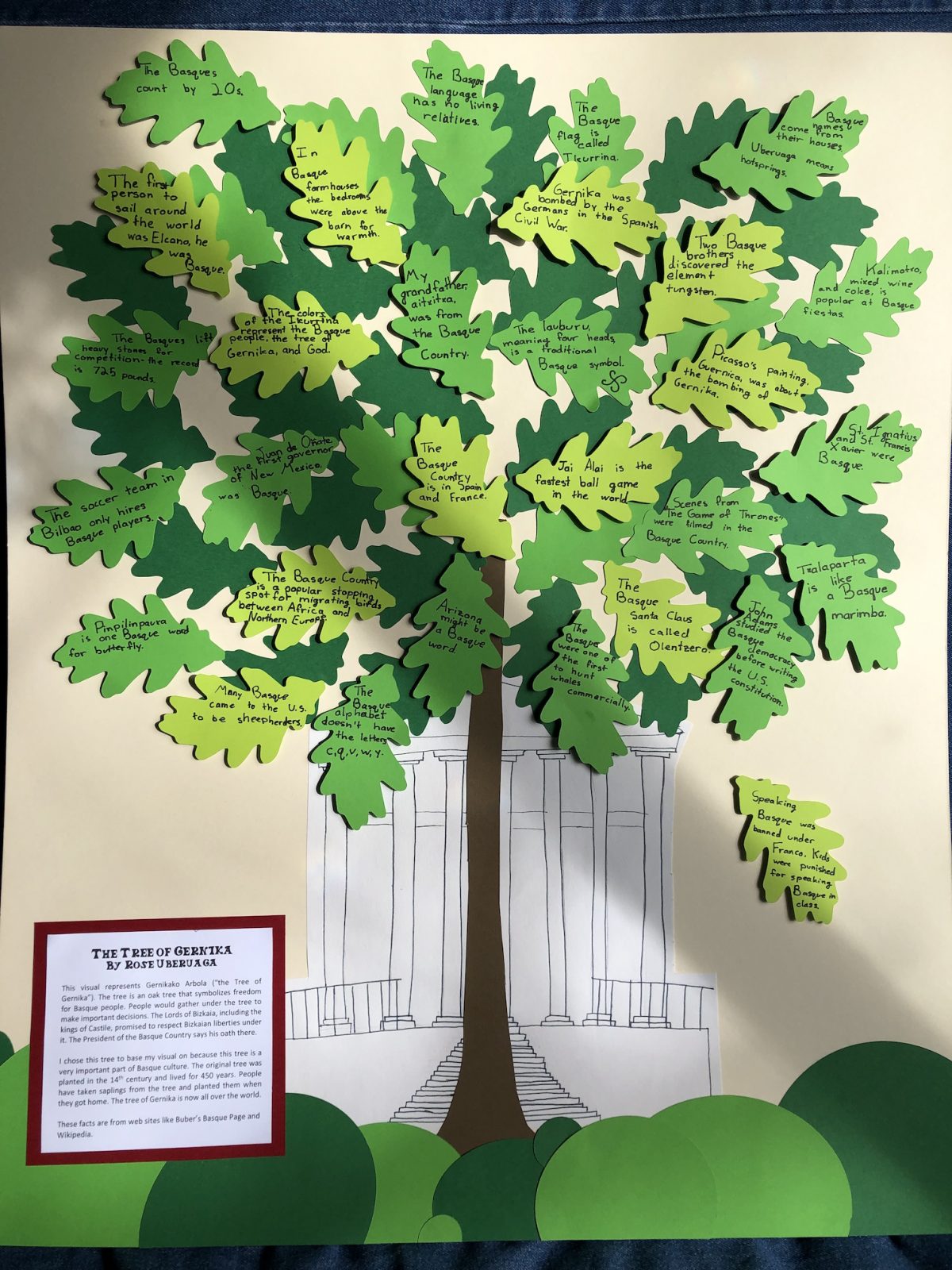
For school, my daughter’s class is studying world cultures and they were told to pick one for each of them to study in depth. My daughter chose Basque as her culture. One of their projects was to write a creative essay. She wrote her interpretation of a Basque family immigrating to America. Maybe she’ll let me share that down the road.

The other project was to create a visual about the culture. Her project was to make a representation of the Tree of Gernika and write on the leaves various facts about the Basque Country and the Basque people. Things like the first person to sail around the world was Elcano, the heaviest stone a Basque has lifted was 725 pounds, many Basques came to the US to be sheepherders. I thought the visual project turned out really nice, so thought I’d share it with everyone.

Great job, txikitxu!