Bengola Natural Energy Park in Munitibar

Munitibar, the town in the heart of Bizkaia that my dad is from, is small, maybe 500 people or so. It has 3 — soon to be 4 — bars and 2 churches, an anachronism from starting off as two separate barrios that eventually merged. I often think that they have it right, a bar/church ratio significantly higher than 1. (I think that the bar/church ratio in Los Alamos is probably closer to 0.03.)
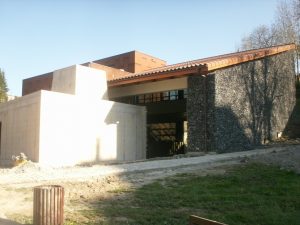
Munitibar is small, but it has ambition. My uncle and aunt showed me a new energy park that is being constructed in the open fields just a bit south of the plaza. The park, Bengola Natural Energy Park, is dedicated to renewable energy and is meant to be a center that demonstrates how different forms of renewable energy work and can contribute to our energy production systems, including wind, solar, and more. There are exhibits, so to speak, of different types of windmills, for example, in an open meadow overseen by the village cemetery (in an interesting contrast of old and new traditions).

The site of the center and museum is on an old iron works site, which was later converted into a mill. In the excavations for the main building, they uncovered some of the foundation and stone work of that original iron works, which have since been incorporated into the building as an example of using water to power industry. They are diverting water into a collecting pool that will feed into the building to drive, I believe, a new water wheel to demonstrate how energy can be extracted from water.
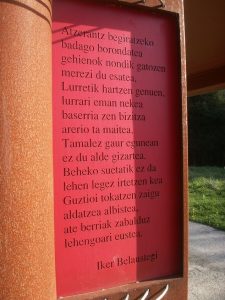
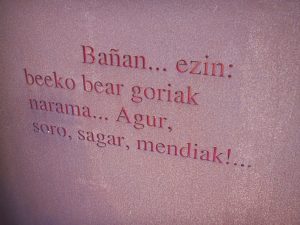
There are multiple scupltures and other features with quotes highlighting the ecological nature of the park. Some of those quotes are in the photos posted here — I would be very grateful if anyone was interested in translating them to English so I can better understand what the message is. There is a stage, a sort of ampitheater, for lectures and concerts dedicated to ecological themes. There is also a very large stone sundial, though local kids have already defaced it by popping wheelies with their motorcycles on it. I guess it’s impossible, no matter where you are, to prevent that kind of stuff.
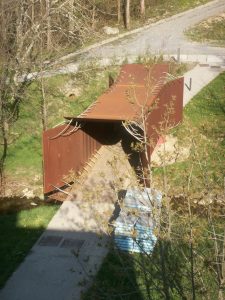
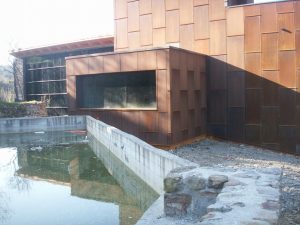
The park is still being finalized and the main building was under active construction when I was there. It was quite extensive, with some large exhibition rooms and what seemed to be possibly some conference rooms. It was originally expected to be completed sometime this summer, but with the crisis, it isn’t clear that the funds will be available to finish it off. But, if not now, I’m sure it will be in the near future. Whenever it is finished, I look forward to seeing how they present renewable energy and the ways it can be used to enhance the way we interact with our environment.

More information about the park can be found here.

Pasai Donibane

I’ve decided on a new resolution, not for New Year’s, but regarding my visits to Euskal Herria. The thing is, I visit, I spend a lot of time with my dad’s family which I of course greatly enjoy, I see some friends (though not nearly all of them), and I come home. I don’t end up seeing anything I hadn’t seen before in terms of the cities, the countryside, museums, or anything else. So, I’ve decided to make an effort that, each time I visit, I see at least one new place.

I was in Euskal Herria during Semana Santa and, following up on my resolution, I went to see Pasai Donibane. With a good friend, Gontzal Aranguren, we left Donosti and drove to Pasai, which is actually a collection of neighborhoods on the outskirts of Donosti. This area is the big port of Donosti, with massive ships coming and going (though we didn’t see any enter or leave the port, there were ships docked in the port). To get to Pasai Donibane, you have to pay a man 1 euro to take a small boat across the water to the other side, where Pasai Donibane looks back towards Donosti.

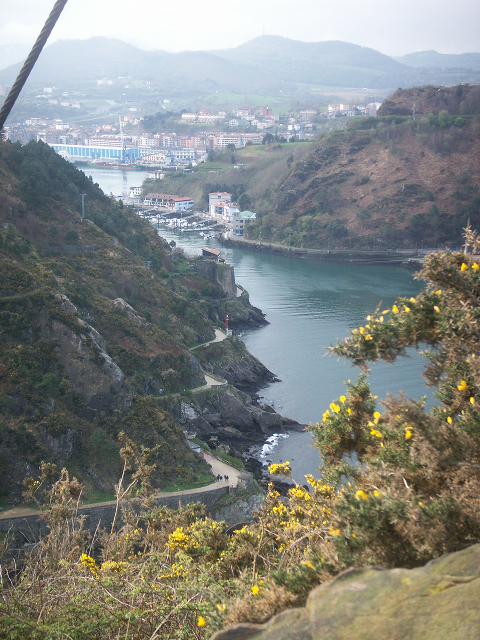
Pasai Donibane is sometimes referred to as the “little Basque Venice.” This, of course, overstates things, as nothing really compares to Venice itself, but it has its own charm. We got there pretty early in the morning and followed a small path outside of the village up the hillside overlooking both the port and the ocean. Not an overly long hike, but it does go up a bit in elevation relatively quickly. The views were magnificent! We then hiked back to Pasai Donibane and walked around a bit. Being early in the morning, not much was open, but the streets, if you could call them that, were glistening with water, reflecting the colors of the apartments overhead. The cobblestone streets barely allowed one car through — there are more than one corner where side mirrors have worn groves into the buildings. If two cars tried to go in opposite directions down the main thoroughfare, one had to back up to an opening in the road to let the other pass.

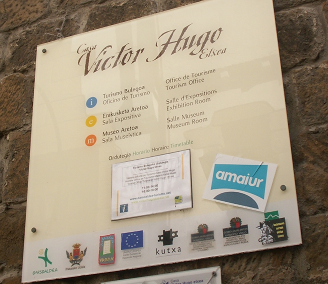
An interesting historical note about Pasai Donibane: Victor Hugo, of Les Miserables fame, spent some time here in 1843 while traveling in Spain. Some say he was inspired to write Les Miserables while staying in Pasai Donibane, overlooking the nearby Pasai San Pedro and Pasai Antxo, which were more industrial. It isn’t clear if this is some apocraphical story or if there might be some truth in this claim. In any case, as anywhere else, Pasai Donibane has capitalized on this brief encounter with history by establishing the “Victor Hugo Etxea“, or Victor Hugo House, which is a small museum that describes his stay. It was closed when we were there, but for the history buff, it might be worth a quick visit. What is clear is that Hugo wrote his Voyage aux Pyrenees while living in Pasai Donibane.

Pasai Donibane is also known for some good seafood restaurants. Again, being there early in the morning, we didn’t take advantage, but it might be the perfect place to spend a romantic evening for two, overlooking the water with the bright lights of Donosti in the background.

Pasai Donibane is no Venice, but it has its own charm. The brightly painted apartments crammed between the hillside and the waterfront plus the breathtaking vistas from the nearby hills are a combination that is truly spectacular.

A history note of interest to Americans: it was from Pasai Donibane that Lafayette set sail for America to aid the Americans against the British during the American Revolution.

The Crisis in Spain and the Basque Country

Of course, during my visit to Euskal Herria in early April, one of the topics that came up was the crisis. Spain is in particularly bad shape, with unemployment over 20% in the general populace and much higher for young men. The Basque Country is in reasonably good shape, with unemployment hovering in the 8-9% range.

It was interesting talking to different people about the situation. Some are clearly very pessimistic about the future, feeling that the rest of Spain cannot help but drag the Basque Country down as the situation worsens. They point to unresponsible government spending in a bad economy. One comment was that, since the Guggenheim in Bilbao, every little town feels like it needs its own museum. So all of these construction projects are going on, some of dubious use. This includes, in the opinion of at least one Donostiatar, the new addition to the San Telmo museum in Donosti, which is a glorified library/meeting space that seems much bigger than necessary.

In contrast, others point to the fact that, despite the supposedly rough economy, people are still taking their vacations and living the good life, including heading to the Mediterranean coast or even to Central America for vacations during Semana Santa. Clearly, in their view, the people have money to spend and they are spending it. It isn’t so bad, yet, such that people feel compelled to save every euro in the face of some great collapse. I heard this particularly from a more elderly gentleman, who likely has seen much harder times in his life.

Clearly, the crisis is on the minds of everyone and what the future holds for the Basque Country, Spain, and all of Europe is unclear. And, as with everything, everyone has their own views of what that future holds. To me, it seems that, as the economy in Spain as a whole worsens, it can only suck in the Basque Country more, worsening things there too. The Spanish Basque Country is an integral part of the Spanish economy and, as such, is not insulated from what is happening in the rest of the country.

The end of the webnotes

When I first started this site, I got lots of great feedback about the articles and pages I was posting. At one point, I felt it would be great to channel that, to create a site bigger than myself where others might contribute and add their expertise, correcting mistakes or expanding on details that would offer more information to everyone. Hence, I added the possibility of people posting their own notes on each of the pages on this site.

With time, though, things change and I’ve decided to deactivate, at least for now, the webnotes for the pages on this site. There are two reasons. The first is technical: the webnotes involve scripts that can be exploited and are possibly one of the ways that my site is used to send spam. I’m not as much of a PHP guru to ensure that the scripts are always secure. They were also clunky for me to approve, making it simply a not-very-pleasant task to go through and approve them all.

The second is more selfish. The vision I had of people adding to the articles, expanding them, adding new details, never really materialized. By far the most popular aspect of the webnotes was with the surname list. While, clearly, I have a great interest in genealogy, these types of posts were the least interesting to me, and also contributed to my lack of drive to go through and approve them all. And I did have to approve them, as otherwise spam or malicious content would have made it to the pages.

I’m rethinking this process. Maybe I will find a better method for doing webnotes, or the equivalent, and reactivate them in the future. I’m not yet sure. If you have a strong opinion, please let me know.

Two Young Cooks win Scholarship to Cook with Basque Chefs!

TWO YOUNG COOKS WIN IV SAMMIC SCHOLARSHIP TO COOK WITH BASQUE CHEFS

Earlier, I posted about the previous BasqueStage contest for young cooks to work with world-renown chefs in the Basque Country.  Well, the 4th edition of the contest has just been decided and two new young men will be joining Chef Berasategui. The following press release gives more details.

May 9, 2012, (SAN SEBASTIÁN, SPAIN): Chef Martín Berasategui has announced the winners of the 2012 4th Sammic Scholarship with BasqueStage.  The winners are Brenden Darby and Luuk Hoffman, and they will join the kitchen of Restaurante Martín Berasategui, ranked in the San Pellegrino World’s Top 100, beginning in July 2012. They were chosen out of over 150 applicants in this, the fourth round of the continually growing BasqueStage program.

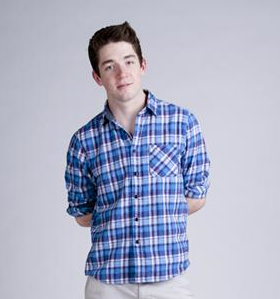
Brenden Darby is a graduate of Johnson & Wales University, where he graduated Dean’s List and Honors Society. He is also completing is WSET (Wine and Spirits Education Trust) Advanced Certificate. He recently spent six months traveling and volunteering in Southeast Asia, and also has varied restaurant experience under his belt.

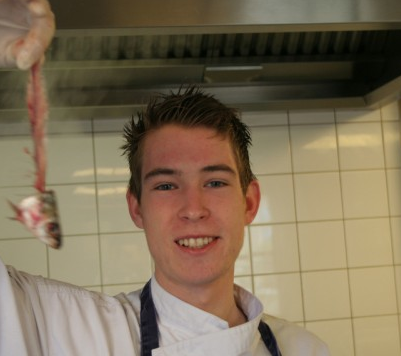
Luuk Hoffman is a young Dutch cook, a graduate of the Hotel School in the Hague and a current student at Sterklas in Amsterdam for an advanced culinary degree. He has worked with an impressive roster of chefs.

BasqueStage is a program that gives cooks the opportunity to learn from some of the best chefs in the world, up close and personal. The Sammic Scholarship is sponsored by Sammic, with the collaboration of Martín Berasategui.

Basque chef Martín Berasategui has earned almost every international culinary award, including 3 Michelin stars for his restaurant in Lasarte. In fact, the high ratio of Michelin stars to population in the area is partially due to his nurturing of other young chefs.

Sammic is one of Europe’s leading designers and manufacturers of Foodservice Equipment, specializing in Food Preparation, Food Preservation, and Hot Temp Ware Washing. Longtime technological partner of chef Martín Berasategui and based only 30 kilometers away from his restaurant, this 50-year-old company has just started operations in the US.

FOR MORE INFORMATION CONTACT:

BasqueStage/DeliFunArt: Marti Kilpatrick  marti@basquestage.com +34 676 040 129

Sammic: Amaia Altuna aaltuna@sammic.com  +34 943 157 340

Eskerrik asko, Txoko Ona!

A big Eskerrik Asko to the Txoko Ona Basque Center in Homedale, Idaho, for the very kind write-up they did about Buber’s Basque Page!  I really appreciate it!

Golaflin, a unique way to experience Euskal Herria

I first met Gontzal Aranguren maybe 15 years ago as part of what became the Seattle Euskal Etxea — the Basque Club of Seattle. Gontzal was one of several transplants from the Basque Country living in Seattle and who became an important part of the fledging club. Gontzal is an interesting twist on the Basque-American identity, being an American-Basque, a Basque who’s mother was from the US. As such, he has strong connections to the US and, because of this, did his university work in the US as well.

Gontzal’s passions have taken him down many paths, including working for an NGO of the Basque Country in India and being an amateur poet. His most recent direction is to parlay his knowledge of the land and history of the Basque Country along with his connections to the US into a business providing tours of the Basque Country. These tours are centered in Donosti, the European Cultural Capital for 2016, and are for small groups of people (up to 5) who want an experience in Spanish or Basque. In particular, for those wanting their tour with a flavor of Euskara, but who only know a smidgen, you are in luck!

I was just in the Basque Country about a month ago and Gontzal was gracious enough to show me some sites I hadn’t had the chance to see before. In particular, he took me to a gastronomic society where, along with a few of his buddies, we had the biggest steak this side of Texas (Gontzal does have some Texan roots). He then showed me Pasai Donibane, a charming water-side village on the outskirts of Donosti. Supposedly, Victor Hugo, who did spend some time there, got some of his inspiration for Les Miserables in Pasai Donibane. Gontzal was a great guide, with a deep knowledge of the history of the area.

If you are looking for a unique way to experience the Basque Country, then I encourage you to check out Golaflin!

Looking towards the future

I just got back from Europe, a trip that took me to both Germany and Spain. While in Spain, I visited two research centers. Both centers were very impressive, primarily because of the vision they represent. When one considers how government funded science research, even in a country like the US, is subject to the whims of political winds, it is refreshing to see initiatives that have a longer term focus and perspective.

These two centers, Nanogune and Energigune, are part of a bigger effort to establish research centers that bridge academia and industry. That is, a primary goal is to take the basic science conducted at universities and transfer it in a usable way to industry. They are the bridge between research and application, with the goal of accelerating that process. There are 7 such centers in the Basque Country, though I only saw these two as they most align with my own research.

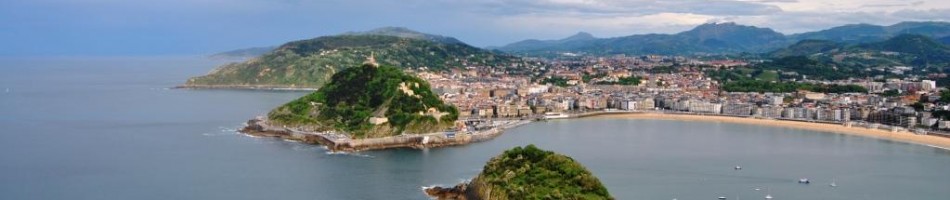
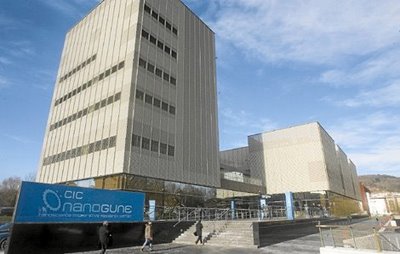
Nanogune, situated in Donostia/San Sebastian, is focused on nanotechnology. In the continuum from basic research to industrial development, Nanogune maybe sits a bit closer to basic research than Energigune. They aren’t driven by any particular application, but rather the development of functional materials based on nanotechnology more generally, particularly the basic science of those materials. Controlling matter at the atomic level to develop new materials is a challenging goal, one that is common with a number of other countries. Nanogune is a focused center working to realize the promise of nanotechnology. Given the focus on more basic research, Nanogune sits in or near the campus of the University of the Basque Country.

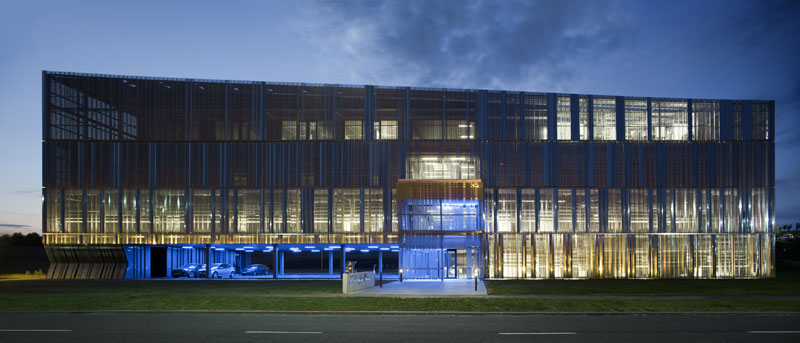
About one and a half hours away in Vitoria-Gasteiz, sits another center, Energigune. Energigune is a bit more focused on developing new energy materials, specifically batteries and supercapacitors. As such, they are a bit more industrial focused, residing in a technological park in Araba. The goal is specifically to develop new materials for these applications. Again, this challenge is being tackled by a number of groups around the world, but Energigune is bringing together a number of scientists under one roof dedicated to this particular class of materials.

Both centers are young, less than 3 years old, but already they have impressive experimental capabilities and scientists. I was especially impressed that such a small region of the world is investing so significantly in scientific development. They are taking a long view with the understanding that the future of their economy and their region depends on investing in basic science and exceptional scientists to develop the foundation for industrial development. It is a view that is too often lacking from political entities. It is also a way of doing science and investing in the future that I think other nations, including the US, would do well to mimic.

Celebrating Boise’s Fronton

Anyone who has been to the Basque Country and visited any of the villages that dot the coast and the valleys between those peaks shrouded in mythology certainly knows the importance of the fronton to the Basque people. The plaza of most any town is often surrounded by the three corner-stones of Basque life: the Church, the tavern, and the fronton. I know best the one in my dad’s home town of Munitibar. Festivities may always begin with a mass at the Church, but they always center on the fronton, either a game of pelota or animal tests or a bertsolari contest. The fronton is the public space in which life happens.

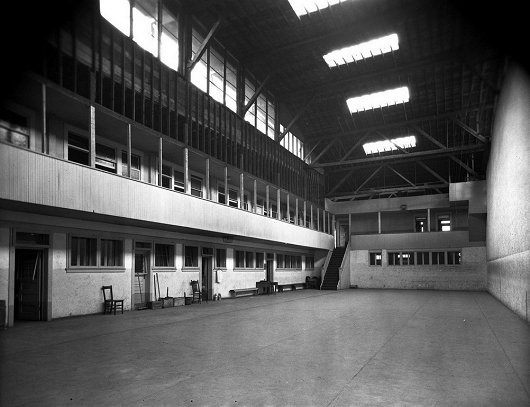
The Basques who immigrated to the US brought their games with them. And, the fronton. A wonderful open-air fronton sits in my mom’s home town, Jordan Valley, Oregon. But, the oldest is in Boise. In fact, the fronton in Boise is probably one of the oldest sporting venues in the US. Like Wrigley Field in Chicago, it will turn 100 in 2014. The Jacobs-Uberuaga boarding house will turn 150 the same year. The Basque community in Boise is gearing up to celebrate these milestones, important not only in the history of Boise Basques, but Basques in the US as a whole. The fronton endures, just as the Basques have endured.

I personally am not overly familiar with Boise’s fronton. I may have stepped foot in it once as a kid. However, both Mark Bieter and Henar Chico have written wonderful testimonies about the role the Boise fronton has played in their lives. Mark describes the history of the fronton and how, to pelota players in the US, it is sort of the Wrigley Field of pelota. Henar, a newer resident of Boise, has become an aficionado of the fronton and the pala leagues that are very active. The fronton has become a very important part of her life in Boise. Both paint a picture, both past and present, of a building that has served as the cornerstone of the Boise Basque community for nearly 100 years. And, knowing the Basques, will likely be standing strong for another 100 years.

Aurrera! Moving Forward with Euskara

Way back in 1991, in between my sophomore and junior years at the University of Idaho, I took a year off to study both Basque and Spanish in the Basque Country through the program offered by the University Studies Abroad Consortium — USAC. I was more interested in Basque, but both my dad and my grandfather stressed the pragmatic wisdom of also learning Spanish. Back then, there weren’t many resources for an English speaker to learn Basque, especially one who knew next to nothing. USAC offered a course that was targeting students exactly like me. However, even so, things didn’t go as smoothly as I would have liked. Despite a semester of intensive Basque language course, I didn’t learn enough to be fluent. I chalk this up to two factors: Spanish was always easier, even for someone not studying Spanish directly (though I did have Spanish in high school) and my dad’s family speaks Bizkaino while I learned Batua. A seeming minor difference, but to someone just learning the language, that difference was night and day.

In any case, since that time, many more resources have become available to the English speaker wanting to learn Basque. One of the more recent ones is Aurrera!, a two volume textbook for studying Basque by Linda White. Now, while I have a number of Basque language resources, I still haven’t made the time to go through them in any serious manner, so I can’t really comment on how one book compares to another. That said, Aurrera! seems to be a very nice resource for the Euskara novice. Arranged by themes, such as Locations, Wants and Needs, and, most important for anyone visiting the Parte Vieja, Living it Up, Aurrera! quickly gets into real world language needs rather than focusing on more arcane grammar. Further, each chapter is accompanied by dialogs and activities that bring the language to life and pull the student into the language. Later chapters focus on all of the different tenses of the Basque verbs, so there are a number of such chapters, including “In the E-Mail that I Received,” that covers these concepts.

One thing that is missing for me are the tables that summarize declensions, conjugation, and the form of the auxiliary verbs. I’m not sure why, maybe it is my more mathematical bent, but encountering those tables as a student just learning Euskara, while certainly daunting in the complexity and density they represent, also gave order to the language for me. They summarized the language in a way I could get my head around. If Dr. White follows up with a second edition, I might suggest an appendix that collects such tables. Further, a brief chapter on the history of the Basque language, the current state, and the dialects would also be appreciated.

That said, for someone trying to learn the language, this seems an invaluable aid. I certainly have all intentions of going systematically through both volumes. Now, I just have to find the time!

More information about these books, as well as accompanying audio, can be found here.