
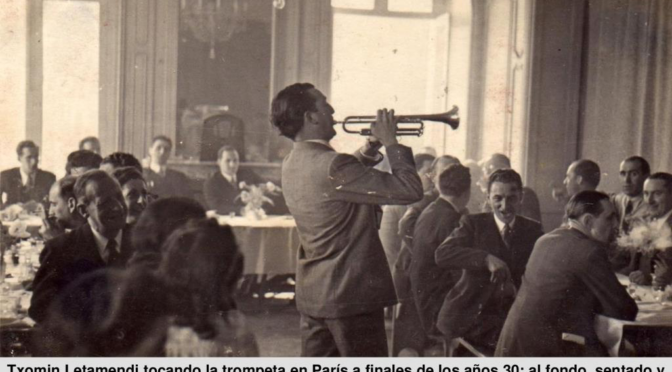
Hard times brings out the best and worst in people, pushing them in directions they may never have ever imagined. Such is the case of Txomin Letamendi. An extremely talented musician, the Spanish Civil War and its aftermath pushed him to become first a soldier and then a spy for the Basque government in exile, a role that would ultimately cost him his life.
- Txomin Letamendi Murua was born in Bilbo in 1901. His family originated from the Oñati region. His father abandoned the family when he was young and his mother ran a bakery in Bilbo.
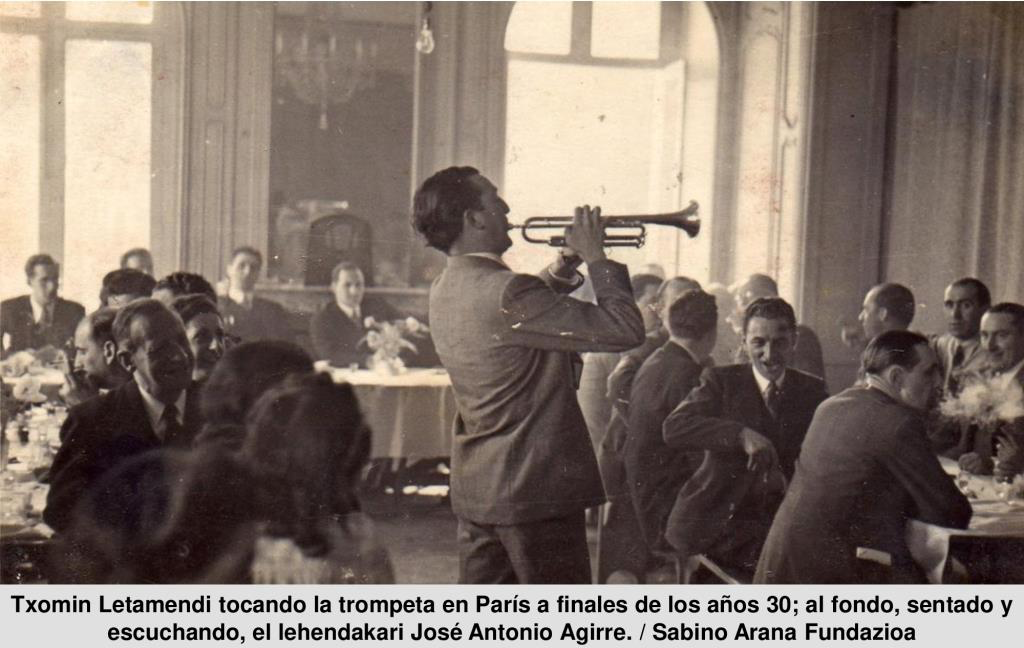
- Txomin was a skilled musician. He played multiple instruments, including the double bass, guitar and oboe, but the trumpet was his main instrument. As a young man, he secured a place in the Bilbo Symphony Orchestra as a trumpeter where he played with, amongst others, Maurice Ravel. In the evenings he would play in cafes, eventually forming a jazz band with some friends. In 1923-24, he played in New York City, including at Carnegie Hall, where he acquired his prized possession, his Conn Silver Trumpet.
- Knowing the mountains of Bizkaia, he joined the Aritzimuño battalion of the Basque Army when the Spanish Civil War broke out. He was part of the anti-aircraft defense during the air raids on Bilbo in 1936. Later, he became the commander of the battalion, commanding some 600 soldiers, who participated in battles near Vitoria, Otxandiano, Gorbeia, Barazarre, Sollube, and Lemoatxea. He was well regarded by his soldiers and during the defense of Bilbo he climbed the walls and played Agur Jauna on his trumpet. When Bilbo fell, Letamendi went into exile in Paris.
- In Paris, he found a job as a trumpeter in a tango orchestra at an Uruguayan establishment. He made contact with the musical group Eresoinka which, commissioned by the Basque lehendakari in exile José Antonio Agirre, acted as a cultural embassy for the Basque Government, promoting and preserving Basque culture. It was during this time that he met Karmele Urresti, a nurse from Ondarroa, who would become his wife. Their first daughter was born in Paris but when Paris was about to fall to the Nazis, Eresoinka was dissolved and Letamendi and his family fled to Venezuela.
- In Venezuela, Letamendi began work in the intelligence services. Still playing his trumpet, he made contact with many people, including the ambassador of Franco’s government, Letamendi was recruited by the United States Office of Strategic Services to gather information on the Venezuelan government, the Nazis who were settling there, and the Franco embassy.
- A key goal was to determine the Venezuelan government’s attitude towards the Nazi government of Germany. Having a good relationship with the Spanish ambassador, Letamendi and his band invited him to a special performance, where they stole his keys, entered the embassy, and stole documents from the safes; they returned the keys before the performance was done. This revealed that Spain had been helping Nazis escape Europe, smuggling diamonds, and participating in money laundering.
- At this time, Letamendi was ordered by Agirre to return to Spain and work for the Basque government’s clandestine intelligence service. The family eventually made their way back to Bilbo by way of Barcelona and Ondarroa. He coordinated teams of informants in both Bilbo and Madrid. In 1946, he fled to Donostia to avoid the secret police. He was captured trying to retrieve a package at the Donostia train station. He was arrested, tortured, and sentenced for two years. While in prison, his third child was born.
- Upon his release, he took over as the clandestine representative of the Basque Government in Barcelona. He was soon arrested again. Fearing this was his last arrest, he asked his wife to raise their children with patriotism and the Basque language, which he himself did not know. He was brutally tortured. His extremely bad health, due to torture and a hunger strike, led to an early release in 1950. He died a few months later in his home in Madrid at the age of 48.
- Txomin and Karmele’s story was the subject of Kirmen Uribe’s book The Time to Wake Up Together which was then turned into the movie Karmele, directed by Asier Altuna. There is an effort to make his prized trumpet an official piece of Basque heritage by displaying it in a museum.
A full list of all of Buber’s Basque Facts of the Week can be found in the Archive. Help with translation was provided by Google Translate.
Primary sources: Txomin Letamendi, Wikipedia; Un siglo de Euskadi a través de una icónica trompeta by Iban Gorriti, Deia