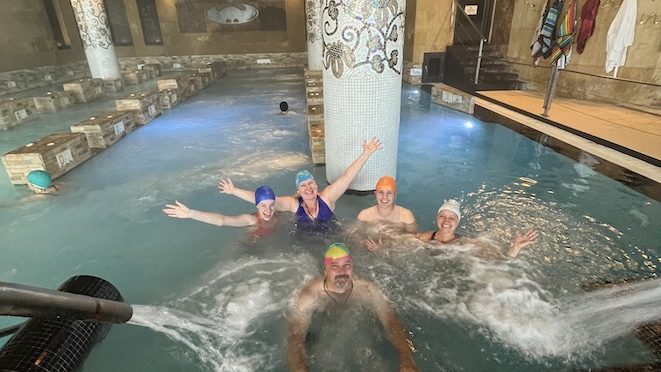
We finally made it to Donostia, skipping some of the other small towns on the coast as we had to meet our AirBnB host. Driving our microbus through the narrow streets of Donostia was not my favorite thing, neither was trying to park it. But we made it. The next day we were rewarded with an appointment at La Perla spa. I had heard of La Perla but in my previous visits, as a “young” student more interested in socializing than in relaxing, I had never really considered visiting. It was pretty amazing, certainly worth a few hours. The variety of water treatments was cool and I think we all left more than refreshed.
- La Perla specializes in thalassotherapy – the use of seawater for therapy (the Greek word thalassa means sea). As a specific form of therapy, thalassotherapy has been promoted for maybe a few centuries, though the Romans certainly took thermal baths and other treatments in what was essentially what we would call thalassotherapy.
- La Perla got its start in 1887, at a time when Donostia was a destination of Europe’s high society. It began as a large red hut on the beach, overlooking La Concha and the sea. It was called “The Pearl of the Ocean.” In the early 1900s, the modern spa was built. Designed by Ramón de Cortázar, the new spa was inaugurated on July 2, 1912.
- The spa grew out of Queen Maria Cristina’s visits to the city as her summer home. She would bathe in the waters of the bay and the original spa was built to serve her and her court’s needs.
- However, the building, partially due to an overall drop in activities in the city that coincided with the ban on gambling, fell into decay such that, by 1924, it was in near total ruin. In the 1960s, it was converted into a hall for festivities. In the 1990s, the spa was given new life. The old building was demolished and a new one that reclaimed its use for thalassotherapy was built, opening in 1995.
- Today, La Perla sports a large number of facilities leveraging the ocean’s bounty for water therapy. These include: a hydrotherapy pool, a relaxation pool, a panoramic jacuzzi, a sensory labyrinth, water beds, a marine vapor bath, an ice fountain, dry and wet saunas, and facilities with sea views and direct access to the beach. It sports a total area of facilities of 5500 square meters, or nearly 60,000 square feet.
Primary sources: La Perla; La Perla (balneario), Wikipedia