Fighting Basques: Basque Women in the US Cadet Nurse Corps, 1943-1948

This article originally appeared in Spanish at Euskalkultura.eus on March 7, 2022.

Joining the worldwide commemoration of Women’s Day, our colleagues from the historical research group of the Sancho de Beurko Association published another new and interesting article, on another little-known topic, the Nurse Cadets Corps of the United States and the participation of Basque-American women in the Corps. This work represents a new contribution, not only for the studious people of our diaspora, but also in the context of the United States and the vindication of the few members of that group who survive, their pending recognition as war veterans, and in anticipation of the 80th anniversary of the Corps’ creation, to be commemorated in 2023.
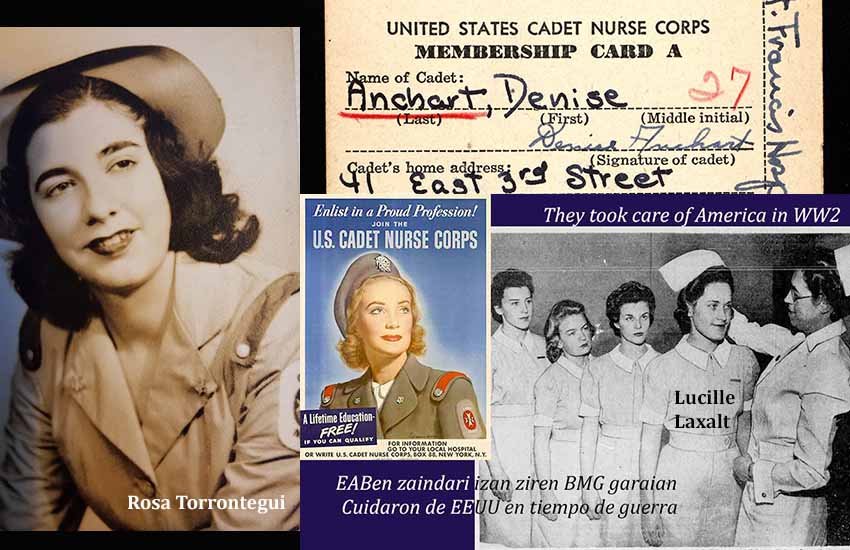
The Cadet Nurse Corps, the only uniformed corps cadet nurses who served in WWII whose members were not recognized as veterans.

ON JULY 1, 1943, in the midst of World War II, the United States Cadet Nurse Corps was created and financed by the United States Congress to train a large number of nurses quickly and efficiently, in order to reverse the situation caused by the serious shortage of nurses both abroad and at home. One in four experienced nurses (about 60,000) had voluntarily enlisted in the Armed Forces.

However, this shortage was not something new since the problem existed before the US entered the war. In fact, the federal government had partially funded the education of 12,000 students in 1941 and 1942, following the recommendations of the Nursing Council for National Defense, established in July 1940. But this was not enough. The demand for nurses by the Armed Forces continued during 1943 at the rate of 2,500 each month [1,2].
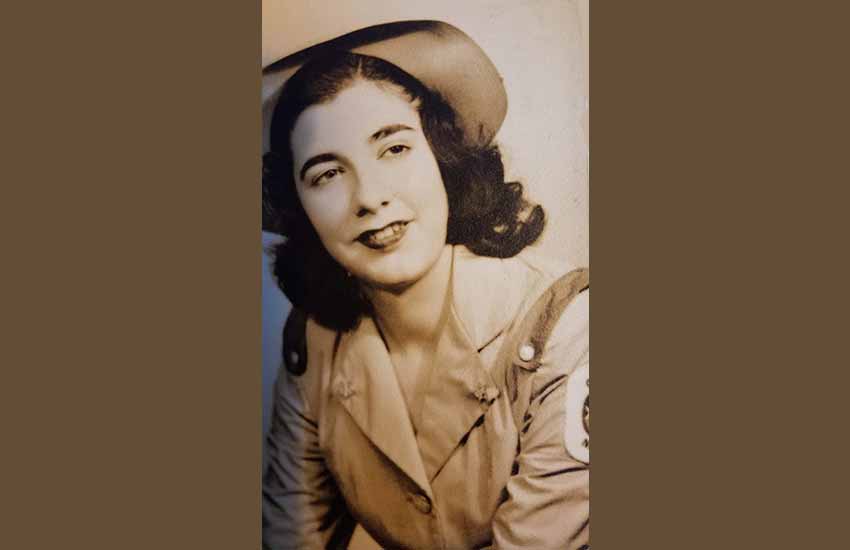
A New Yorker of Bizkaian origin, Rosa Torrontegui poses smiling in the uniform of the United States Cadet Nurse Corps, which she joined in 1943 at the age of 18. (Courtesy of the Oleaga Torrontegui family).

Under the command of the United States Public Health Service – a militarized service during WWII – the Cadet Nurse Corps tried to solve this pressing problem via a global approach.

Commitment to perform service with honor during the war

The Cadet Nurse Corps accepted more than 86% of the existing nursing schools to participate “in the first accelerated nursing education programs in the country” [3] in exchange for a series of compensatory aid and subsidies that covered tuition and other student fees. These students, in turn, received a monthly stipend according to their rank (Pre-Cadet, Cadet and Senior Cadet), free room and board, and military-style uniforms and berets (grey in color) with their own rank symbols and insignia. The Nurse Corps also provided postgraduate scholarships, which increased the number of women attending universities. In exchange, the cadets promised to perform their service with honor during the war.

The plan to address the nursing deficit focused on providing substitute care by female students in both civilian and military hospitals across the country, while graduating cadets were given the option of joining their respective nursing corps in the Army and Navy.

The initial goal of recruiting about 10% of female high school graduates (about 65,000 young women) for the program’s first year in 1943 was quickly exceeded. In fact, any woman between the ages of 17 and 35 with at least a high school diploma could apply to join the Cadet Nurse Corps. This was due, in part, to the success of the recruitment drives. Slogans such as “The girl with a future,” “A lifetime education Free!” or “Enlist in a proud profession!” attracted a wide range of women from different socioeconomic backgrounds “without discriminating on the basis of race, creed, or color” [4]. The goal of recruiting additional nursing students for the next two years (65,000 for 1944 and 60,000 for 1945) was also met. A total of almost 180,000 women applied to join the Corps.
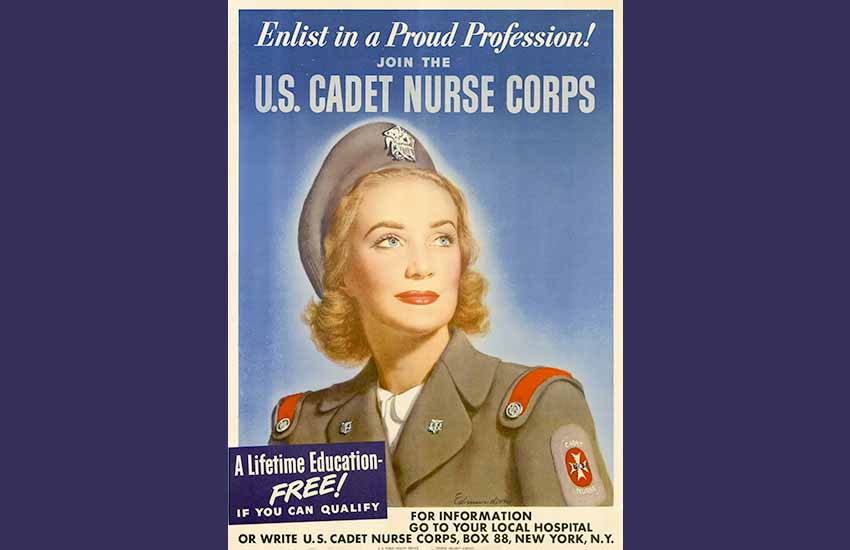
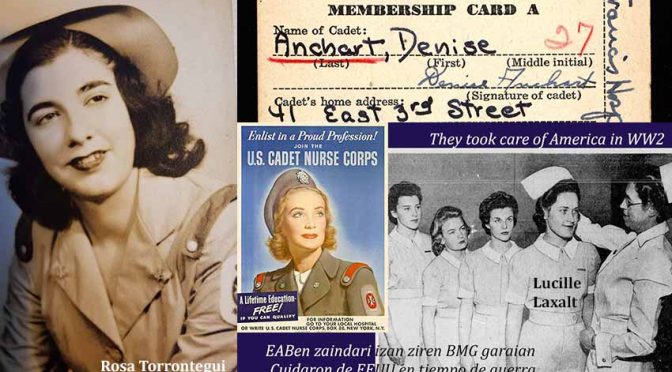
Recruitment poster “Enlist in a proud profession! Join the US Cadet Nurse Corps” (Carolyn Moorhead Edmundson, 1943. University of North Texas Libraries).

During the last six months of their training, Senior Cadets were required to work 48 hours a week on active duty, in military, government, or civilian hospitals, under supervision and assuming the same duties as a registered nurse. Most of them served in non-federal hospitals (mainly the hospitals where the cadet was trained), federal hospitals (mainly the Veterans Administration), and military hospitals. After completing this last stage, the cadet nurses received their diploma from the nursing school where they had started their training.

The positive impact of the Cadet Nurse Corps was unquestioned. In 1945, 85% of the country’s nursing students were nurse cadets, and about 80% of the hospitals were served by them during and immediately after the war, replacing the nurses who joined the Armed Forces. In conclusion, it prevented the collapse of nursing care in hospitals. In January 1945, US Surgeon General Thomas Parran, Jr. testified before the House Committee on Military Affairs, stating: “In my opinion, the country has received and increasingly will receive substantial returns on this investment. We can not measure what the loss to the country would have been if civilian nursing service had collapsed, any more than we could measure the cost of failure at the Normandy beachheads” [5].

Basque veterans of the Cadet Nursing Corps

As a national program, the Cadet Nurse Corps had a presence in all states. In this article we present the unpublished stories of seven cadet nurses of Basque origin from five states – California, Montana, Nevada, New York and Wyoming – that can help us understand the importance of the Corps in the personal and professional development of its members and in the patriotic involvement, at an early age, of the first Basque generation born or raised in the US.
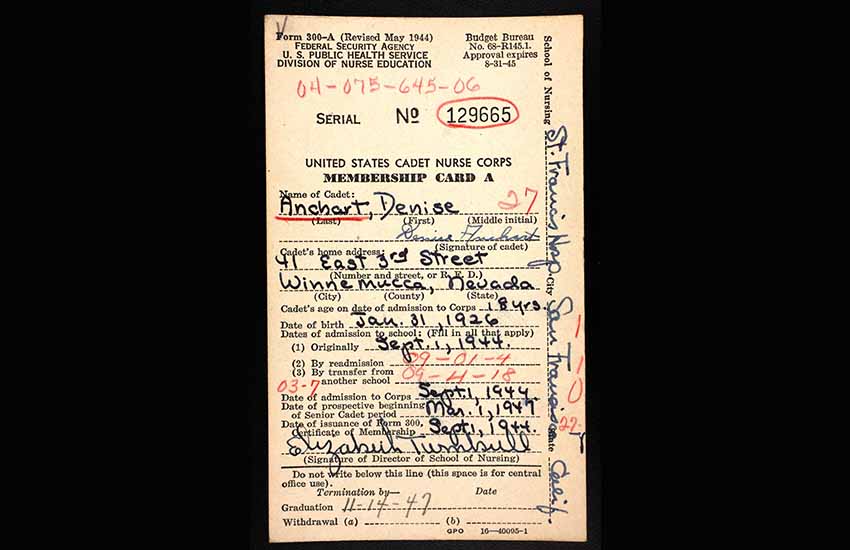
Cadet Nurse Corps Card of the Basque-American Denise Anchart, which she enlisted at the age of 17. Anchart was born to a father from Nafarroa Beherea and a Béarnaise mother in Winnemucca, Nevada, in 1926.

Six of the Cadets were born in the United States. They are Denise Anchart (Anchartechahar) Mon (born 1926 in Winnemucca, Nevada), Genevieve Mary Caricaburu (Carricaburu) Ader (1927, Glasgow, Montana), Mary Jean Etcheverry Mendiola (1921, Border Junction, Wyoming), Lucille Catherine Laxalt Ucarriet (1921, Alturas, California), Rosa Torrontegui Olondo (1924, New York), and Laura Ugarriza Sarrionandia (1926, McDermitt, Nevada).

In addition, we have been able to identify the first woman born in Euskadi to enlist in the Cadet Nurse Corps: María Josefa “Mary Josephine” Alcorta Larrañaga, born in 1927, in Bilbao, Bizkaia, but raised since she was a baby in Indian Valley, California, and later in Winnemucca, Nevada.

All of our Basque veterans of the Cadet Nurse Corps were young women between the ages of 17 and 22 at the time of their enrollment. All of them came from small rural towns – except Torrontegui who grew up in the City of Skyscrapers – and had parents that had dedicated themselves to a great extent to farming and ranching, hospitality, construction, or mining.

Only Laxalt and Etcheverry began their nursing careers before the creation of the Cadet Nurse Corps and even before the Japanese attack on Pearl Harbor.
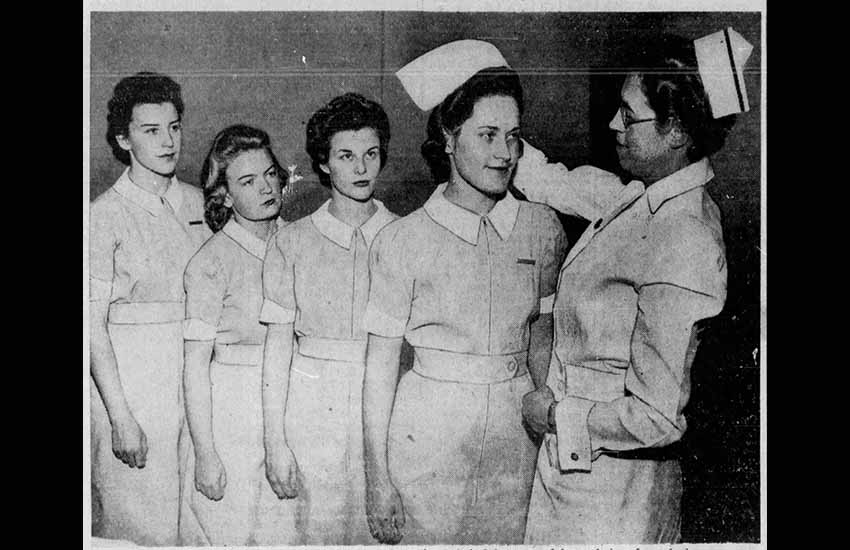
Lucille Laxalt (second from right) at the ceremony marking the end of the first three months of probation at the San Francisco Children’s Hospital nursing school (The San Francisco Examiner, December 21, 1941).

On August 19, 1941, Lucille Catherine Laxalt Ucarriet, born to parents from Zuberoa and Nafarroa Beherea, was admitted to the Children’s Hospital in San Francisco, California, to train as a nurse. She was followed by Mary Jean Etcheverry Mendiola, born to parents from Nafarroa Beherea and Bizkaia, who enrolled in the Holy Cross Hospital School of Nursing, in Salt Lake City, Utah, on September 9, 1941. While in training school, Laxalt, 22, was admitted to the Cadet Nurse Corps on July 1, 1943, the date of its creation. She graduated on March 20, 1944. Later, Laxalt successfully passed the State Board’s rigorous exam to become a Registered Nurse, a fundamental requirement to start her working life.

Like Laxalt, Etcheverry also became part of the Cadet Nurse Corps, at the age of 21, at the time of its creation. She was one of approximately 120 Wyoming cadets who served in the Corps. Etcheverry graduated from nursing school on September 14, 1944, being sent to Madigan General Hospital/Madigan Army Medical Center in Tacoma, Washington. It was there that she met her future husband, Normandy D-Day veteran Clarence Edward Vote (1911, Minot, North Dakota). Seriously injured, Vote spent four years of his life recovering in the hospital. Although cadets weren’t supposed to fraternize with soldiers, they found a way to get to know each other. Etcheverry was honorably discharged with the rank of second lieutenant on June 9, 1948, as part of the Army Nurse Corps, which she had joined upon her graduation as a cadet. Four months later, on October 16, 1948, she married Vote.
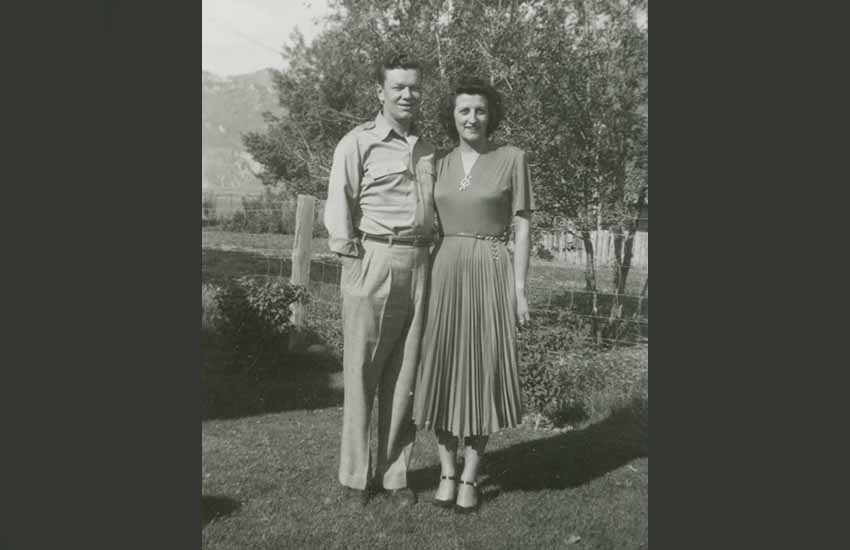
Mary Jean Etcheverry poses with her husband Clarence Edward Vote in military uniform (Courtesy of the Etcheverry family).

On the east coast, 18-year-old Rosa Torrontegui Olondo, born to Bizkaian parents, also joined the Cadet Nurse Corps in 1943, just one month after its formation, being admitted to Bellevue Nursing School, New York, on August 12. Torrontegui graduated on October 12, 1946. As her daughter, Patricia Oleaga, told us, “She was expected to serve in the war, but the war ended just when she graduated from nursing school.” A year after her graduation, Torrontegui married her Basque compatriot, WWII veteran Feliciano “Félix” Oleaga Garayo (Mundaka, Bizkaia, December 13, 1921) in New York.

“Echoes of two wars, 1936-1945” aims to disseminate the stories of those Basques and Navarrese who participated in two of the warfare events that defined the future of much of the 20th century. With this blog, the intention of the Sancho de Beurko Association is to rescue from anonymity the thousands of people who constitute the backbone of the historical memory of the Basque and Navarre communities, on both sides of the Pyrenees, and their diasporas of emigrants and descendants, with a primary emphasis on the United States, during the period from 1936 to 1945.

THE AUTHORS
Guillermo Tabernilla
is a researcher and founder of the Sancho de Beurko Association, a non-profit organization that studies the history of the Basques and Navarrese from both sides of the Pyrenees in the Spanish Civil War and in World War II. He is currently their secretary and community manager. He is also editor of the digital magazine Saibigain. Between 2008 and 2016 he directed the catalog of the “Iron Belt” for the Heritage Directorate of the Basque Government and is, together with Pedro J. Oiarzabal, principal investigator of the Fighting Basques Project, a memory project on the Basques and Navarrese in the Second World War in collaboration with the federation of Basque Organizations of North America.

Pedro J. Oiarzabal is a Doctor in Political Science-Basque Studies, granted by the University of Nevada, Reno (USA). For two decades, his work has focused on research and consulting on public policies (citizenship abroad and return), diasporas and new technologies, and social and historical memory (oral history, migration and exile), with special emphasis on the Basque case. He is the author of more than twenty publications. He has authored the blog “Basque Identity 2.0” by EITB and “Diaspora Bizia” by EuskalKultura.eus. On Twitter @Oiarzabal.

Josu M. Aguirregabiria is a researcher and founder of the Sancho de Beurko Association and is currently its president. A specialist in the Civil War in Álava, he is the author of several publications related to this topic, among which “La batalla de Villarreal de Álava” (2015) y “Seis días de guerra en el frente de Álava. Comienza la ofensiva de Mola” (2018) stand out.

The Torronteguis, leaders of the New York Eusko Etxea

When Patricia was young, her mother went back to work as a nurse and then as a pediatrics instructor at the Queens General School of Nursing until it closed. She completed her bachelor’s degree from the City University of New York in Queens and her master’s degree at C.W. Post at Long Island University. She continued to work in Manhattan at Gouverneur Hospital as a charge nurse and returned to Queens General as their nurse epidemiologist just as New York City was hit by a virus, totally unknown at the time, and later known as AIDS. She worked as an epidemiologist until she retired. Both Rose and her husband were very active in the hundred-year-old Basque association in New York, Euzko-Etxea: he becoming president of it and she the president of the Andrak women’s group.

Back in the American West, after graduating from Glasgow High School, Montana, Genevieve Mary Caricaburu Ader joined the Cadet Nurse Corps on September 25, 1944, training at the Columbus Hospital School of Nursing in Great Falls, Montana. Born to parents from Nafarroa Beherea and Lapurdi, Caricaburu was one of approximately 1,770 Montana women who joined the corps. She was just 17 years old, the second youngest in our group of Basque veterans.

Caricaburu graduated in February 1947. A month later, she began studying psychiatric nursing at the Montana State College of Nursing in Warm Springs, later working at the Veterans Hospital in Lincoln, Nebraska. At the end of that year, Genevieve married WWII veteran Lawrence Frank Kotecki (1924, Thorp, Wisconsin) in Lincoln. Upon her death at the age of 81, she was buried at Fort Logan National Cemetery in Denver, Colorado, alongside her husband, not on her own merits during the war, but because she was the wife of a veteran. Today, as we will see later, the associations related to the Cadet Nurse Corps have made the right to be buried in a military cemetery a central part of their banner of struggle.

The three remaining Basques – Alcorta, Anchart, and Ugarriza – joined the Cadet Nurse Corps after graduating from Humboldt High School in Winnemucca in May 1944. Two more girls out of a total of 40 young women from the same class also joined. They were Emile Germanine Bellon and Iva May Quilici. All of them were admitted in early September 1944 and graduated between September and November 1947.

A patriotic commitment

“Probably if the war hadn’t come along I know my father expected me to go to the University of Nevada,” Denise Anchart (Anchartechahar) Mon confessed. “But all the boys were going into the service […] the boys were doing their patriotic thing and we thought we should […] and if you look at our year book it’s the skimpiest one in the library, and the girls thought, ‘Well what are we going to do?’ So they had the Cadet Nurse Corps and quite a few from Winnemucca did go. Let’s see, five of us went the year I went,” recalled Anchart [6].

At just 17 years old and the youngest of our Basque cadets, María Josefa “Mary” Alcorta Larrañaga, began her training at Mercy Hospital Nursing College in Sacramento, California, while Anchart began hers at St. Francis Hospital in San Francisco. Laura Ugarriza Sarrionandia, whose parents were from Bizkaia, was admitted to St. Luke’s Hospital, also in San Francisco. After the war, Ugarriza continued her nursing career and studied Public Health at the University of California, Berkeley.

“Fortunately the war ended soon,” Anchart said, relieved. The Nurse Cadet Corps “was a three-year hospital program, and the war did end in three years… If the war hadn’t ended – the government paid for my education, my obligation was to go in the service as an officer,” Anchart explained. At the time of their induction, each nurse cadet had to take an oath, part of which reads: “I am solemnly aware of the obligations I assume toward my country and toward my chosen profession; […] As a Cadet Nurse, I pledge to my country my service in essential nursing for the duration of the war.” She concluded “I did have a choice as to whether I wanted to go in the Army or whether I wanted to go in the Navy. And we thought about it all the time. Fortunately, I was in San Francisco VE Day, and VJ Day” [6].

Towards the honorary status of war veterans

Cadets in gray are here to carry along
The valiant fight to keep America strong!

We’re the Cadets, 
We’re in the Corps,
Doing our part to help the nation win the war, 
Doing the job we’re chosen for, 
United States Cadet Nurse Corps

(Stanza of the U.S. Cadet Nurse Corps March by Beatrice and Edmund Ziman, 1944.) 

Approximately 124,000 nurse cadets were trained during the course of the war. The Nurse Cadet Corps became the largest and youngest group of uniformed women to serve their country. Admission to the Corps – a time-honored service for the duration of the war – stopped two months after Japan’s surrender. However, the Corps remained active until 1948, completing the training of over 116,000 cadets and caring for wounded soldiers on their return to military hospitals.

Only uniformed Corps without veteran status

In addition to the tens of thousands of nurse cadets, another 350,000 American women served as volunteers in the “auxiliary” military corps created ad hoc at the beginning of the war and assigned to different military branches, serving both at home and abroad.

These new military corps (Women’s Army Corps, Women Accepted for Voluntary Emergency Service, and Women Air Force Service Pilots) joined the traditional Army and Navy nursing corps, which numbered a large number of women, many of them cadets. With the exception of the Women Air Force Service Pilots, who did not receive veteran status until 1977, the rest of the “auxiliary” corps received full military status and thus enjoyed post-war benefits.

In contrast, upon discharge, members of the Cadet Nurse Corps did not receive veteran status nor the benefits associated with it.

At the time of this writing, nurse cadets are the only members of all uniformed corps that served in WWII who have not yet been recognized as veterans by the US Congress. Several bills have been introduced in Congress to rectify this injustice, but so far all have failed.

As Barbara Poremba, founder of Friends of U.S. Cadet Nurse Corps WWII, comments “These women of the Greatest Generation only request to be honored as Veterans of WWII with an American flag and a gravesite plaque forever marking their proud service to our country during wartime in the United States Cadet Nurse Corps” [7].
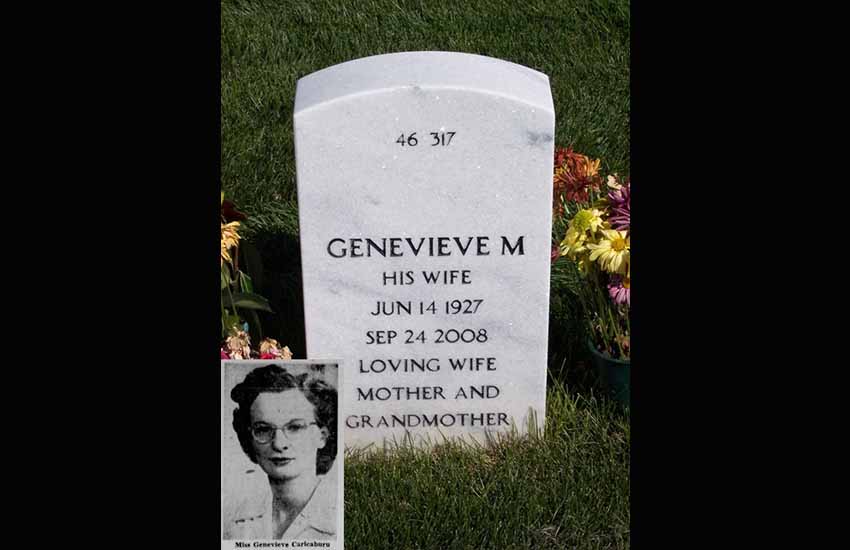
Genenieve M. “His wife” refers to Basque-American Genevieve Caricaburu, wife of veteran Lawrence Kotecki, both buried in Logan National Cemetery, Colorado. Despite having been a member of the WWII Cadet Nurse Corps, they have not been recognized as war veterans and therefore do not have the right on their own merits to be buried in a military cemetery like the one in Logan (Courtesy of “2Honour&Remember”; https://www.findagrave.com/memorial/36077468/genevieve-m-kotecki; The Lincoln Star (Lincoln, Nebraska. July 16, 1950. P. 30)).

The year 2023 will mark the 80th anniversary of the creation of the US Nurse Cadet Corps. Wouldn’t it be fair to recognize the service performed by the nurse cadets during the WWII? What better way to do this than by granting its members honorary veteran status. From Sancho de Beurko and the “Fighting Basques” research team we believe so and we fully support the initiative.

If you know a cadet nurse of Basque origin, you can write to us at sanchobeurko@gmail.com.

Sources

American Nurses Association, Inc./Foundation. “50th Anniversary: 1944-1994: Enlist in a Proud Profession! Join the U.S. Cadet Nurse Corps.” Part 1 and Part 2.

Anchart, Denise and Andrée, “The Anchart Family Oral History,” by Linda Dufurrena. 1993. Humboldt County Library Oral History Project. Nevada Library Cooperative.

A Salute to the Cadet Nurse Corps: Commemorating Fifty Years of Service.”

Information Program for the United States Cadet Nurse Corps.” Prepared by the Office of Program Coordination, Office of War Information, in cooperation with U.S. Public Health Service, Federal Security Agency. September 1943.

Poremba, Barbara. “Celebrating the 75th Anniversary of the Establishment of the US Cadet Nurse Corps of 1943”.

The USCadetNurse.org Foundation.

Turk, Marilyn. “The United States Cadet Nurse Corps.” April 22, 2017. Heroes, Heroines and History.

Willever-Farr, Heather and John Parascandola. “The Cadet Nurse Corps, 1943-48.” Public Health Reports, Vol. 109 (May-June 1994): 455-457.

References

[1] Turk
[2] American Nurses Association
[3] Poremba
[4] “A Salute to the Cadet Nurse Corps…”
[5] Poremba
[6] Anchart, Denise and Andrée… Pp. 43-45.
[7] Poremba

Collaborate with ‘Echoes of two wars, 1936-1945.’

If you want to collaborate with “Echoes of two wars” send us an original article on any aspect of WWII or the Civil War and Basque or Navarre participation to the following email: sanchobeurko@gmail.com

Articles selected for publication will receive a signed copy of “Combatientes Vascos en la Segunda Guerra Mundial.”

Basque Fact of the Week: Pheasant Island, the Basque Island that is Part of both Spain and France

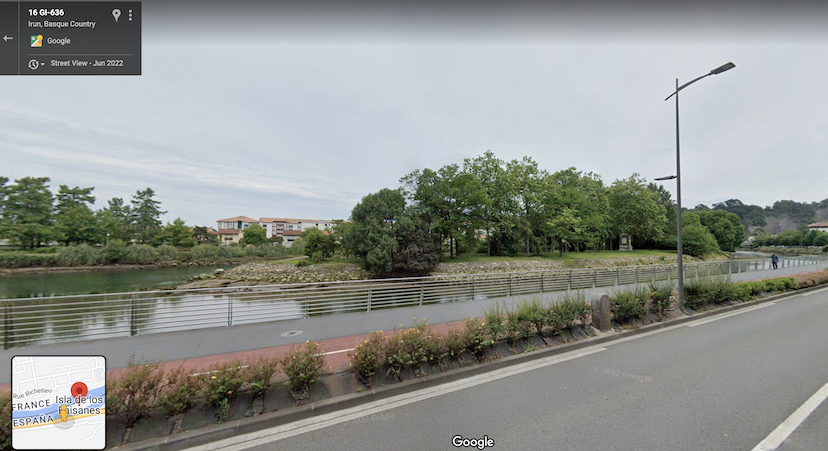
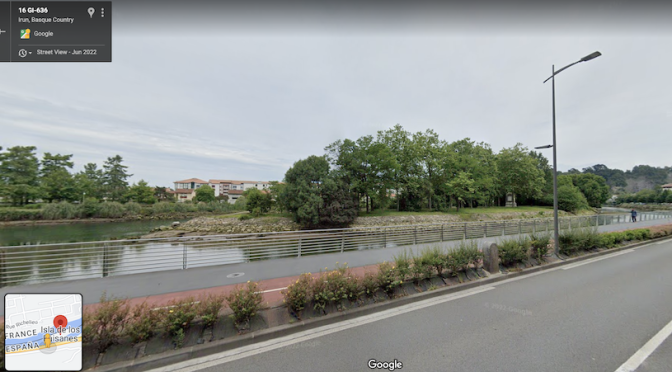
Pheasant Island, called Konpantzia in Euskara, is an island jointly administered by Spain and France, swapping hands every six months. It is what is called a condominium, a territory shared by more than one sovereign power. Because of its unique position on the river that defines the Spanish-French border, the island has seen its share of history. The shared agreement also leads to some complex legal matters between the two countries.

A view of Pheasant Island from Irun, as found on Google Maps.
  • Pheasant Island is small, only about two acres. While Pheasant Island isn’t the only condominium in the world (Antarctica is also a condominium), it is both the longest lasting and the only one that actually alternates sovereignty between two nations.
  • The ownership of, or better said jurisdiction over, Pheasant Island shifts every six months between Spain and France. In practice, administration alternates between Irun, Gipuzkoa, and Hendaia, Lapurdi. No one is allowed on the island, which sits in the middle of the Bidasoa river, which itself defines the border between France and Spain, and separates Irun from Hendaia.
  • Pheasant Island is sometimes also known as Conference Island, though the shifting sands of the river banks may have actually created two islands at one point. This second name comes from the fact that several international meetings occurred on the island. Perhaps the most famous led to the Treaty of the Pyrenees. This treaty, signed on November 7, 1659, was negotiated on Pheasant Island and ended the Franco-Spanish War, which had begun in 1635. Amongst other things, this treaty had France give up its claim to Catalunya while Spain had to cede all of the territory France had gained in the previous Peace of WestphaliaMaria Theresa of SpainPhilip IV of Spain‘s daughter, was also arranged to marry Louis XIV of France. In the Meeting on the Isle of Pheasants in June of 1660, Maria crossed over from Spain to France via the island. The treaty also established the dual authority of Spain and France of Pheasant Island.
  • The Treaty of Bayonne, in 1856, further solidified this status. At the time, there was a real danger of the island simply disappearing due to erosion, so what would the two nations co-own in that case? Further, Spain was asserting ownership of the Bidasoa river, which caused the legal status of the island to be reevaluated. This treaty confirmed the condominium status of the island.
  • However, there was still some confusion. On May 21, 1877, Spanish authorities arrested five girls from Hendaia who had made their way to the island, at that moment under Spanish control. The French protested, saying that jurisdiction over crimes should belong to the accused’s country. On the other hand, Spain said it should belong to whoever was in charge of the island at the time of the crime. In 1901, they reached an agreement where policing would be the responsibility of the country that currently administered the Island, but if the crime involved a French or Spanish national, they would be handled by their respective national courts. It becomes quite messy when, for example, a Frenchman does something that would be a crime in France, but not in Spain while Spain is administering the island…

Primary sources: Auñamendi Entziklopedia. FAISANES, Isla de los. Available at: https://aunamendi.eusko-ikaskuntza.eus/en/faisanes-isla-de-los/ar-64848/; Pheasant Island, Wikipedia; Pheasant Island, Atlas Obscura

The Adventures of Maite and Kepa: Part 112

Maite turned back to de Lancre. “I don’t understand why you haven’t collected that zatia yet. Why are you still here?”

“Simple, really,” said de Lancre. “I can do whatever I want in this bubble. I can live whatever life I want. I can get away with anything.” He looked over the railing at the people walking on the pathways far below. “See all of those people? You know what they remind me of? Ants. Scurrying to and fro, oblivious to the powers above them. I could squash any one of them at a moment’s notice. And, there isn’t anything to stop me.”

The Adventures of Maite and Kepa is a weekly serial. While it is a work of fiction, it has elements from both my own experiences and stories I’ve heard from various people. The characters, while in some cases inspired by real people, aren’t directly modeled on anyone in particular. I expect there will be inconsistencies and factual errors. I don’t know where it is going, and I’ll probably forget where it’s been. Why am I doing this? To give me an excuse and a deadline for some creative writing and because I thought people might enjoy it. Gozatu!

“I’m sure there have to be laws about killing random civilians even here,” replied Maite dryly. 

“Oh, of course,” continued de Lacre. “But, there is no consequence. If I were to get into any kind of trouble, I can simply pop the bubble by collecting that piece of magic over there -” he gestured to the table and the sphere that floated above it “- and be back to my own time. I can literally get away with murder and no one would even know, once it is all erased.”

“You would know.”

“True, but it wouldn’t bother me. And, I have to admit, I have lived through many bubbles with that attitude. But, I’ve grown rather bored of it all. That’s why, here, I decided to take a different approach. I want to do things the ‘right’ way, I want to be a real part of the bubble and its people. And.” He paused, looking directly at Maite. “And, I want to get to know you.”

“What do you mean by that?” asked Maite, her sense of dread growing.

“We can do anything here,” said de Lancre. “I want you to be my partner. I want to share all of this with you.”

Maite shook her head. “Even if I were tempted, which I’m not, I won’t do that to Kepa.”

“He’ll never know. Once the bubble is popped, you go back to him. Consider it a fling.”

Maite shivered with disgust. “I would know.”

De Lancre sighed. “I expected you to say that. I admit, I hoped you wouldn’t, but while I’m disappointed, I’m not surprised.”

De Lancre snapped his fingers. Three spheres immediately swooped in. “They will lead you back to your room. You can ponder my offer further in there.”

Maite didn’t bother looking at de Lancre as she followed the spheres back to her room, which she fully realized was also her cell.

If you get this post via email, the return-to address goes no where, so please write blas@buber.net if you want to get in touch with me.

Basque Fact of the Week: Basques and Costa Rica

At the end of June, my wife, my daughter, and I did an ecotour of Costa Rica. We did and saw lots of awesome things, from wildlife (the goal was to find frogs and we saw a lot of them, as well as bats, tapir, monkeys, and crocodiles), whitewater rafting, ziplining, waterfalls, cocoa and coffee tours… it was jam packed. But one thing we didn’t see a lot of was Basque names. We see them everywhere in New Mexico, but not so much in Costa Rica. It made me curious about the Basque history of this beautiful country…

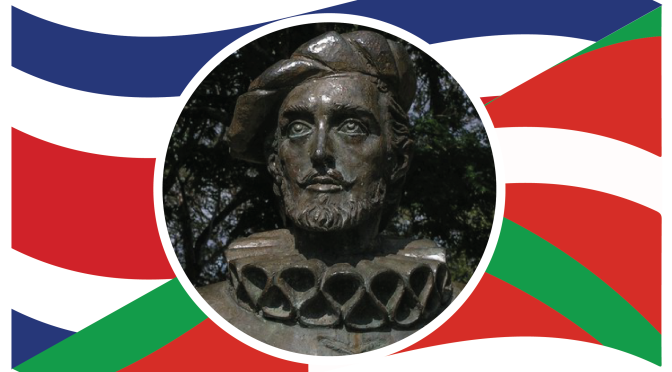
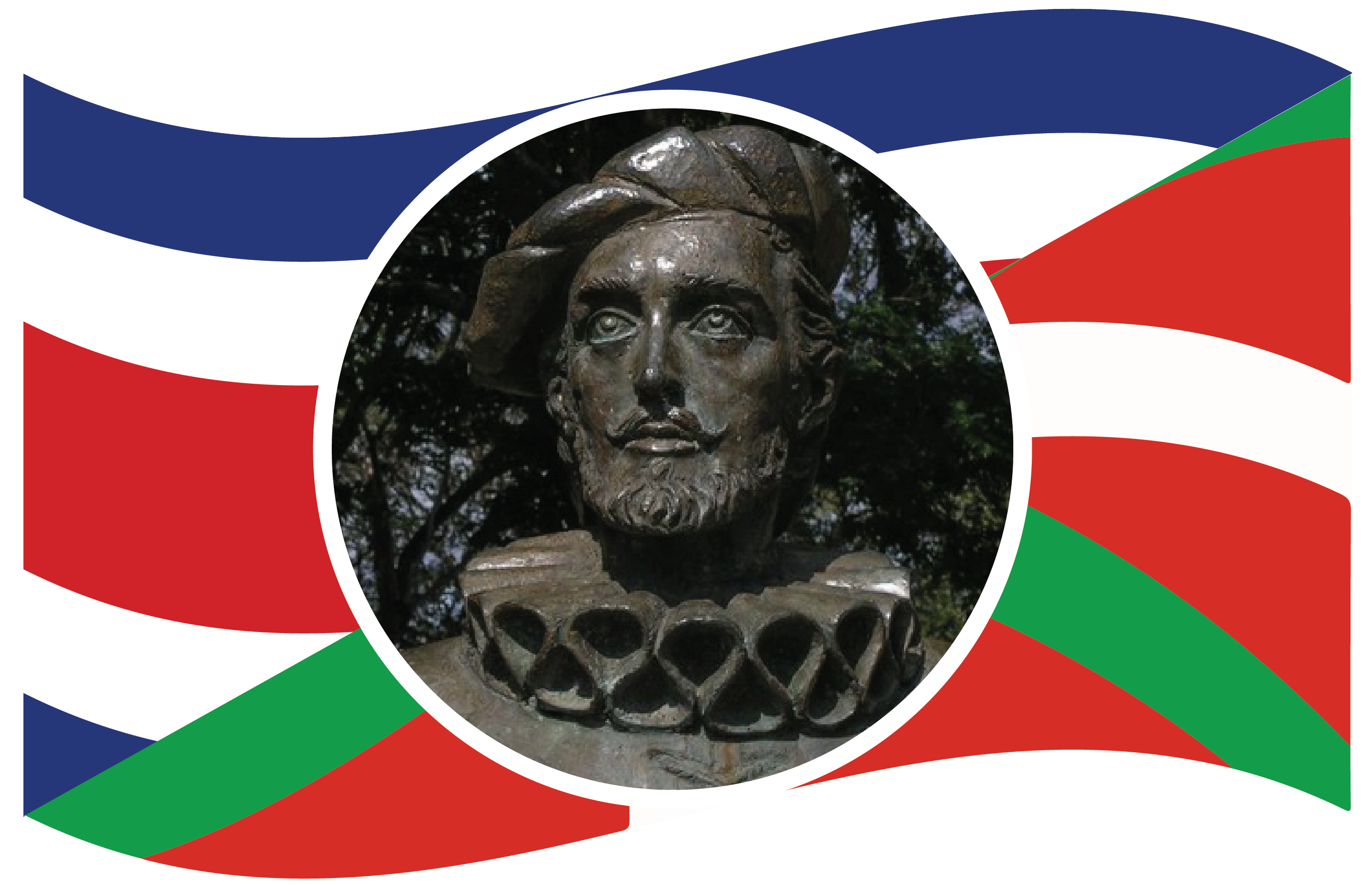
Bust of Diego de Artieda Chirino y Uclés (photo found on diver.net).
  • While what would become Costa Rica was first encountered by Christopher Columbus in 1502, and many settlers tried to colonize the region in the name of the Spanish crown in later years, it wasn’t until 1573 that Costa Rica was established as its own province – the Province of Costa Rica – separate from that of other larger entities such as the Kingdom of Guatemala, replacing the Province of Nuevo Cartago y Costa Rica. In that year, Diego de Artieda Chirino y Uclés was authorized by King Felipe II to “discover and settle the province called Costa Rica.” Artieda was from Esparza de Salazar (Espartza Zaraitzu in Euskara), a small town in Nafarroa. His parents were Pedro de Uclés and María Enriquez Chirino. He was charged with founding at least three cities, one of which – Artieda del Nuevo Reino de Navarra – didn’t last long. He also founded the city of Esparza (today Esparta) in 1578. In 1577 he was named governor for life of Costa Rica, until he was deposed in 1589. He died a year later in Guatemala City.
  • Two Basque families figured prominently in the early history of Costa Rica. The first is the Retes family. Jerónimo de Retes Salazar was born in 1560 in Bilbao to Pedro de Retes and Doña Petronila Lloredo. He married María de Ortega in 1595 and died young, in 1596, in Cartago, Costa Rica. His son, Jerónimo de Retes y López de Ortega, was an important military man and explorer of the region. He was captain of the militia and later Alguacil Mayor of Cartago. He subdued two kings of the indigenous Votos, Pocica and Pisiaca, and explored the Cutrís and Jovi rivers (today San Carlos and Sarapiquí). He was a very active merchant and continued to make excursions into indigenous areas, trying to capture slave labor. His daughter, Doña Ana de Retes, sold some of the land she inherited from her father which later became the site of the city of Santa Ana.
  • The second family was the Echavarría Navarro. Juan de Echavarría Navarro was born in sometime in the late 1580s in Spain. He became treasurer of Costa Rica until 1632 when he died at a relatively young age. He had married María de Sandoval. Their son, also named Juan, married the previously-mentioned Doña Ana de Retes. Juan, the junior, was mayor of Cartago for a few years. He obtained weapons and ammunition to protect the city and region against pirates. Two of his brothers, Domingo and Francisco, became priests.
  • By the 18th century, the economic fortunes of these families had declined. However, connections to the Basque Country remained strong. The women descended from these “first” families often married emigrants from the Basque Country, men like Domingo Inza and Lorenzo de Arburola Irribaren from Gipuzkoa, Luis Fernando de Liendo y Goicoechea from Bizkaia, and Esteban de Hoses from Nafarroa. Thus, through these networks with the Basque Country, Basques continued to be an important part of Costa Rican society and politics.
  • However, the cultural impact of the Basque immigrants to the region is less visible. There was a fronton in San José, the capital. Beti-Jai opened in 1904. This fronton is now the headquarters of the Technological Institute of Costa Rica stands .A second, named Jai-Alai, opened in 1929. This second one was built by two Basque brothers – Ángel and Serafín Makúa. Serafín, an architect, also was involved in the construction of frontons Havana, Mexico City, San Salvador, and Guatemala City. However, Jai-Alai lasted only a decade before it was converted to a skating rink and then a police station, before being demolished to make way for an artist market. The club Campestre Español, in Belén, opened a fronton in 2002.

Primary source: Quirós Vargas, C., Velázquez Bonilla, C., & Payne Iglesias, E. (2004). Los Vascos en la República de Costa Rica. Análisis de su posición social, económica y mentalidad colectiva. Siglos XVII y XVIII. Revista Del Archivo Nacional68, 117-139. 

The Adventures of Maite and Kepa: Part 111

“What now?” asked Maite, as she finished her coffee and placed the empty cup on the table.

“Well,” said de Lancre, “I thought I might show you some of the most amazing parts of the city, the parts that the average person never gets to see. The real heart.”

The Adventures of Maite and Kepa is a weekly serial. While it is a work of fiction, it has elements from both my own experiences and stories I’ve heard from various people. The characters, while in some cases inspired by real people, aren’t directly modeled on anyone in particular. I expect there will be inconsistencies and factual errors. I don’t know where it is going, and I’ll probably forget where it’s been. Why am I doing this? To give me an excuse and a deadline for some creative writing and because I thought people might enjoy it. Gozatu!

“That does sound fascinating.” Maite stood up. “Do you mind if I freshen up before we go?”

“Of course not,” replied de Lancre. With a wave of his hand, a few spherical drones flew in to clean up the table. “Take your time, we are in no hurry.”

Maite murmured a thanks as she made her way back to her room. Once inside, she nearly collapsed against the wall. 

“What am I going to do?” she thought to herself. “Kepa probably thinks I’m dead. But, instead, I’m stuck here with a madman.”

She went to the bathroom. The large pod loomed in the corner. She shook her head, disappointed there was no sink for her to splash some water on her face. Remembering how she felt after using the pod earlier, she stripped down and entered the pod. A few minutes later, she stepped out, feeling rejuvenated. She wasn’t quite sure what the pod did, but she felt like she had just had the best combination of a massage, spa treatment, and shower all rolled into one.

She decided to go with something more understated and practical to wear, picking out tight leggings and a long-sleeved shirt that fell past her buttocks. It almost reminded her of the workout outfits people wore in the eighties, though without so much color. She looked into the mirror (at least they still had mirrors!), sighed, and made her way back to the patio.

De Lancre was standing at the railing, looking over the city. He turned as he heard her footsteps. “If I may say so, you look stunning.”

Maite blushed but said nothing as she approached the railing. Trying to ignore de Lancre, she focused on the view. Buildings reached as far as she could see. There seemed to be no boundary to the city. There was no rural countryside. A pang went through her as she realized that there would be no more baserriak, no more farm houses. However, she did see that the buildings were intertwined with trees and plants. She could hear the call of birds as they flew between the buildings as if they were in a forest canopy. The city itself was as green as any forest she had seen. It was as if the city had pulled surrounding nature into itself.

“The way the city melds with nature…” she began.

“Amazing, isn’t it?”

“How do you plan all of this?”

“I – we – don’t plan anything, to be honest,” said de Lancre as he turned, leaning on the railing, to look at Maite. “There is a a central AI that controls all of this, directing the swarms of nanobots to do the actual work.”

“Who controls the AI?” asked Maite.

De Lancre shrugged. “No one? To be honest, I don’t really know. It was already in place when I got here. I’ve just helped guide it a bit, that’s all.”

Maite shook her head in disbelief. “You let computers control everything. That’s our worst nightmare where and when I’m from. Is it… alive?”

“I don’t know. Maybe? I don’t know enough to be able to answer that. Remember, I am from a time where we didn’t even have running water. While I’ve lived literally hundreds of lives since then, most of them are in bubbles where I haven’t had a chance to learn these things myself.”

Maite turned back to the view of the city and watched as another building disappeared in front of her eyes. The awe she felt before was replaced, at least in part, by a sense of dread.

If you get this post via email, the return-to address goes no where, so please write blas@buber.net if you want to get in touch with me.

Basque Fact of the Week: Jai Alai

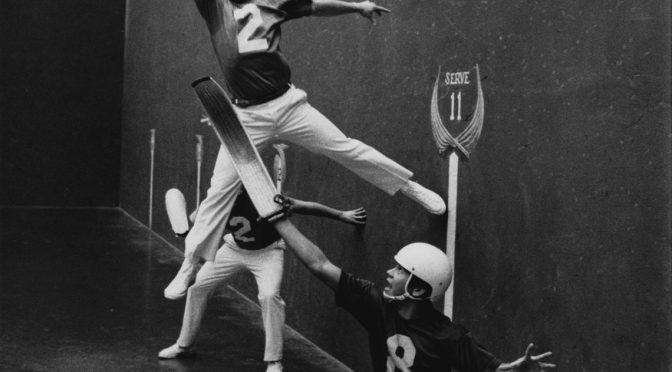
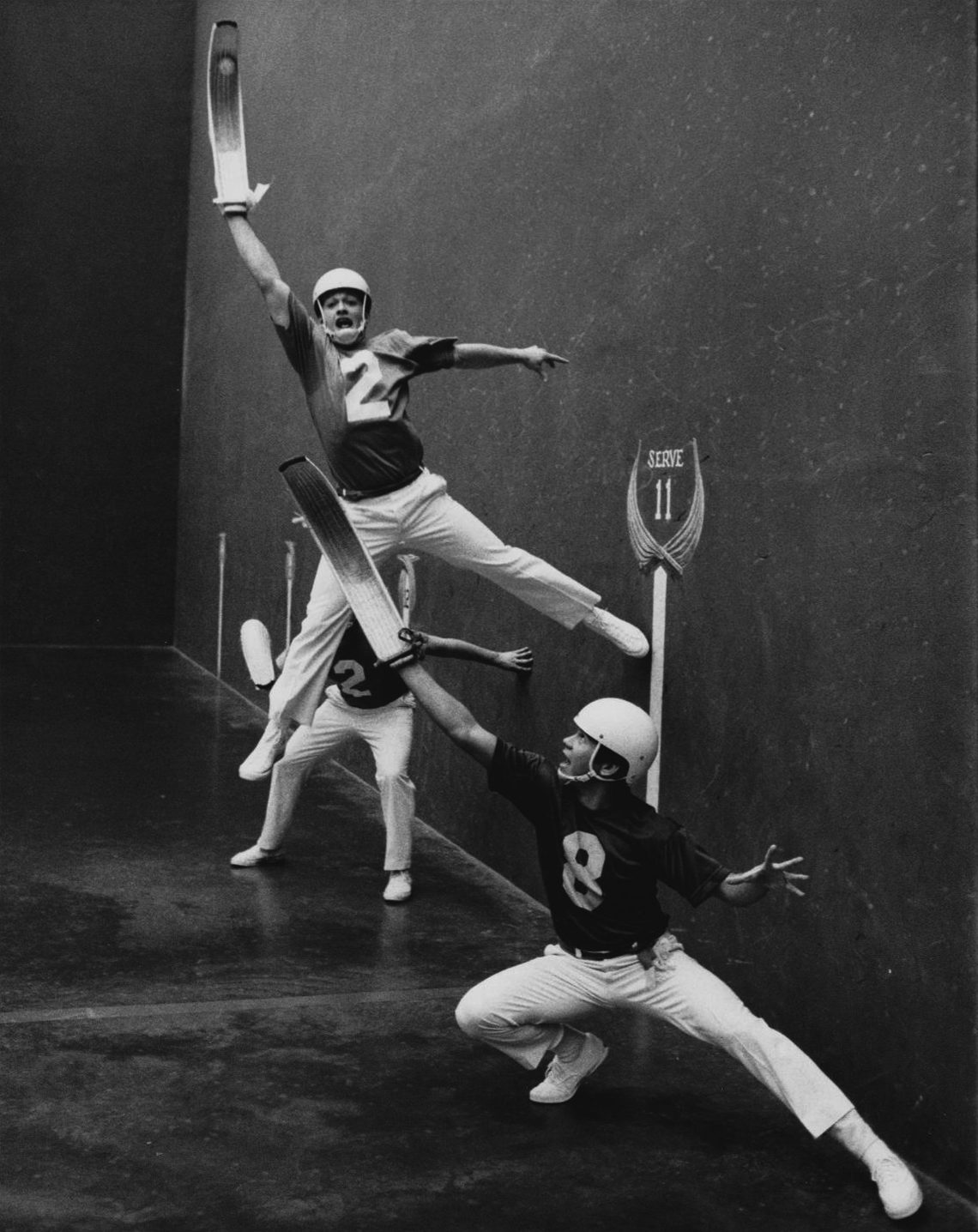
Jai alai has been called the world’s fastest sports game and, indeed, the fastest clocked ball, at 188 miles per hour, is from a jai alai player (though golf balls have been clocked at over 217 miles per hour). Since 1920, at least four players have died from being hit by the ball, or pelota. The strange visuals of the sport, involving a long wicker basket that players use to throw the ball against the front wall, has captured the imagination of many. The game’s popularity soared in the United States in the 1970s, along with its association with gambling.

Jai alai players in Florida. Photo from Le Courrier de Floride.
  • Jai alai grew out of other forms of pelota when, in 1857, Juan Dithurbide started selling wicker baskets to replace the leather gloves then being used. Alberto Alcorta Tellechea further modified the baskets to be worn instead of held. From there, the sport took off. It was an official sport of the 1900 Olympic Games in Paris, though that was the only time it held that honor.
  • Almost from day one, jai alai has been associated with gambling and the two have ever since held an intertwined history. The sport was popular in US cities such as Chicago and New Orleans until those cities banned gambling. Cuba boasted the first fronton in the Americas, built in 1901, but jai alai was banned by Fidel Castro when he took power in 1959. The sport was even played in China until the communist party, again concerned about the associated gambling, banned the sport. In the United States, jai alai is still played in Florida where betting on the sport is legal.
  • In the United States, the popularity of jai alai peaked in the 1970s. In 1975, Miami Jai Alai hosted some 15,000 spectators. But, as you can see from this timeline, jai alai’s popularity soon declined as other options for gambling, including the lottery and casinos on Native American lands, became more prevalent and popular.
  • Jai alai was also the backdrop to some very dark intrigue. Roger Wheeler, the newly minted owner of World Jai Alai in Miami, was found dead, shot in the head, in his car on May 27, 1981. It turns out that World Jai Alai was being used in an embezzling scheme and Wheeler found out about it when he became owner. The gang was skimming on the order of $10,000 per week from parking lot revenues. The infamous Whitey Bulger was one of the men associated with Wheeler’s murder, which was featured on the first-ever episode of Unsolved Mysteries.
  • Jai alai witnessed the longest strike in professional sports history in the United States, lasting from 1988 to 1991. Players, mostly Basques, picketed the frontons as they were replaced by relatively inexperienced players.
  • Famed novelist Ernest Hemingway proposed a plan to help the Allied efforts during World War II. He would pretend to be fishing on his boat, Pilar. With him would be jai alai players he recruited from Cuba. They would sit aboard his boat and toss grenades at the German U-boats. He proposed this plan to the Office of Naval Intelligence (ONI), who were skeptical but who gave him just enough weaponry to placate the writer. In the end, he encountered only one U-boat, but was unable to engage it. It doesn’t seem any jai alai players were part of his activities in the end.

Primary sources: The Shrouded Mystery of Jai Alai, Weebly.com; Jai alai, Quartz; Jai alai, Wikipedia

Basque Fact of the Week: Otorduak, Meals of the Day

There is a scene in one of The Lord of the Rings movies when one of the hobbits is shocked that the human doesn’t know what second breakfast is. The scene always makes me think of the Basque Country; when I go there, it seems I never stop eating. Food is such an important part of the Basque culture, not only to fill bellies but to bring people together – meals are a big part of social life.

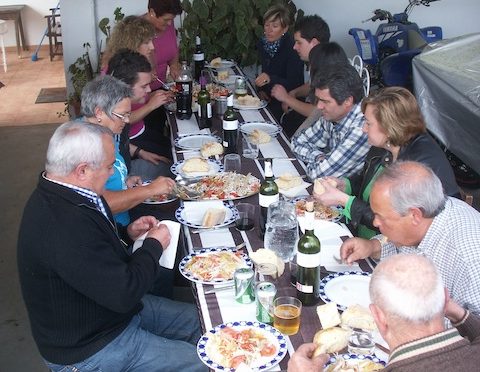
Lunch with my dad’s family in Amorebieta back in 2012. I think they “made” me eat three whole rabbits that day…
  • Like most western cultures, there are three primary meals each day. The day starts with breakfast – gosari or barausi. In the Basque Country, this often consists of a drink – coffee or tea for adults and milk or juice for children – and some kind of cereal or pastry, though sometimes eggs or ham might make its way to the breakfast plate. According to Larry Trask, gosari comes from the word gose, meaning hunger. The suffix –ari is often associated with meals, so this is the meal of hunger.
  • The middle of the day, usually between 12 and 4pm, is broken up with lunch – bazkari. Timing is slightly different in Iparralde compared to Hegoalde: in the north, influenced by French customs, lunch is typically from 12-2, while in the south it is more often from 1-3. Lunch is by far the biggest meal of the day in the Basque Country. Trask relates this word to baratu, a Basque word for stop.
  • And, the last meal of the day is afari – dinner. In Hegoalde, dinner is usually pretty late, particularly by standards in the United States: dinnertime ranges from 9pm to midnight (I’ve sat down to eat more than once after midnight in the Basque Country). Trask’s etymological dictionary highlights sorgin-afari, used in Bizkaia, which is a dinner eaten by women celebrating the last social gathering of the winter and sorgin-apari, from Gipuzkoa, a light midnight supper eaten while building a lime-kiln. Of course, sorgin means witch. While afari has that same –ari ending, the meaning of the root has been lost, though some of related it to gau, the word for night.
  • But, that’s not all! Hamaiketako or hamarretako – literally meaning the meal of 11am or 10am, respectively – is a light meal that is eaten between breakfast and lunch, typically at 10 or 11am, as the name suggests.
  • And, not to be outdone, there is an afternoon meal as well: askari, arratsaldeko, or merienda. This is another light snack, often a sandwich, to bridge the gap between lunch and dinner.

Primary reference: Otordu, Wikipedia; Etymological Dictionary of Basque, by R. L. Trask, edited for web publication by Max W. Wheeler

The Adventures of Maite and Kepa: Part 110

Kepa wasn’t sure what time it was when he woke up. If there was a way to access the time in his room, he couldn’t find it. And, while he suspected the pod next to his cot was meant to help him with his… bodily functions… he couldn’t figure it out either.

He approached his door, the sphere in his hand, and it silently opened. The big circular room had about the same number of people as before – maybe ten to fifteen – but they were scattered in different parts of the room at different tables. He scanned the room and saw Latxe sitting at one of the tables with a couple of other people, a man and a woman.

The Adventures of Maite and Kepa is a weekly serial. While it is a work of fiction, it has elements from both my own experiences and stories I’ve heard from various people. The characters, while in some cases inspired by real people, aren’t directly modeled on anyone in particular. I expect there will be inconsistencies and factual errors. I don’t know where it is going, and I’ll probably forget where it’s been. Why am I doing this? To give me an excuse and a deadline for some creative writing and because I thought people might enjoy it. Gozatu!

He approached the table. Before he got there, Latxe looked up. “Kepa!” she greeted him enthusiastically. “How did you sleep?”

“Good,” admitted Kepa. “Um…” he began and paused. “Could I talk to you for a minute?” He looked at the other two at the table. “In private?”

Latxe shrugged and stood up. She and Kepa walked a few steps away. “Zer gertatzen da?” she asked. “What’s up?”

Kepa looked sheepishly at his feet. “I… I can’t figure out how to use the toilet,” he mumbled.

Latxe smiled, explained to him how the pod worked, and let Kepa find his way back to his room. A few moments later he returned, completely groomed and refreshed. He sat at the table.

“That was amazing!” he said. 

“What?” asked the other woman. She was blond, with her hair cut short and various patterns that didn’t mean anything to Kepa cut into the stubble. 

“The toilet!” exclaimed Kepa.

The woman looked at Latxe. “What’s he on about?” 

“He’s never seen one of our pods before,” she said. 

“Seriously?” asked the man, who was probably shorter than Kepa but much more muscular. He had longer dark hair that fell past his shoulders. “Where did you come from where you didn’t have a pod?”

“The countryside…” began Kepa before Latxe interrupted him.

“He’s been away for many years, in what used to be the United States, living off the land and all.”

The man nodded as if he understood. “That’s cool!” he said. “I’ve always thought about trying that.”

Kepa looked around the room. “What happened to the door we came in?” he asked, noticing there was just a blank wall.

“It’s gone,” said Latxe matter of factly. “Like it never existed.”

“How?” stammered Kepa.

“Nanobots,” said Latxe. “They are everywhere, they build everything and destroy everything. They clean up our waste. They tend our gardens. They do everything.” She held up a small tablet about the size of her palm. “With this, we can control a small cluster of them, within a few meters. We can get them to do what we want, like create a door out of nothing.”

“And make it disappear,” added the other woman.

“Wow!” said Kepa, just staring at the blank wall. “This time is so amazing!”

Latxe, the woman, and the man exchanged questioning glances. 

“This time?” asked Latxe.

If you get this post via email, the return-to address goes no where, so please write blas@buber.net if you want to get in touch with me.

Ancient “bear-dog” Fossils Named After Basque Cyclops

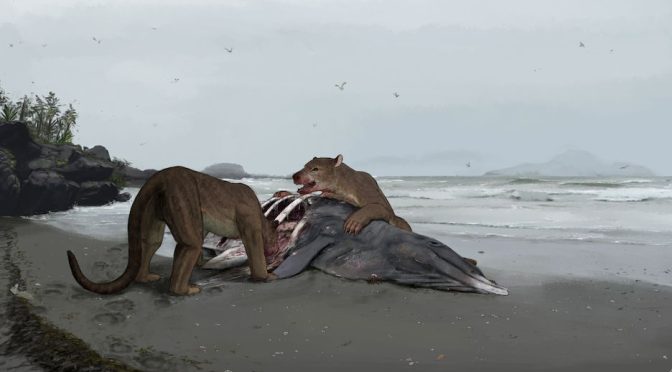
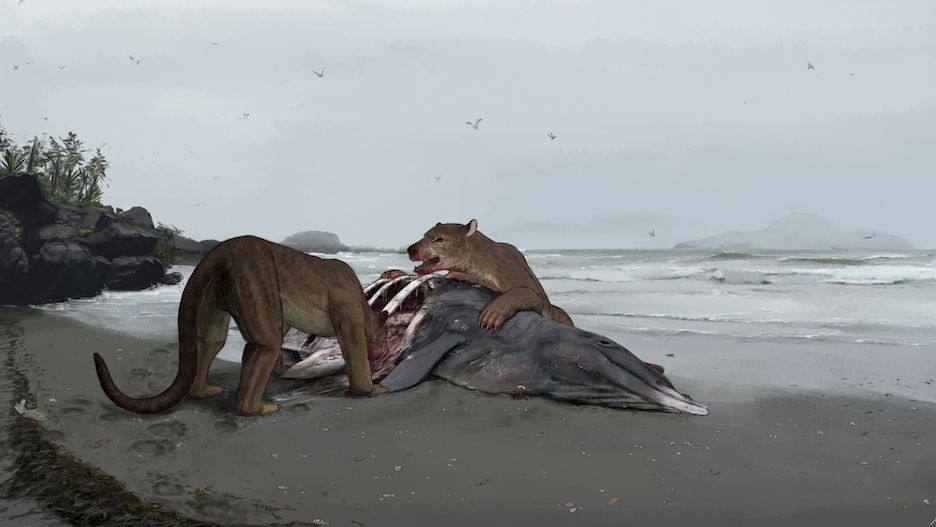
Gerard Ezcurra sent me this cool article about the discovery of extinct carnivore predators that inhabited the Pyrenees (as well as other parts of the world) some 7-8 million years ago. These bear-dogs are not related to neither bears nor dogs, but have characteristics of both. Fossils discovered in the Pyrenees point to maybe a new genus of the species, which the researchers named Tartarocyon, after the Tartalo, a monstrous cyclops-like being from Basque folklore. Pretty cool!

The Tartarocyon bear-dogs, Artwork by Denny Navarra and found on LiveScience.com.

Basque Fact of the Week: Luis de Unzaga, the Basque Who Coined the Phrase “United States of America”

History is full of characters that, while not always highlighted in our text books, made seminal contributions that certainly impacted the course of events. In the early days of what would eventually become the United States of America, numerous Basque were behind the scenes, working in official capacities for France and Spain, aiding the American effort against the British. Luis de Unzaga was one of those Basques, over his life governing several regions of Spanish America.

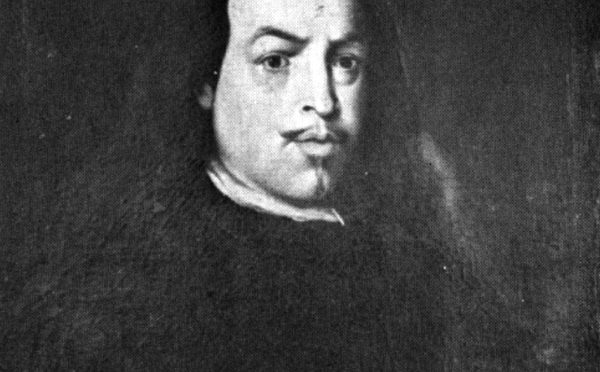
Portrait of Luis de Unzaga y Amézaga when he was Capitán general de Venezuela, from Wikipedia.
  • Luis de Unzaga y Amézaga was born in 1717 to a prominent Basque family in the southern Spanish city of Málaga. He was the son of the mayor of the Alcazaba of Malaga, Francisco de Unzaga-Amézaga Aperribay; the grandson of the alderman of Bilbao, Tomás de Unzaga Gardoqui (Diego Gardoqui was a cousin) and great-grandson of the royal commissioner and paymaster of the Navy, Francisco de Unzaga Beraza. On his mother’s side (Juana Paniza Ladrón de Guevara), he was the grandson of Luis de Paniza-Ladrón de Guevara, captain of the coast of Granada, and great-great-grandson of the philanthropist and founder of schools in Lombardy, Luigi de Paniza. Coming from a military family, he himself joined when he was only 13 and in 1732 was part of the reconquest of the Algerian city of Oran.
  • Unzaga was the fourth Spanish governor of Spanish Louisiana, which had become part of the Spanish empire in 1762 after the Treaty of Fontainebleau. He served from 1769 to 1777, when the American colonies declared their independence from Great Britain. He wrote George Washington, calling him “General of the United States of America.” Washington so liked this phrase — the United States of America — that it became the new name of what until then had been called the 13 colonies.
  • Unzaga used his powerful family connections to help the fledgling nation, particularly by alerting Washington to the movement of British troops. He created a spy network that helped him deliver, clandestinely, five tons of gunpowder up the Mississippi River that was used in the defense of Fort Pitt. Before that, in 1772, he had sent a merchant, one Juan de Surriret, to New York to collect intelligence on British activities, in an effort to understand threats against Spanish holdings in the Americas. With his superior, Antonio María de Bucareli, he used Cuba’s fishing fleet to both gather and transmit intelligence.
  • Unzaga was instrumental in the transition from French to Spanish rule in Louisiana. He tried to bolster New Orlean’s exports and promoted lumber and cotton industries that would benefit the region for many years. And he turned around Louisiana’s treasury.
  • While in Louisiana, he married Elizabeth St. Maxent, daughter of Gilbert Antoine de St. Maxent who was the wealthiest man in Louisiana. They had one daughter.
  • After completing his service in Louisiana, Unzaga became Captain General of Venezuela in 1777 and, in 1783, governor of Cuba. He retired to Málaga, serving as Lieutenant General of the General Command of the coasts of Granada. He died in 1793.

Primary sources: Luis de Unzaga, Wikipedia (English); Luis de Unzaga y Amézaga, Wikipedia (Spanish); Luis de Unzaga y Amézaga, Real Academia de la Historia; The Role of the Basques in the US War of Independence, About Basque Country