Basque Fact of the Week: Mayie Maitia and the Wool Growers Restaurant

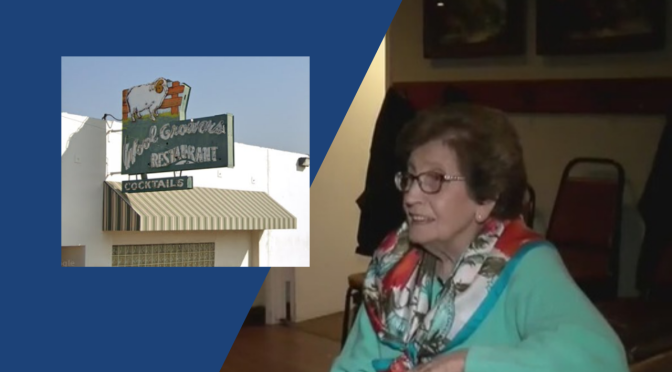
One of the distinguishing features of Basque culture in the US West are the Basque restaurants. Often serving family-style meals, with long tables and large plates and bowls of food, they are the cornerstone of Basque-American identity. The Wool Growers, in Bakersfield, California, is one of these wonderful dining spots, a place for Basques and non-Basques to gather and share in Basque food and culture. Its founder, Mayie Maitia, died on December 15, 2021 at the age of 92. Goian bego.
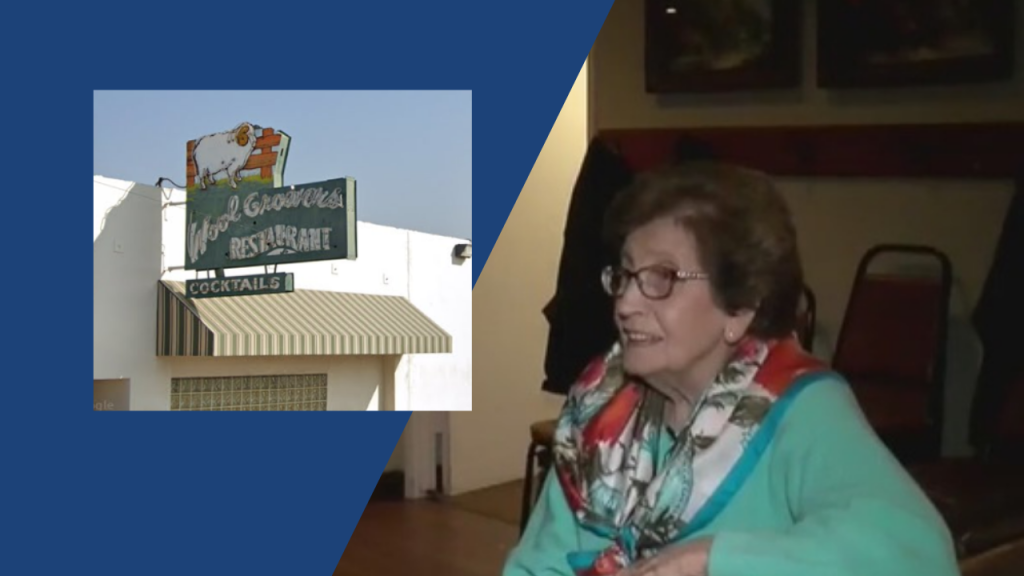
Mayie Maitia and the Wool Growers, from 23ABC News, Bakersfield.
  • Mayie was born on May 8, 1929 in Saint Étienne de Baïgorry, in Nafarroa Beherea, Iparralde, to Jean and Marie Etchebarne. She was the seventh of nine children. With some of her siblings, she immigrated to the United States when she was 17, working first as a nanny for the Amestoy family and then at the Noriega and Pyrenees restaurants. Her father had been to the United States; his stories instilled within her the promise of the American Dream.
  • It was during this time that she met Jean Baptiste Maitia, a bartender, and they married in 1947. After their two children, Jenny and Daniel, were born, they opened their own restaurant in 1954, the Wool Growers, in Bakersfield. She was only 25 years old when she and her husband opened the Wool Growers, armed only with their determination and a $15,000 loan.
  • The Wool Growers became a cornerstone of the community and beyond. It served many local Basques and celebrities, including Barbra Streisand and Ronald Reagan. Mayie became the “mother of the Basques,” helping the recent immigrants who, like her, had no knowledge of English navigate life and bureaucracy in the strange land. And the Wool Growers became a spot where people congregated, where many relationships started and even a few weddings were hosted. Back in 2019, Mayie received NABO’s “Bizi Emankorra” (Lifetime Contribution) award, which recognized her “thoughtfulness, generosity, and unconditional support of her Basque culture.”
  • More important to Mayie than any of her success was her family. She once said “If you don’t have family, you have nothing.” Though Mayie has passed on, the Wool Growers continues to serve the Basque community in Bakersfield through the efforts of her daughter Jenny and her grand daughter Christiane.

Primary sources: Mayie Maitia obituary, Doughty Calhoun O’Meara Funeral Home; Culinary extraordinaire and Basque matriarch Mayie Maitia dies at 92, The Bakersfield Californian; Wool Growers; Mayie Maitia obituary, Legacy.com


The Adventures of Maite and Kepa: Part 85

It was late, almost two in the morning, when they finally left the club. 

“It’s been so long since I went dancing like that,” said Maite, her cheeks flush from the heat and physical exertion. She sighed as a gentle breeze hit her face. 

“You guys have great clubs over there,” replied Javi. “Why aren’t you dancing every weekend if you like it so much?”

Maite shrugged. “Life just gets in the way, I guess.”

The Adventures of Maite and Kepa is a weekly serial. While it is a work of fiction, it has elements from both my own experiences and stories I’ve heard from various people. The characters, while in some cases inspired by real people, aren’t directly modeled on anyone in particular. I expect there will be inconsistencies and factual errors. I don’t know where it is going, and I’ll probably forget where it’s been. Why am I doing this? To give me an excuse and a deadline for some creative writing and because I thought people might enjoy it. Gozatu!

“That, and some of our cuadrilla don’t like to dance so much,” added Kepa. “They prefer to listen to the metal bands at the fiestas.”

Javi nodded. “I can appreciate that too. But, it seems there would be room for both.”

“Javi’s played me some Basque metal,” said Julie. “I don’t understand a thing, but I really like the music.”

“When you come over, we’ll take you on a little tour of the fiestas,” replied Kepa. “We’ve got some friends in one of the bands. They aren’t well known yet, but they are really good. At least, I think so.”

“Sounds like a date!” said Julie as they began the walk back to Javi’s place. They had decided to leave Javi’s car downtown as they had all had a few drinks. And Javi’s place wasn’t so far away, only thirty minutes walking.

“It’s nice to be walking,” said Javi. “We rely on our cars too much. I liked that about the Basque Country, how people walk to things a lot more.”

“Well,” replied Maite, “our towns are a lot more compact and vertical. It’s a lot easier to walk to the store or the pub from our homes.”

“True,” continued Javi, “but it’s still nice to just walk.”

They reached an intersection and Javi pushed the button to activate the crosswalk. As they stood there waiting, the calm night sky was suddenly interrupted with a loud “Bang!” Kepa immediately fell to the ground, his eyes wide in panic.

“Lasai!” said Javi as he knelt down next to his cousin. “Calm down, it was only a car backfiring.”

Kepa got to his feet, his legs weak, his face wet with sweat. “Barkatu,” he said, his voice small. “I guess I’m still not over from when I got shot.”

“Got shot?” exclaimed Javi incredulously. “When did that happen? I didn’t know you got shot!”

A new look of panic crossed his face as Kepa looked over at Maite, his eyes pleading.

“Ehm,” said Maite, searching for something to say. “It was in a play,” she said at last. “Kepa had a part where he got shot. They made it look very convincing. His ama fainted when she saw him get shot and fall to the stage. I think the alcohol and dancing must have confused him, made it seem like he was back in the play.”

Javi gave first Maite and then Kepa a wary look. He shook his head. “There’s something strange going on with you two,” he said as he led the cuadrilla across the intersection.

If you get this post via email, the return-to address goes no where, so please write blas@buber.net if you want to get in touch with me.

Basque Fact of the Week: The First Translation of the New Testament into Basque

As compared to its neighbors, the Basque language was standardized only recently, in the 1970s. The challenges in standardizing the language so that all Basque speakers could communicate with one another was expressed by Joanes Leizarraga, one of the first to attempt the task. One of the first to refer to the Basque Country in print as heuscal herria, he said “everyone knows how the manner of speaking almost changes from one house to the next in the Basque Country.” While it took centuries more for Basque to be standardized, Leizarraga’s translation of the New Testament was a critical first step along that path.

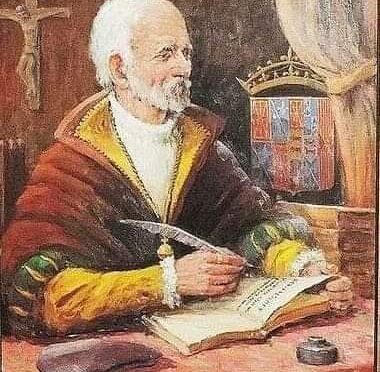
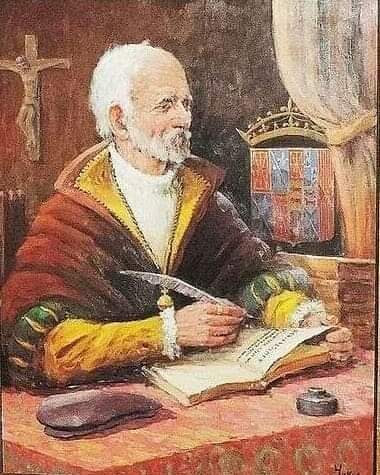
Modern interpretation of Joanes Leizarraga, by painter Irkus Robles-Aranguiz.
  • Born in Beskoitze, Lapurdi, sometime around 1506, not much more is known about Joanes Leizarraga’s origins. While he was baptized Catholic, in 1559 he embraced Protestantism, specifically Calvinism, and was imprisoned for his beliefs.
  • This was about the same time that Queen Joana de Albret of Nafarroa also converted to Calvinism. She recognized the need to spread the word about Calvinism in Euskara and commissioned Leizarraga for this task, as he was a well known Basque scholar (Basque shepherds of the area are known to have sent their children to him to learn Basque). In March of 1563, at the synod of Pau, he was tasked with translating the New Testament to Basque. He finished this first translation of the Bible into Basque in 2 or 3 years. His translation, officially entitled Iesus Christ Gure Iaunaren Testamentu Berria (The New Testament of Jesus Christ our Lord), was published in 1571.
  • After that, there is little known about his life. He simply disappears from the historical record. In 1581, he met with French politician and historian Jacobo Augusto de Thou, and he participated in Protestant meetings in 1577 and 1579, but not in those held in the 1590s. Historians surmise he must have died around the year 1600, which would have put him in his mid-nineties.
  • In addition to his translation of the New Testament, Leizarraga also published two other works in 1571, his Kalendrera (Calendar) and ABC, edo Christinoen Instructionea (ABC, or the instruction of the Christians). The first is a religious calendar, intended to help believers organize their religious life. ABC is a small instructional booklet meant for children and young people that contains chapters on grammar, math, and Christian doctrine. It seems inspired by a similar book, a Calvinist ABC, that was published in Lyon in 1555.
  • The Queen that had commissioned his translation died in 1572, and while it was published in 1571, it wasn’t distributed until 1574. Thus, the Queen may not have seen the translation reach her subjects. Shortly after her death, her son, King Henry III of Navarre (Henry IV of France), reinstated Catholicism. Protestantism was outlawed and Leizarraga’s works were essentially discarded and abandoned.
  • It wasn’t until the 19th century that his work was reprinted, and this was motivated more by linguistic interests than anything else. Linguists and historians have examined his word choice and the difficulty of his task, of choosing words that wouldn’t automatically alienate some of his readers. He also Latinized his language significantly, perhaps in a need to adhere to the original as much as he could and to make the language as accessible as possible.

Primary sources: Zuloaga San Román, Eneko. Leizarraga, Joanes. Enciclopedia Auñamendi; Available at https://aunamendi.eusko-ikaskuntza.eus/es/leizarraga-joanes/ar-80231/; Joanes Leizarraga, Wikipedia

The Adventures of Maite and Kepa: Part 84

Before long, dinner came and went. As they were finishing up, Javi looked over at his cousin and Maite. “Are you still up for dancing?”

Kepa looked over at Maite who simply smiled and gave him a slight nod. Kepa beamed as he turned back to Javi. “Bai! Noski!”

Javi led them out of the restaurant and across the street. “There aren’t many good places to go dancing around here, but we’ve found them all. This is our favorite.” He smiled at Julie.

The Adventures of Maite and Kepa is a weekly serial. While it is a work of fiction, it has elements from both my own experiences and stories I’ve heard from various people. The characters, while in some cases inspired by real people, aren’t directly modeled on anyone in particular. I expect there will be inconsistencies and factual errors. I don’t know where it is going, and I’ll probably forget where it’s been. Why am I doing this? To give me an excuse and a deadline for some creative writing and because I thought people might enjoy it. Gozatu!

There was a small cover to get into the club, which Javi paid for all of them. Inside, the lights were dim and the room filled with bass. There were tables on the sides surrounding a dance floor that was lit up with a disco ball above them. Maite couldn’t help but think of the clubs they would hit when she was a teenager. It had been so long since she’d gone out dancing. Kepa more felt than heard her sigh.

“Is everything ok?” he asked, almost yelling into her ear to be heard. “We can go if you want.”

“No,” she yelled back. “I’m good. It’s just been so long since I’ve been dancing like this.”

Kepa nodded. “I know what you mean.”

They found a small table in one of the corners. Kepa and Javi went to the bar to fetch drinks, leaving Maite and Julie at the table. They sat next to each other so they could hear themselves over the music.

“I’m so happy for Javi,” said Maite. “You really make him happy.”

Julie smiled. “He’s just so great. I’m so glad we found each other.” Julie looked up toward the bar and saw Javi looking back at her. Her smile widened. Turning back to Maite, she continued. “Kepa seems like a great guy too.”

Maite nodded. “He is. We’ve been friends forever, but only recently decided to make things more.”

“What happens if you go to Berkeley?”

Maite’s shoulders slumped a bit. “I don’t know. He says he would come out with me, but I know he needs to help take care of his mom. I think it would be hard for him. And I don’t think I could ask him to do that.”

“He’s a big boy,” replied Julie. “He can make his own decisions. And,” she said, nodding toward the bar, “the way he looks at you, I don’t think you could keep him away if you tried.”

Maite looked over and saw Kepa looking at her, a large smile on his face as he talked to Javi. Maite’s heart fluttered just a little.

If you get this post via email, the return-to address goes no where, so please write blas@buber.net if you want to get in touch with me.

Basque Fact of the Week: Mari Domingi, Olentzero’s Companion

These days, Olentzero, the Basque “Santa Claus” who brings gifts to children during Christmas, is reasonably well recognized in the Basque diaspora. He not only visits children in Euskal Herria, but can often be found in Basque clubs in the United States, South America, and elsewhere. Even the New Mexico Euskal Etxea, back when it was active, saw Olentzero come for a visit at one of our Christmas parties. Less well known is his companion and accomplice, Mari Domingi, who is often found at Christmas celebrations in the Basque Country.

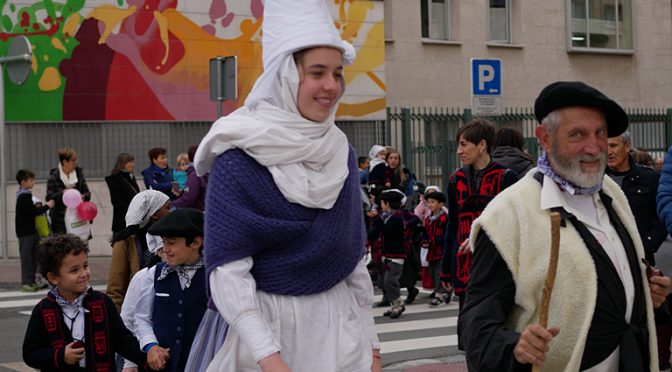
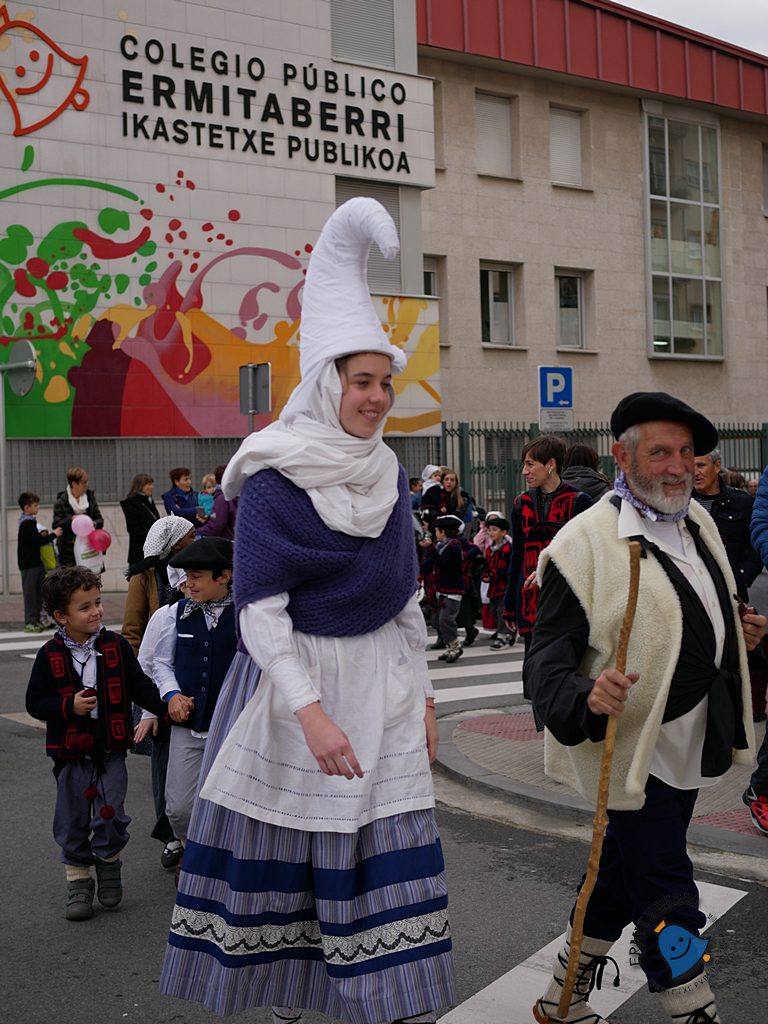
Mari Domingi and Olentzero at a celebration in Ermitaberri in 2019.h
  • Mari Domingi has her origins as a Christmas figure in the 1990s. As a character, she was created in Donosti in 1994 to add gender balance to the Basque Christmas festivities. Her story was first told in a booklet of stories published by the Asociación de Ikastolas in the Antiguo district. The first image of Mari Domingi was created by illustrator Edorta Murua, while the story was written by Mitxel Murua. She was originally created as a character called Xixuko who was simply supposed to collect letters to deliver to Olentzero, but her role grew quickly and she became his co-equal as a bringer of Christmas in the Basque Country.
  • She was inspired by a popular Christmas song Horra Mari Domingi, collected by Resurrección María de Azkue, in which Mari Domingi wants to visit Bethlehem to see the newborn Christ child. She is told that she needs change her skirt, to put on something a bit more presentable, before she can go.
  • As Olentzero’s accomplice, she is described as a shepherd and a farmer. She knows the land, the phases of the moon, and the use of medicinal plants. She typically dresses in medieval costume, characterized by the tall headdresses Basque women used to wear in the 15th century. This is in contrast to Olentzero’s costume, which dates to a later time.
  • Mari Domingi loves apples, and rather than the cookies that kids leave for Santa, she prefers that a plate of apples, preferably roasted, be left for her instead.
  • These days, it is common to see Mari Domingi in the streets with Olentzero on Christmas Eve. Together, they deliver presents to the children that have written them letters. The more mischievous kids, though, get coal, which is an interesting twist as it was said that Olentzero originally gave coal to people to help keep them warm in older times. Coal has shifted from something good to give as a present to something bad.
  • The creation of Mari Domingi is not without controversy. Some view her creation as the result of political correctness gone too far, while others see her as an attempt to rewrite Basque traditions. Whatever one’s opinion of her is, it cannot be denied that she is becoming an important aspect of modern Basque celebrations of Christmas.

Primary sources: Mari Domingi, Wikipedia

The Adventures of Maite and Kepa: Part 83

After lunch, the small cuadrilla wandered to some of the wine tasting rooms that dotted downtown. At each stop, they got a small glass of wine, just for tasting, before moving on to the next one. It really reminded Maite of the txikiteo of the Basque Country and she felt more at home than she had since they had left the Basque Country.

“So,” she heard Kepa asking Julie, “when is Javi going to bring you to the Basque Country?”

Julie shrugged. “Good question.” She turned to Javi. “When are we going?” she asked with a mischievous smile.

The Adventures of Maite and Kepa is a weekly serial. While it is a work of fiction, it has elements from both my own experiences and stories I’ve heard from various people. The characters, while in some cases inspired by real people, aren’t directly modeled on anyone in particular. I expect there will be inconsistencies and factual errors. I don’t know where it is going, and I’ll probably forget where it’s been. Why am I doing this? To give me an excuse and a deadline for some creative writing and because I thought people might enjoy it. Gozatu!

“Well,” began Javi, “we haven’t really talked about it. With school and everything else, there just hasn’t been time to think about a trip like that.”

“We can make time,” replied Julie. “It would be nice to go when these two are still there, before they end up over here.”

“That’s true,” said Javi. He turned back to Kepa. “I guess as soon as we can,” he said with a big smile.

“Everyone will be happy to see you again,” said Kepa. “It’s been a while, hasn’t it?”

“Maybe five years, at least,” replied Javi. “Before I started school, that’s for sure.”

Maite turned to Julie. “Just be careful. Knowing his mom -” she nodded in Kepa’s direction “- you’ll literally be eating the entire time you are there.”

Javi laughed. “That’s for sure! Every time I went, I must have gained at least ten pounds. Everyone thinks that the long lunches are for siesta, but it seemed that you all eat the entire time.”

“Bah,” said Kepa, waving his hand dismissively. “That’s only for visitors.”

“Well,” continued Javi, “since I’m always a visitor, that’s all I see.” He turned to Julie. “They all want to play host and have this spectacular meal together, but when everyone wants to do that, well, it can really add up.”

“Tell you what,” said Kepa. “We can organize one big dinner with the whole family so that you can see everyone at once and don’t have to feel obligated to go to everyone’s house. That way, you’ll have time to see other things too. Maybe have a romantic getaway to the big city or something.”

Javi smiled as he looked over at Julie. “That would indeed be nice.” Julie simply nodded and smiled as she took another sip of her wine.

They stopped at a few more tasting rooms, each of them trying different wines and passing glasses around when they found a particularly nice one. The conversation drifted to Javi and Kepa’s family, what everyone was doing these days, particularly all of the cousins. Javi knew who everyone was and had a vague sense of what they had been up to, but was ignorant of the details – “There are just so many of them!” he exclaimed. Kepa was happy to fill in the gaps. Javi, in turn, caught him up on his parents and what they were doing.

If you get this post via email, the return-to address goes no where, so please write blas@buber.net if you want to get in touch with me.

Basque Fact of the Week: La Concha, the Iconic Beach of Donostia

You can do worse than having La Concha be the path you take to class. When I lived in Donostia, during my attempt to learn a bit of Euskara, I lived in the neighborhood Egia. While I often took the bus, when I wasn’t late and the weather was decent, I’d walk along the beach to the university – the building where our classes were held was just a few “blocks” away from the beach. Most times, I’d walk along the sidewalk above the beach, but once in a while I’d actually walk on the beach itself. It was certainly a magnificent view. As I walked along the promenade, little did I ponder the history of La Concha.

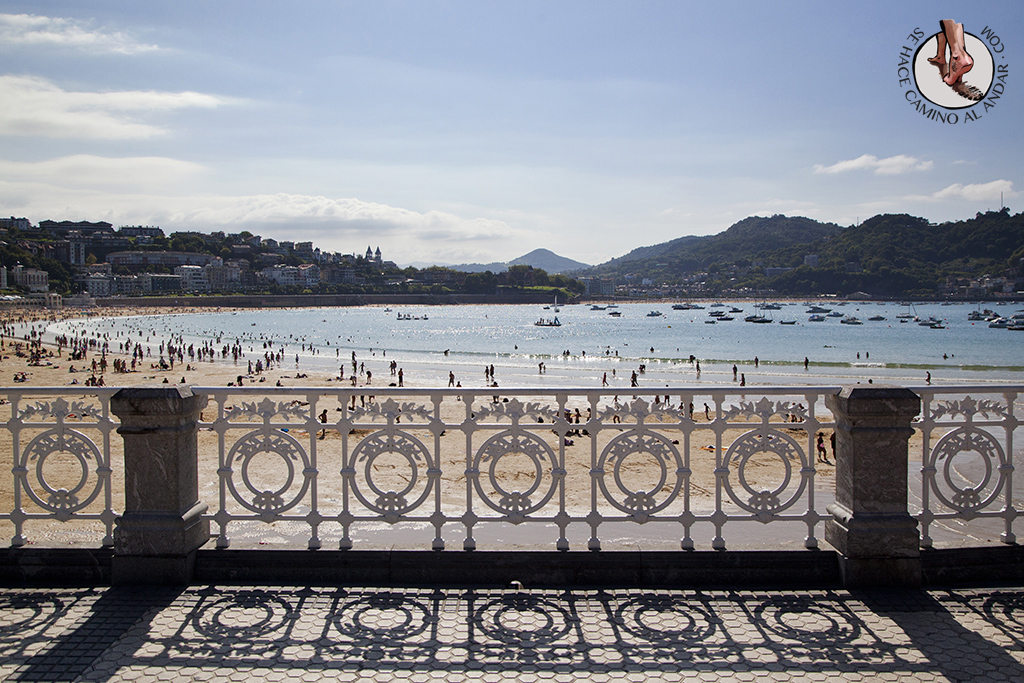
La Concha, photo from Se Hace Camino Al Andar.
  • The beach was given the name La Concha back in 1541 (in Euskara, it is called Kontxa Hondartza). The name means “the shell.” With Ondarreta beach, it connects Mount Igeldo with Mount Urgull. In the middle of the bay sits Santa Clara island. La Concha extends about 1,350 meters in length, with Ondarreta continuing on for another 600 meters. The bay sits at the mouth of the Urumea river, which starts some 33 kilometers earlier in the Nafarroan town of Goizueta.
  • The beach became fashionable in the mid 1800s when Queen Isabel II, at the recommendation of her doctors, came to the city to bathe in its waters. Her doctors thought it would help her skin condition. Other royals followed.
  • As the beach became popular, there were mobile cabins in which people could change in complete privacy and women wore long swim suits. However, as time passed, people became more relaxed and some even came to the beach already dressed in their bathing suits. This sparked a “war” with the cabin workers, who of course were losing income. At the same time, swimsuits became smaller, even inciting an anti-bikini editorial by El Diario Vasco in 1967.
  • In 1945, the Nazi collaborator Belgian Léon Degrelle landed a small plane on the beach in his escape from the Allies during World War II.
  • The Paseo de la Concha, the walkway that follows the beach, is notable for its architecture and design. There are unique lampposts which have since become a symbol of the city, their likeness used as awards for the San Sebastián Film Festival. La Perla spa, a center for thalassotherapy (the use of seawater for therapy), was established by Queen Maria Cristina and built in 1912. And the Royal Palace of Miramar, built in 1893, was the summer home of the Spanish royalty. It has a magnificent view of the bay and beach. Today, its gardens are open to the public and various buildings are used for education.
  • The railing that runs along the Paseo de la Concha has become itself an iconic symbol of the city. Installed in 1910 in anticipation of the arrival of the queen, it was designed by one Juan Rafael Alday, the city architect, and was constructed by “Fundiciones Molinao.” The railing was officially inaugurated by King Alfonso XIII in 1916. Over the years, the railing deteriorated to such a state that, in 1999, the city decided to restore the iconic symbol of the city. All 271 sections were dismantled, repaired, and reinstalled.
  • Since 1879 for men and 2008 for women, the Bay has played host to the Bandera de la Concha, a rowing competition held each September. The first race was won by the host city while the most recent men’s race, held just this year, was won by Santurce and the women’s 2021 race was won by a team from the host city.

Auñamendi Entziklopedia. Paseo de la Concha. Available at: https://aunamendi.eusko-ikaskuntza.eus/es/paseo-de-la-concha/ar-31981/; Historia y curiosidades de la barandilla de La Concha, Se Hace Camino Al Andar; Bahía de La Concha, Wikipedia; Kontxa, Wikipedia.

Random Bits of Basqueness

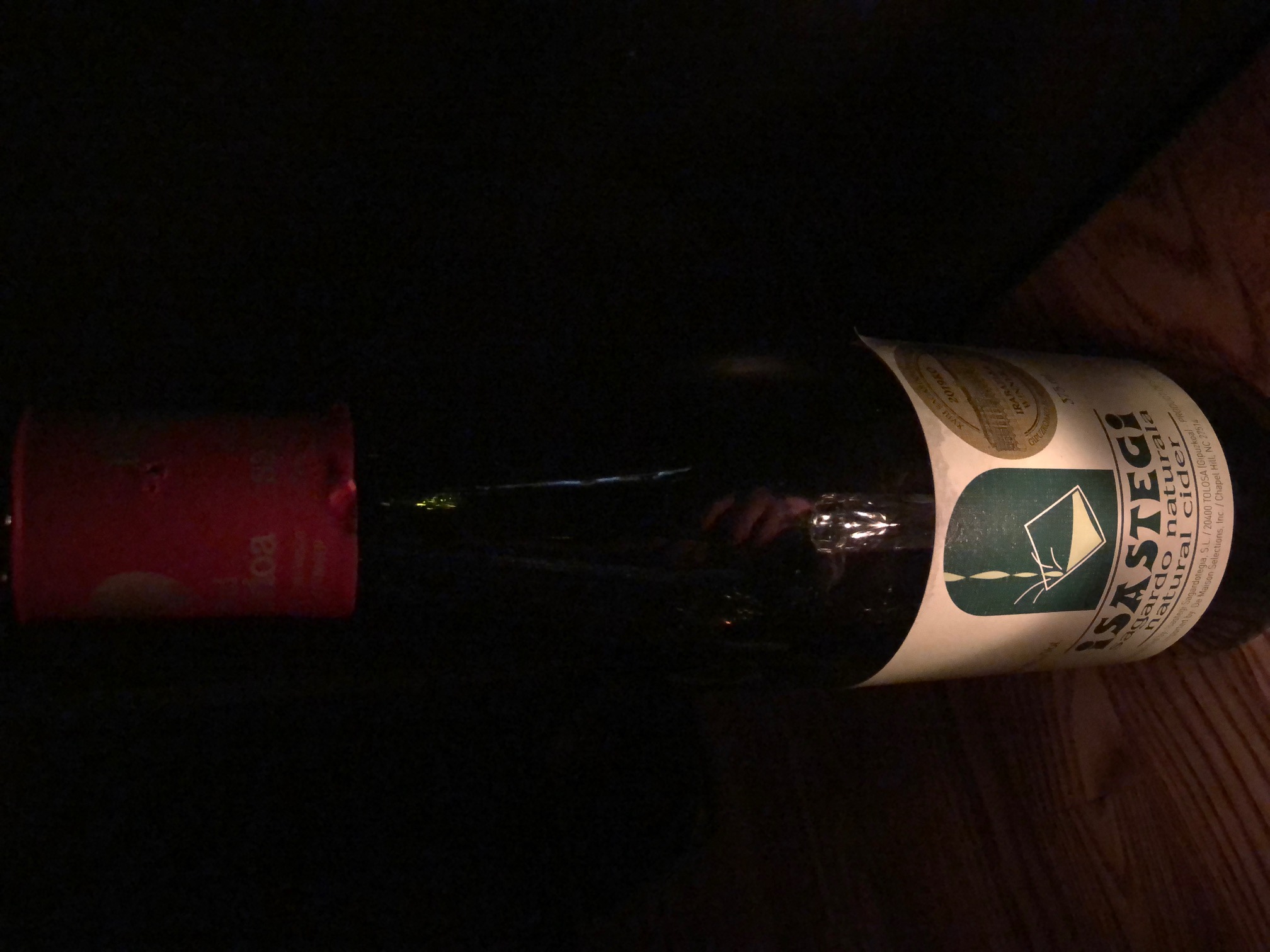
A bottle of sagardoa that I found on the menu of an Italian place in Washington DC. Yeah, I had to drink it all.

The Adventures of Maite and Kepa: Part 82

Soon, they all found themselves downtown. Javi led them to a small pub tucked in a corner.

“This is one of my favorite places. Low key, but good food. And good beer if you want it. Julie’s going to meet us here.”

The Adventures of Maite and Kepa is a weekly serial. While it is a work of fiction, it has elements from both my own experiences and stories I’ve heard from various people. The characters, while in some cases inspired by real people, aren’t directly modeled on anyone in particular. I expect there will be inconsistencies and factual errors. I don’t know where it is going, and I’ll probably forget where it’s been. Why am I doing this? To give me an excuse and a deadline for some creative writing and because I thought people might enjoy it. Gozatu!

As Javi checked in with the host, Kepa noticed a woman sitting at a table waving at them.

“Is that her?” he asked, pointing to the redheaded woman.

Javi smiled. “Bai, that’s her!”

Julie stood as they made their way to the table, her smile beaming. She was wearing a floral-print sundress that didn’t quite reach her knees. Her red hair was matched by freckles on her cheeks, making Kepa think she must have Irish ancestry. She gave Javi a hug and a kiss. 

“Thanks for snagging a table for us!” said Javi after they broke their kiss.

“No problem!” She turned her attention to the other two. “You must be Kepa. Javi’s told me so much about you.” She gave Kepa a kiss on each cheek. “And you are Maite? Javi told me about his childhood crush on you; I understand why!” She gave Maite a kiss on each cheek as well.

“Mil esker…?” questioned Maite as she sat down. “Seems I’m the only one who didn’t know about Javi’s crush.”

Javi blushed. “Well, that was a long time ago. Now, Julie has my heart.”

“How are you liking California? It’s your first time here, right?” asked Julie.

“So far, it’s been great,” replied Kepa. “I admit, a bit more… how do you say? Rugged or less glamorous than what I expected from the movies.”

“Once you get away from the coast,” said Javi, “it’s like anywhere else. Ranches and farms, and no movie stars.”

Maite laughed. “We certainly haven’t seen any movie stars yet! Though Kepa is still hoping to bump into Jon Hamm.”

Julie returned her laugh. “So would I!” she said with a wink.

It was Kepa’s turn to blush. “It’s not like that…” he began.

“I’m just teasing,” interrupted Julie. She turned to Maite. “Javi said you were thinking about going to Berkeley?”

Maite shrugged. “Thinking about it. That’s why we came out here, so I could interview with one of the professors. And I think it went well. But, they haven’t made a decision yet. And, besides, I don’t know if I can leave my parents behind.”

“I can understand that,” said Julie. “It isn’t quite the same, but I moved here from Boston. All of my family is back there. It took me a while to get used to being out here on my own.” She reached over and squeezed Javi’s hand. “Having Javi has sure helped a lot.”

Maite nodded. “My parents are older and I would just hate to not be there if they needed anything. I’m an only child, so they don’t have anyone else to help.”

Javi shrugged. “It’s what my dad did, leave everything there behind to come out here. But it was hard for him. When his dad died, he couldn’t make it back for the funeral. I think that always gnawed at him.”

“It had to be so hard, coming out here to be a sheepherder,” said Julie.

“You have no idea,” replied Kepa, with an air of authority. Javi and Julie looked at him, quizzically. “Or so I imagine,” he sputtered.

Javi gave his cousin a strange look before continuing. “It’s funny, when my dad first came over, he’d call home maybe once a year. It was so expensive. But, now, he’s on his cell phone talking to his brother back home almost every day. It’s amazing how the world changes.”

“I agree,” said Maite. “It certainly wouldn’t be as hard for me to come out here as it was for people like your dad. But, it’s still far away.”

Javi nodded as the waiter came to take their orders.

If you get this post via email, the return-to address goes no where, so please write blas@buber.net if you want to get in touch with me.