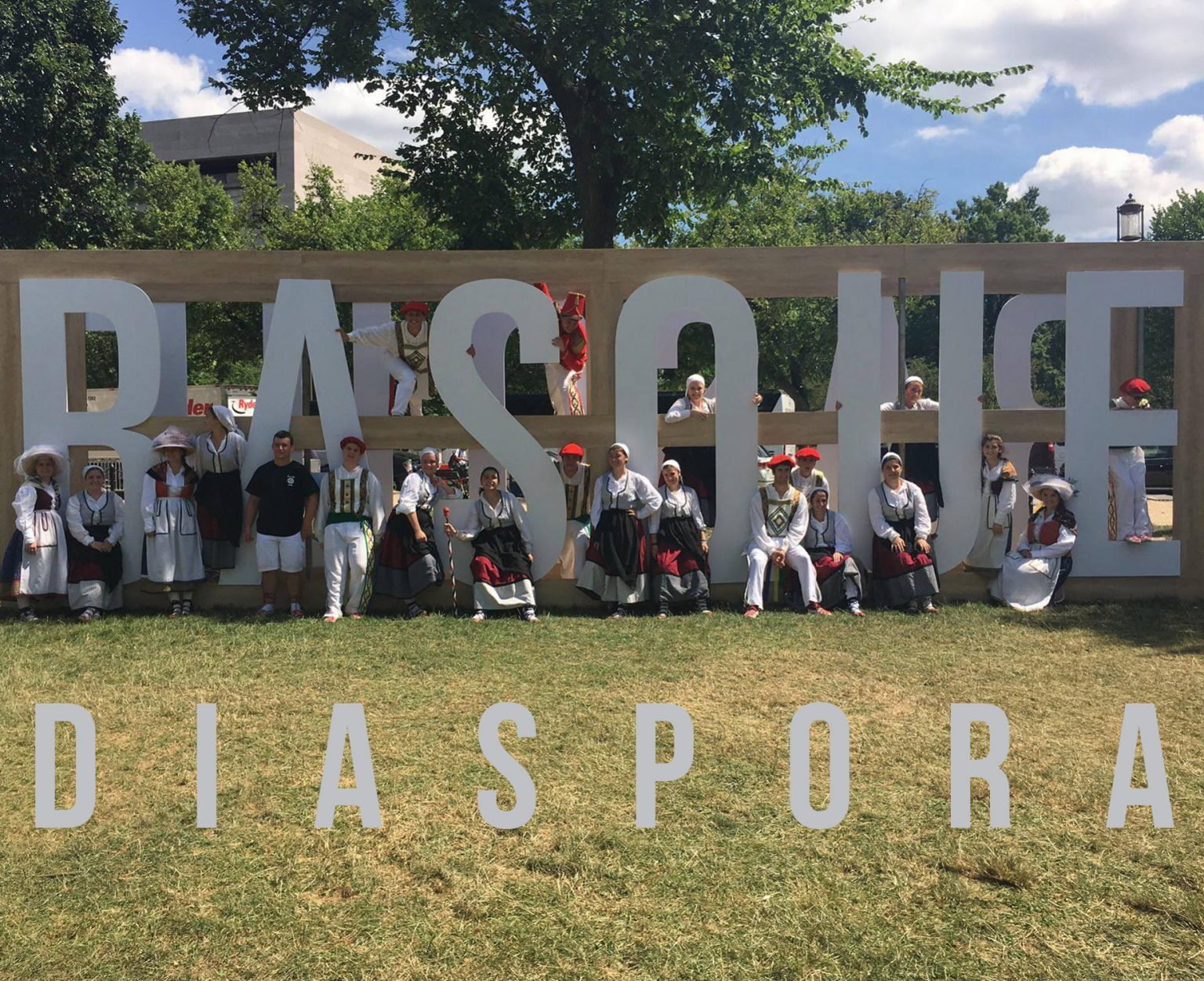
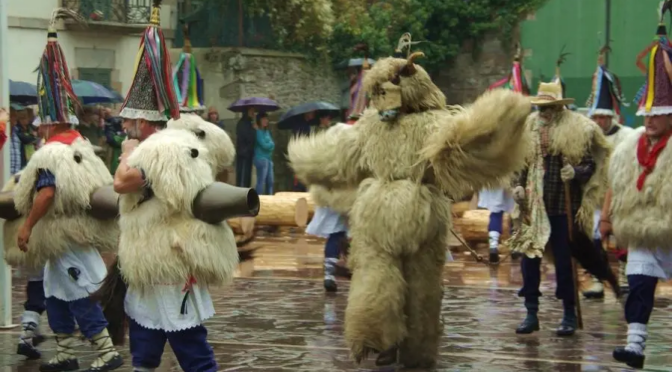
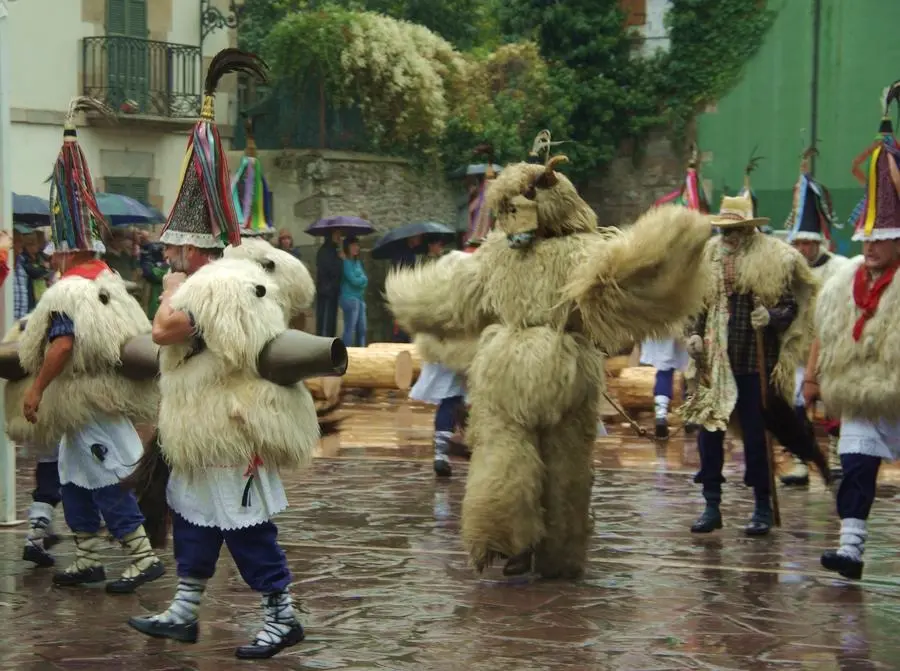
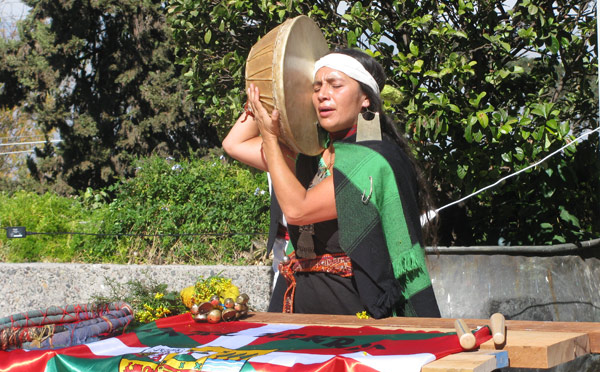
Happy New Year! Urte Berri On! Around the world, the new year is ushered in with various customs. In the Basque Country, there has been a tradition associating the new year with water, particularly “new water,” water that represents a fresh start, a new beginning. While this tradition has disappeared from much of Euskal Herria, there are still a few places where it continues.
During his studies, José Antonio de San Sebastián, otherwise known as Father Donostia, recorded several Christmas carols from the local towns during his breaks. He found a belief in Lekaroz, a small town in Nafarroa, that on the day of Urtezar (New Year’s Eve, December 31st), at midnight, the waters of the river Urandia turned into wine. The local girls would go to fetch the water. As they then made their rounds of the village, if they found the doors of any house open, they would throw the water on those who were in bed, on members of their family, and on the young people.
While traditions associated with water and the new year have largely been lost in the Basque Country, there are still places where it remains. In Urdiain, at midnight of New Year’s Eve, the young men of the town, carry a jug of water, ur berria, and sing a traditional song of offering. The town authorities taste the water and thus the new year officially begins in Urdiáin.
One of those ritual songs is “Urtararats” or “New Water.” These songs typically request “osasuna eta pakea” – health and peace. In Elizondo, as they collect the first waters that flow from the fountains after midnight, they sing: “Urte berri, berri / Zer dakarrazu berri / Uraren gana / Bakia ta osasuna / Urtes, Urtes!” – “New year, new year / What do you bring new year / Peace and health / New year, new year!” This new water of the new year was thought to have curative virtues.
At least one researcher speculated that the idea of “new water” originates from the ice age. The hypothesis is that it was about that time of year that ice began to melt and water began to flow again. This marked the beginning of the new year, with the new source of water.
A full list of all of Buber’s Basque Facts of the Week can be found in the Archive.
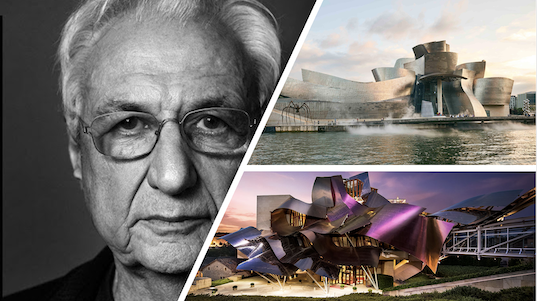
Even as recently as the early 1990s, when I lived in Donostia for a year, Bilbao seemed this dirty place that wasn’t really worth a visit. I think in that whole year, I only visited a couple of times at most. However, the city transformed itself from a relic of industry to a modern and vibrant destination. Now, I can’t imagine a visit to the Basque Country without a stop in Bilbao. Though there are many factors that, together, led to this transformation, the symbolic heart of it all has to be Frank Gehry’s Guggenheim Museum.
Frank Owen Gehry was born in Toronto, Canada, on February 28, 1929. His mother, Sadie Thelma, had immigrated from Poland while his father, Irving Goldberg who was born in New York City, was the son of an immigrant from Russia. Both of his parents were Jewish. Gehry’s grandfather owned a hardware store and he often played with scraps of materials, building cities with his grandmother. In 1954, urged by his wife and fears of rising antisemitism, Frank changed his surname from Goldberg to Gehry.
The family moved to California in 1947 and after some aborted attempts at various pursuits including chemical engineering, Gehry settled on architecture, graduating from the University of Southern California in 1954. After a stint in the Army, he attended Harvard on the GI Bill, but became disillusioned and dropped out, returning to California. In 1957, he designed his first building – a private home. From there, his career took off.
In 1997, the Guggenheim Museum in Bilbao opened. At the time, it faced significant criticism, particularly as an example of architectural imperialism. However, the building itself was hailed as a masterpiece of architecture, called “the greatest building of our time.” The curves of the building were intentionally designed to capture the light and the central atrium was designed with views of the estuary and the surrounding hills.
The museum has been credited with helping revitalize the city. Other cities have tried to replicate the “Bilbao effect” with unique architecture. However, Gehry himself downplayed the role of the museum, instead saying it was a collective effort and crediting the overall urban plan of the city and Basque government that his building was only one part of.
The Guggenheim isn’t the only building in the Basque Country that Gehry designed. He also designed the Marqués de Riscal Hotel, situated in the wine country of Araba, in the town of Elciego. Built between 2003-2006, the hotel’s design employs similar methods and elements that Gehry used in the Guggenheim. In both buildings, Gehry used flowing structures of titanium to capture the light and to give the buildings their unique flowing forms.
Gehry fell in love with the Basque Country. In 2014, the city of Bilbao built a bridge connecting Deusto and Zorrotzaurre which they named after Gehry. He was in the city for laying the cornerstone and during his visit he said “I fell in love with patxaran, txakoli, hake, and pil-pil. I love you all, I love Bilbao, and I will be back.” He felt that the Basques he worked with were particularly trustworthy, saying “When the Basques say something, you don’t have to get it in writing. They keep their word in a way that I’d never seen before.”
Gehry died on December 5, 2025, at his home in Santa Monica, California. He was 96.
A full list of all of Buber’s Basque Facts of the Week can be found in the Archive.
Singing is such a part of Basque culture. More than once, I’ve been in a restaurant where everyone broke into song. Christmas is a time when singing abounds. Leave it to the Basques to then create unique traditions around songs and Christmas. The Marijesiak is a group of singers that roam the streets of primarily but not exclusively Gernika in the early mornings of the days leading up to Christmas.
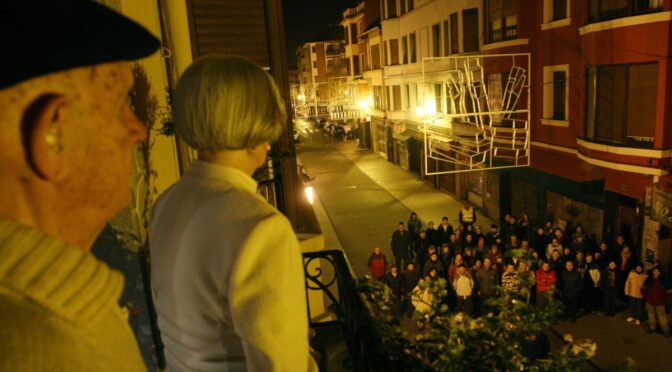
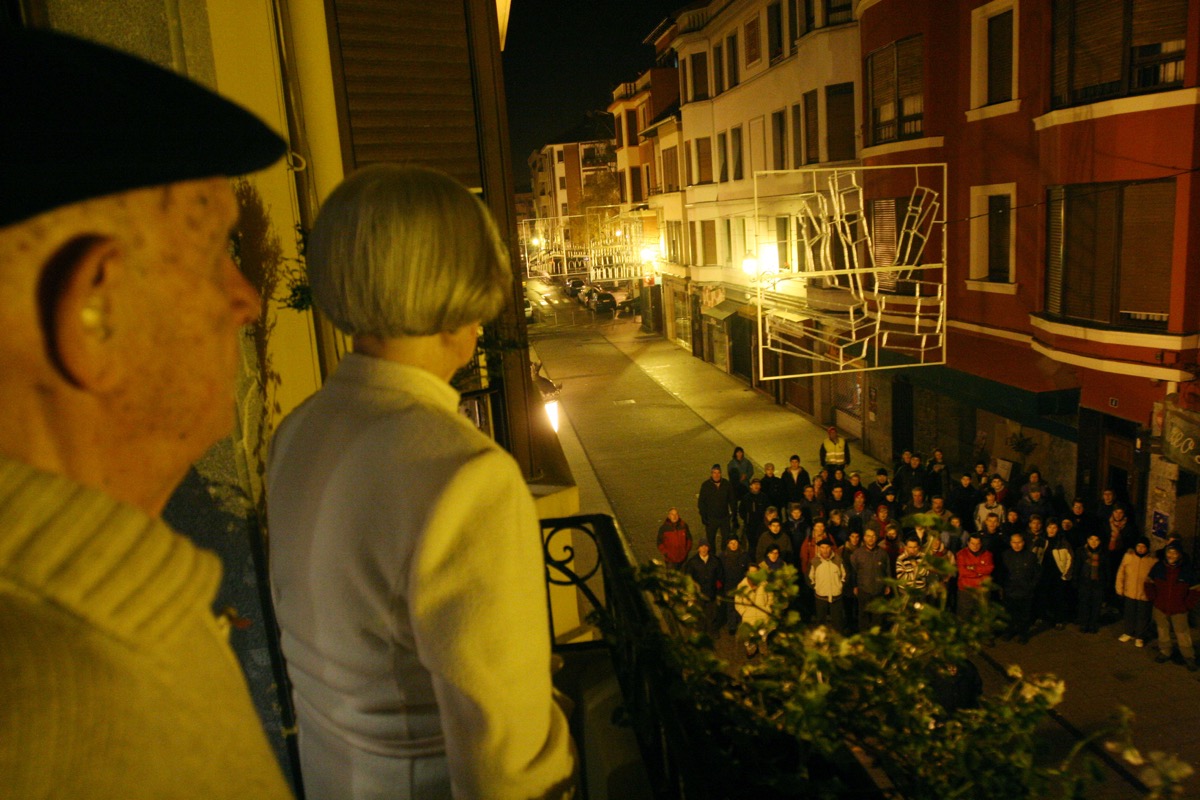
The Marijesiak in the streets of Gernika, with a couple watching from their balcony. Photo from Marijesiak.eus, taken by Maika Salguero.
The Marijesiak is a Christmas tradition that takes place over the nine days before Christmas. Early each morning, starting at 4am, a group of men and women kneel in front of the main church of Gernika, the Church of Andra Mari. They begin singing their verses, with a lead soloist leading the procession through town while the rest of the singers accompanying the lead. There are some 28 verses that the soloist must recite from memory, of course in Basque. The group walks through the streets of Gernika, hitting as many parts as they can. They stop in front of every church, the houses of former members, and even shelters where people hid from the 1936 bombing. In all, the route takes about one-and-a-half hours to complete.
Each of the nine days, a different part of the Christmas story is told, from the Creation to the birth of Jesus. However, in recent times, some secular verses have also been added, including some that recognize the 1936 bombing of the town and the political reality of the Basque Country:
Hor goiko landetan eperrak dabiltz kantetan Errigoitiko alkatiari Kaka eintziela praketan. Hor goian Juaniko hemen behean Periko eta bien bitartean dago Martzelino Polanko. Hor goian Frantzia Hor behean España eta bien bitartean dago Gora Euskadi Askatuta.
In the high lands the partridges are singing to the mayor of Errigoiti that he has poop in his pants. Up there is Juaniko here below is Periko and between the two is Marzelino Polanko. Up there is France Down there is Spain and in between is Long Live a free Basque Country.
The Marijesiak is part of a larger tradition of Christmas carolers. In many parts of the Basque Country, it is common to see carolers on Christmas Eve. In some places they are known as the Joenikuek, “those of Saint Joseph,” or Abenduko umiek, “the Children of the Advent.” However, the Marijesiak, which are most prevalent in Gernika, have maintained the strongest tradition, one that was revived in the 1970s.
The name Marijesiak comes from the repeated verse of “Mary, Joseph, Jesus, Mary” which over time was combined and shortened into Marijesiak.
The origin of the Marijesiak tradition is not completely clear. Some theories postulate it arose from medieval religious theater while others state that it came from the local convents, perhaps the Franciscan monastery of Bermeo. The earliest mention we have of this tradition comes from the 17th century.
In 2018, Ane Miren Arejita became the first woman to be the lead soloist for the Marijesiak.
A full list of all of Buber’s Basque Facts of the Week can be found in the Archive.
We don’t know much about the early history of the Basques. While discoveries such as the Hand of Irulegi reveal more than ever, there is still a lot that is shadowed in the mists of time. The Basques have never recorded their own history – what we know is typically from the pens of neighbors or other observers. This includes the Romans. The Romans certainly conquered much of the Iberian peninsula, including parts of the modern day Basque Country. Indeed, Pamplona is named after the Roman general Pompey. Much of what was written back then is through the lens of the conqueror and, even worse, by people who had only heard of the Basques but never visited the region.
Roman roads around and through parts of the modern day Basque Country, highlighting Roman settlements. From Itiner-e.
The website Itiner-e has put together a map of all of the roads of the Roman Empire. Nature calls it a “Google Maps” for Ancient Rome. It is quite interesting. If you zoom in on what is today the Basque Country, you can see a few roads around the periphery, but the interior is completely devoid of any Roman roads. This highlights how the Romans had very little activity in the region.
A lot of what we know about the Basques during the time of the Romans comes from Roman historians. Strabo, in particular, wrote about the Basques in his Geographica, an atlas of the world known to the Romans. Though, many of the places he wrote about he never visited, he was just repeating what others had said.
To Strabo and the Greek and Roman worlds, people in the far regions, particularly those in the mountains, were barbarous: “All the mountain dwellers are austere, they usually drink water, sleep on the ground and let their hair reach very low, like women, but they fight by girding their foreheads with a band. They eat mainly goats, and they sacrifice a goat to Ares. They also make hecatombs of every kind in the Greek way, as Pindar says: they sacrifice a hundred of everything.”
He goes on: “They also have gymnastic, hoplite and equestrian competitions, with boxing, running, skirmishing and combat in formation. The mountaineers, for two thirds of the year, feed on oak acorns, letting them dry, grinding them and making bread with them that keeps for a while. They also know beer. They drink wine on rare occasions, but what they have is quickly consumed at feasts with relatives. They use butter instead of oil. They eat sitting on benches built against the wall and they sit in order of age and rank. The food is passed around in a circle, and at the time of drinking they dance in a circle to the sound of flute and trumpet, but also jumping and crouching, and… women also dance together with men holding hands.”
“…those who live far inland use the barter of goods, or cut off a silver flake and give it. Those condemned to death are thrown off a cliff and parricides are stoned beyond the mountains or rivers. They marry just like the Greeks. The sick, like the Egyptians of old, are exposed on the roads so that those who have suffered from it can give them advice about their illness…..”
“This, as I have explained, is the way of life of the mountaineers, and I am referring to those who mark the northern flank of Iberia: Calaic, Asturians and Cantabrians up to the Basques and the Pyrenees; because the way of life of all of them is similar.”
A full list of all of Buber’s Basque Facts of the Week can be found in the Archive.
Nearly none of the young men and women who immigrated to the United States from the Basque County to herd sheep in the American West had any knowledge of English. This wasn’t much of a problem as they typically worked with other Basques. However, encounters with the dominant language of their new home were unavoidable and sometimes represented concepts that they didn’t have a Basque word for, so they simply transliterated the English word into Basque spelling. This leads to an interesting collection of “Basqlish” words.
Updated: I’ve added new words as they’ve been suggested. Those from Joxe are in bold, others are in regular text. I’ve also removed the hidden text.
Joxe and me with his daughter and my family at Jaialdi.
Joxe Mallea-Olaetxe, who has done extensive research on Basque arboglyphs, has uncovered a number of transliterations of English words to Basque. Some of these will be familiar to those who had a Basque parent – you can almost hear their accent coming through. He shared these with me after I wished him Happy Thanksgiving.
Here are a few of Joxe’s favorites, with a few others from visitors.
aizkrime
anburgesa
arrantxu
bakola
escrewdrivera
esprinkola
estorra
foki
friueia
grinjouse
hammera
karrue
kauboi
kukia/kukije
laddera
morojona
mubije/mubia
paia/paije
pikapa/pickopa
pikinikixe
sanabitxe
saniskibi
sizpaka
taia/taije
troka
txip
uintxila
whiskia/whiskixe
xata
zereala
ice cream
hamburger
ranch
backhoe
screwdriver
sprinkler
store
the f-word
freeway
greenhouse
hammer
car
cowboy
cookie
ladder
motorhome
movie
pie
pickup
picnic
son of a bitch
Thanksgiving
six pack
tire
truck
sheep
windshield
whiskey
shot
cereal
A full list of all of Buber’s Basque Facts of the Week can be found in the Archive.
Primary sources: Joxe Mallea-Olaetxe, private communication
I spent the 1991-92 school year in the Basque Country, trying to learn Basque and learning a bit more Spanish. It was my first time to the Basque Country and it really opened my eyes as to what life was like in the Basque Country. I had learned something about the traditional culture, primarily dance, when I was a kid, but I hadn’t realized that the Basque Country, like everywhere, was a modern, vibrant place that was continuously evolving. All that to say that the exchange program that I participated in was, literally, life-changing. Ateak Ireki is a new cultural exchange program with the goal of exposing young Basques in the diaspora to the life and culture of the Basque Country today. If you are interested, registration for summer 2026 ends soon.
Ateak Ireki means “Open Doors” in Basque and the program has the primary goal of giving young Basques in the diaspora the chance to experience life in the Basque Country first hand. For three weeks, these youngsters spend time with families in the Goierri region in southern Gipuzkoa (where incidentally Mutiloa, the town my great grandfather Blas Telleria was from, is).
The program hopes to strengthen ties between the Basque Country and the Basque diaspora. Participants learn about traditional aspects of Basque culture including language, dance and literature but also network with local and business leaders to help establish new professional connections.
Participants live with a local family that speaks primarily Basque at home (though knowledge of Basque beforehand is not a requirement). Each family also has someone at home of a similar age to each participant and each also has an English speaker at home. All this to make each participant feel as welcome as possible while they also get an immersive experience.
Registration for the summer 2026 program is open until December 7. Participants must be between 18 and 25 years old, become a member of the North American Basque Organization after being accepted, and participate in all activities. There is also opportunity for chaperones.
The program is inspired by the cultural exchange program between Boise and Oñati that occurred in the 1970s. That program, spearheaded by Pat Bieter and Jon Bilbao, was instrumental in giving the Basque diaspora of Idaho and by extension the American West a huge boost. Many of the leading figures of the Basque diaspora of the United States participated in that program.
A full list of all of Buber’s Basque Facts of the Week can be found in the Archive.
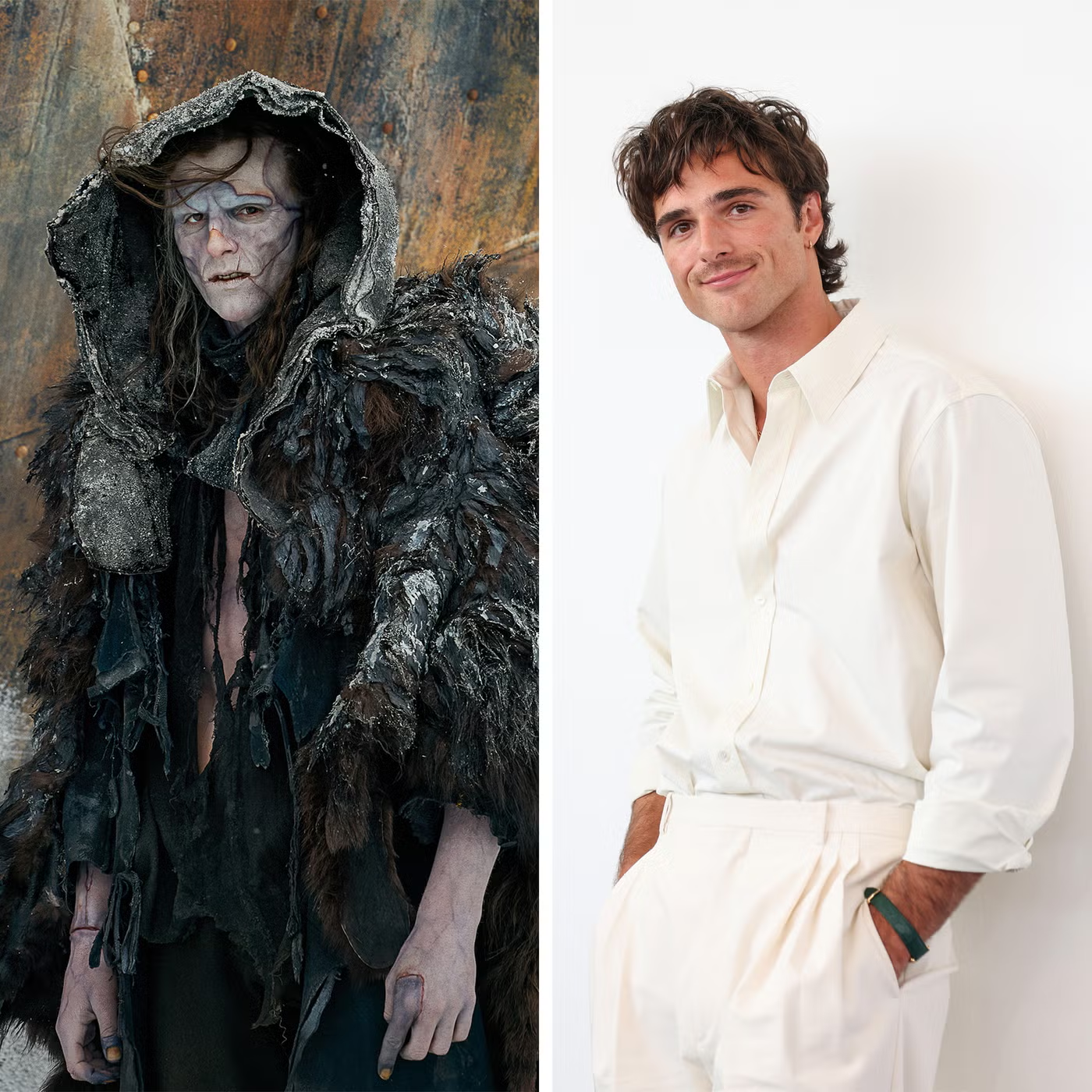
It is always cool to see Basque names on the big screen. Whenever we sit through the credits of a movie, I tend to scan the names to see if any Basque names pop out to me. So, it’s even cooler when the Basque name is also the star of the movie. Jacob Elordi has been getting a lot of buzz and his career has really taken off in the last couple of years. The son of a Basque immigrant, Elordi grew up in Australia before making his way to Hollywood. His most recent film is Frankenstein, directed by Guillermo del Toro, in which Elordi plays the creature.
Incidentally, I just saw Frankenstein and really enjoyed it.
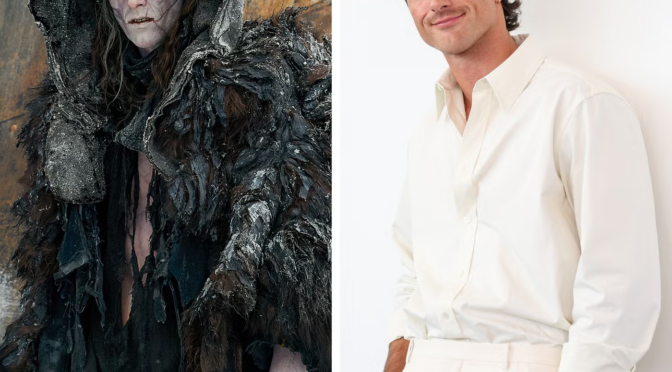
Jacob Elordi after his transformation into Frankenstein’s monster. Photo from Elle.
Jacob Nathaniel Elordi was born on June 26, 1997, in Brisbane, Australia. He comes from a working class family. His father John is a house painter and his mother Melissa is a stay-at-home mom and waitress. John was born in the Bizkaian province of Marikina-Xeimen while John’s father, Joaquin, was born in Ondarroa. Jacob has three older sisters.
Joaquin had immigrated to Australia to escape Franco’s dictatorship. He originally worked in the sugar cane fields until he saved enough money to bring his mother and his son, John, to Australia. John was eight years old at the time.
Elordi says that he was inspired to become an actor by Heath Ledger. He started acting in musicals at his school at the age of 12. He was interested in rugby until he hurt his back when he was 14, which pushed him from athletics to acting. It was when he was 15 and reading Waiting for Godot in drama class that he really decided acting was his passion. His father initially discouraged Jacob’s acting ambitions, saying that “acting is a one-in-a-million kind of situation.” Jacob replied by saying “Well, why can’t that one be me? Why can’t I be that one in a million?”
Elordi’s first Hollywood role was as an extra in 2017’s Pirates of the Caribbean: Dead Men Tell No Tales. He started gaining fame in 2018 as part of Netflix’s The Kissing Booth. He was about to give up on his Hollywood dream – he had been sleeping in his car and on friends’ couches – when he was cast in HBO’s Euphoria.
After that, his career began to take off. In 2023, he played Elvis Presley in Priscilla and starred in Saltburn, for which he received a BAFTA nomination for best supporting actor. Most recently, he starred as the titular monster in Guillermo del Toro‘s Frankenstein. His performance in this and other recent films has earned him praise. For Frankenstein, he spent 10 hours a day in make-up to complete his transformation.
Elordi has made his pride in his Basque ancestry very clear. When a Wikipedia article about him listed his ancestry as Spanish, he said he wasn’t of Spanish but Basque descent, and his grandfather would strangle him if he heard that.
A full list of all of Buber’s Basque Facts of the Week can be found in the Archive.
The Basque Country has a long association with bears. Indeed, research by people like Roslyn Frank indicates that the Basques may have worshipped bears at one time and that Basques believed that humans were descended from bears. The importance of bears to Basque culture is reflected in their role in carnivals in various towns. However, despite this importance, real bears have all but disappeared from the Basque landscape, with the last bear sited more than 15 years ago.
At one time, at least three different species of bears lived in the Pyrenees and the Basque Country, the oldest remains dating over 240,000 years ago. The last native Basque bear, named Camille, had lived in the Roncal Valley but died some time around 2010.
Hartza, the bear, is the protagonist of more than than one festival in the Basque Country. For example, in Ituren, Nafarroa, the arrival of Hartza and his handler, hartzazain, during their fiesta announces that spring has come.
There are tales highlighting the relationship between bears and humans, with some telling how Basques are descended from bears. Indeed, in 1983, Petiri Prébende, the last Basque bear hunter, said, “Lehenagoko eüskaldünek gizona hartzetik jiten zela sinhesten zizien. […] Hartzak eginak gara” (“Basques used to believe that humans descended from bears. […] We were created by the bear.”) Bears were said, once shorn, to look like humans and that humans were bears without fur.
The close relationship meant that bears and humans could interchange souls: “The primitive belief in the possibility of such an exchange of souls comes clearly out in a story of a Basque hunter who affirmed that he had been killed by a bear, but that the bear had, after killing him, breathed its own soul into him, so that the bear’s body was now dead, but he himself was a bear, being animated by the bear’s soul.” (The Golden Bough by JG Frazer)
One story describes Joan Hartza or Bear’s Son or Little Bear or Hamalau or Hartz-ume (there are many names for this story). This hero was half human, half bear, with a human mother and bear father. He represents the transition from bears to humans and bear ancestry. The story relates his adventures, including his encounter with a group of animals that he helps and is rewarded with talismans of their power. Roslyn Frank suggests that this story, though appearing throughout Europe, originated in the Basque Country.
There is also some evidence of belief in a Celestial Bear, a bear that helps guard the gates of heaven with St Peter. An English folklorist, Thomas Hollingsworth, was interviewing two Basques from Nafarroa who told him in 1891 that bears could understand human speech, including Euskara, and that bears were smart enough to learn from people and take that knowledge back to other bears, and that this would allow bears to come back and rule over humans as they had once done. They referred to the bear as the “dog of God” and the “dog of St Peter.”
Though bears have now essentially disappeared from the Basque Country, the last bear hunter was still alive in 1983. He and his son discussed how killing a bear would bring bad luck. However, a bear’s paw has also been seen as a powerful magical item, protecting people from the evil eye and other illnesses.
One final curious note is worth expanding on. One of the names for the Little Bear is Hamalau, which literally means 14. Frank alludes to the special role that 7 has in Basque culture, and maybe the name 14 is related to this. Hamalau is also a name for the boogeyman, who scares people at night. It is also a large number, representing infinity. Maybe a future post will go into 14 in more detail.
A full list of all of Buber’s Basque Facts of the Week can be found in the Archive.
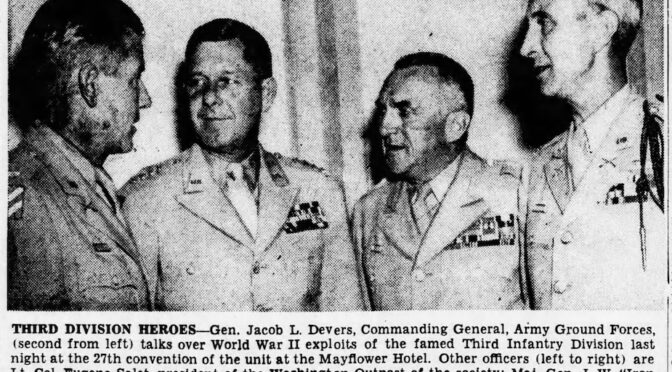
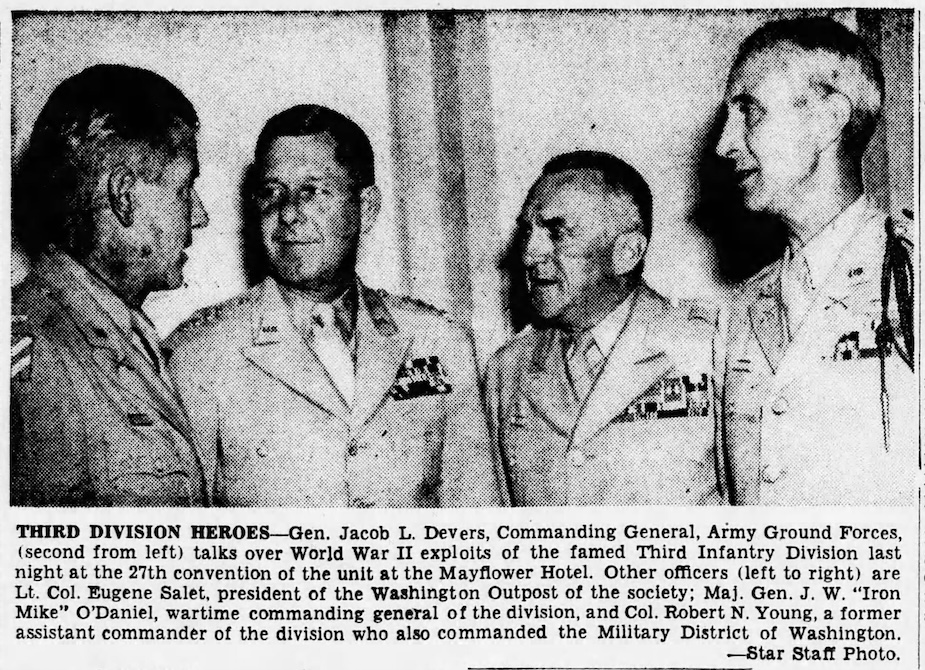
“Third Division Heroes.” From Left to Right: Lieutenant Colonel Eugene Salet, General Jacob L. Devers, Major General John W. “Iron Mike” O’Daniel, and Colonel Robert Nicholas Young (Evening Star, July 14, 1946. P. 7).
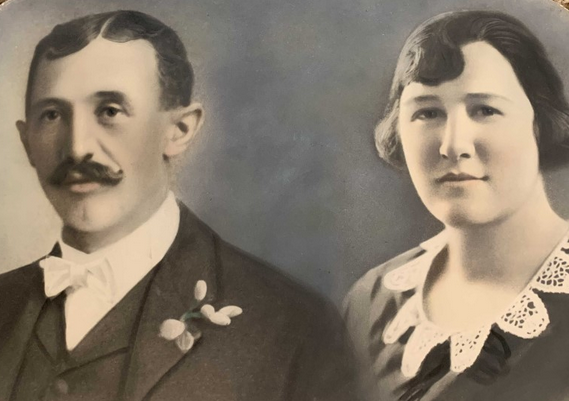
At barely 19 years old, Marie Irigaray Inchauspe arrived in the United States to start a new life. The year was 1904. She was accompanied by her older brother Jean who was 20 at the time. Years later, at least three more siblings—Marie, Jeanne, and Grace—joined them in pursuit of the “American Dream.” A fourth sibling, Martin, forged his own path in Buenos Aires, Argentina. Marie and Jean’s final destination was the state of Nevada, more than 5,600 miles from their hometown of Ezterenzubi in Nafarroa Beherea, or Lower Navarre.
A few months after arriving, Marie met and married the prominent Basque immigrant sheep rancher Bernard “Ben” Etchegoin, also from Ezterenzubi, on July 25, 1904, in Reno, Nevada, where they established their home. In 1906, their first and only child, Beatrice Marian, was born. Tragedy struck the family in early 1908 when Bernard was assaulted by a group of men, resulting in his untimely death, just six days shy of his 39th birthday.
Portrait of Bernard Etchegoin and Marie Irigaray (Via authors).
“Echoes of two wars, 1936-1945” aims to disseminate the stories of those Basques and Navarrese who participated in two of the warfare events that defined the future of much of the 20th century. With this blog, the intention of the Sancho de Beurko Association is to rescue from anonymity the thousands of people who constitute the backbone of the historical memory of the Basque and Navarre communities, on both sides of the Pyrenees, and their diasporas of emigrants and descendants, with a primary emphasis on the United States, during the period from 1936 to 1945.
THE AUTHORS Guillermo Tabernilla is a researcher and founder of the Sancho de Beurko Association, a non-profit organization that studies the history of the Basques and Navarrese from both sides of the Pyrenees in the Spanish Civil War and in World War II. He is currently their secretary and community manager. He is also editor of the digital magazine Saibigain. Between 2008 and 2016 he directed the catalog of the “Iron Belt” for the Heritage Directorate of the Basque Government and is, together with Pedro J. Oiarzabal, principal investigator of the Fighting Basques Project, a memory project on the Basques and Navarrese in the Second World War in collaboration with the federation of Basque Organizations of North America.
Pedro J. Oiarzabal is a Doctor in Political Science-Basque Studies, granted by the University of Nevada, Reno (USA). For two decades, his work has focused on research and consulting on public policies (citizenship abroad and return), diasporas and new technologies, and social and historical memory (oral history, migration and exile), with special emphasis on the Basque case. He is the author of more than twenty publications. He has authored the blog “Basque Identity 2.0” by EITB and “Diaspora Bizia” by EuskalKultura.eus. On Twitter @Oiarzabal.
Josu M. Aguirregabiria is a researcher and founder of the Sancho de Beurko Association and is currently its president. A specialist in the Civil War in Álava, he is the author of several publications related to this topic, among which “La batalla de Villarreal de Álava” (2015) y “Seis días de guerra en el frente de Álava. Comienza la ofensiva de Mola” (2018) stand out.
Left with a daughter under the age of two and only 22 herself, life for Marie was far from easy. In 1910, she married French immigrant Auguste “August” Salet, born in Bordeaux in 1875, who had arrived in the United States around 1893. They had one child together: Eugene Albert Salet, born on May 25, 1911, in Standish, Lassen County, California.
By 1920, Eugene and his family were living in Sparks, Nevada, where August worked as a general rancher. Although the details of Marie and August’s marriage are unclear, it most likely ended in divorce. Three years later, in 1923, Marie married Alexander Hamilton Aldrich II in Canal, Nevada. Alexander, born in Cameron, Missouri, in 1875, was a U.S. Army veteran of the Great War. Marie and Alexander had three children: Maria Eugenia (born 1924, Fernley, Nevada), Catherine May (born 1927, Lovelock, Nevada), and Alexander Hamilton III (born 1928, Reno, Nevada).
The Wall Street crash of 1929 triggered a decade-long period of poverty and unemployment known as the Great Depression, which took a heavy toll on much of American society. For Marie and her children (three of them under five years of age), it meant facing daily struggles and navigating the hardships of a rural life under one of the harshest economic crises in U.S. history. Yet, growing up amid these challenges in Nevada’s rural communities Eugene developed the resilience, courage, and determination that would shape him into a military leader of remarkable distinction.
By 1930, Eugene’s father Auguste was living in Gerlach, Nevada, working as a sheepherder. Unfortunately, he died in 1934 in Fernley at the age of 58. In 1935, after divorcing Alexander Hamilton Aldrich II, Marie married William Edward Warren (born 1875 in Virginia City, Nevada; died 1949 in Fallon, Nevada).
The matriarch of the family, Marie, lived a long and full life, passing away at the age of 90 in 1975 in her adopted home of Reno. Her first daughter, Beatrice, had died two years earlier at the age of 67 in Fallon. Her other children also lived long lives: Alexander died in 2004 at 76, Catherine in 2015 at 88, and Maria Eugenia in 2020 at 96. The family remained proud of their Basque heritage. Catherine, for example, had always hoped to visit her mother’s homeland—though, unfortunately, that dream was never realized.
Formative Years: Education, ROTC, and Early Leadership
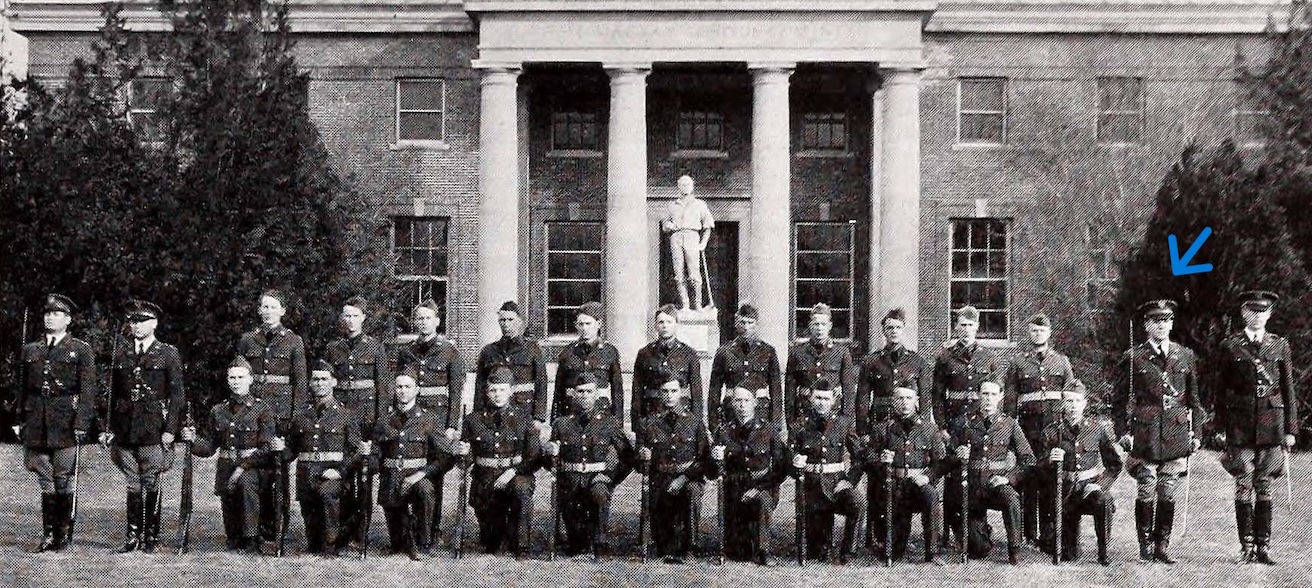
Eugene grew up in the rural town of Lovelock, Nevada, and graduated from Pershing County High School. In 1930, he moved to Reno and enrolled at the University of Nevada, where he earned a bachelor’s degree in history, education, and physical education in 1934. During his student years, he played varsity football and basketball and was an active member of several societies, including the Sigma Alpha Epsilon fraternity, Blue Key, Coffin and Keys, Sagers, Sundowners, and Scabbard and Blade. Eugene also completed the Reserve Officers’ Training Corps (ROTC) program and was commissioned as a second lieutenant in the infantry in May 1934, serving in the U.S. Army Reserve until 1941.
Official group photo of ROTC Company B standing in front of the statue of Irish immigrant and industrialist John Mackay, and the building that bears his name—the Mackay School of Mines—on the University of Nevada campus. Second Lieutenant Eugene Salet is indicated by the arrow (University of Nevada’s Artemisia Yearbook, 1933).
After graduation, Eugene taught and coached at Dayton High School and later became its principal. On June 13, 1936, he married the love of his life, Irene Adele Taylor, in her hometown of Buffalo, New York. He was 25 years old, and they established their home in Dayton, Nevada, where they had two children. In 1940, Eugene also managed a Shell service station in Carson City, Nevada, living there with his family and his mother-in-law.
World War II: From Operation Torch to the Heart of Europe
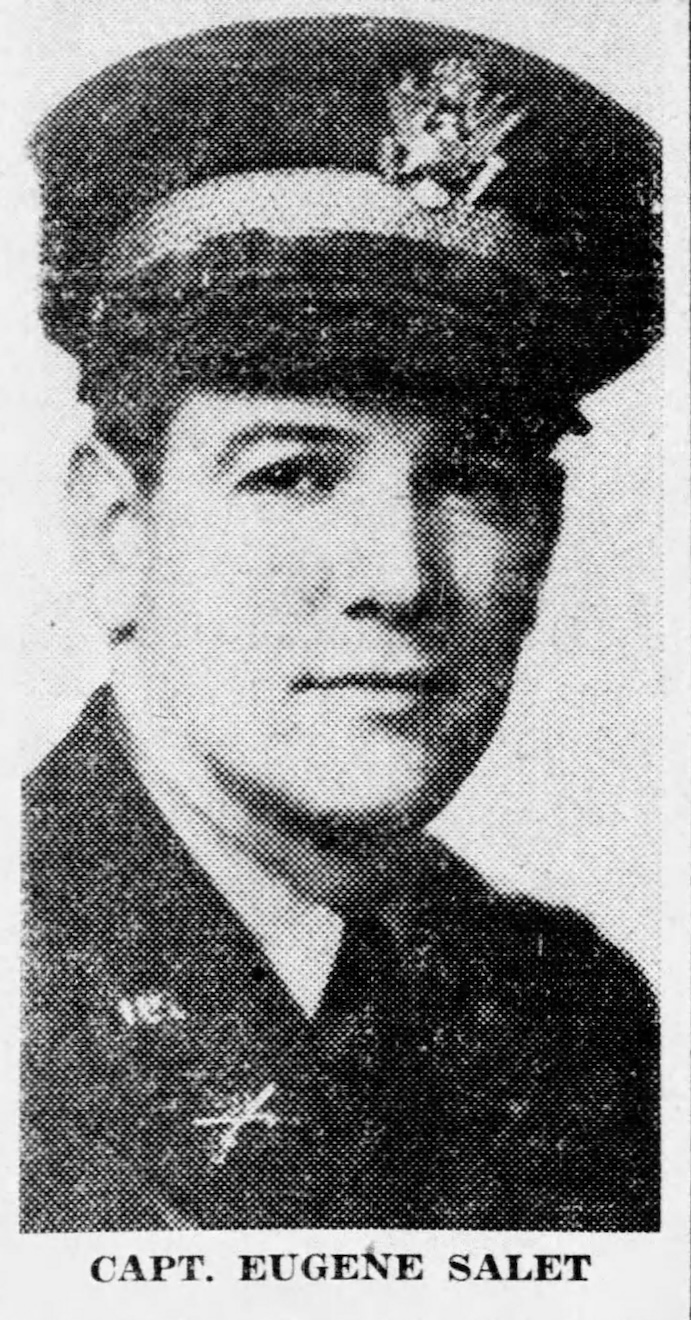
Eugene was called to active duty on June 16, 1941, shortly before the Japanese attack on Pearl Harbor, which brought the United States into World War II (WWII). He was assigned to the 30th Infantry Regiment, Third Infantry Division, at the Presidio of San Francisco, California. In 1942, he was promoted from first lieutenant to captain while commanding a heavy weapons infantry company at Fort Ord, California [1].
Captain Eugene Salet was widely praised by the press for his courage during the North African campaign (Reno Gazette Journal, October 22, 1943. P. 5).
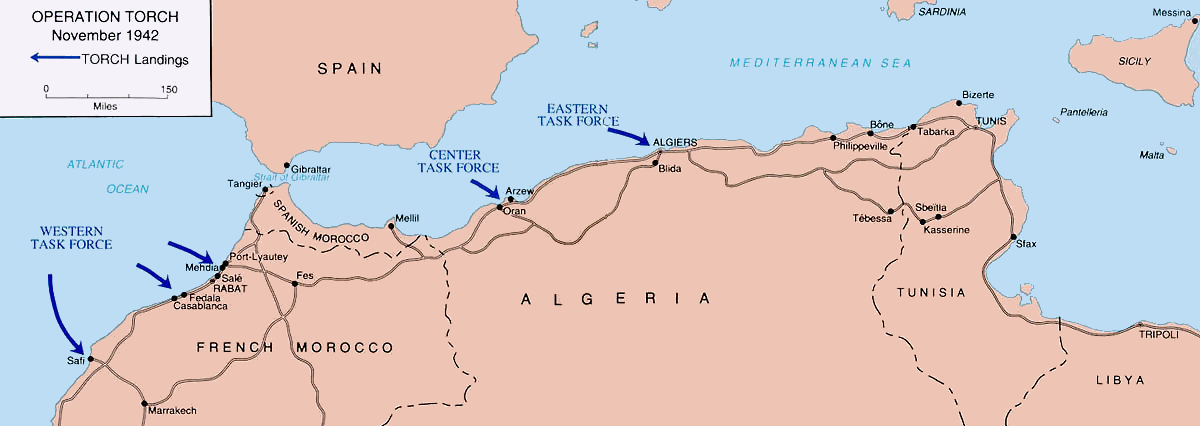
Eugene served as an infantry platoon leader and heavy weapons company commander in North Africa and Sicily. He landed at the small port of Fedala, near Casablanca, as part of the Allies’ invasion of North Africa (Operation Torch, November 8–16, 1942). In a letter written to his mother on November 24, 1942, from Rabat, he reflected on the invasion, providing a vivid firsthand account:
“It was my first taste of fire, and I’ll probably never forget it […] Well, mother dear, here we are. Have been wanting to write ever since we arrived […] Have a great deal to tell you […] We were on the water for 15 days. On Sunday morning about 1:00 a.m., November 8, we stopped about six miles off the coast of Africa, and made ready to attack and capture it. We lowered our assault boats, climbed over the side of the transport, got into assault boats and headed for the coast six miles away […] It was still dark as the devil. As we neared the shore the French were alerted and started throwing big search lights out over the water. Then all hell broke loose. They opened up on us with big machine guns, etc. We could see the red tracer bullets coming at us through the dark; some too close for comfort. We kept on coming and finally hit the beach. It is still dark but dawn is ready to break. Then the big French guns on the coast opened up on our navy warships. What a bombardment […] I was lucky and didn’t get a scratch. Hope I can continue to be as lucky. One thing, Mom, you can tell the folks that your wandering boy led the assault waves in the great American attack of [North Africa]. Our division was the spearhead of the entire assault. We’ll give Herr Hitler and gang something to think about. Feel kind of proud, Mom, to have been a member of the assault” [2].
Overview map of Operation Torch, highlighting the landing of Eugene Salet with the Western Task Force Force (U.S. Army Center of Military History).
Serving as operations officer of the 2nd Battalion, 15th Infantry Regiment, Third Infantry Division, Eugene participated in nine campaigns: French Morocco, Algeria, Sicily, Naples-Foggia, Anzio, Southern France, Rhineland, Ardennes-Alsace, and Central Europe. He took part in four major amphibious assaults: the invasions of North Africa, Sicily, Italy, and Southern France—often referred to as the “Forgotten D-Day.” The Third Infantry Division holds the distinction of being the only American division to engage Axis forces on all European fronts.
By mid-1944, Eugene had been promoted to major, and by January 1945, he received a battlefield promotion to lieutenant colonel, having served 27 months overseas. Remarkably, Eugene saw combat for approximately 530 consecutive days, writing to his mother after his first day on the frontline: “I was lucky and didn’t get a scratch. Hope I can continue to be as lucky.” Despite the heavy casualties suffered by the Third Infantry Division—the highest of any American division in WWII—Eugene emerged unscathed.
In 1945, he returned to the United States and was assigned to Headquarters, Army Ground Forces, in Washington, D.C., where he served until August 1946. For his extraordinary service during WWII, Eugene received numerous honors, including the Silver Star for gallantry in action at the Colmar Pocket, Alsace, France, on January 5, 1945; the Legion of Merit with five Oak Leaf Clusters for exceptionally meritorious conduct in the performance of outstanding services to the Government of the United States; and the Bronze Star Medal with two Oak Leaf Clusters. Internationally, he was awarded the Italian Military Valor Cross, the Croix de Guerre with Gold Star, and the French Fourragère in the colors of the Croix de Guerre. Additionally, he received the Distinguished Unit Citation with one Oak Leaf Cluster and the Army’s highest civilian honor, the Decoration for Distinguished Civilian Service [3].
A Lifetime of Military Excellence and Education
Eugene had a remarkable military career that combined instruction, strategic planning, and leadership in both national and international organizations. After World War II, he served as an instructor at the U.S. Army Command and General Staff College, shaping the education of officers at Fort Leavenworth, Kansas, and solidifying his expertise in military instruction.
During the 1950s, he took on roles in strategic planning and operations, including serving as senior planning officer at the North Atlantic Treaty Organization’s (NATO) Supreme Headquarters, in Paris, France, during the Korean War, contributing to multinational coordination under General Dwight D. Eisenhower’s command. Eugene alternated between command and international administrative responsibilities, notably as a regimental commander in Germany and subsequently as deputy director and secretary of the NATO Standing Group and Military Committee, playing a key role in organizing the Alliance’s collective defense. He also served as assistant civil administrator of the Ryukyu Islands, Japan, demonstrating leadership beyond strictly military duties.
In the 1960s, Eugene focused on military education and institutional leadership, first as commanding officer of the Army Training Center at Fort Gordon, Georgia, and then as president of the U.S. Army War College and Carlisle Army Barracks, Carlisle, Pennsylvania, and the U.S. Army Institute for Advanced Studies, overseeing advanced officer education and strategic programs. Recognized with the Army Distinguished Service Medal for exceptionally meritorious and distinguished services to the Government of the United States, he continued his career contributing to weapons systems analysis at the Department of Defense and serving as military adviser to the U.S. mission at NATO’s headquarters in Belgium.
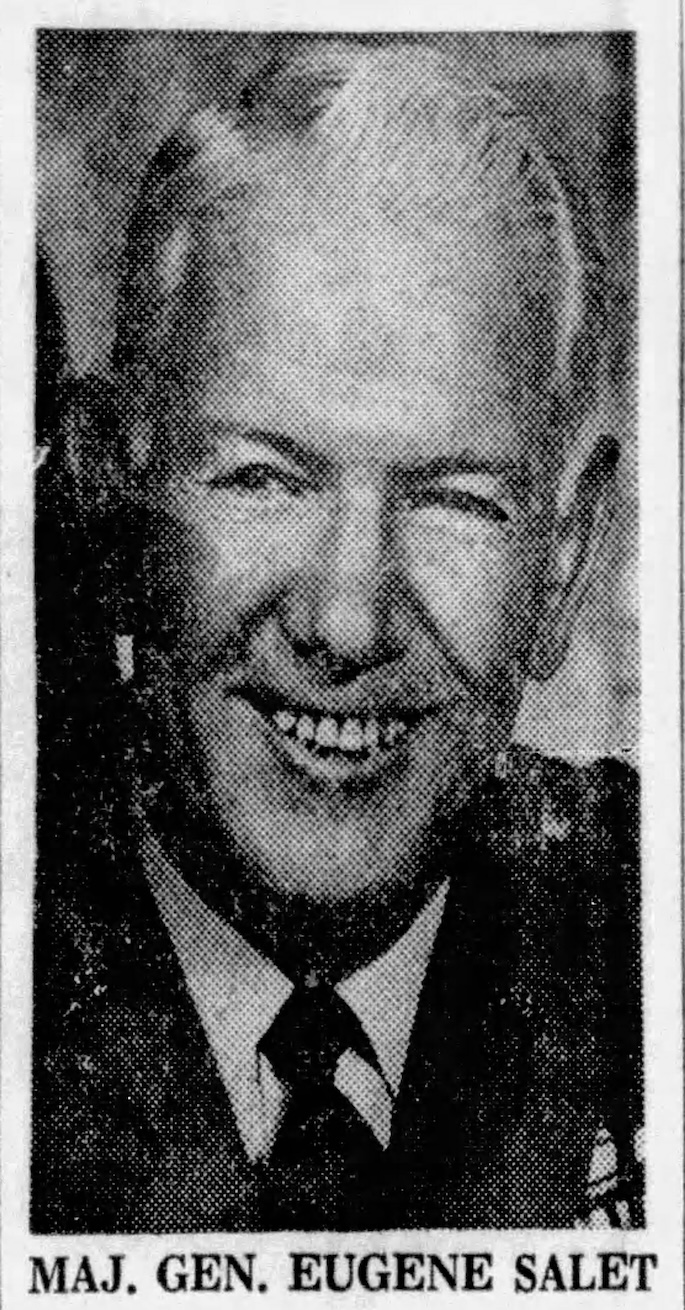
Photograph of Major General Eugene Salet in 1968 (Nevada State Journal, May 17, 1968. P. 12).
Eugene retired from active duty as a major general on September 30, 1970. Following his active service, he cemented his legacy in civil-military education, serving as dean and president of the Georgia Military Academy in Milledgeville, Georgia and leading the Association of Military Colleges and Schools of the U.S., nurturing future generations of military and civic leaders until 1985. [4]
Sharing a Vision: Values and Legacy
In 1967, Eugene was named Outstanding Nevadan by fellow Basque-American and WWII veteran Governor Paul Laxalt. He received an honorary doctorate in law from the University of Nevada, Reno, in 1968 and served as the commencement speaker that same year. During his address, he shared his vision for America:
“The keys which fit the door to this nation’s survival are held by each of you. These keys are faith, not fear; courage, not complacency; patriotism, not patronage; sacrifice, not selfishness.” [5]
Major General Eugene Salet Irigaray passed away on February 6, 1992, at the age of 80, at the Eisenhower Army Medical Center in Augusta, Georgia. He was buried with full military honors at Westover Memorial Park. He is the highest-ranking senior officer of Basque origin identified in the U.S. Armed Forces, according to our research.
Would You Like to Honor Veterans Like Eugene Salet?
The North American Basque Organizations, Inc. has launched a fundraising campaign to build the National Basque WWII Veterans Memorial by the end of 2026. This memorial will honor all WWII veterans of Basque origin—a place where their names, stories, and sacrifices will be permanently remembered. Your contribution is essential.
Please consider making a tax-deductible donation and become part of this historic tribute. Together, we can ensure that no veteran is ever forgotten.
“There are at least two things that can clearly be attributed to Basque ingenuity: the Society of Jesus and the Republic of Chile.” – Miguel de Unamuno
When we think about Basque emigration and the Basque diaspora, places like Argentina and Idaho are the first to come to mind. But, as I recently learned, Chile drew a large number of Basques. Whether for the rugged landscape and nearby coast or simply because that was were earlier relatives had gone or the economic opportunities were so tempting, many Basques made their way to Chile such that, today, maybe 25-30 percent of Chileans have a Basque surname.
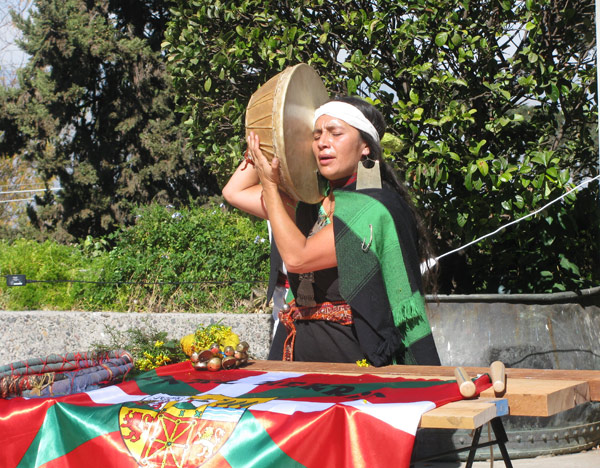
A member of the Mapuche performing a ceremony to bless the Ikurrina. Photo from Euskal Kultura.
Before the arrival of Europeans, the predominant group of people living in what is now Chile were the Mapuche. The Mapuche, primarily located in south-central Chile, first settled in the region sometime around 500-600 BCE. They resisted incursions from the nearby Inca and maybe numbered 700,000 to 900,000 when Europeans arrived. Today, they make up about 9% of Chile’s population.
The first European to set foot on what is now Chile was Ferdinand Magellan, in 1520 during his attempt to circumnavigate the globe. It wasn’t long before the Spanish crown began exploring the region, with colonists and conquistadors arriving in 1535. Several Basques were amongst that first wave, including the Bilbainos Martín de Cote, Francisco Galdemes, Francisco de Isásaga, Domingo de la Orta, and Juan de Larrañaga; fellow Bizkaian Ortún Jiménez de Bertendona; and the Gipuzkoans Pedro de Zárate and Gaspar de Bergara.
Of the families that settled Chile from the Iberian peninsula in the 1500s – 157 in total – 39 had Basque names.
The capital of Chile, Santiago, founded in 1541, was designed by Pedro de Gamboa, whose parents were from Bizkaia. Supposedly his friend played the txistu while he was working on the city plans.
This was only the first wave of Basque immigration to Chile. In fact, even greater influxes occurred in the 18th, 19th, and 20th centuries. In the 18th century, there was such a huge number of Basques coming to the country that, by the end of the century, some 30% of Chileans had Basque ancestry. While much of that immigration was from Hegoalde, starting in the 19th century Basques from Iparralde also started arriving. The Carlist Wars and the Spanish Civil War both led to large bumps in Basque immigration to Chile.
Basques established themselves as part of the elite of the country, in part due to success in business and their ties back to Iberia, but also because of favorable laws that enabled property to be passed down to single heirs rather than being broken up. Thus, Basques and their descendants have been part of the Chilean elite – the Castilian-Basque aristocracy – and ruling class for centuries. However, the shear number of Basques in the country also means that many people in other parts of Chilean society can trace ancestry to the Basque Country.
As a consequence of the Basque presence in Chile, many important Chileans have had Basque connections. A few examples include:
Bernardo O’Higgins, who led Chile’s war of independence from Spain and was Chile’s second Supreme Director, was of Basque heritage through his mother Isabel Riquelme, daughter of Simón Riquelme de la Barrera y Goycochea.
Actor Pedro Pascal‘s parents are Verónica Pascal Ureta and José Balmaceda Riera, who is a member of that aristocracy.
Augusto Pinochet, who led the military coup that overthrew Salvador Allende, was dictator of Chile from 1974 to 1990. His mother, Avelina Ugarte Martínez, was of Basque descent.
Gabriela Mistral (born Lucila Godoy Alcayaga) won the Nobel Prize in Literature in 1945.
Pablo Neruda (born Ricardo Eliécer Neftalí Reyes Basoalto), who won the same prize in 1971, is speculated to have had Basque heritage, though definitive links are missing. Basoalto is possibly a Basque name meaning “next to the forest” or “the elevated forest” (though some sources say it is a Spanish name meaning “high foundation or base”). He denied his Basque heritage, though, perhaps because of its association with the aristocracy of his country.
It is estimated that 10-30 percent of Chileans today have Basque heritage, translating to between 1.6 to 5 million people. Given that the population of the Basque Country is just over 3 million, Chile perhaps has more people of Basque heritage than the Basque Country.
A full list of all of Buber’s Basque Facts of the Week can be found in the Archive.