The more I learn, the more I realize how much I don’t know about Basque culture. When she accepted her award for her dedication to Basque culture at the Zortziak Bat symposium, Meggan Laxalt Mackey emphasized the role of auzolan – community work or more broadly collaboration – in her work. I hadn’t heard of that concept before, but it is central to Basque culture. It embodies the collective spirit, of working together to make your community better.
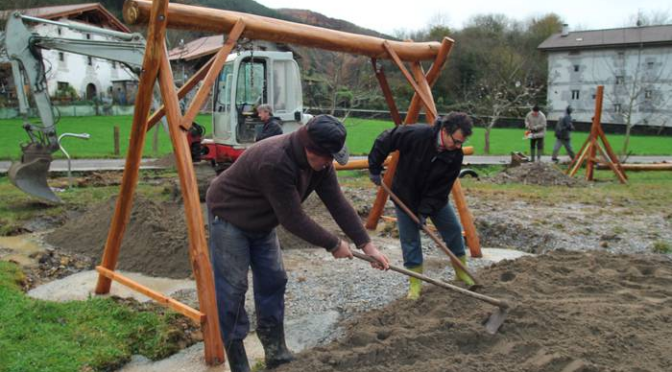
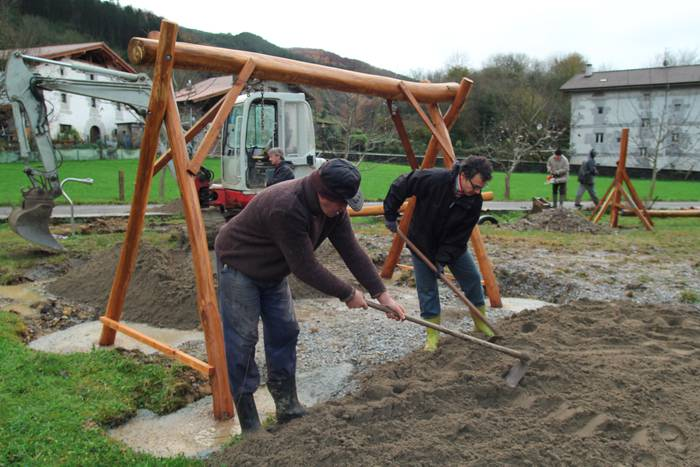
Auzolan to create a park in the town of Gaztelu in 2015. Photo from ataria.
Auzolan, or the related Bizkaian concept of lorra, is the concept of communal work, or performing work that benefits the community. In the Basque Country, this has manifested itself in many ways, from the building of churches to the maintenance of forest trails. While the concept of auzolan was defined by custom in the Basque Country, in more recent times it has been codified into law in some places.
Auzolan promotes community solidarity and cohesion. As described by Prof. Xabier Barandiaran, the concept of auzolan reflects “the individual’s responsibility to the community and their service to others, fostering solidarity and forms of social organisation that prioritize community interests over individual ones.”
To decide what work the neighborhood would focus on, either the town council or a simple local meeting would convene. Two types of auzolan could be planned: big or small, reflecting what tools would be needed to do the work: just hoes and shovels for a small job or carts and the like for a bigger job.
Often, auzolan would happen in September though a special auzolan might also happen in the spring. The committee would alert everyone in the neighborhood as to the time and place of the work and, if they couldn’t participate, they had to send an alternate. If the work was on public land, the city would provide food and supplies while if it was on private land, the owner would. People weren’t paid for their time – participating in the auzolan was viewed as an obligation of living in the community; it was mandatory.
The actual work associated with auzolan was often a community improvement effort, to construct or maintain roads, parks, fountains, or other things that would benefit the community as a whole. However, in some cases it could be directed to specific people that needed extra help, such as a widow or sick farmer.
Today, the concept has expanded to include collaboration more broadly, especially collaboration carried out freely and voluntarily, and to actions that benefit a neighborhood, town, or region voluntarily without receiving money.
The idea of communal work for the benefit of the community is not unique to the Basque Country and was common in medieval European societies. Indeed, the Asturians have a similar concept called andecha. Modern ideas associated with crowdsourcing certainly have a similar spirit. The Mondragon cooperative is one example originating from the concept of auzolan.
A full list of all of Buber’s Basque Facts of the Week can be found in the Archive.
It is amazing how fast technology has changed over my lifetime. When my dad first came to the United States, he rarely called back home in the Basque Country. He’d call maybe at Christmas. It was just too expensive. However, at the end of his life, he was constantly on his cell phone talking to his brothers back in the Basque Country. What was once a prohibitively expensive and extremely inconvenient became almost trivial. The Basque Country is on the forefront of pushing forward one of the next frontiers of technology – quantum computing. They just got one of the newest quantum computers in the world, and are only the second place outside of IBM to have one.
The IBM Quantum System Two in its home in Donostia. Photo from NetworkWorld.
Quantum computing is an alternative approach to computing from the more traditional analog and digital computing.
In October of 2025, IBM delivered to the Basque Country the IBM Quantum System Two, the first of its kind in Europe. This machine is modular and scalable, and can be upgraded in the future as newer quantum processors are developed. It uses IBM’s Heron chips, which contain 156 qubits. The computer is housed in Ikerbasque’s new building in Donostia. To perform, the computer has to be cooled to 0.15 Kelvin, or -459 Fahrenheit.
A key player the push to make the Basque Country a leader in this area is the Basque Quantum Initiative, or BasQ. This initiative is led by “the Department of Science, Universities and Innovation of the Basque Government and the three Provincial Councils of Araba, Bizkaia, and Gipuzkoa.” The Director of the initiative is Professor Javier Aizpuru, a research scientist at the Donostia International Physics Center (DIPC).
These researchers have already been pushing the frontiers of quantum computing even before the delivery of this new system. For example, they used a quantum computer to simulate the motion of quarks, subatomic particles that make up protons and neutrons. They have also used such machines to look at “time crystals,” for the first time in two dimensions. Regular crystals, such as the NaCl crystals in table salt, have repeating patterns in space. Time crystals also repeat their structures in time, oscillating periodically.
A full list of all of Buber’s Basque Facts of the Week can be found in the Archive.
Amuma Says No has been a staple of the Boise Basque music scene for almost 2 decades. Not only are they at every Basque event in Boise, but they travel the country spreading Basque sounds wherever they go. At Jaialdi 2025, you could find them on the stage in the middle of the Basque Block or in the Idaho Central Arena, one of the three acts including Neomak and Gatibu that rocked Saturday night.
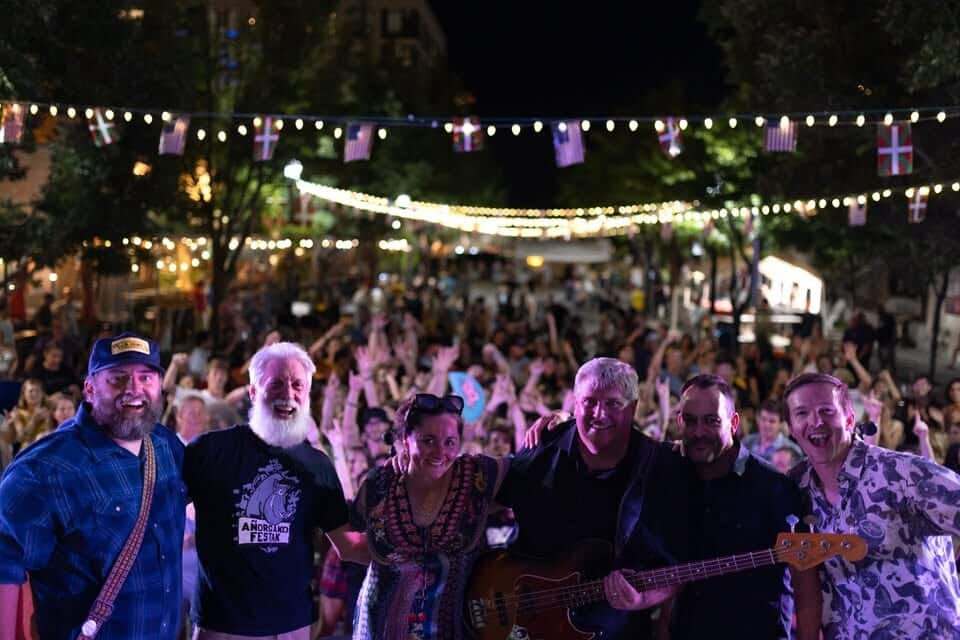
Amuma Says No playing on the Basque Block in Boise. Photo from the Jaialdi website.
Amuma Says No grew out of the traditions of Basque dancing in Boise – more than one member was part of the Oinkari Basque Dancers and grew up with the sounds of people like Jimmy Jausoro and Domingo Ansotegui. They play a mix of traditional music centered around the trikitixa with more modern sounds including rock.
The band has come to embody the Basque American spirit and has represented Basque culture throughout the country, traveling to various picnics and fiestas all across the American west. They even performed at the Kennedy Center and in 2010 at the Library of Congress.
The current – and original – line up includes
Dan Ansotegui on accordion. Dan was an Oinkari and has been a part of the Boise Basque community for a while, owning in the past both Bar Gernika and The Basque Market and playing in Jimmy Jausoro’s band. He current also owns Ansots, a restaurant and caterer in Boise.
Jill Aldape, vocals. She has served as both President and head instructor of the Oinkari Basque Dancers.
Sean Aucutt, pandero, was also a dancer for the Oinkaris.
The band was formed in 2006. Dan and Sean had met when they both had been teaching for Txantxan Gorriak, a musical group teaching Basque music to children. They knew Jill who was an instructor for the Oinkaris. Spencer, who has Basque roots, had just moved to Boise and wanted to play drums. He was directed to Dan, Sean, and Jill. They put together some songs for a December dance and the reception was so great that the rest is history.
In 2011, the group accompanied the Oinkari dancers for a few performances in the Basque Country.
Over the last few years, they have been in semi-retirement, but they came back out to perform at Jaialdi 2025.
A full list of all of Buber’s Basque Facts of the Week can be found in the Archive.
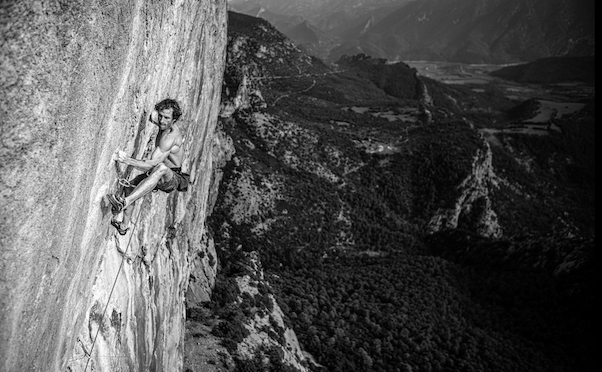
I’ve said it before – for such a small place, Basques seem to outdo themselves, making an impact above and beyond what their small population might suggest. Case in point: Patxi Usobiaga. Patxi is a rock climber who reached the pinnacle of his sport, doing things no one had ever done before. Maybe growing up in the mountains of the Basque Country gave him an advantage. But you only make it to the top with hard work, dedication, and sacrifice.
Patxi Usobiaga Lakunza was born on September 7, 1980, in Eibar, Gipuzkoa. He started climbing when he was 10 years old.
Usobiaga is the first climber in the world to complete an 8c+ climbing route “on sight.” What does this mean? 8c+ refers to the difficulty of the climb, or its rating, in the Fontainebleau bouldering system. An 8c+, equivalent to an 5.14c in the Yosemite Decimal System, is one of the hardest climbs there is, though there are routes that are rated in the 9s. Onsighting means that he had no prior knowledge of the route – he didn’t know where the handholds were or what order might be best to attack them, he discovered them as he climbed. He couldn’t even watch another climber attempt the route. Further, to qualify as an onsight climb, he had to complete it in his first attempt.
The route itself is called Bizi Euskaraz (live by Basque) and is in Etxauri, Nafarroa. Usobiaga climbed it in 2007.
This isn’t the hardest route he climbed. He also redpointed 9a+ routes. Redpointing means that he didn’t complete it on his first attempt, so that when he did complete it, he had some familiarity with the route.
During one two-week period in December, 2007, he redpointed two 9a+’s and a 8c+/9a and onsighted a 8b, 8c, 8b+, and 8c+.
In both 2006 and 2007, he won the Climbing World Cup in the individual discipline of lead climbing. He was also the World Climbing Champion in 2009.
In 2010, he was in a car accident that caused a slip disk in his back. He retired from the sport the following year. Since then, he has become a personal trainer, training other climbers in the sport.
A full list of all of Buber’s Basque Facts of the Week can be found in the Archive.
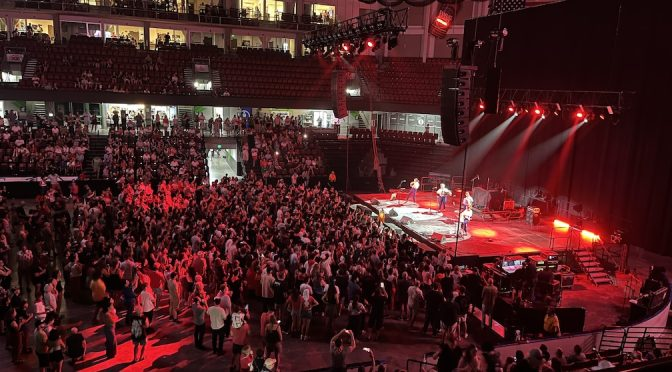
Rediscovering Gatibu at Jaialdi was a great experience, but Lisa, Rose, and I were also blown away by a band I’d never heard of before: Neomak. Opening for Gatibu in the Idaho Central Arena, Neomak both had a more traditional sound than Gatibu – trikitixa, tambourines, and drums – but pushed that sound in new and innovative ways. The steady drum beat instilled an energy that was only rivaled by the women dancing and singing on stage. Another band I would highly recommend.
Neomak playing at the Idaho Central Arena during Jaialdi 2025. Photo by Blas Uberuaga.
Neomak was formed in 2020. Their name, translating from the Greek to new moon, represents their goals of transforming tradition, of keeping their roots but making something new.
Originally comprised of seven young women, Neomak got their start touring with renowned Basque musician Kepa Junkera. After the touring stopped, they realized they had more to say, more to do, and so they started Neomak. In 2025, three of the members of the group left with the remaining four continuing to find new ways to interpret Basque music and stories. Those four are Alaitz Escudero Unanue, Leire Etxezarreta Learreta, Irati Gutierrez Artetxe, and Garazi Otaegi Lasarte.
In 2022, after releasing only two songs, Neomak toured the Basque Country before releasing their first self-titled album later that year. In 2024, they composed and released a song, “Hor Daude,” in support of Herri Urrats, a festival that promotes the ikastolas of Iparralde.
As they discuss in this interview, their songs give voice to their grandmothers, to the women who haven’t had a voice. “We begin by talking about the stories told by our grandmothers and saying that we will be the voice they often haven’t been able to have. We continue with a critique of the repression of our grandmothers, the church, some traditional ideas, etc. We shift gears by talking about the taboo surrounding sex and end with a vindication and critique of today’s society with the song “XXI.mendekua,” which has a double meaning: the 21st Century and the 21st Revenge. It’s a song that champions support among women and empowerment.”
A full list of all of Buber’s Basque Facts of the Week can be found in the Archive.
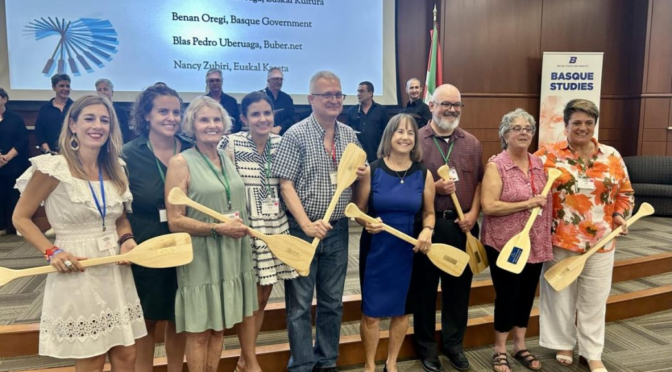
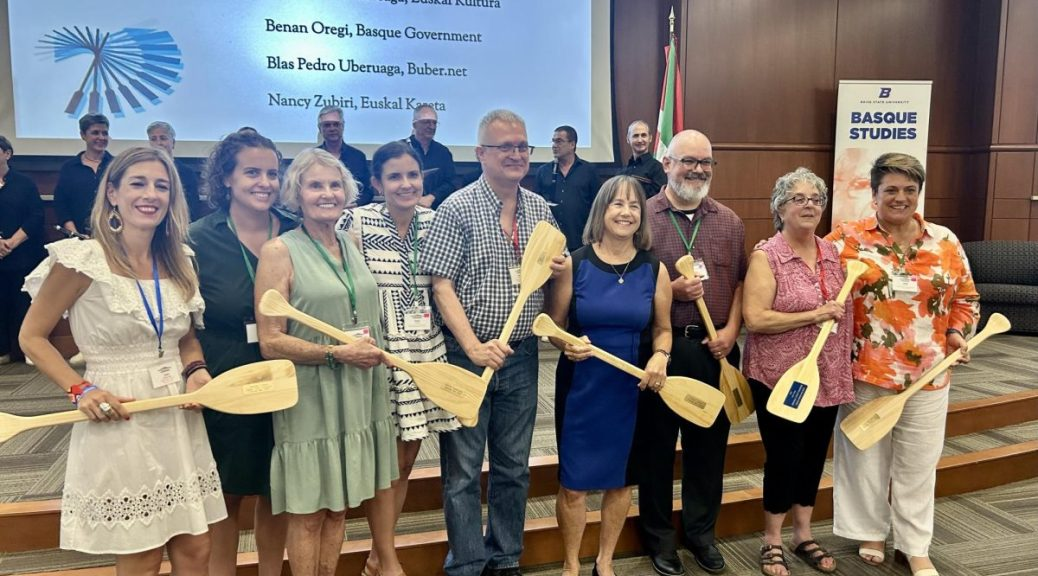
The theme of the Zortziak Bat symposium that was held during Jaialdi was Elkarrekin Arraunean, or “Rowing Together,” highlighting the contributions of so many people that have helped promote and support the Basque language and culture. Seven people were honored for their lifetime of effort – I was pleased to be one of those recognized. But I was also humbled to be in the presence of such a great group of people, people who have done so much for Basque culture.
Honorees at the Zortziak Bat symposium. Photo from Euskal Kazeta.
Joseba Etxarri first came to the United States in 1987 and has been a stable of Basque festivals ever since. He wrote about his experiences in his book Euskaldunen Ameriketa, Bidaia bat EEBBetan zehar. He is the director of the website EuskalKultura.com where he shares news from all over the Basque diaspora, not just the United States. Euskal Kultura, which began as a print publication in 1998 and went online in 2001, is an invaluable resource with the goal to “inform, connect, facilitate mutual understanding, and build bridges.”
David Lachiondo was honored posthumously. He spent 41 years in secondary education before moving to Boise State University. He was director of the Basque Studies Program at BSU while also teaching on topics including Basque history. Born in Boise, his first language wasn’t English and he struggled when he first went to school, but later education became his passion. He was recognized for his many contributions to Basque culture, in Boise and beyond.
Meggan Laxalt Mackey was the heart and soul of the symposium. She was recognized for her dedication to Basque Studies, having taught at Boise State’s Basque Studies Program. She has spent the greater part of her adult life promoting the Basque Culture and Language, not only as an educator but also as an author, publishing amongst other books Lekuak: The Basque Places of Boise, Idaho. She currently owns and runs Studio M Publications and Design, which helps other authors bring their ideas to light.
Nere Lete Bieter, a Professor of Basque in the World Languages Department at Boise State University, was honored for her dedication and continued efforts to promote Basque culture and language. She is also one of the co-founders of the Boiseko Ikastola, the only Basque language preschool outside of the Basque Country. Previously director of the Basque Studies Minor at Boise State University, she has also translated numerous documentaries to provide a larger corpus for natural language processing.
Benan Oregi is Senior Diaspora Policy Officer with the Basque Government, which means he has been working to strengthen ties between the Basque Country and the Basque diaspora. He has worked in this area for more than 25 years, recognizing that relationships with diasporas are becoming ever more important for governments at all levels. He also teaches post-graduate classes on diaspora relations at the University of the Basque Country.
Nancy Zubiri is the force behind Euskal Kazeta, which is “the premier website for news about the Basque community in the United States.” Started in 2009, Euskal Kazeta shares news about all things Basque in the United States. Its mission is to “help preserve the Basque culture by promoting social engagement and public education relating to Basque culture.” Nancy, who recently retired as from teaching high school English, has also published multiple books, including Travel Guide to Basque America and Jaialdi: A Celebration of Basque Culture.
A full list of all of Buber’s Basque Facts of the Week can be found in the Archive.
I have a dream of slowly migrating the original parts of this site – the parts you can find with the menu on the left of each page – to the more modern blog format of the newer version of Buber’s Basque Page. One of my first forays was to copy my translation of MG Ramos’s DeAstronomástica Vasca, a treatise from nearly 100 years ago about the Basque names for the sun and moon. In doing a little searching on what new information there might be, I stumbled upon this cool story about how a star and its exoplanet were given names in Euskara, a first for the language.
The International Astronomical Union has, amongst other functions, the authority to assign names to celestial bodies, including stars and planets. Founded in 1919 and headquartered in Paris, France, the IAU holds a regular contest called NameExoWorlds with the goal of naming a selection of exoplanets that have been discovered.
An exoplanet is any planet that resides outside of our solar system. The first confirmed discovery of such a planet was in 1992, when two such planets – now called Phobetor and Poltergeist – were discovered orbiting a pulsar called Lich. As of today, nearly 6,000 exoplanets have been discovered.
The star now known as Gar was previously designated as either Gliese 486 or Wolf 437. Residing in the constellation Virgo, it is a red dwarf star that is about 26 light years away from Earth.
In 2021, an exoplanet was discovered orbiting Gar by a team led by Trifon Trofonov with the Max Planck Institute for Astronomy. This planet, now named Su, has been studied using the James Webb Space Telescope which has found that the day time surface temperature is in excess of 1000 degrees Fahrenheit. This suggests Su has little to no atmosphere. It is about 3 times as massive as the Earth but is rocky.
A team from the University of the Basque Country, led by Itziar Garate-Lopez, proposed the names Gar and Su during the 2022 NameExoWorlds contest in part because the exoplanet had been discovered from observations made in Spain, with key contributions from the Calar Alto Observatory. It’s also a fiery ball of rock, which inspired the name Su.
In Euskara, Gar means flame and Su means fire. The Basque phrase “su ta gar” means literally “fire and flame,” but is used to indicate passion and enthusiasm. Su Ta Gar is also a heavy metal band from Eibar, Gipuzkoa.
A full list of all of Buber’s Basque Facts of the Week can be found in the Archive.
In celebration of Basque Diaspora Day 2025, which on Monday, September 8 in Markina, Bizkaia, will recognize the contribution of pelota to the Diaspora, the authors of this blog publish the previously untold story of the jai-alai player from Eibar, Agustín Guisasola, a World War II veteran with the United States Army.
This year, the International Day of the Basque Diaspora 2025 is being celebrated in Markina (Bizkaia). This year’s celebration pays tribute to the Basque pelotaris who brought “jai-alai” or cesta punta to courts all over the world. Among those young men who pursued their professional careers in America was Agustín Guisasola of Eibar, whose life story exemplifies the intersection of sport, emigration, and commitment to his adopted country.
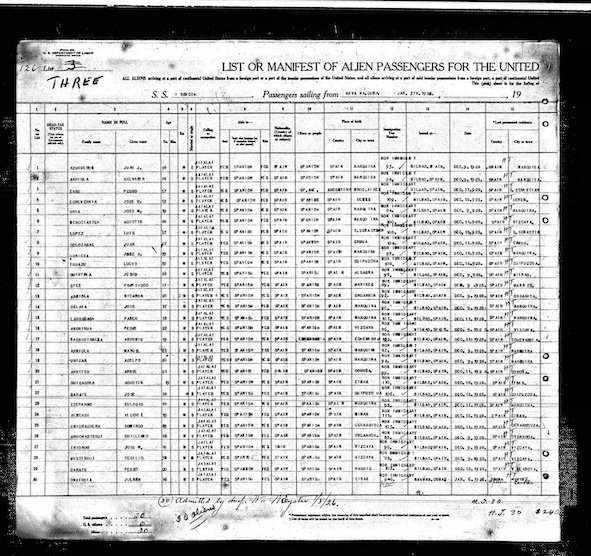
Passenger list of the steamship Seneca, on which Agustín Guisasola and his companions embarked from Havana, Cuba, bound for Miami, Florida, on January 7, 1926. (Source: Document via authors).
Oiarzabal received his Doctorate of Political Science-Basque Studies from the University of Nevada, Reno. Over the last two decades, his work has focused on research and consulting on public policies (citizenship abroad and return), diasporas and new technologies, and social and historical memory (oral history, migration and exile), with special emphasis on the Basque case. He is a member of Eusko Ikaskuntza.
Tabernilla is a researcher and founder of the Sancho de Beurko Elkartea, a non-profit organization that studies the history of the Basques of both slopes of the Pyrenees in the Spanish Civil War and in World War II. Between 2008 and 2016 he directed the catalog of the “Iron Belt” for the Heritage Directorate of the Basque Government. He is author, along with Ander González, of Basque Fighters in World War II (Desperta Ferro, 2018).
Born in 1906 in Eibar, Gipuzkoa, Guisasola set sail for Florida, United States (U.S.), at the age of 19 as part of a large group of professional jai-alai players who inaugurated a second fronton in Miami, the Biscayne, on April 1, 1926. Its opening was warmly received by the local press as a major event, which even included Basque traditional dances performed by the young puntistas. The first court, the Hialeah, inaugurated in January 1925 in the city of Hialeah in Miami-Dade County, was forced to close after its first season due to the success of the Biscayne. The Biscayne had become a cultural and sporting landmark in Miami.
Just a few months later, in September 1926, a devastating hurricane left the Biscayne in ruins, but it was soon rebuilt and reopened in June 1927. Nevertheless, it never returned to its former glory until it changed ownership [1]. Chronicles of the time highlight its Basque players, among them Guisasola, as the stars of a spectacle that drew thousands of spectators in South Florida.
Agustín also took part in the inauguration of the Summer Casino in Havana in 1928, and in 1930 he played at the Habana-Madrid court, also located in the Cuban capital.
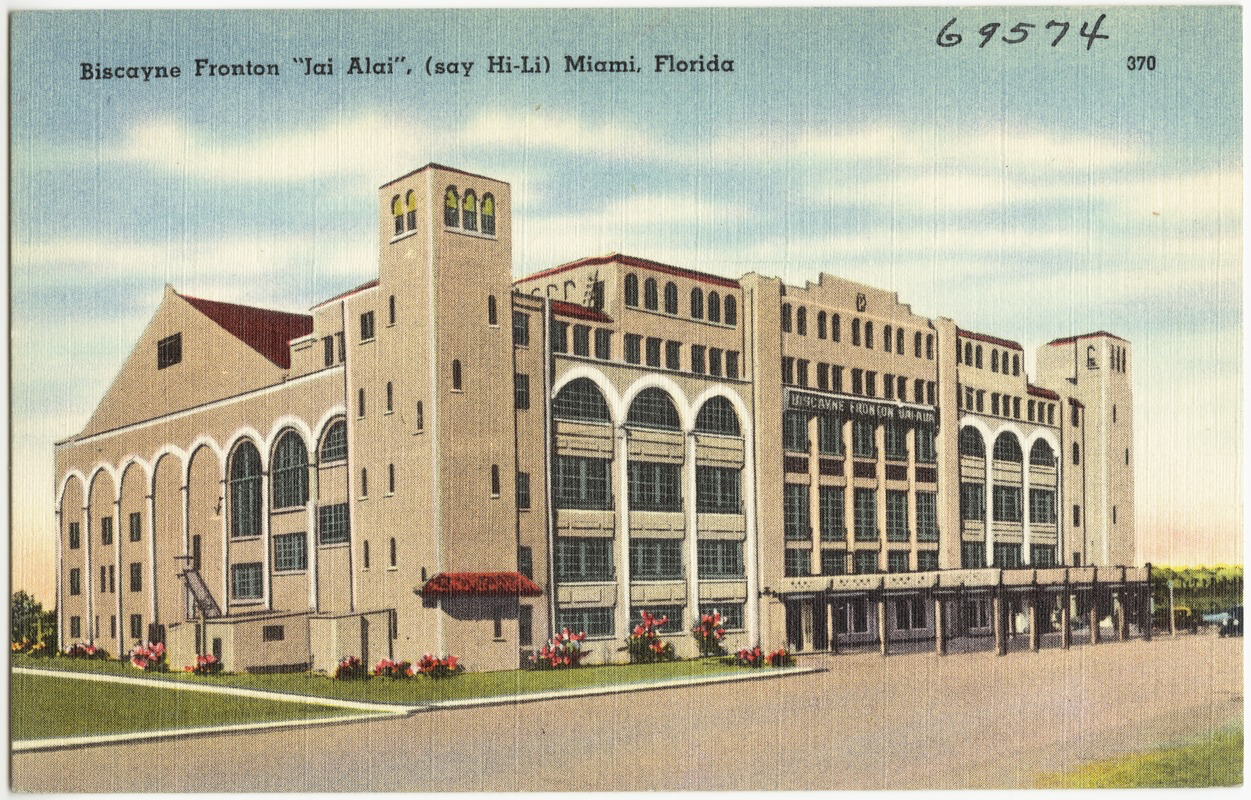
Postcard of the Biscayne Fronton in Miami, 1930s. (Source: Boston Public Library).
In 1928, Agustín married French-born Therese Yvonne Savoli in New York. During the 1930s the couple alternated their residence between the United States and France. Upon returning to New York, he played—already a veteran—at the Biscayne until 1940 and afterward worked in the textile industry. Naturalized as a U.S. citizen in 1943, only a few months later, in October, he enlisted in the United States Army during World War II (WWII). He is very likely the first and only professional Jai-Alai player (identified to date) who served with the United States during WWII.
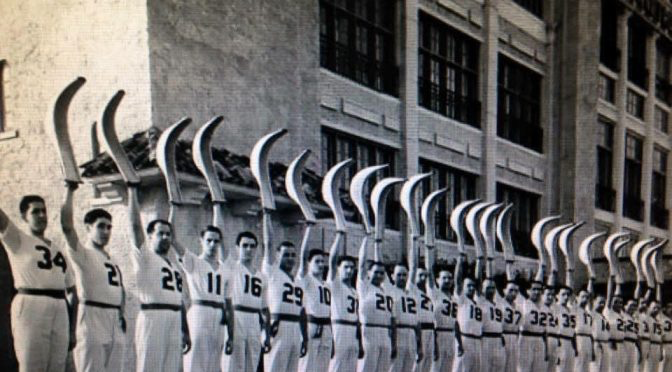
The roster of jai-alai players at the BiscayneFronton in 1940. Number 12 could possibly be Agustín Guisasola, though this has not been confirmed. (Source: Miami Springs Historical Society and Museum).
After the war, Agustín and his wife continued to reside in New York, and later in Florida, where he passed away in 1982 at the age of 76.
The story of Agustín Guisasola is that of an emigrant whose trade was pelota, who participated in the early days of cesta punta in America and who, when the time came, put on the U.S. uniform to fight under his new flag. His name is now added to the nearly 2,100 Basque and Basque-American veterans of WWII whose memory we seek to preserve and honor.
If anyone has photographs, newspaper clippings, or memories of Agustín Guisasola as a jai-alai player in Miami or Havana, we would be most grateful if you could contact us at sanchobeurko@gmail.com. A photograph of him would be a valuable testimony to accompany his story and enrich our project to preserve the memory of the Basques in World War II.
Tomorrow, September 8, the anniversary of Juan Sebastián Elcano‘s circumnavigation of the globe, is the International Day of the Basque Diaspora. This day is meant to highlight the contributions the Basque diaspora have made to Basque culture and Basque society. The Basque Government has made an explicit effort to strengthen connections and relations with the diaspora, starting with the law of 1994 that formalized these relationships. The Basque government intends to modernize this law, as outlined in a speech given at Jaialdi.
International Day of the Basque Diaspora is just one way the Basque government is promoting relations with Basques outside of the Basque Country. Image from Boise State University’s Mintzagai website.
At the Zortziak Bat symposium at Boise State University, held during Jaialdi, Lehendakari Imanol Pradales and his government announced that, in 2026, they will introduce a new draft law aimed at strengthening ties between the Basque Country and the diaspora. This will be an updated and expansion of the 1994 law that formalized relationships with the diaspora.
The main goal of this new law would be for the Basque Country to take advantage of the talent that resides in the Basque diaspora. For example, in the “Global Basque Country” or “Euskadi Global” initiative, they want Basques in the diaspora to be active ambassadors to promote the Basque Country. They also want the Basque Government to take a greater role in serving that same diaspora.
The 1994 law has been key in establishing and strengthening relationships between the Basque Country and the diaspora, primarily through the euskal etxeak, or Basque houses. These are organizations that promote Basque culture locally and they exist all around the world. There are currently euskal etxeak in 25 countries representing some 36,000 people. However, there are 80,000 Basques across 100 countries that have the right to vote. Thus, while the euskal etxeak have been instrumental in promoting Basque culture, they only represent a small fraction of the Basques in the diaspora.
The New Basque Diaspora Law and the bigger Euskadi Global strategy are meant to position the Basque Country globally by taking advantage of the strong capabilities represented by Basques both within and without the Basque Country.
Part of this strategy is the development of the digital HanHemen network. The goal of this platform is to connect Basques all across the globe “with the aim of connecting, exchanging information and resources, as well as sharing experiences.”
The new law is part of the bigger “Eraldoroa” Four-Year Institutional Action Plan of the Pradales government. More specifically, this plan has four lines of action and several goals:
Actions:
Consolidating the Basque presence abroad
Diasporising Basque society
Connecting the global Basque community
Talent and Return
Goals:
To boost the dynamism of the Basque community abroad by supporting the activities of its associations and those that help to project Euskadi / the Basque Country wherever it may be.
To recognise the value of the diaspora as human, social, cultural and economic capital (transversality).
To boost relations between the Basque Country and its diaspora populations (Eraldaroa).
To make Basque society aware of its potential, through knowledge and recognition (Diasporizatu)
To welcome members of the diaspora wishing to return to the Basque Country on the best possible terms.
To align Basque diaspora policy with global approaches, positioning the Basque Country at the cutting edge.
A full list of all of Buber’s Basque Facts of the Week can be found in the Archive.
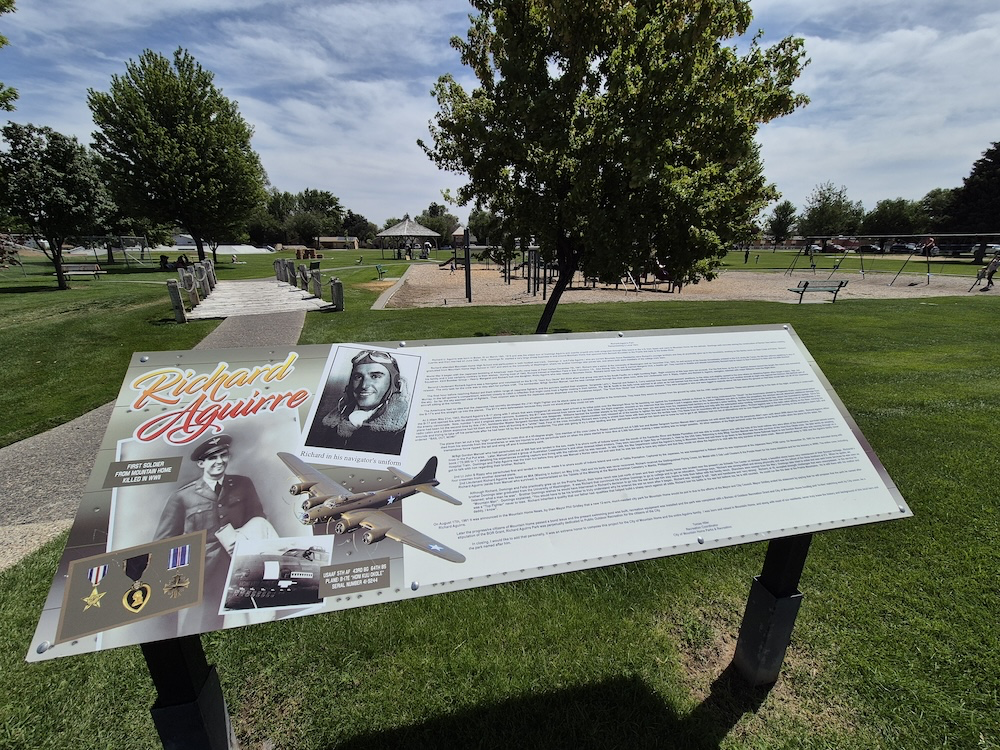
A B-17 navigator, Second Lieutenant Richard Aguirre Urquidi, son of Basque emigrants and a native of Boise, was the first World War II fatality in Mountain Home, where his family had established their residence. Shot down in 1943 over Rabaul Island, he was taken prisoner and later executed in 1944. A municipal park in Mountain Home is dedicated to his memory. (Photo by Pedro J. Oiarzabal).
Below we publish the chronicle of the latest trip of Dr. Pedro J. Oiarzabal – co-author of this blog and co-principal investigator of “Fighting Basques: Memory of World War II” – to the United States. His trip’s goals were two-fold: to disseminate the nearly-final results of the research, on the tenth anniversary of the projects beginning, on the Basque participation in the American ranks during the last world conflict; and to deepen the work developed to date in the achievement of a monument, on American soil, to the memory of these soldiers.
The Choice of Identities
The American West is the place where the hopes and dreams of thousands of Basques for generations and generations were born.
Oiarzabal received his Doctorate of Political Science-Basque Studies from the University of Nevada, Reno. Over the last two decades, his work has focused on research and consulting on public policies (citizenship abroad and return), diasporas and new technologies, and social and historical memory (oral history, migration and exile), with special emphasis on the Basque case. He is a member of Eusko Ikaskuntza.
Tabernilla is a researcher and founder of the Sancho de Beurko Elkartea, a non-profit organization that studies the history of the Basques of both slopes of the Pyrenees in the Spanish Civil War and in World War II. Between 2008 and 2016 he directed the catalog of the “Iron Belt” for the Heritage Directorate of the Basque Government. He is author, along with Ander González, of Basque Fighters in World War II (Desperta Ferro, 2018).
On my latest trip through Idaho and Nevada, as well as on the numerous others I have made for nearly a quarter of a century, I continue to be amazed by the depth of the Basque legacy in the American West, both in the construction of its imagery and in all the different facets of its society. The extraordinarily positive image of this legacy, which the various Basque-American communities and their institutions enjoy today, very likely does not correspond to its real weight. It is, however, an intangible heritage of incalculable value, and if managed well, it could help strengthen the future of this historic and complex American diaspora, while also enabling its members to continue choosing to connect with all things Basque.
Between the hyperbolic public image of Basque identity generated by the Jaialdi festival in Boise, Idaho – the largest Basque festival in the United States – in its eighth edition (July 29 to August 4, 2025) and the more modest annual Basque picnics in Mountain Home, Idaho and Gardnerville, Nevada, both held on the weekend of August 9 and 10, lies in some ways the situation, closer to reality, in which the Basque communities of the American West find themselves.
The Basque diaspora, whether in the United States or in any other country, historical or recent, is a vast chain in which every link is necessary for its very existence. This is also true at the local and community levels. In the postmodern identity market, choosing to identify with the Basque identity in the diaspora is similar to a small salmon struggling against the current to reach its final destination. Connecting with Basque identity and culture means contemplating the importance of the small things in life, shaped by time and the legacy of one’s ancestors, and enjoying them before they fade away irreversibly.
The American West is also the place where the descendants of those Basque emigrants who left their homes weave together, day after day, transformative complicities of the present, rooted in a distant past, and filled with unpredictable and uncertain futures. Each generation struggles to prevent everything they knew and loved from vanishing, while every action and decision they make leads them to transform their memories into present-day projects for future generations. In every dance step, in every musical note, in every bertso, and in every bite of food lie the seeds of a Basque identity laden with memories and recollections that honor the vision and actions of their parents, grandparents, and great-grandparents, in keeping their historical and cultural legacy alive.
Recognize and Honor World War II Veterans of Basque origin
For a decade, the non-profit Sancho de Beurko Elkartea has led the research project “Fighting Basques,” the first systematic academic study of the contributions of Basques and Basque Americans to the U.S. Armed Forces and Merchant Marines during World War II (WWII). This is a pioneering study, both in the Basque Country and in our immediate geographic context, on the role played by a minority emigrant group and their descendants up to the second degree (grandchildren of emigrants) in the last world conflict under the American flag. It is, in fact, a history of the United States during WWII through a Basque lens.
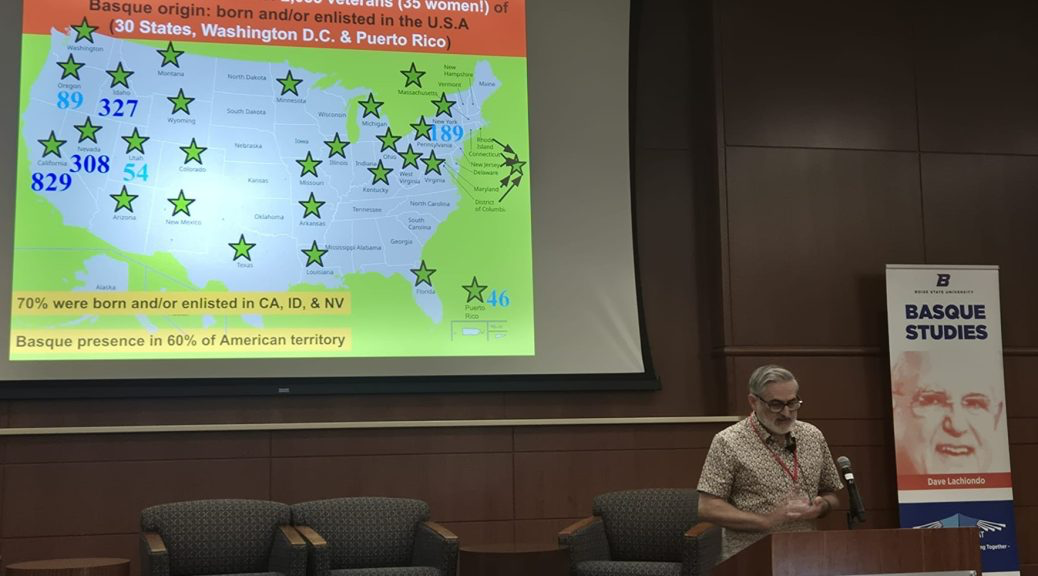
Oiarzabal during his presentation at the Boise International Symposium on July 30, 2025. (Photo from the author).
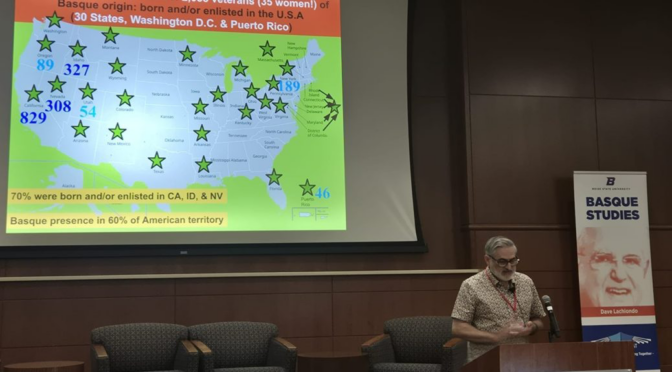
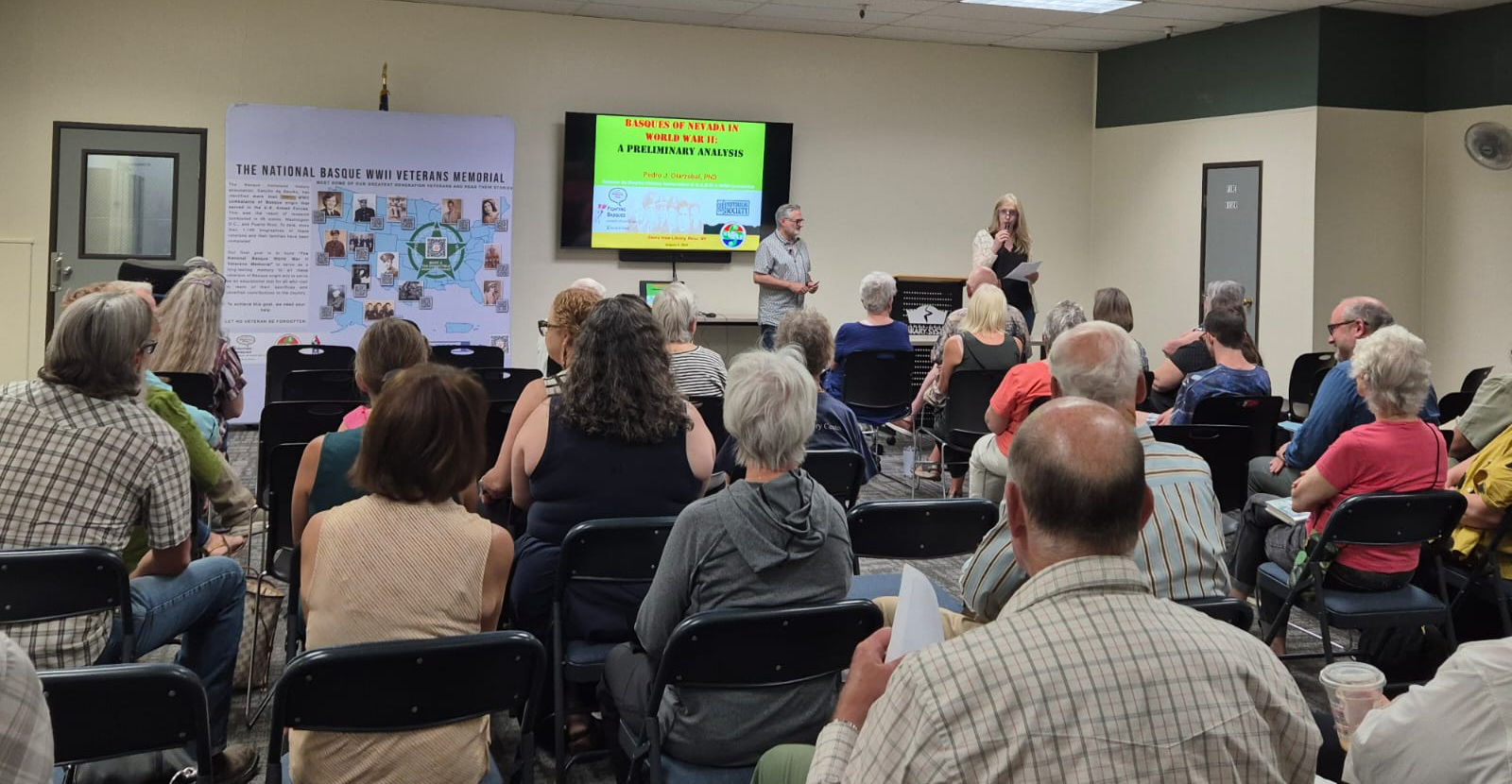
Once the study was almost completed, I had the honor of presenting its main results in Boise during the International Symposium on the Basque Diaspora “Zortziak Bat” (at Boise State University) and in Reno, Nevada at the Nevada Historical Society.
Month by month, year by year, we have been putting together the pieces of the hitherto largely unknown puzzle about the Basque and Basque-American contributions to the U.S. military forces during WWII. Today, we have identified nearly 2,100 men and women of Basque origin, born and/or enlisted in 30 states, as well as Washington, D.C., and Puerto Rico – which represents 60% of the country. Even so, 70% of them were born and/or enlisted in California, Idaho, and Nevada. (It is not surprising to find that these three states are home to the majority of the U.S. population of Basque origin today.) These 2,100 soldiers served in all branches of the military and fought on all fronts.
Furthermore, nearly 270 of these soldiers were born in the Basque Country. More than half of them were not U.S. citizens at the time of their enlistment, which speaks to their true commitment to their adopted country. Despite their participation in WWII, unfortunately many of them would not achieve citizenship.
Oiarzabal at the beginning of his presentation in Reno on August 6, 2025, about the 300 Nevadans of Basque origin who fought during World War II. (Photo from the author).
At the beginning of our research, very little, if anything, was known about the Basque participation in WWII under the U.S. flag, and even less about the number of soldiers identified to date. They were simply shadows in oblivion. It is “the greatest generation,” but also the most unknown, one that had gone unnoticed by the academic world and remained alive only in the memories of their closest relatives. Without a doubt, the most cherished moments of my trip have been related to the encounters with the children, nephews, or grandchildren of our veterans, whether in Boise, Elko (Nevada), Reno, or Gardnerville.
If the dozens of relatives I was able to speak with during my short stay in the country had one thing in common, it was their desire to demand a place for their veterans in our public history, in our collective memory. Their veterans survived the Great Depression and stood up to authoritarianism and fought for democracy, for many of them to the bitter end. This is why their families are demanding immediate public recognition.
And this is exactly what we, under the leadership of the North American Basque Organizations (N.A.B.O.), are working on, to build an official commemorative memorial on American soil to permanently honor their memory and sacrifices, with the intention of inaugurating it by the end of 2026, coinciding with the 85th anniversary of the U.S. entry into the war.
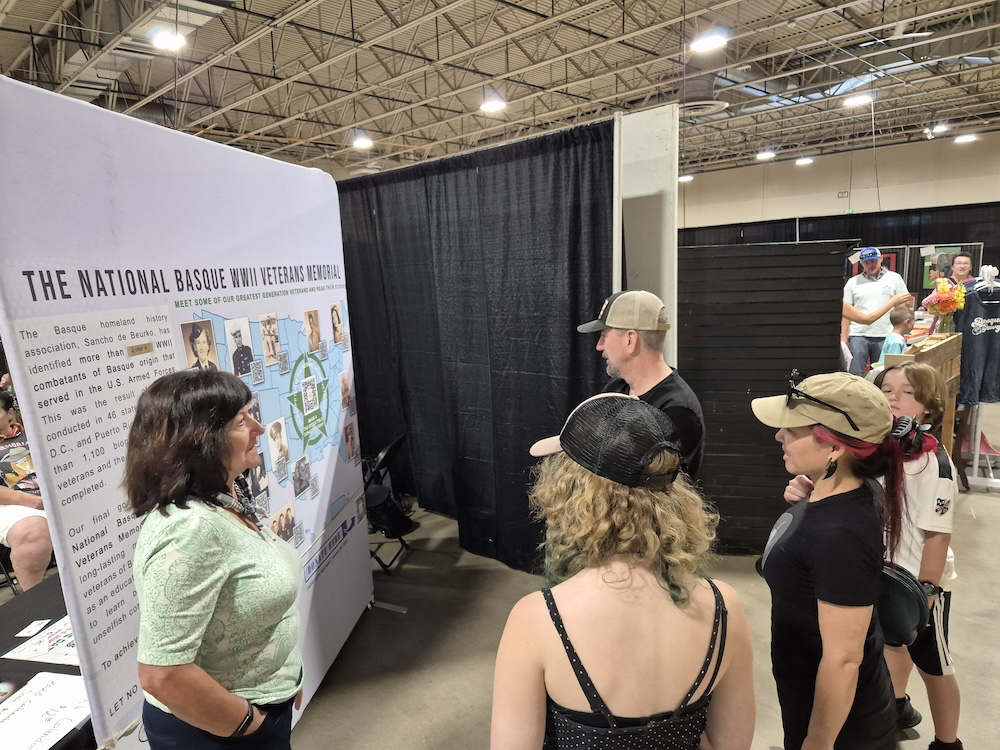
Mayi Berterretche Petracek, chair of N.A.B.O.’s Basques in WWII Special Committee, speaks with friends and relatives of Basque veterans about the future memorial during Jaialdi on August 3, 2025. (Photo by Pedro J. Oiarzabal).
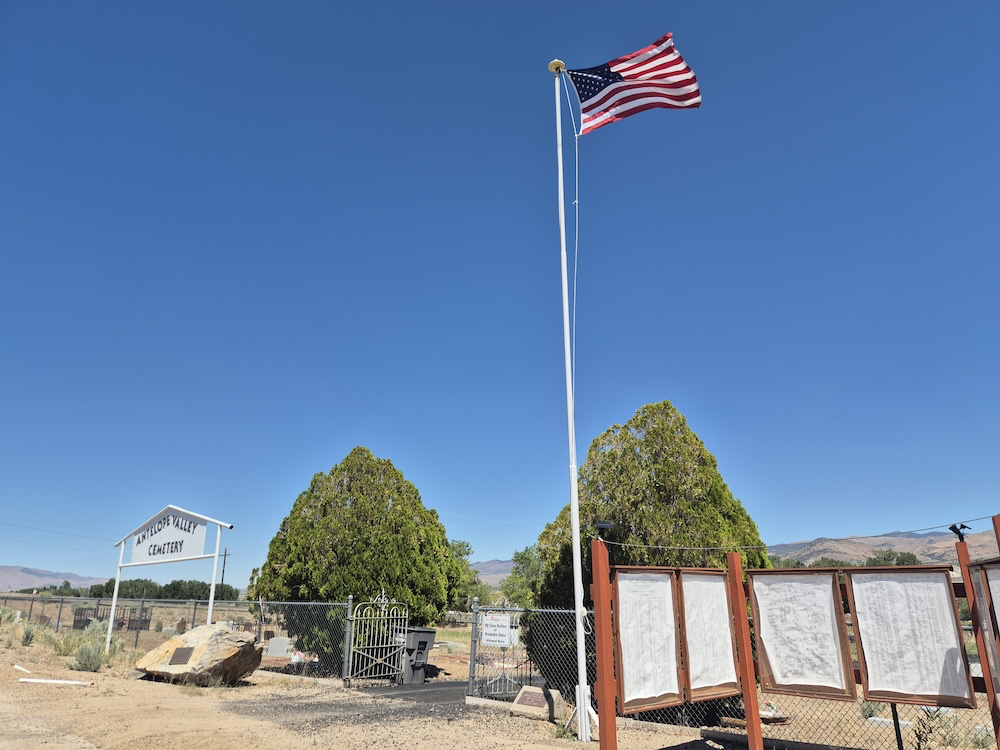
Finally, before my trip came to an end, I visited the small cemetery of the California town of Coleville, in Antelope Valley, where I paid a small tribute to three veteran brothers, whose father was Basque and whose mother was Native American, and who are part of a little-studied chapter of Basque history in the American West.
There are not many Basque-Native American veterans who participated in WWII, but they tell a story of understanding between seemingly very separate cultures, but undoubtedly very close in their experiences of nomadic life, dispossession, and extreme survival in the deserts and high-altitude mountains of both Nevada and California.
Entrance to the Antelope Valley Cemetery in Coleville, California, where the remains of three brothers, WWII heroes of Basque-Washoe origin, lie. (Photo by Pedro J. Oiarzabal).
I would like to remind you that N.A.B.O. has launched a fundraising campaign with the aim of building the National Basque WWII Veterans Memorial in honor of all WWII veterans of Basque origin.
To achieve this goal, we need your help. It requires all of us – individuals, companies as well as public institutions – to make this worthy initiative a reality.