Remembering Dad by Telling His Stories

Today would have been dad’s 82nd birthday.

Dad came to the United States when he was 18 years old to be a sheepherder. But, when I was growing up, I knew him as a truck driver, hauling hay to the local dairies. He started out working for his childhood friend Felix Anchustegui, also from Munitibar, but later bought one of Felix’s trucks to start his own business. A one-truck, one-man show, though dad did hire help from time to time. Dad started off by just charging for delivering hay but after a while he and mom decided that more money could be made if he was more than just the delivery man; if he actually bought and sold the hay, he could also make a profit as the middle man, finding hay for the buyer and selling it for more than he bought it. That worked for a while, and they were doing quite well until a couple of dairymen went bankrupt and didn’t pay dad for the hay he had sold them. The business essentially lived paycheck to paycheck and didn’t really have anything in the bank to weather such a hit. That put mom and dad into what he always called his “big shit hole” that he never quite got out of. 
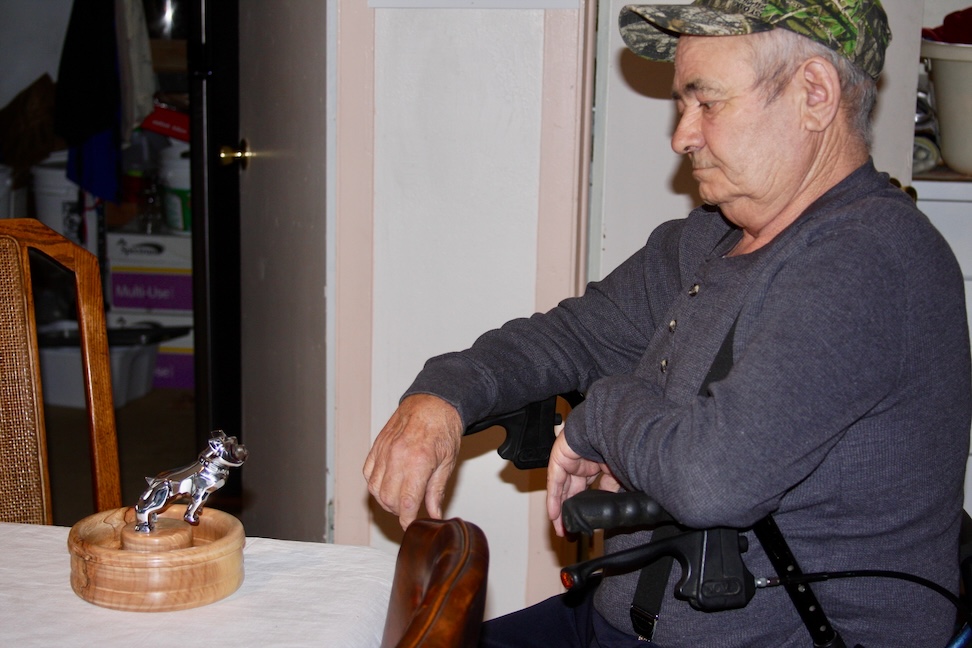
Dad and Mack, Christmas 2013. Photo by Lisa Van De Graaff.

His truck dominated my childhood. It was ever-present, this massive beast that was always parked on the street in front of the house. It dwarfed everything around it, especially when it was loaded with hay. My brothers and I would climb the haystacks and run around on top. We would have races to see who could climb to the top the fastest. I wasn’t the strongest climber, so sometimes I would have to climb against the backstop of the cab. But, while dad’s truck was the main source of income for the family, it was also our playground. It’s a miracle we all survived. Whenever dad would take us on the road to the haystacks, he would lift us up with the grabber on his tractor to the top of the stack to untie the ropes. We just sat on the end, no ropes or anything, as he lifted us up. It was always the highlight of going with him, just feeling so daring, sitting on the grabber with my legs dangling in the air.

Dad could drive that truck anywhere, maneuvering his truck like mere mortals like me drive our car. It was a double trailer with one hitch – the first trailer was attached to the cab. I’m sure there is a special name for this type of truck but I don’t know it. Anyways, dad would navigate it down remote dirt roads to get to the haystacks and between barns and fences to unload. He could back that thing up as easily as a four-wheeler. And he was just as good with the tractor, using the grabber to adjust the bales of hay, tightening them so that he could grab them more easily and make a more stable stack. The things he could do with both was just amazing.

Dad never listened to music or the radio when driving, but the chatter from the CB radio was constant. He never said much – once in a while, if there was another Basque, they would chat – but mostly he just listened. There were always people telling stories, or warning people of accidents or cops ahead. Dad was a master at avoiding the weigh stations as he was always pushing the limits of what he was allowed to haul. All of the truckers would tell each other which weigh stations were open and routes around them. Dad got his share of tickets, but it could have been a whole lot more.
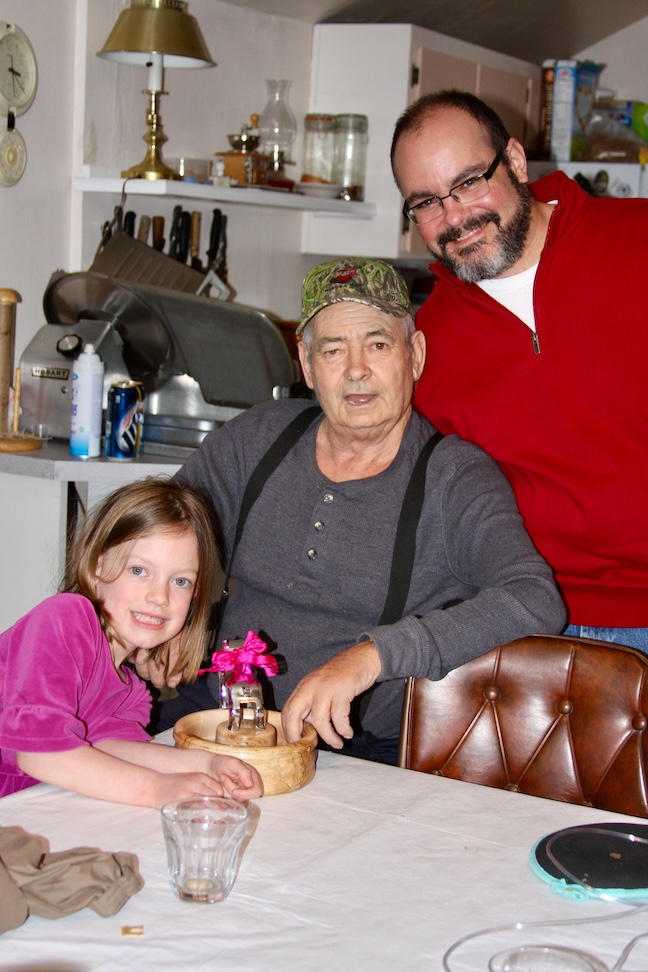
My daughter, dad, and me, Christmas 2013. Photo by Lisa Van De Graaff.

Dad liked to be at the haystack by dawn so that he could maximize the amount of daylight he had to work. That often meant getting up too damn early. I remember him waking me up at 3 or 4 in the morning. We would sometimes stop at a gas station to get some sandwiches or pop – in those days, my drink of choice was Mountain Dew. Dad let me sleep in the passenger seat while he drove in the dark, often several hours, to the stack. And he worked all day, usually getting home long after dark, often after we had eaten dinner. They were long days and I know they took their toll.

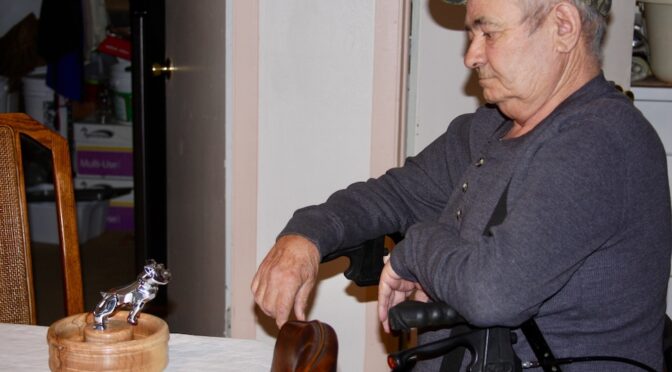
Dad only had the one truck and it was a Mack. A flat nose cab with the Mack statue sticking out the front. That little dog embodied the truck, gave it an identity. When he had his heart transplant and had to stop working, dad eventually sold the truck. I’m sure it must have been hard for him as it was almost an extension of him. He probably spent more time sitting in that truck than he did at home. For Christmas, my wife, daughter and I designed and created a little wooden bowl with a Mack bulldog centerpiece – it was one of the first pieces I made on my father-in-law’s lathe. When dad opened it up, his eyes gleamed as he exclaimed “Mack!” Lisa described it as greeting an old friend. It wasn’t much but it was the perfect gift. He had it on his side table and would store his loose change and small pocket knives in the bowl. After he died, I got it back and it sits on my desk, a constant reminder of dad and his truck. 

Happy birthday dad. I miss you.

Thanks to Lisa Van De Graaff for inspiring me to write this and reminding me that today was dad’s birthday. I am sad to think that I got too distracted by work and other things to remember myself. 

Basque Fact of the Week: Elko and the National Basque Festival

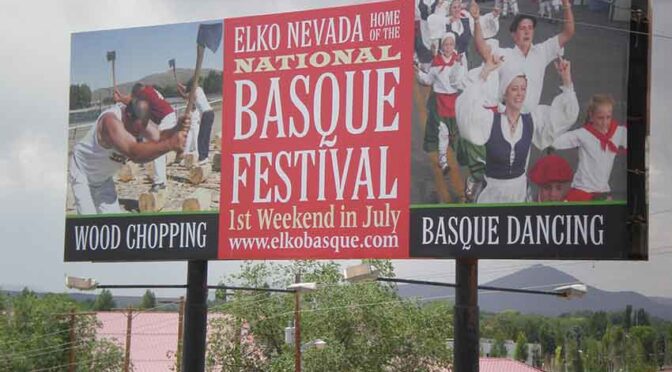
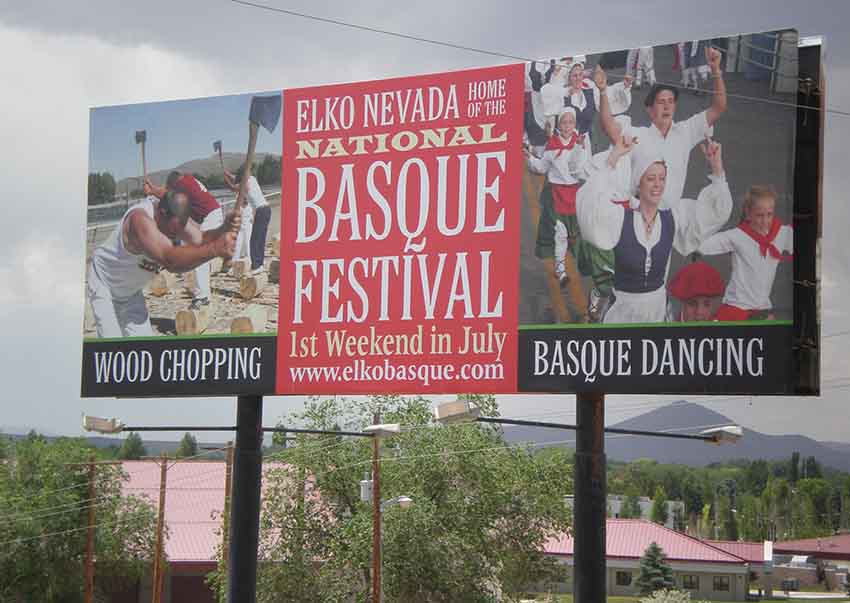
The season of Basque festivals in the western United States is upon us. All across the west, Basque clubs and communities hold celebrations of Basque culture and history, recognizing their ancestors who braved unknown lands to build a better life for themselves. Elko, Nevada, hosts one of the largest Basque festivals in the country, second only to Boise’s Jaialdi. It is also one of the oldest. If you are looking for Basque flavor this summer, check out Elko!

A billboard advertising the National Basque Festival held annually in Elko. Photo by Joseba Etxarri, found on Euskal Kultura.
  • Elko sits in the northeast corner of Nevada. At one time it was the eastern most part of the California-Utah portion of the first transcontinental railroad. Thus, its roots as a settlement date back to 1868. When the railroad crews left, the settlement remained and grew into modern day Elko. The city was officially incorporated in 1917. Today, Elko boasts a population of just over 20,000 people.
  • Perhaps the first Basques in the region were Bernardo and Pedro Altube, two brothers from Onati, Gipuzkoa. Having already established themselves in California, they drove 3000 head of cattle to a new ranch in Independence Valley, near what is now Elko. Within a few years they operated one of the largest cattle ranches in Nevada. About the same time, Jean and Grace Garat also moved their cattle operations from California to Elko, creating the Y-Par Ranch.
  • It was only in 1900 that the Altube brothers introduced sheep. Before that, Basques were cattlemen and women. However, it wasn’t long until the sheep industry exploded and by early 1900s there were one million sheep in Elko County. This afforded new opportunities for Basques who were prized as sheepherders. Ranchers such as John Taylor hired many Basques as sheepherders.
  • It wasn’t long until other local ranchers complained about the Basque herders, how they over grazed, sent money home instead of investing it locally, and didn’t become citizens. This led some of these herders to buy land and become citizens.
  • Basques also established ranching adjacent businesses such as boarding houses, hotels, and stores. For example, Pedro Jauregui and Guy Saval (Zabalbeascoa) built the Telescope Hotel which boasted a fronton. In 1910, Jauregui and his wife Matilde built the Star Hotel. The Overland Hotel was built in 1908 by Gregoria and Domingo Sabala. More hotels followed. And, in 1936, Joe Anacabe started Anacabe’s General Merchandise Store.
  • Since 1963, Elko has hosted the National Basque Festival, though the very first festival was held in nearby Sparks. Like many Basque festivals, it features rural sport and weight lifting/carrying competitions, dancing, and food. This year they celebrate the 62nd anniversary of the festival, which will be held July 3-5. Organized by the Elko Euzkaldunak Club, it is one of the oldest and longest running Basque festivals in the United States.
  • Elko Euzkaldunak Club, or the Elko Basque Club, itself started only a few years before. The first meeting of interested parties was in 1959. Elections were soon held and Johnnie Aguirre was elected the first president of the club. And it wasn’t long before they began organizing the celebrations that would become the National Basque Festival.
  • In 1966, Joe Anacabe started the Elko Ariñak Dancers, a Basque dance group that still exists and continues to dance at festivals all over the country.
  • Elko even had their own Basque-language radio program. Led by Jesús Lopategui, it shared news from the Basque Country and Basques from the United States, including notices of births, deaths, and marriages. They also transmitted Catholic masses in Basque.

A full list of all of Buber’s Basque Facts of the Week can be found in the Archive.

Primary sources: Elko Euzkaldunak Club; Elko, Nevada, Wikipedia; The Basques of the Great Basin: Elko, Nevada by Gloria Pilar Totoricagüena, Eusko Ikaskuntza

Basque Fact of the Week: Txikita de Anoeta, Erraketistak

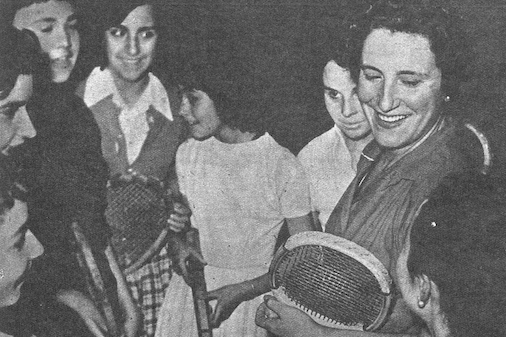
Last week I wrote about the women Erraketistak, professional racket ball players that were pioneers in the world of women’s sport. One of the very best to ever play was Maria Antonia Uzkudun, also known as Txikita de Anoeta. She began playing professionally at the age of 13 and had a stellar career that took her across Spain and to Mexico and Cuba until her retirement in 1967.

Txikita de Anoeta with her racket and students from the racket school at the fronton in Madrid. Photo from La Hora.
  • Maria Antonia Uzkudun Amunarriz, professionally known as Txikita (or Chiquita) de Anoeta, was born in 1927 in Anoeta, Gipuzkoa. Not much is known about her childhood (or at least, I couldn’t find much). She was born in a baserri and as a child she played handball in her hometown. In fact, she always had a pelota – or ball – in her pocket so she could play whenever she got a chance. She was the youngest of 13 children.
  • In 1941, at the age of 13, she was playing the pala variety of pelota – or better said, a version using a tennis-like racket instead of the wooden ones often seen – professionally, making her debut in the city of Salamanca. In fact, she falsified her vital records, lying about her age, so that she could begin playing, as the minimum age to play professionally was 14. This was only a few years before the Spanish government banned new licenses for professional women racket players.
  • In Salamanca, she earned a monthly salary of some 1000 pesetas, which was remarkable considering that the average salary for a professional player was 300-400 pesetas. However, she only stayed in Salamanca for 6 months before moving to Madrid where she played much of her career. By 1946, she was making 500 pesetas per match.
  • Her career took her around the world, playing all over Spain as well as in Mexico and Cuba. She ended her career in 1967 at the age of 40, retiring in Madrid, where she died in 2008.
  • Txikita de Anoeta was considered one of, if not the, best players in the world. She played the back position, but sometimes played by herself against a pair of opponents.
  • She rose to international fame. In Mexico, she was often called upon to present awards and prizes, ranging from horse races to literary awards. When she went to Mexico, she was met at the airport by a mariachi band – in the words of her daughter, she was “sort of a diva.”
  • Despite the negative view Franco’s government had of women’s sport, she was still awarded the Medal of Sporting Merit. This was but one of many accolades she received. She was on the cover of many magazines and publications. She was so famous that a pasodoble was composed in her honor, which described her game as a blend of “grace with emotion.”

A full list of all of Buber’s Basque Facts of the Week can be found in the Archive.

Primary sources: “Ama de casa de día, raquetista de tarde”: la increíble historia de unas “adelantadas a su época” by Iñigo Corral, El Confidencial; Txikita de Anoeta pionera de la pelota vasca, Onda Cero; El debut de ‘la Messi de los frontones’ by Roberto Zamarbide, La Gaceta; Maria Antonia Uzkudun, Wikipedia

Basque Fact of the Week: The Erraketistak, or Professional Women’s Racket Players

While women have played sport for as long as humans have existed, it is only recently that that they have had the opportunity to play professionally, to make sport a career. In the early 1900s, women, primarily from the Basque Country, pioneered a professional league of racket ball that at one time dominated the professional sports world of Spain. These women, often from rural areas, were able to establish a lucrative life. However, stigmas associated with playing professional sport often led to their stories being erased.

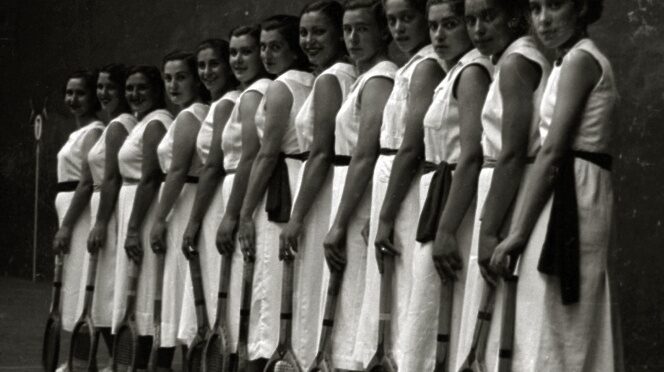
A group of racket players in Donostia in 1938. Photo from Wikipedia.
  • While the idea of professional women’s racket ball had precedent, it didn’t take off until Luciano Berriatua and former pelota player Ildefonso Anabitarte created a school and league for the sport. The first fronton with a cadre of permanent professional players opened in Madrid in 1917. It was a huge success, particularly because of the high quality of play and the ease the sport made it to gamble on matches.
  • The game was adapted from the traditional pelota played in frontons across the Basque Country. Women used a strung racket much like a tennis racket but the ball was the heavier leather ball often used in pelota. To withstand the heavier ball, the racket was double strung.
  • To ensure the high quality, women trained for a year before becoming professionals. They had to foot the bill for the training and lodging themselves. This devotion to quality mean that matches were highly competitive and full of drama, attracting an adoring and dedicated public.
  • At one time, the number of professional women racket players was greater than the number of men playing professionally – in excess of 700 women were playing in 1943. At its peak, it was the most watched sport in Spain.
  • After the Spanish Civil War, women playing professional sports was discouraged and bans were pursued in some cases. It was deemed unfeminine to play sport. In Spain, to play professionally, one had to obtain a license from the government. Franco’s government stopped issuing these licenses in 1944. New licenses weren’t granted until 1957.
  • This led many women to leave Spain and instead play in places like Mexico, Brazil, and Cuba.
  • These women were pioneers, not only for women’s professional sport, but professional sport more broadly. They were the first athletes to contribute to Social Security and had rights recognized even before men’s soccer players. They made significant money for the time – their salaries met or exceed that of the highest government officials – and were at the top of the professional sporting world.
  • The stigma associated with playing professional sports meant that many of these women never talked about their experiences. They had already had to endure hardship in leaving their families to play, something many of their families disapproved of. And they rarely spoke about it even with their spouses. There were accusations that these women paraded themselves on the fronton for the enjoyment of men and thus, while they were pioneers in their field, they were somehow viewed as anti-feminist. Indeed, a leading Catholic magazine of the time wrote “We have a collection of unfortunate women who exhibit themselves in public for a salary, to promote, to a larger extent, the fatal vice of gambling among men.”
  • Further, their relationship with Basque nationalism is complicated. While they were pioneers of professional sport, and played a variant of Basque pelota, they were viewed as something outside of tradition: their sport wasn’t a true Basque sport. And men dominated the story of Basque nationalism with little room for women. This plus the stigma associated with women playing sport meant that much of their history was lost until recently, with new efforts to promote their pioneering role in women’s sport and society more broadly. The site Raketistak has profiles of players and history of the sport, while this Youtube video has interviews with some of these women.

A full list of all of Buber’s Basque Facts of the Week can be found in the Archive.

Primary sources: Erraketista, Wikipedia; González Abrisketa, Olatz. “Basque women on court: The success, repression, and oblivion of professional racket pelota players in Spain, 1917–1980.” The International Journal of the History of Sport 35, no. 6 (2018): 554-574.

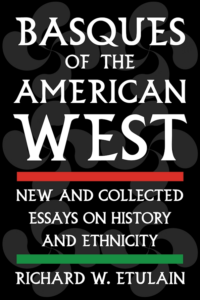
Basques of the American West by Richard Etulain

A while ago, I wrote about Jon Bilbao and his pioneering work Amerikanuak. Richard Etulain has just published Basques of the American West, which brings new perspectives to the Basques that helped shape the history of the western United States. It also explores newer topics such as the history of Basques in places such as Washington state.

Basques of the American West
New and Collected Essays on History and Ethnicity

Richard W. Etulain

DESCRIPTION

Basques of the American West: New and Collected Essays on History and Ethnicity brings together new and previously published work by Richard W. Etulain, blending historical analysis and literary criticism to explore the lives, stories, and representations of the Basques in this region. The essays examine key figures such as Robert Laxalt and Frank Bergon; survey historical studies, memoirs, and novels; and trace evolving interpretations of Basque identity in Western literature and scholarship. Etulain highlights major trends in both Basque and Western American historiography while identifying important topics that remain open for additional research.

This collection offers readers a thoughtful and engaging look at the enduring presence and influence of Basques across the cultural and historical landscape of the American West.

AUTHOR/EDITOR BIOGRAPHY

Richard W. Etulain, PhD, is professor emeritus of history at the University of New Mexico. He studied at Northwest Nazarene College in Idaho and received his graduate degrees from the University of Oregon. He was a Fulbright Lecturer in Ukraine and taught at the University of the Basque Country. Etulain is an author or editor of more than sixty books and has served as the president of both the Western History and Western Literature Associations.

Basque Fact of the Week: Why is there a Hole in the Middle of Araba?

Back in March, we took a quick trip to the Basque Country to see family. On the way, we had stopped at Burgos, just to see a new place. We were talking about Burgos when a friend said he had passed through Burgos when he participated in Korrika, the massive race in support of the Basque language. At first, we were a little confused – why would Korrika pass through Burgos – until they pointed out the big hole in the middle of Araba…

  • Let’s start with some definitions. An enclave is a territory belonging to one jurisdiction that is surrounded by an other. An exclave is the opposite – it is a piece of territory that is separated from the main jurisdiction. So, an enclave of one place can be an exclave of another.
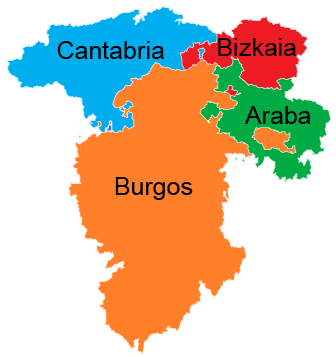
  • The “hole” in Araba is the Treviño enclave. It is actual part of the province of Burgos, but it is surrounded by the province of Araba. It consists of two municipalities, Condado de Treviño and La Puebla de Arganzón. Puebla de Arganzón was founded (received its fueros) in 1191 from Sancho VI of Navarre (“Sancho el Sabio”, “Sancho the Wise”) in 1191. It is thought that Condado de Treviño is even older. When Araba was conquered by Castilla, the region that now forms the Treviño enclave was given to Manrique family and passed down as part of a noble title.
  • As one might expect, this has led to both some complications and challenges. The people of the enclave must travel to Vitoria-Gasteiz, the capital of Araba, for many of their services. This creates a strange administration problem in which Araba provides the bulk of the services to the people of another province.
  • The people of the enclave have voted in the past to join Araba, but that vote was ignored. More recently, there have been votes to have a referendum on the issue, but that was also ignored. The current leaders of the enclave have deferred the discussion to higher level government officials.
  • Araba isn’t the only Basque province with an enclave. Bizkaia also has one, this one belonging to the province of Cantabria. Valle de Villaverde was purchased in the 15th century by one Pedro Fernández de Velasco, and at that time it ceased being a part of Bizkaia.
  • And, Bizkaia has an exclave. The city of Urduña is part of Bizkaia, but it sits on the border between Araba and Burgos – it is not an enclave as it is not surrounded by a single other territory, it is on the border. It has strong historical ties to Bizkaia with long standing economic agreements and commercial routes connecting to Bizkaia. Though Araba has tried to annex it in the past, the people of Urduña have reaffirmed their commitment to remain part of Bizkaia.
  • …AND, within Urduña there is yet another enclave. The Cerca de Villaño sits within the Urduña exclave but is part of Burgos.

A full list of all of Buber’s Basque Facts of the Week can be found in the Archive.

Primary sources: See the links in the main article.

Under Construction…

Unfortunately, Buber’s Basque Page was down for a few days due to a compromised server, which meant that some posts have been lost. My most recent backup dates to December, 2024, so I’ve lost about 1.5 years of posts. I’ll slowly work to replace those posts as I continue to add new content, but it will take me some time.

If you recently sent me an email or had a message that was awaiting a response from me, I likely don’t have it anymore, so feel free to write me again.

And, if you recently subscribed to the blog, you might have to subscribe again to continue to receive posts via email.

My apologies for this. Clearly, I should backup more often than I do (isn’t that what we all say???). I appreciate your patience as I slowly recover the posts that have been lost.

Language Speaks Louder Than Bones: The Story of The Basques Naming Themselves, ca. 500,000 BP

Joxe Mallea-Olaetxe, a long-time friend, is a historian who has worked tirelessly to document the history of Basques in the American West. One very visible example is his work on the arboglyphs Basque sheepherders left behind as they roamed the hills, valleys, and mountains of states such as Nevada, Idaho, and Oregon, but he has done much more. But, as with any attempt to document history, there are always holes that can’t be filled through evidence alone, and that is particularly acute for any and all things Basque. Thus, Joxe has turned to fiction to fill that void, rooted in his long years of study. Below is a trailer for his first novel.

Language Speaks Louder Than Bones: The Story of The Basques Naming Themselves, ca. 500,000 BP
A Trailer by Joxe Mallea-Olaetxe

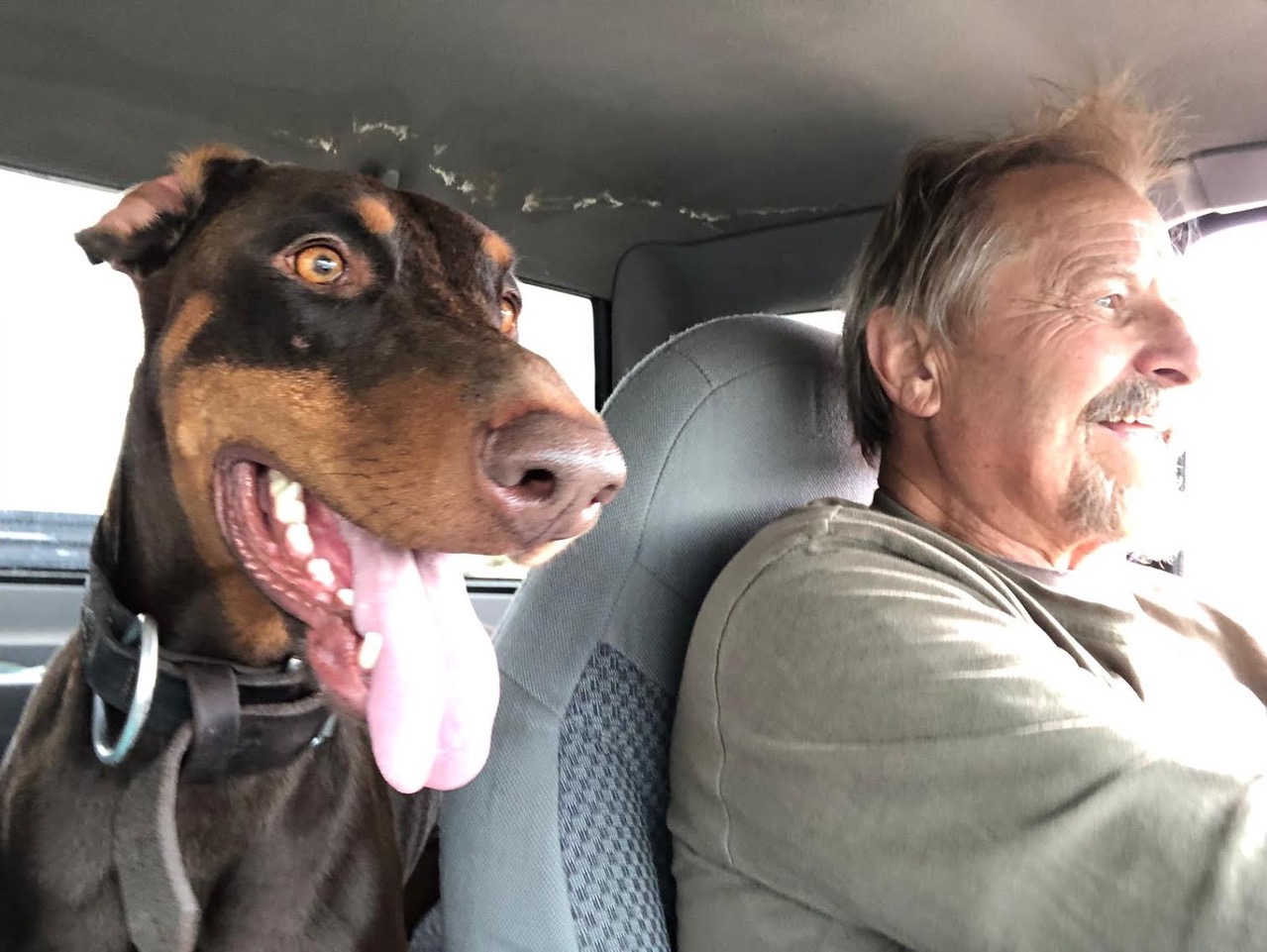
Joxe with his daughter’s doberman Zoe as they go for a hike. Photo by Nikane Mallea.

Most of my life I have been a historian and a history-writer, until recently when I embarked in a new career as a fiction writer. I am young enough to undertake it, because writing fiction is less taxing than historical research. Besides, Saint Augustin says that fiction is another aspect of history, therefore I am not running away from it.

I am also a linguist, and though I do not have a proper university degree in linguistics, I have taught several languages at the university and college level.

My first novel is finished. It is not your run-of-the-mill novel that happens tomorrow or a century ago. Action is set ca. 500,000 BP.

What,? you might say; What do you know about life half a million years ago? Not much, but that’s the point. Is there anyone else who knows much about it? A lot has been written about our cave-dwelling ancestors, but the evidence comes from a few old bones and stone tools. The discovery of a new bone is enough to trigger someone to write a book demolishing all we thought we knew before.

I find it curious that no scientist ever attempted to use language to gaze into our deep past. Perhaps nobody thought that their language had any value, which might as well be true, but Euskara, the language of the Basques, does.

Appropriately, the title of the novel is Language Speaks Louder than Bones.

I am the narrator and thus an eye witness, which means I am there where the actions is. By the time I am done with the novel, I — and you — will probably know more than anyone about the cave dwellers. There are some — many — holes in my narrative, it happened so suddenly. I don’t know how but I found myself on a tree watching below a group of pre-Neanderthal hunters, or bears? At first I thought they were bears, until I realized that they were holding spears. Do bears hold spears?

I have still no idea where I was, but certainly somewhere in the Atlantic Europe. The huge discovery was that the dozen or so clans that I came into contact with, had some proto-Euskara words in their languages. The next finding was that these clans lived at considerable distance from each other, but they could communicate, because their languages shared some common basic words, of which some sounded like Basque.

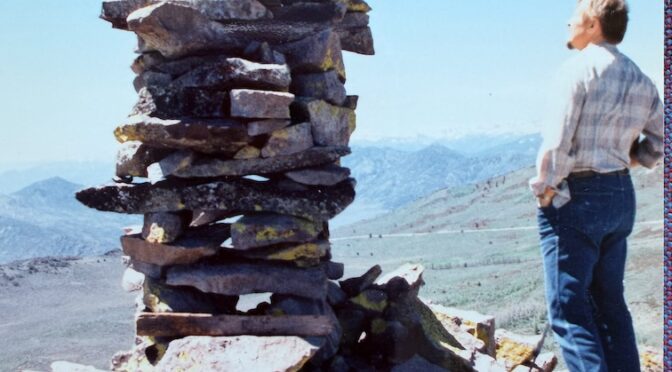
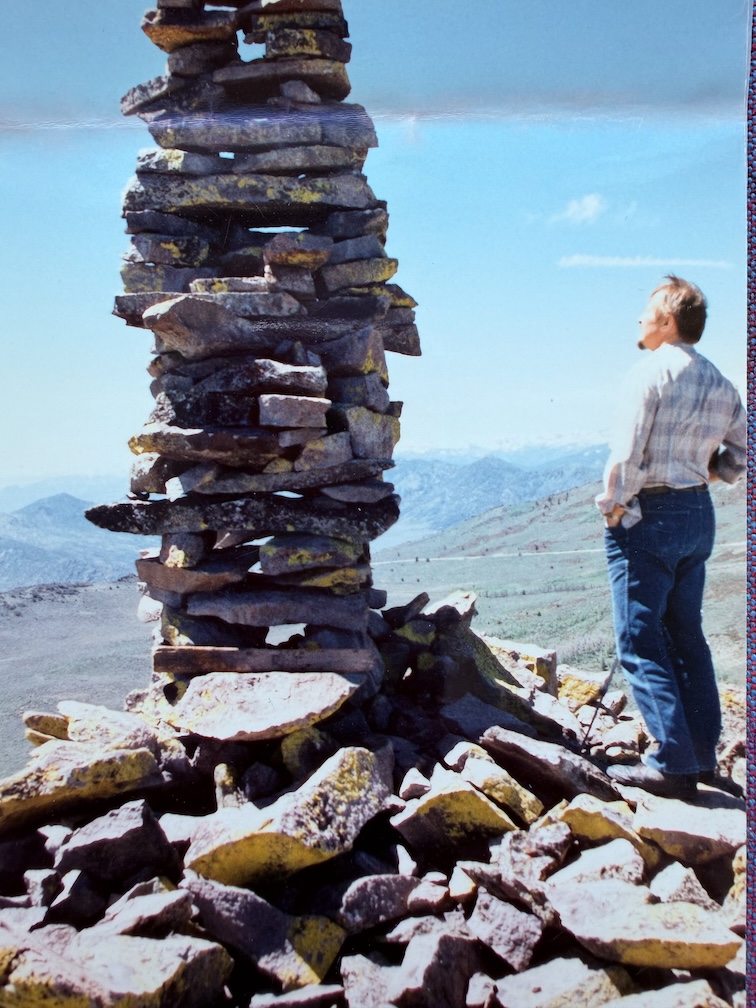
A monumental harrimutil (stone cairn) erected by sheepherders in Alpine County, CA.

The Basque language, Euskara, has words that literally take us back to the time when “gize” (humans) had four hands, so before they embarked their bipedal journey.

The gist of the novel is that I was at the meeting when eight clans came together to choose a common name for themselves. In fact, they ended up selecting two names, one picked by the men and one preferred by women.

It did not happen overnight. It came after the realization that they, the cave dwellers, were not any different from bears, but had some differences, for example, making tools and building a fire, something they didn’t see other animals do, in fact, all animals avoided fire. The other monumental discovery was the language, so let no one call them primitive or brutes anymore.

I haven’t decided where or how I want to publish; I may end up going the Kindle way.

Basque Fact of the Week: The Bombing of Gernika

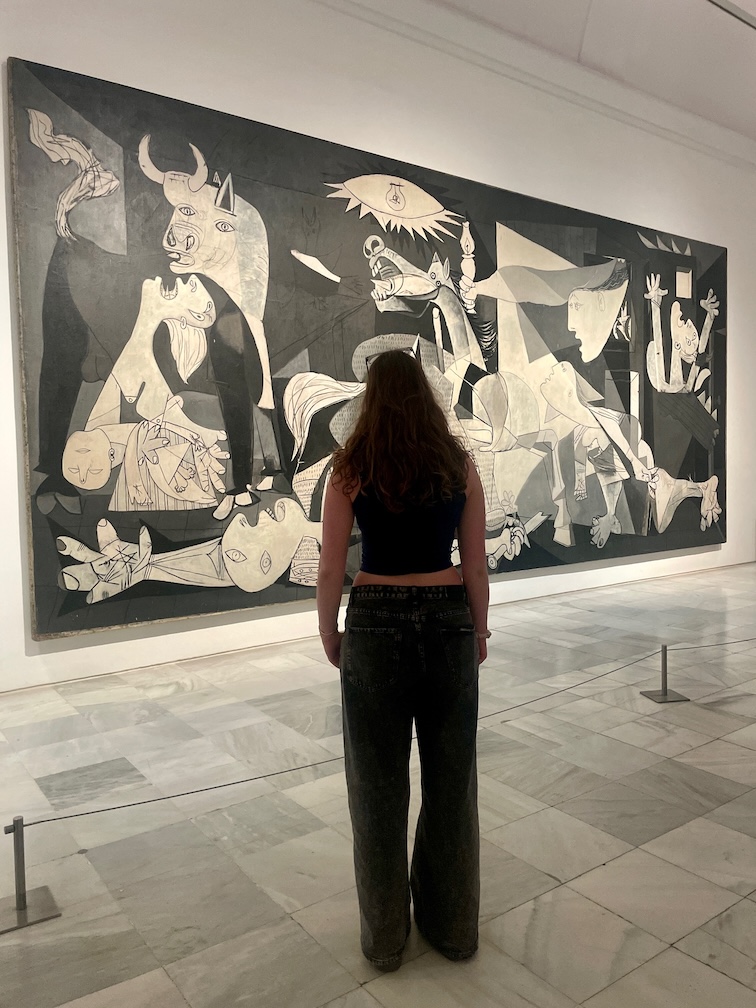
Today marks the 89th anniversary of the bombing of Gernika. Last month, in March, we made a quick trip to the Basque Country over spring break to visit my dad’s family and made of point of seeing Picasso’s Guernica. As we near the 90th anniversary of the bombing, the painting is once again in the news as the Basque government has requested that the painting be loaned to the Basque Country. This request has been denied, based on arguments that the painting is too fragile.

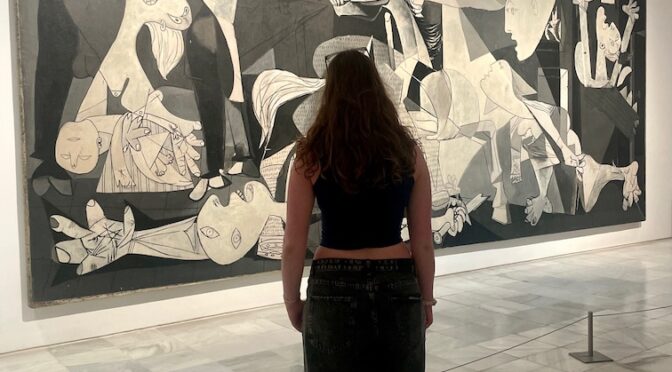
My daughter Rose contemplating Picasso’s Guernica. Photo taken by Lisa Van De Graaff.
  • Gernika sits at a crossroads, centrally located between the cities of Lekeitio, Nabarniz, Markina, Amorebieta, and Mungia and Bermeo. Every Monday, the city hosted a market and fair which would draw residents of nearby towns; more than 10,000 people typically attended the market. There were few military targets in Gernika: the bridge and the arms factory.
  • At 4:30pm on April 26, 1937 – a Monday – planes from the German Condor Legion and the Italian Air Force began bombing the city. George Steer, a journalist who arrived in Gernika the day after the bombing, took accounts from the survivors and sent the first account of the bombing to the international press. 
  • Some air raid shelters had been established as a response to the bombing of Durango only about a month before. As church bells pealed out a warning of an air raid, people fled to find shelter, leaving their livestock in the market square. Two planes flew over and dropped bombs and incendiary devices. As the aircraft flew overhead, machine-gun fire strafed the people running in the streets.
  • After that, nothing happened for about 15 minutes and the people began emerging from their shelters when another group of bombers flew overhead, dropping more bombs that then exploded. The streets filled with fire and smoke. Some of these bombs were one thousand pounds and penetrated through buildings and into basements and shelters. As the panicked populace again emptied to the streets to flee, more planes strafed them with more machine-gun fire.
  • This continued until about 7:30pm, by which time nearly the entire city was ablaze. The Church of San Juan had a hole in its roof where a bomb had penetrated, setting the altar ablaze. 
  • The immediate aftermath of the bombing was a series of denials and accusations from both Franco and the German government. While they acknowledged that Gernika had been a military target, poor visibility led to some stray bombs that hit the city itself and that then the Basque “Reds” deliberately set the city ablaze. However, the discovery of Wolfram von Richthofen‘s diary (von Richtofen was commander of the Condor Legion), which were made public in the 1970s, confirmed the bombing and the tactics used. At the Nuremberg trialsHerman Göring said that Gernika was “a sort of test bed for the Luftwaffe” and that it was an experiment that “could not be conducted anywhere else.”
  • The plans to bomb Gernika, while gestating for some time, were finalized in a meeting the day before, on April 25, in Burgos. It is hard to know precisely who was involved, but at least Richthofen and the Spanish fascist leaders Juan VigónEmilio Mola and Franco were involved in the planning. Richthofen and Italian general Vellani were at the Burgos meeting, though Mola was elsewhere.
  • The number of people who died in the attacks is hard to pinpoint as there are many figures out there, but they range from a minimum of 153 to more than 1500. Xabier Irujo’s analysis points to the higher number, or even more than 2000 dead. The bombing received international attention as it was one of the first aerial bombardments of a civilian population. However, it wasn’t the first: several Basque towns had been bombed earlier in the war, including Munitibar and Durango.

A full list of all of Buber’s Basque Facts of the Week can be found in the Archive.

Primary sources: Castaño García, Manu; Editorial Auñamendi. Gernika-Lumo. Auñamendi Encyclopedia, 2026. Available at: https://aunamendi.eusko-ikaskuntza.eus/en/gernika-lumo/ar-57197/; Bombing of Guernica, Wikipedia

Basque Fact of the Week: Real Sociedad, Copa del Rey Champions

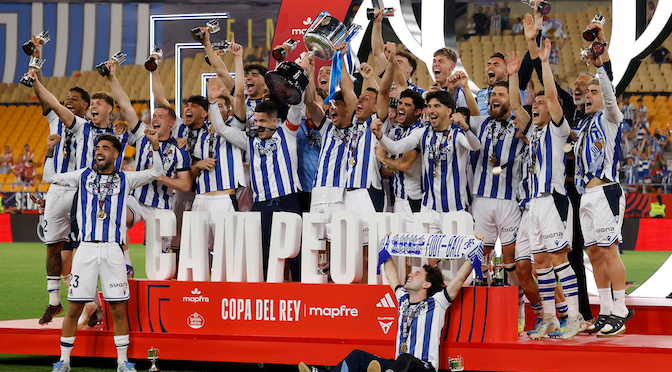
While Athletic Bilbao receives more international attention, primarily due to their unique policy of signing only Basque players, they are not the only team in the Basque Country – there are several. Yesterday, April 18, 2026, the soccer team from Donostia, Real Sociedad de Fútbol, won the Copa del Rey, their first win since 2000 and only their fourth win in their history. Star player Mikel Oyarzabal scored one of their goals, with rising star Ander Barrenetxea scoring the other. Led by an American-born coach, this win caps a remarkable turnaround where they were almost relegated to second division only a year ago.

The players of Real Sociedad celebrating their Copa del Rey win against Atletico Madrid on August 18, 2026. Photo from Reuters.
  • Fútbol came relatively late to Donostia – the first recorded match was played in 1902, a time when other towns in Gipuzkoa already playing. The sport was brought over from England, by young men who had worked or studied there. By 1903, the first clubs had been established.
  • To formally compete in official championships, clubs had to be registered. One club in Donostia registered under the name Club Ciclista so that they could play in the 1909 Spanish Championship, the Copa del Rey, which they won. This team ultimately became Real Sociedad. In 1909, they formed their own team, the Society of Football, and in 1910 the Spanish king bestowed the title “Real”, or Royal. Hence, they became known as Real Sociedad de Fútbol, the Royal Society of Football.
  • In 1913, the city and team inaugurated their football field, Atotxa, which became their home for over 80 years. The first match in the new stadium as against Athletic Bilbao, a game that ended in a 3-3 tie. In 1993, the team moved to their current stadium, Anoeta
  • Real Sociedad was one of the founding teams of the Spanish La Liga in 1929. In 1931, they briefly changed their name to the Donostia Club de Futbol during the Second Spanish Republic, but after the Spanish Civil War they reverted back to Real Sociedad de Futbol. Their nicknames in Basque are Erreala (“Royal”) and the txuri-urdin (“white-blue”).
  • Since their founding, Real Sociedad has won the Copa del Rey four times, including that first year in 1909 and most recently just yesterday – April 18, 2026. The previous win was in 2020, when they beat Athletic Bilbao for the win after a year delay due to COVID. They have also won the Spanish Premier League twice, most recently during the 1981-82 season.
  • Up until 1989, Real Sociedad maintained a policy similar to Athletic Bilbao in that they only signed Basque players. However, in that year, they signed forward John Aldridge from Ireland. 
  • Real Sociedad is more than a men’s soccer team. They also consist of track and field, field hockey, and pelota. In 2004, the group formed a women’s soccer team, Real Sociedad Feminino. That team won the Copa de la Reina in 2019. 
  • Their current coach, Pellegrino Matarazzo, was born in the United States to Italian immigrant parents. Though obtaining a degree in applied math from Columbia, his passion was soccer. After a less than stellar career as a player, he became a coach and in December, 2025, he was named Real Sociedad’s coach. Real’s winning of the Copa del Rey is his crowning achievement. Just last year, the team was on the verge of being relegated to second division.

A full list of all of Buber’s Basque Facts of the Week can be found in the Archive.

Primary sources: Cuesta Olaizola, Eneko de la. Real Sociedad de San Sebastián. Auñamendi Encyclopedia, 2026. Available at: https://aunamendi.eusko-ikaskuntza.eus/en/real-sociedad-de-san-sebastian/ar-124806/Real Sociedad, Wikipedia