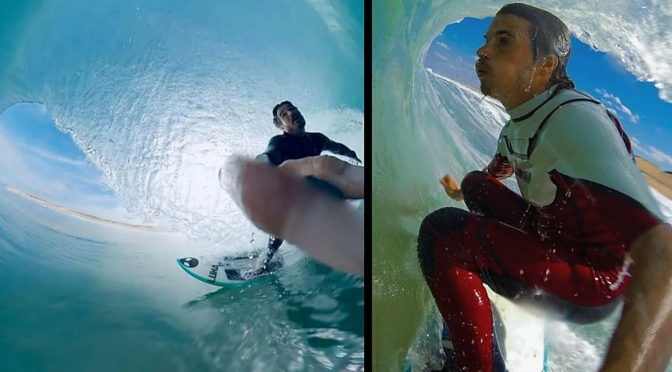
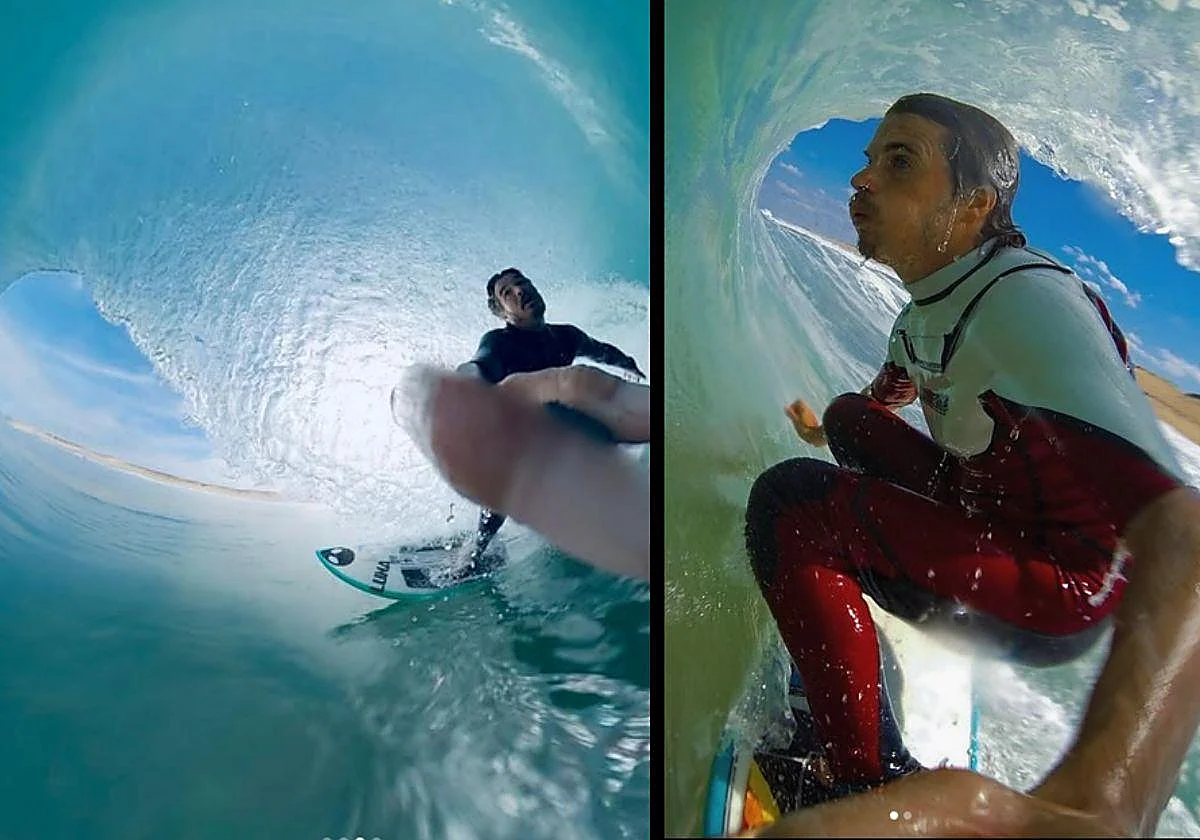
While surfing originated in Polynesia and Hawaii, many Basques have distinguished themselves in the sport. Indeed, the Basque Country has some prime surfing spots, including the Bizkaian coastal town of Mundaka. Hugues Oyarzabal became one of the pioneers of the sport, surfing some of the biggest waves in the world while filming himself riding down the center of a barrel wave long before GoPro was a thing.
Two images captured by Oyarzabal himself while surfing. Image from El Diario Vasco.
Waian Hugues Oyarzabal – he added the Waian later which means “first born son” in Balinese – was born March 7, 1985, in Donibane Lohitzune (Saint-Jean-de-Luz) to Charles and Lucette Oyarzabal. He grew up in the village of Biriatu. From an early age, he was an avid athlete, excelling at tennis and pelota, but when he was 11 he discovered surfing, which would become his lifelong passion.
When he was 16, he quit high school and, with the support of his parents, moved to Australia to work with a private coach. He never really became a competitive surfer, instead being what he called a “freesurfer,” traveling the world looking for the most challenging surfing spots.
Indeed, even before he left for Australia, he had already surfed Belharra beach, considered at the time impossible to surf. Throughout his life, he surfed some of the most isolated and difficult spots, including in Southern Africa and what would become his second home, Indonesia.
Oyarzabal was most famous for filming his surfing exploits. Before GoPro cameras became a thing, he attached a camera to his board and filmed himself in the barrel of a wave – he is thought to be the first person to do this. He also designed a device he could clamp into his teeth, giving the most intimate view of his surfing. For his pioneering videography, he won the inaugural GoPro award in Hawaii.
In 2006, he married Jana Kondo. They had a daughter, Kailani (“sea and sky” in Hawaiian), before divorcing in 2013. Kailani is an accomplished surfer in her own right, having learned from her father.
Oyarzabal took his own life on February 21, 2025, in Biarritz, his home at the time. He had suffered for years from bipolar disorder. Both in the Basque Country, in Hendaia, and in Indonesia, surfers took to the water and scattered flowers in his memory.
A full list of all of Buber’s Basque Facts of the Week can be found in the Archive.
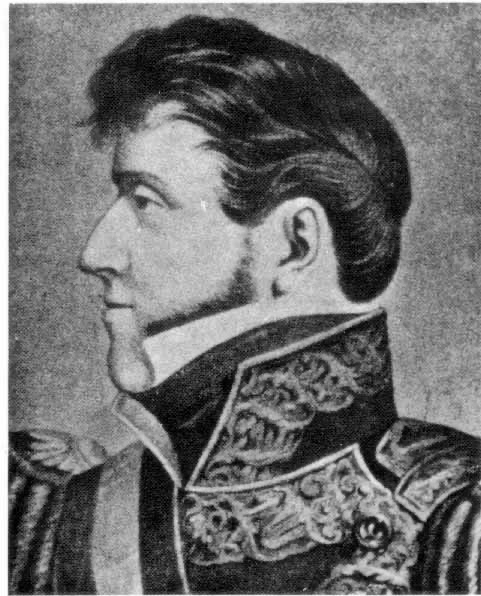
Growing up in Idaho, I of course learned about the Basque presence in the western United States and their role as sheepherders. But I didn’t realize the impact that Basques had had across other parts of the Americas. This is particularly true in Mexico, where as I’ve written Basques founded important cities. Basques continued to play an important part of the history of Mexico, and a prime example is the first Emperor of Mexico.
Agustín de Itúrbide y Aramburu was born on September 27, 1783 in Valladolid (current day Morelia), Mexico. His father, Joaquín, was from Nafarroa and came from a family of confirmed nobility. In Mexico, Joaquín married a Spanish woman who had been born in Mexico (at the time, there was a big distinction between pure blooded Spanish born in Mexico and those that weren’t pure Spanish). The family were large land owners, including more than one hacienda.
Agustín attended a local Catholic seminary and managed one of the family’s haciendas before enrolling in the army in 1805. That same year, he married Doña Ana María Josefa Ramona de Huarte y Muñiz, who also came from a prosperous family. Before joining the army, he had found he had an aptitude for horsemanship, a skill which would serve him well in the army.
In the first decade of the 1800s, there were multiple insurgency campaigns for Mexico’s independence and Agustín was tasked with helping to quell these insurrections. He gained a reputation for his combat prowess, often defeating much larger forces, though he also was known for his cruelty, including against women and children. His success in battle quickly led to advancement in the army. However, accusations of cruelty and corruption led to him being removed from command in 1816.
His supporters, needing a leader against the rebels, got the charges dismissed a year later. However, politics were changing in Spain and the Mexican nobility felt that independence might be good for them, helping them consolidate power and to protect Mexico from rising republicanism. Agustín was one of the leaders, developing a plan for independence that included a monarchy. He joined forces with one of the rebel leaders to fight for Mexican independence.
In the negotiation for independence with Spain (though continuing with a Spanish monarch), the Spanish viceroy, Juan O’Donojú, suggested that if no one in the Bourbon family wanted the monarchy, the Mexican people should elect someone. Agustín was selected as the head of the new ruling Junta. When Ferdinand VII rejected the position of Mexican monarch, and forbade any of his family from accepting it, Agustín became emperor of Mexico in 1822. There is debate whether he was given this title or took it. Regardless, he became the first emperor of the newly independent nation. This new nation included, at the time, the current US states of California, Texas, Arizona, Utah, Nevada, Colorado, and New Mexico.
At first, the Mexican Congress was the sovereign body over the nation. However, as rumblings against Agustín grew, primarily from republicans that didn’t want a monarchy or empire, Agustín took complete control of the government, replacing that Congress with his own body. Agustín also persecuted his enemies, including many in the former Congress, leading even more to turn against him. Further, Spain had regained stability and power with the intent of reconquering Mexico, such that no European nation would recognize their newly won independence. Finally, Agustín himself lived quite extravagantly, leading to further resentment.
When he was unable to pay the army, he lost the support of his base. Things quickly deteriorated from there. New rebel leaders, including the infamous Antonio López de Santa Anna, arose, wanting to bring back the old Congressional government. Agustín’s military leaders changed sides when they encountered Santa Anna’s forces. To avoid a civil war, Agustín offered to abdicate, but Congress refused, as that would recognize the legitimacy of the throne, something they didn’t want to do.
In 1823, only about a year after being named emperor, Agustín and his family found themselves exiled in Italy. At Spain’s insistence, Italy kicked him out so they moved to England where he published an autobiography. He returned to Mexico a year later, in 1824, unaware of a law enacted by Congress that called for his death if he ever returned. He was executed by firing squad a few days later. His remains now reside in Mexico City where an inscription says “Author of the independence of Mexico.” The modern Mexican flag and that the country is known as Mexico are attributed to Agustín.
A full list of all of Buber’s Basque Facts of the Week can be found in the Archive.
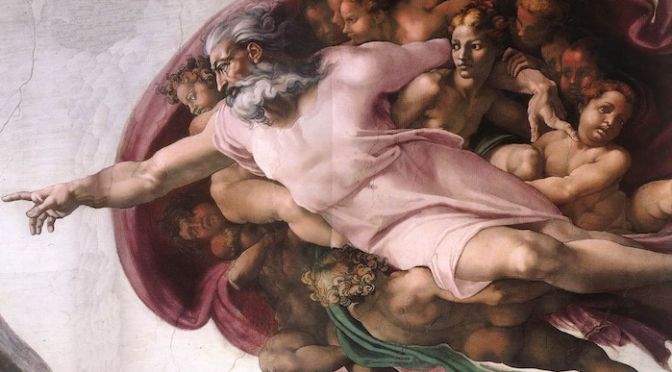
It seems like a simple question: what is the Basque word for God? But, like almost everything Basque, there is a lot of nuance in this simple question. The modern words for god and God in Basque are not typical Basque words. Does that mean they were borrowed? Or created by a priest only semi-literate in Basque? Or do they come from a more ancient source, the pre-Christian religion of the Basques? We’ll likely never know for sure, but this “simple” word carries a lot of history with it.
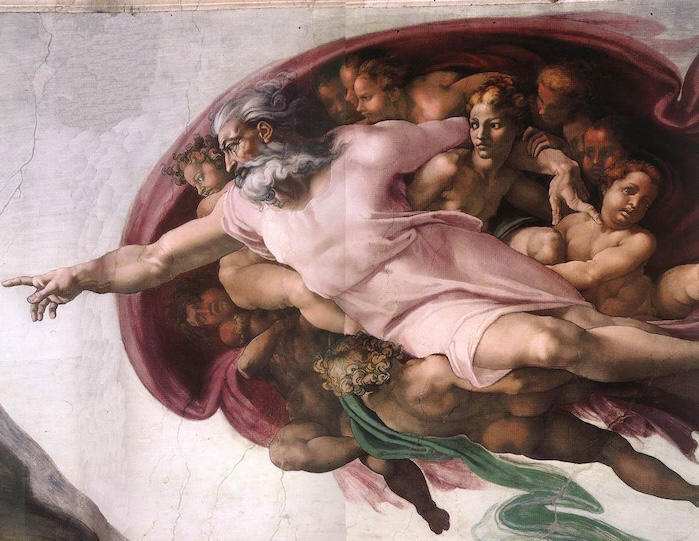
Michelangelo’s The Creation of Adam. Image from Wikipedia.
The modern Basque word for god is jainko, and for God in the monotheistic Christian sense Jainko. However, the more typical word for the Christian God is Jaungoikoa, which literally means “Lord from on high.” In earlier texts, especially in Iparralde, Jainko is more prevalent than Jaungoikoa.
As Larry Trask discusses, the form of Jaungoikoa is very atypical for Basque words. We would normally expect a word that meant “Lord from on high” to look more like Goikojauna. While no one knows where this word came from, it might be a more literal translation of “Lord from on high,” the typical Latin phrasing, where that Latin word order was kept in an invented Basque word.
There are at least three hypotheses on the origins of these two words.
Jainko is the ancient Basque name for some god in the Basque folk pantheon and Jaungoikoa was invented, as mentioned, as a backwards formation of the Christian “Lord from on high.”
Jainko is not ancient at all and is some kind of contraction of Jaungoikoa.
The two words are not related at all and just share a coincidental similarity (Trask favored this hypothesis).
Jainko is also odd in a few other ways. It is rare, though not impossible, for native Basque words to start with ‘j.’ And, the letter/sound combination ‘nk’ is also very rare.
There is another Basque word for god, and that is ortzi. The French pilgrim Aymeric Picaud, in his “tourist” guide to the Way of Santiago, has a brief Basque “dictionary” and lists ortzi (in his notation Urcia) as meaning god. Probably, ortzi is the native Basque word for sky, and it is present in many modern Basque words: as a few examples, orzargi ‘daylight’ (argi ‘light’), ortzadar ‘rainbow’ (adar ‘horn’), ortzantz ‘thunder, storm’ (azantz ‘noise’), ortzitsu ‘stormy’ (tsu ‘full of’), orzgarbi ‘clear sky’ (garbi ‘clean’). There is speculation that, when Picaud pointed to the sky and asked what the word for god was, the natives thought he was literally pointing at the sky and told him the word for sky. However, that the Basque word for Thursday is ortzegun or ostegun – `ortzi-day’ – suggests that, just like our Thors-day, Ortzi was originally a god of thunder.
A full list of all of Buber’s Basque Facts of the Week can be found in the Archive.
Would you like your Basque club or town to be the “home” of the National (U.S.) Basque WWII Veterans Memorial?
The North American Basque Organizations’(N.A.B.O.)Basques in World War II Special Committee has opened a call for proposals among its member clubs to host the future memorial intended to permanently remember and honor our Basque WWII veterans. The submission deadline is May 30, 2025.
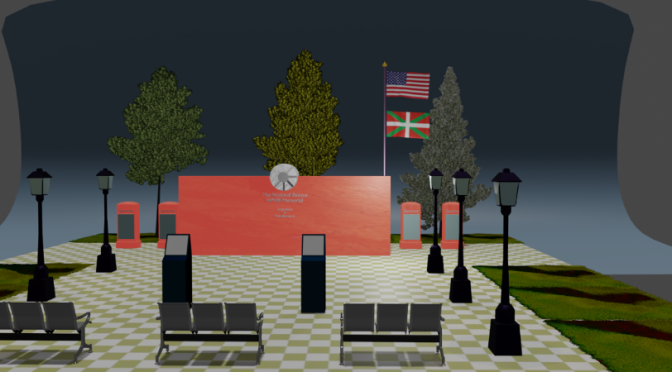
Simulation of the National Basque WWII Memorial Plaza.
How to keep the memory of this ‘greatest generation’ alive?
Our mission is to honor the valor, sacrifice, and enduring legacy of Basque WWII veterans recognizing their profound contributions to freedom and democracy. Through commemorations, education, and advocacy, we pledge to ensure their stories are remembered, their sacrifices acknowledged, and their courage celebrated for generations to come.
Oiarzabal received his Doctorate of Political Science-Basque Studies from the University of Nevada, Reno. Over the last two decades, his work has focused on research and consulting on public policies (citizenship abroad and return), diasporas and new technologies, and social and historical memory (oral history, migration and exile), with special emphasis on the Basque case. He is a member of Eusko Ikaskuntza.
Tabernilla is a researcher and founder of the Sancho de Beurko Elkartea, a non-profit organization that studies the history of the Basques of both slopes of the Pyrenees in the Spanish Civil War and in World War II. Between 2008 and 2016 he directed the catalog of the “Iron Belt” for the Heritage Directorate of the Basque Government. He is author, along with Ander González, of Basque Fighters in World War II (Desperta Ferro, 2018).
As of today, the not-for profit historical association Sancho de Beurko Association has been able to identify over 1,900 WWII veterans of Basque origin (spanning three generations) in the U.S. Armed Forces, compiling research in 46 States, Washington D.C., and Puerto Rico, and the completion of 1,200 biographies. The identified 1,900 veterans resided in 30 States, Washington D.C., and Puerto Rico at the time of their enlistment.
As soon as the research is completed, the Sancho de Beurko Association would be pleased todonate and hand over the names of all identified Basque WWII veterans to N.A.B.O. as the main institutional representative of the Basque American community with the goal of creating a memorial. Consequently, no family will have to pay to have the names of their veterans engraved on the memorial.
The above image is just a simulation of a possible memorial plaza for our veterans. The memorial would consist of a physical site, displaying the names of all identified veterans of Basque ancestry who have served in every branch of the U.S. Armed Forces, including the Merchant Marines. (Needless to say, like any other memorial, ours will also have space for additional names as they are identified.) It would also be a place of public reflection and remembrance. The memorial would attempt to bring awareness and public recognition of the historical contribution made by a small immigrant community such as the Basques during WWII.
The memorial roster is Not Just a list of Names! It will be a permanent testament to their lives, families’ histories, sacrifices, and contributions to the U.S. The memorial would provide an opportunity to bring together all Basques from different communities across the country in the endeavor of commemorating the ‘greatest generation’ of Basque origin. In other words, it would promote social cohesion with a strong intergenerational component. In addition, the physical site would be complemented with a digital memorial site to access the veterans’ personal and military biographies.
The memorial is intended to preserve the memory of all veterans of Basque origin who served in the U.S. military in WWII and to serve as an educational tool for all who visit to learn of their sacrifices and unselfish contributions to this country.
Considering the size and the migration pattern of the Basques, this could be one of the first war memorial sites of its kind in the country. We believe that the National Basque WWII Veterans Memorial would become anational symbol of public recognition and pride comparable to the Basque Sheepherder Monument at Rancho San Rafael, in Reno, Nevada.
In summary, the memorial is the vehicle that embodies our mission. We have the duty to tell the story of these soldiers and preserve their memory. We must ensure the history of our veterans is never forgotten. For that we need your help. Would you like your club or town to be the “home” of the National Basque WWII Veterans Memorial?
Finding a suitable location for the National Basque WWII Veterans Memorial
As we are approaching the end of the research phase, we have started working on a set of criteria to select the best “home” for the physical memorial. Our idea is to inaugurate the memorial by the end of 2026, which marks the 85th anniversary of the United States entering WWII and the 250th anniversary of the founding of the United States. A great context for the American society at large to learn about the contributions made by the Basques during the times of war and peace.
SELECTION PROCESS
All candidates wishing to bid for the memorial should present a brief plan, addressing the following criteria, in time and form.
What’s in it for the potential bidders?
Become the proud “Home” of the first National Basque WWII Veterans Memorial in the nation.
Become part of a network of local, state and nation-wide civic and military memorials.
Participation of nation-wide commemorations: Memorial Day, Veterans Day…
Attraction of out-of-town and out-of-state visitors, which can be translated into a potential socio-economic impact for your club and community.
Public and media exposure to Basque culture, history and traditions.
Educating younger generations, Basques or not, about the contributions made by ethnic minorities and emigrant communities to World War II though the Basque Memorial.
Bringing together Basques from different communities across the country in the endeavor of commemorating the ‘greatest generation’ of Basque origin.
Criteria
The criteria items are ranked as “Required” (meaning essential criteria) and “Desired” (meaning an extra bonus criteria):
Facilities:
Whether the memorial is built on a private or public (city, county, or state) property
Public access [REQUIRED]
Restrooms [DESIRED]
Security and safety [DESIRED]
Free parking [DESIRED]
Closeness to a national cemetery or cemetery with a military section [DESIRED]
Closeness to amenities (e.g., coffee houses, restaurants, churches) [DESIRED]
Plan for long-term maintenance of the memorial [REQUIRED]
Partnership with N.A.B.O., through our committee, in terms of the design of the monument, materials, costs, and funding [REQUIRED]
The design of the war memorial should be respectful, meaningful and should dignify the veterans and their families. For instance, the hoisting and lowering of flags should follow proper protocols. Regarding the design, this could be a product of an open competition or the work of a specialized company [REQUIRED]
Funds available to cover the costs of the physical monument, which depends on factors, such as materials, labor, and location [DESIRED]
SELECTION COMMITTEE
N.A.B.O.’s Basques in World War II Special Committee.
TIMELINE
February 1, 2025: Presentation of selection process document at N.A.B.O.’s winter meeting (Salt Lake City, UT). Opening of the selection process (February-May).
DEADLINE. May 30, 2025: Closing of the selection process.
June – July 2025: Selection of candidacy.
Jaialdi Convention 2025: Presentation of the results of the selection process at N.A.B.O.’s convention meeting.
Establishing a working / liaison committee (bidder group + N.A.B.O.’s WWII committee).
Please do not hesitate to contact Marie Berterretche Petracek, Chair of the N.A.B.O.’s Basques in World War II Special Committee, at treasurer@nabasque.eus, if you have any questions.
“Let no veteran be forgotten—Ez ditzagun beteranoak ahaztu.”
The txapela, or beret, is a defining feature of the traditional Basque costume. Wherever and whenever Basques gather, there are sure to be a few txapelak. The walls of my uncle’s home are lined with txapelak from all of the mus tournaments he’s been part of and, when my Tio Joe turned 100, they celebrated with a custom txapela embroidered with a congratulatory message.
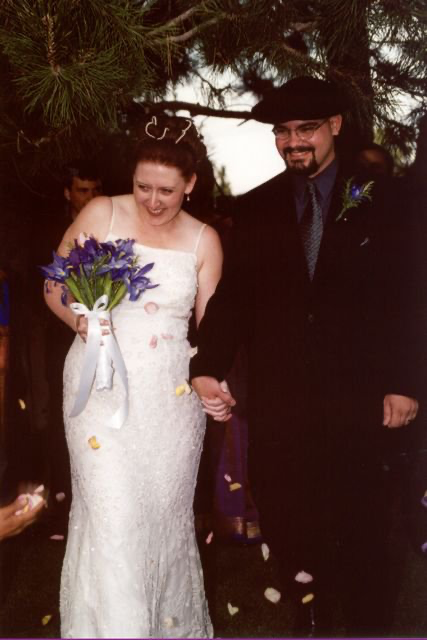
Me and my txapela on our wedding day.
Txapela actually means ‘hat’ so while every beret is a txapela, not all txapela are berets. In particular, in the northern part of the Basque Country, they say bonnet instead. That said, often txapela means beret. And, the beret or boina is often called a Basque cap by neighboring regions and in other parts of Europe. The word txapela itself is not a native Basque word, but derives from the Latin capellum ‘cap.’
Despite its ubiquitous association with the Basques, the tradition of Basques wearing a beret is not so old. There are scattered references in the 15th century, but really it became popular in the 1800s, very likely due to the influence of Tomas Zumalakarregi, the Carlist general in the First Carlist War who outfitted his troops with red berets and named them the txapelgorris – the red caps.
The origins of the beret are lost to time, but it seems likely that it came to the Basque Country by way of France. Regardless of how it came to the Basque Country, it has been a feature of the local costume since the 16th century and became very popular in the 1800s, as mentioned. This popularity arose, in part, due to the industrialized manufacturing of berets, first in Oloroe-Donamaria, just outside of Iparralde in France, then in Gipuzkoa in 1859 and Bizkaia in 1892.
Similar headwear is common to other parts of Europe, including Scotland, though the Basque beret does have a few unique traits, particularly that it has no peak, that the rim folds inward, and it has a small stem – a txertena – in the middle. The txertena is such an integral part of the Basque beret that cutting it off was seen as a great insult, sometimes leading to duels.
The importance of the txapela to Basque culture is reflected in the fact that the words for competition and champion – txapelketaand txapeldun – derive from the word. The txapeldun – literally the one who has the txapela – is often given a beret embroidered with details of the contest as a trophy.
How one wears a txapela can identify where they are from. In Araba, there is a slight point to the front. In Bizkaia, it’s always tilted to one side or the other. And, in Gipuzkoa, the beret is worn flat, so that it looks the same from all angles.
Traditionally, black is the color of the worker, worn for every day tasks, while red is the color of the fiesta as epitomized in the festival of San Fermín. However, other colors are also seen, depending on the taste of the wearer and the occasion.
A full list of all of Buber’s Basque Facts of the Week can be found in the Archive.
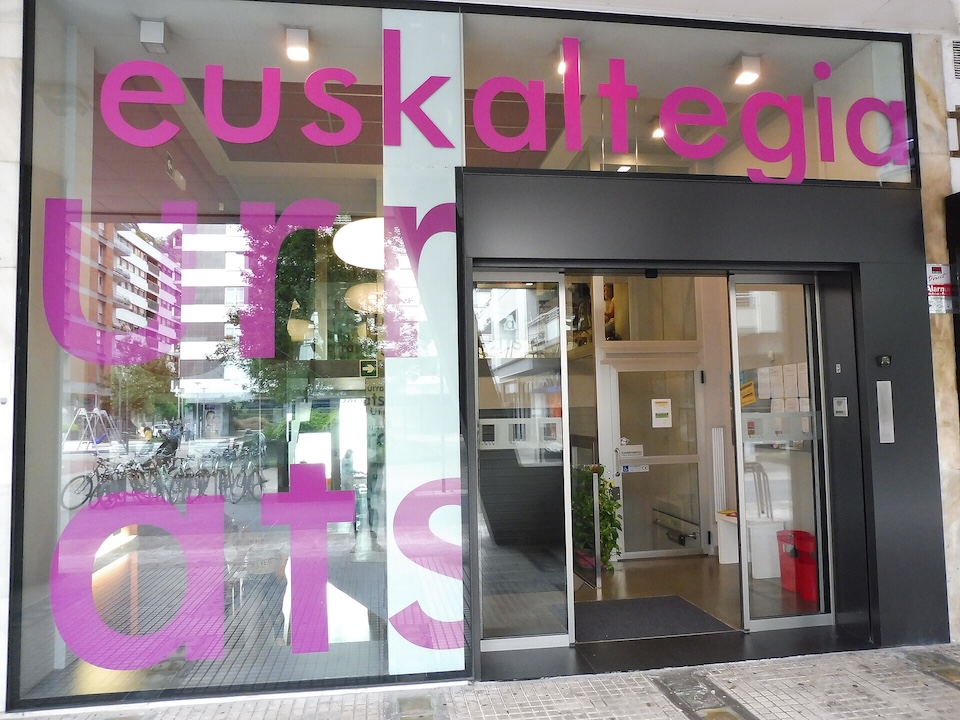
Learning Euskara can be a daunting challenge as it is simply so different from English, Spanish, or French. During Franco’s time, the use of Basque was discouraged or even outright forbidden and this led to the decline of the language. However, this also motivated people to create new institutions, new avenues, new places for people to learn Basque. These euskaltegis became a key part in the effort to preserve and promote the language.
Euskaltegi literally means “Basque-place” – a place to learn Basque. Euskaltegis target adults that want to learn the language. There are two primary types, public and private. The private euskaltegis are usually associated with a federation, such as Alfabetatze Euskalduntze Koordinakundea (AEK). The public ones, usually associated and funded by individual towns, are called Udal Euskaltegiak (udal means town or city council). A list of Udal Euskaltegiak can be found here. HABE – Helduen Alfabetatze eta Berreuskalduntzerako Erakundea or the Institute for Adult Literacy and Re-Basqueization – also has a list of Euskaltegiak in Euskadi.
Euskaltegis where people board at the school and essentially immerse themselves in the Basque language 24/7 are called barnetegis – “barne” means boarder. Courses are often about a month, though they can be as short as 12 days, and students often live on site, with every interaction in Basque.
There are more than 100 Euskaltegiak around the globe. Of course, most are in the Basque Country, with most of those being in Hegoalde, but there are Euskaltegiak in other parts of the world.
Schools specializing in teaching adults the Basque language have existed for at least 100 years. In Nafarroa, they were called “Cátedras vascas” o “Academias de la lengua vasca.” The Spanish Civil War disrupted so many things, including these schools. In 1950, the Diputación Foral de Navarra created the first public euskaltegi in Pamplona, the Academia del Euskera. Ulibarri Euskaltegi of Bilbao, created in 1975, is the oldest professional euskaltegi in the Basque Country.
The first modern Euskaltegiak created in the 1960s specialized in night classes for adults. They hit their peak in the 1980s and 1990s where some 44,000 people learned Basque at an euskaltegi. However, enrollment has dropped since then, possibly as other avenues to learn Basque arose.
A full list of all of Buber’s Basque Facts of the Week can be found in the Archive.
Why are the Basques called the Basques? Baskijski, Baskický, Baskisk, Vasco, Baskilainen, Baskisch, βασκικός, Vasco, Baskijski, Bass, баскский. All of the names for the Basques are similar and seemingly have nothing to do with what the Basques actually call themselves, Euskaldunak. Where does the word Basque even come from?
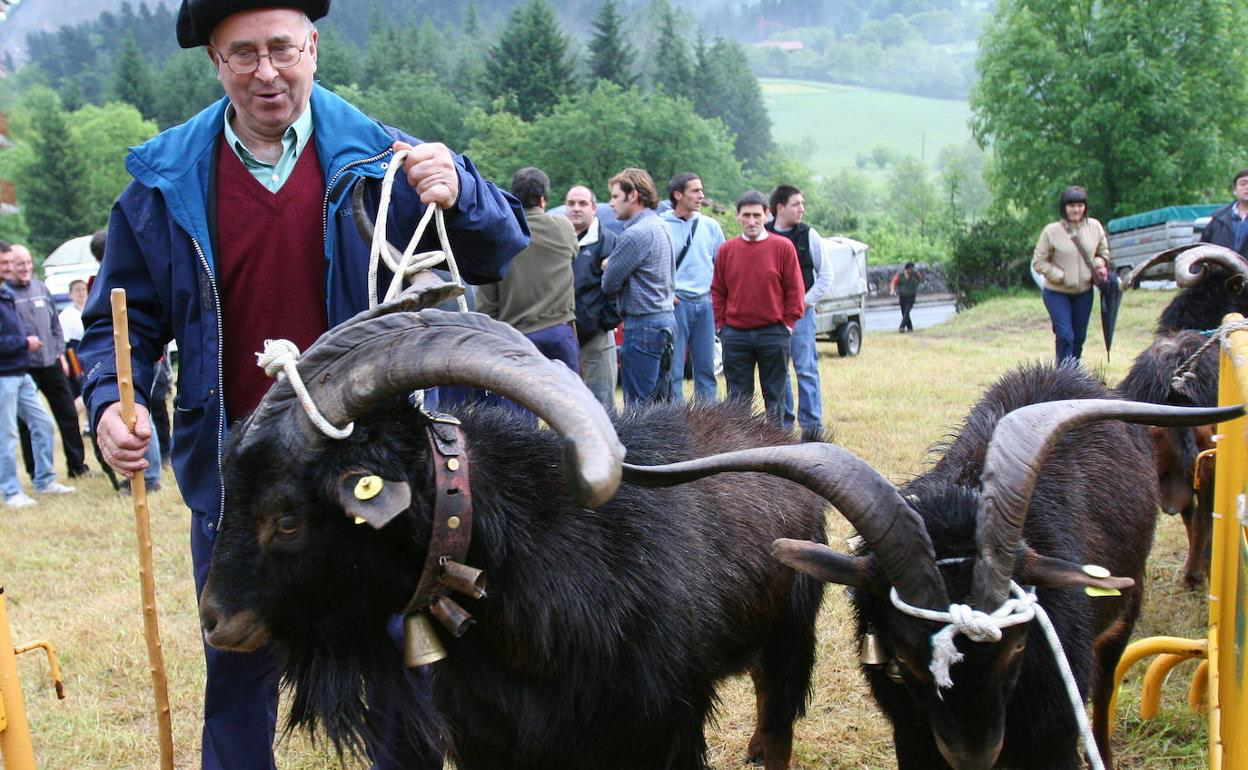
A Basque with his azpi gorri, one of the few native breeds of goats in the Basque Country. Image from El Correo.
The English word Basque comes from the French, which in turn comes from the Gascon word Basco. In fact, both Basque and Gasconcome from the Latin word for one of the tribes that inhabited what is the modern day Basque Country, the Vascones. In Latin, the word was originally uasco.
There was a theory that the Latin word for the Basques evolved from the Latin word for forest – boscus o buscus – but that has been discarded as that word itself is of relatively modern origin (the Middle Ages) and maybe comes from German.
Another theory is that uasco came from what the Basques and Aquitainians called themselves, from an early form of the modern Basque eusk-. The Romans called another tribe in the region the Auscii, which is theorized to have a similar origin.
Yet another theory links the word Basque to an inscription found on an old Roman-era coin that read barscunes. This has been interpreted as a Celtic word possibly meaning “the mountain people.”
Strabo, the Greek chronicler of the Roman Empire, called what was possibly (likely?) that same tribe as the Vascones the Ouaskonous or the Ouáskones. This is what the Greeks called them, the Οὐάσκωνες. Ouaskonous means the “goat people” as these people were known to sacrifice rams to their gods. Ouaskonous is typically rendered in English as Vasconians.
At least tworeferences link the Latin uasco with the Greek Ouaskonous, but the vast majority don’t – even the Oxford Dictionary doesn’t make this connection.
Just like the theory that uasco comes from eusk-, there is speculation that so does Ouaskonous.
It is surprisingly hard to find serious discussion of these relationships. For example, while multiple sources say that Ouaskonousmeans something like “the goat people,” I can’t find conclusive evidence of this.
A full list of all of Buber’s Basque Facts of the Week can be found in the Archive.
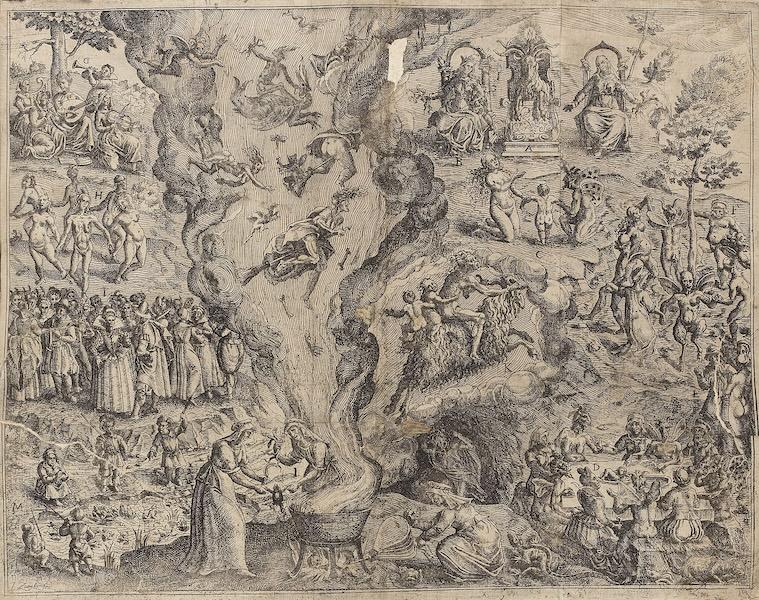
Of the things often associated with the Basques – exploration and seafaring, pintxos, rural sports, an odd language – one of the most infamous is the Witch Trials. A mania, at least fueled by if not instigated by the Inquisition and other religious figures, swept parts of the Basque Country, leading to people accusing neighbors, friends, and families of cohorting with Satan. This happened more than once, and led to the trial and execution of many accused witches.
Engraving by Jan Ziarnko depicting a witches’ Sabbath, according to the description of Pierre de Lancre in Tableau de l’inconstance des mauvais anges et demons, from Wikimedia.
The first witch trials in the Basque Country immediately followed Castilla’s and the Inquisition’s conquering of the Kingdom of Nafarroa, in 1525. These trials essentially defined how the Inquisition would conduct such trials. The first trials were held by the Council of Nafarroa’s special commissioner. Two sisters, aged 9 and 11, were brought in to look for the Devil’s mark in peoples’ eyes. In at least five different places, people were detained and executed, but we don’t know how many. At the end, the Inquisition took over and actually tempered activities, urging skepticism of spell casting and banning confiscation of property. They insisted that witches be re-educated rather than executed.
In 1609, Pierre de Lancre led a witch-hunt in Iparralde, in the province of Lapurdi. His investigations led to the burning of 70 people, including a few priests, for witchcraft. However, he estimated that some 10% of the population – 3000 people – were witches. He was dismissed from office before he could persecute all of his suspects. However, his efforts directly inspired the trials in Logroño.
Perhaps the most well known witch trials were in 1609-1610. The Inquisition held trials in the town of Logroño, in La Rioja. In these trials, the Inquisition resumed executions. In 1610, some 10-12 people were burned at the stake, though about half had already died during torture to extract confessions and were burned symbolically.
After, the Inquisition appointed Alonso de Salazar Frías, the so-called Witches’ Advocate, to investigate witchcraft activities, with a particular focus on the region around Zugarramurdi. He collected confessions from nearly 2000 people, naming upwards of an additional 5000 people as witches. The majority of those 2000 people were children aged 7-14. In the end, 6 of the nearly 7000 people accused were executed for witchcraft. The nature of the accounts of witchcraft and how people created the stories they told the Inquisitors has been studied by Emma Wilby.
A full list of all of Buber’s Basque Facts of the Week can be found in the Archive.
Despite their small country and the relatively small number of people, Basques have left their mark all across the globe. This is reflected in place names and one prime example is Durango. Durango is a relatively small village in the heart of Bizkaia, a larger city in Mexico, and a quaint town in Colorado.
The original Durango is in Bizkaia. We don’t know exactly when Durango was founded, but the name Durango was mentioned in documents by at least 1051, when it was part of the Kingdom of Nafarroa, though the town was probably founded 100 years later. Right around the turn of the century (about 1200), it became part of Castilla. In the 1400s, Durango was a part of the War of the Bands, during which time a number of tower houses were built in the town and the surrounding area. It was also during this time that the Heresy of Durango occurred.
The 1500s were a rough time for Durango. In 1517, it was hit by plague. 1544 brought flooding followed by fires in 1554. And, in 1597, plague ravaged the town yet again.
Today, the town has about 30,000 people. While the town is possibly the oldest in Bizkaia, it doesn’t look it as it was devastated by bombings during the Spanish Civil War and had to be rebuilt.
In Mexico, Durango refers to both a state and a city. As a state within Mexico, Durango is the 8th largest, boasting a population of nearly 2 million people. Before the Spanish arrived, the area was settled by the Huichols, Coras, Tepehuanos and Tarahumaras native peoples. The first Spaniard arrived in 1532. However, it wasn’t until 1546 when silver was discovered that the region attracted attention. Francisco de Ibarra, a conquistador from Eibar, Gipuzkoa (though some sources say he was from Durango) came and conquered the area.
The city was founded in 1563 by Ibarra and is the capital of the state. It began as a mining town. It became an official city, receiving its coat of arms, in 1630. During the Mexican War of Independence in the early 1800s, a number of key players were executed in the city. In 1911, under the leadership of the Arrieta brothers, the city joined the Mexican Revolution. In the 1950s, the city started growing a film industry.
Durango, Colorado, is a town of about 20,000 in the southwest corner of Colorado. The town was created in 1880 by the Denver and Rio Grande Railroad as a stop along the way to Silverton, Colorado and to service the local mining activity. The city was named after the Mexican Durango by an ex-Governor of Colorado.
It isn’t clear where the name Durango comes from. One theory says it comes from the Latin Turanicus, from the times the Romans were in the area. Or, it could come from a number of Basque names such as Duranco, Urazango or Padurango. Until the 1500s, the Basque town was known as Uribarri de Durango, meaning the “new town of Durango.” Some references say that Durango comes from Urango meaning “water town” or “well watered place,” but it isn’t clear if this is a true etymology or an invention.
All three Durangos are sister cities.
A full list of all of Buber’s Basque Facts of the Week can be found in the Archive.
The most basic element of a written language is the alphabet. However, because Euskara wasn’t standardized until the 1970s, spelling of Basque names and words was all over the place, often borrowing from Spanish and French. With standardization, the chaos finally settled and now there is a common alphabet used in all parts of the Basque Country. Those who standardized the alphabet and orthography made some interesting choices – using the letter x to represent the ‘sh’ sound and tx to represent ‘ch’ – that I haven’t been able to find why. If anyone knows, please leave a comment!
Formally, the Basque alphabet has only 23 letters – a b d e f g h i j k l m n ñ o p r s t u x z. The letters c q v w ydo exist, but are typically only used in foreign words and names.
h is a bit interesting as some dialects of Basque use it, particularly in Iparralde, while others don’t. When Euskara was being standardized in the 1970s, it was decided to use the h in some words and not in others. It is voiceless in Batua – the unified standard Basque – but is vocalized in some dialects. The choice to include it in some words and not in others caused consternation for everyone.
Another interesting letter is x, which is pronounced like ‘sh’ in English.
z is also interesting. It represents the ‘s’ sound, much like (but subtly different) from the Basque letter s. However, because of the influence of Spanish, I’ve heard it pronounced more like ‘th,’ so that, for example, my grandmother’s surname Zabala, which should be pronounced like Sabala, is sometimes pronounced like Thabala.
There are also digraphs – pairs of letters that represent unique sounds – just like ‘ch’ or ‘th’ in English. In Basque, these are:
dd: this is a bit softer sound than normal d but doesn’t really have an English equivalent (as far as I can tell). Some dialects don’t have this sound.
ll: much like in Spanish, this sounds like ‘y’ in English
rr: this is trilled much like in Spanish
ts: this is pronounced much like the ‘ts’ in ‘rats’
tt: softer than ts or tz, but similar in spirit (again, I don’t know of an English equivalent)
tx: this is the ‘ch’ sound in English, like in the word ‘chair’
tz: this is a bit harder than ts and is pronounced like ‘ts’ in ‘gets’
ñ is like the ‘ni’ in ‘onion.’ The combination ‘in’ in Basque has a similar sound.
Because Basque was only standardized within the last century, before that words were written with either Spanish or French orthography. So, modern Basque Etxebarria would be Echevarria or Etchevarria.
Finally, it is interesting to look at where some of the letter choices come from. As the last example demonstrates, Basque uses tx for the ‘ch’ sound while the neighboring languages do not. Catalan also uses tx for the ‘ch’ sound. Maybe Basque took inspiration from Catalan? I can’t find anything that says anything about the origin of using tx to represent the ‘ch’ sound…
A full list of all of Buber’s Basque Facts of the Week can be found in the Archive.
Primary sources: Basque by Larry Trask, Buber’s Basque Page; Euskera, Wikipedia