My mom tells a story of my dad where they were out in the countryside working, spending the night camping in the field. Somehow, my dad became aware of a rattlesnake nearby and freaked out, dousing the whole area with gas and lighting it on fire to kill the snake. My mom said it was because he was deathly afraid of snakes because of a “red snake” he knew about in the Basque Country.
I admit, I was a bit skeptical about this existence of this “red snake,” so I asked, and indeed it is a thing: the sugegorri – literally “red snake” – is a viper native to the Basque Country.
There are three types of vipers that are native to the Basque Country and, more generally, the Atlantic coastal regions nearby: the Cantabrian viper (Vipera seoanei), on the Atlantic side; the aspis viper (Vipera aspis aspis), in the Pyrenees themselves; and the Lataste viper (Vipera latastei), in the south. The latter is rare.
Sugegorri – literally red snake – is both a general term for a class of vipers and more specifically to the Cantabrian viper, though there are two subspecies of snakes that fall in this class: Vipera seoanei seoanei and Vipera seoanei cantabrica.
The sugegorri is polymorphic, meaning it can take on various colors and patterns. Typically, males, which can be smaller than females, are white and blue-barred, with strong black markings. Females are brown or reddish. The belly is blue or black; sometimes with white spots. The tail is yellow, orange and red underneath. There are some very dark, almost black, specimens.
Various beliefs were associated with snakes and, more specifically, vipers in the Basque Country. For example, in Bedaroa, they thought that a viper would return to the scene of the crime, so to speak, after biting someone, so the people would go to the spot the next day to kill it. In places like Karrantza, Sara, and Gernika, they thought that vipers didn’t bite, but rather stung people with their tongues. The gathering and/or hiding of certain herbs could protect against snake attacks. Or one should carry garlic, but never cheese.
Some believed that the common slow worm, a legless lizard, protected men from snakes by warning them when they were sleeping in the countryside. Sometimes they would do this by wiggling their tail in the sleeping man’s ear. However, they would only warn men, whom they considered friends – they didn’t warn women.
The bite of the viper was considered very dangerous, with people in Erroibar saying that if you were bit by a viper, you would die within an hour.
An interesting side note… in Basque, the verb “to die” is hil. However, in some places, for snakes and other animals, other words are used to say “to die.” Examples include akaatu (used for harmful animals), akabau, galdu (used for the violent death of a snake, literally meaning lost), kalitu, and amaitu (meaning finished).
The ultimate snake is the herensuge. Some beliefs suggest that all snakes descend from the herensuge. In some places, it was thought that vipers came from snakes and could eventually turn into a dragon.
A full list of all of Buber’s Basque Facts of the Week can be found in the Archive.
Primary sources: Most are linked directly in the post.
Love is the universal language, so they say. Though sometimes it is more difficult to “speak” than even Euskara! In every culture, there are norms of how men and women socialize and get to know one another, and this is true in the Basque Country. Particularly in rural areas before the advent of phones and the like, there were strict expectations on how young men and women interacted. While that has changed dramatically in the last decades, it is still interesting to see how Basque society expected young folks to navigate this part of their lives.
In old times, before TV and the internet, young men and women had few opportunities to mingle – both worked a full day and had little free time. Dances on Sundays and holidays and meeting after religious services were some of the few occasions men and women could meet. Sometimes, after a big task such as a harvest, a home would host a dance that also brought young men and women together. Or those tasks themselves provided that opportunity. Later, young people had more free time and would often “go to the mountains” to socialize. When a couple was ready to “announce” they were courting, the boy would often walk the girl home.
Young people who wanted to find a boyfriend or girlfriend often prayed to saints, particularly Saint Anthony, to help them in their quest. In some places, young women would go to the chapel and place a pin in a panel: a black-headed pin for a dark-haired boy and a white-headed pin for a blonde. The first girl to bath on Saint John’s day would find a boyfriend within a year.
In some places, boys would head to a girl’s house to serenade her as a group. Or, they would go individually and just talk to the girl who was up in her room while the boy stood outside. If another boy had already gotten there, the second might throw stones at him to get him to leave. Sometimes, the girl would let the boy into her room by climbing a ladder.
Girls also showed their affection, primarily through treats. Piperopilak are sweets, a type of cake, that the girl could buy or make and give to the boy of her affection. Sometimes, she would put it in her pocket and let the boy she liked search her to find it. If a boy was serenading a young woman and she fancied him, she (or her father!) might drop a bollo – a sweet bread – from her window.
However, it was expected that the boy take the lead and that the girl not show too much interest, that she play hard to get. It was also frowned upon for girls to go out at night – they might be called farolas, or streetlights. If a woman made the first move, she was often criticized with sayings such as “la morcilla nunca vaya tras el gato” – the sausage should never chase the cat.
Depending on the location, summer or winter was considered the best time to start a courtship. Summers were great because of all of the festivals, particularly the big ones which drew people from multiple towns. However, the summer was also full of hard work, so winters were thought better in some places.
A full list of all of Buber’s Basque Facts of the Week can be found in the Archive.
The Basque Country holds so many hidden gems. We are all familiar with the big places – Donostia, Bilbo, Vitoria-Gasteiz, Pamplona/Iruña – but there is so much more to see. Spectacular waterfalls. Strange geological forms. Nature reserves. Small villages untouched by modernization. Ainhoa falls in this last category. A small town in Lapurdi on the border between France and Spain, it has seen a lot of history. Despite all of the conflict, it has managed to retain a medieval charm.
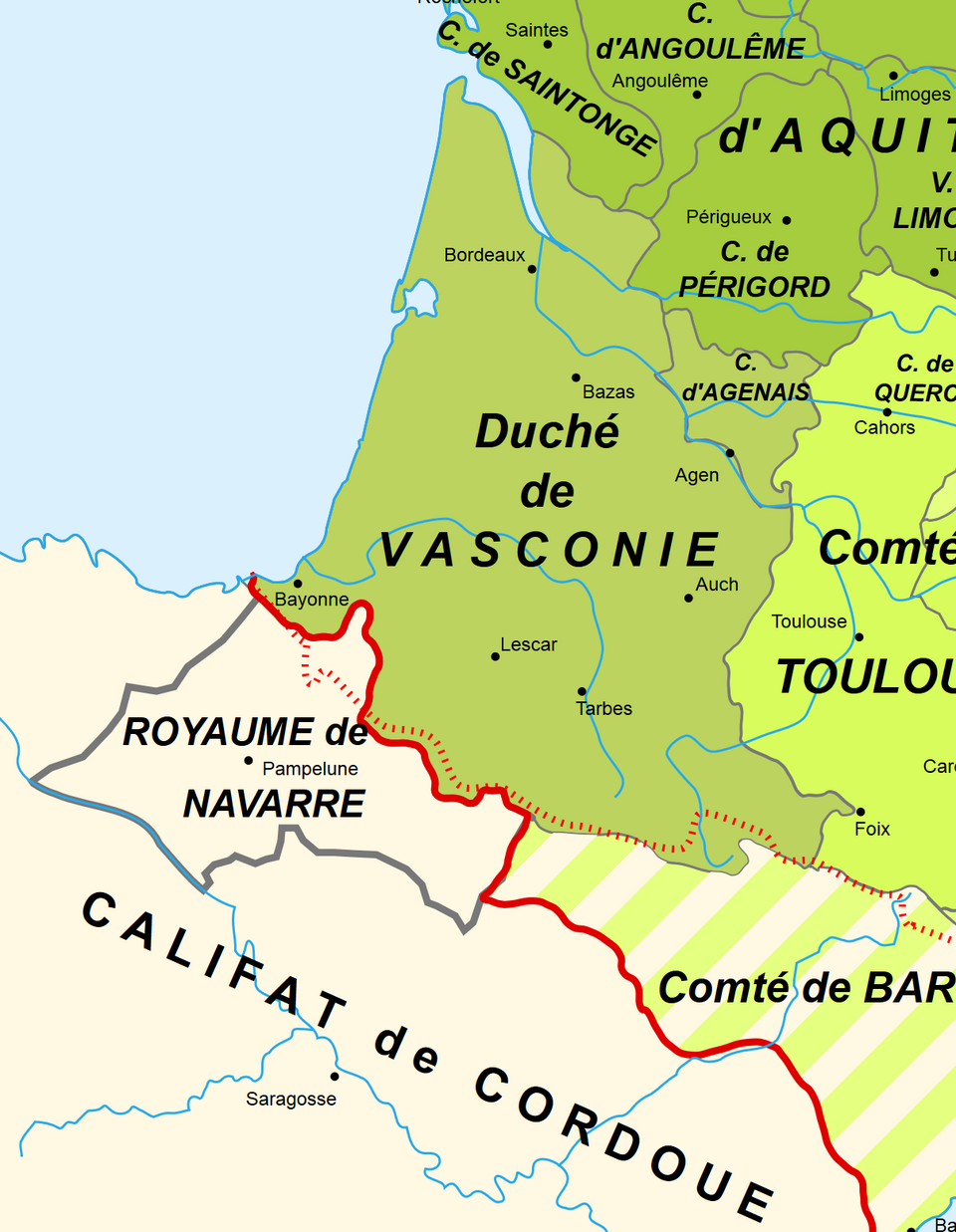
Ainhoa is what is called a commune in France. It was founded sometime in the 13th century. As it sat on the border between the Duchy of Aquitaine and the Kingdom of Nafarroa, it was founded as a stop for pilgrims on the Camino de Santiago. In 1238, Theobald I of Navarre bought the toll rights of the town, meaning he was able charge those pilgrims a fee to pass through.
As Lapurdi was then under the English crown, Ainhoa was at the center of the tensions between the two kingdoms and, in fact, the residents of Ainhoa paid taxes to both England and Nafarroa. This lasted until the 15th century when Ainhoa and neighboring regions came under French rule.
The town, along with several others, was destroyed 1636 during the Thirty Years’ War (1618-1648) when Spain invaded. Only the church – a recognized historical monument – and one house, named Machitorénéa, which had been built only a few years earlier in 1629.
Ainhoa is a so-called Bastide style town, with one street around which the town was built, and later rebuilt. Today, the town is home to just over 600 people.
In the early 1700s, Ainhoa, primarily the women of the town, was central to the revolts against the salt tax and other taxes. The revolts started in Ainhoa in 1724, spreading to the rest of Lapurdi and then other parts of Iparralde, in the following years.
In 1794, during the French terror and after Iparralde had been incorporated into larger French departments, towns like Ainhoa on the border with Spain were declared to be “infamous communes” – people were arrested and deported to other parts of France. These were “any citizen suspected of having an anti-revolutionary spirit or of having an understanding with the Spanish.” They returned later that year but only with great difficulty.
Today, Ainhoa retains much of that original medieval flavor – it has been named one of France’s most beautiful villages. The cemetery, right next to the church, has some excellent examples of funeral steles that are common to the Basque Country. And, Ainhoa boasts Ithurria, a one-star Michelin restaurant. Amazing for such a small town!
A full list of all of Buber’s Basque Facts of the Week can be found in the Archive.
The Basques weren’t the first to explore the seas… or were they? The Basques didn’t invent boats… or did they? The Basques aren’t aliens from outer space… or are they?
Seriously, the Basques played an important part in the development of shipbuilding and seafaring. We know that they were outstanding navigators, but their contributions go beyond that, to also improving ship technology. As a sort of nexus between northern and southern Europe, they fused technologies to make things even better.
Baiona was a hub of shipbuilding expertise, and this is one factor that drove innovation. Even by 1131, Baiona was building ships, an activity that only increased when Aquitaine became English in 1154 and the King of England gave the citizens of Baiona fishing and whaling rights in 1170.
In the 1100-1200s, the Basques began building cogs, also called cocas, which were inspired by northern cog-designed ships. In contrast, in the Mediterranean ships called caravels were more common.
One of the innovations that came from all of that activity was the Bayonne rudder. Northern ships tended to use a stern rudder, one that was in the back of the boat, but Mediterranean boats had a quarter rudder, or one that emanated from the side. The stern rudder was a significant improvement for maneuverability and also allowed for larger ship designs.
These boats also employed another Northern European technology in how the hull was made. In the Mediterranean, people used the carvel technique in which the panels were mounted flush against one another. This led to a tighter seal against water but also required greater skill and time to make the interlocking plates. The Basques adopted the clinker technique used in the North in which the planks were overlaid on top of one another, much like roofing tiles. This was faster and required less precision.
Basque or Bayonnese cogs also were flatter in the hull so that they were better at transporting horses and thus better for military action where soldiers and their mounts had to be transported. They could also hold more cargo and thus had an advantage for trade.
The Basques employed a combination of iron nails and wooden treenails. Treenails were used in the north but were bad in the warmer souther waters where iron nails were used more. The Basques used both – iron for strength and treenails for flexibility.
Basques also used a unique technique to shape their wood. They would shape the oak trees as they grew so that they had the form needed for the ship. This reduced joints and made elements stronger. This technique, called ipinabarres, also allowed people to better manage forest resources.
The strong Basque – or more specifically Baiona – shipbuilding tradition led to Basque shipwrights being recruited to places like England to build ships. The English were commissioning ships to be built in Baiona by as early as the 1200s. And, by 1294, Basques were in London building ships.
Basque innovation continued through the centuries. In the 1700s, for example, Antonio de Gaztañeta brought scientific principles to shipbuilding, which not only standardized design but also reduced waste. He redesigned the hull such that ships-of-the-line, the biggest ships at the time, had greater stability without sacrificing speed.
Albaola is a “sea factory” that is trying to revive the traditional shipbuilding practices of the Basques by reconstructing the San Juan, which was a whaling boat that sunk off the coast of Labrador.
A full list of all of Buber’s Basque Facts of the Week can be found in the Archive.
For decades, the story of Basques and Basque Americans who served in the United States Armed Forces during World War II lived quietly within families and local communities — preserved in fading photographs, personal letters, and stories shared at kitchen tables, yet largely absent from the public historical landscape.
Today, that story is finally beginning to take physical form.
The Basque American community has officially announced both the location and the conceptual design of the National Basque World War II Veterans Memorial— the first national memorial in the U.S. dedicated exclusively to honoring WWII veterans of Basque origin.
The Memorial is a project of North American Basque Organizations, Inc. (N.A.B.O.), developed in close collaboration with the long‑term historical research initiative Fighting Basques: Memory of WWII, led by the Basque homeland association Sancho de Beurko. Together, these efforts seek not only to commemorate the past, but to bring into public view a long-overlooked chapter of American and Basque history.
A national fundraising campaign launched in 2024 supports both the continued historical research and the construction of the Memorial, with completion envisioned by the end of 2026.
The Legacy of the “Fighting Basques”
Years of archival research, oral history, and sustained collaboration with families have now made it possible to identify more than 2,150 men and women of Basque origin who served in the U.S. Armed Forces during WWII, including members of the U.S. Merchant Marine.
Geographic distribution of the “Fighting Basques” at the time of enlistment (via authors).
At the time of their enlistment, these veterans lived in thirty U.S. states, as well as Washington, D.C., and Puerto Rico — covering nearly 60% of the United States’ territory. They served in every branch of the U.S. Armed Forces and in every theater of operations worldwide.
The majority were American born: approximately 85%were citizens by birth, mostly the children or grandchildren of Basque immigrants. Yet more than 260 veterans were born in the Basque Country itself, and others came from Basque communities across ten different countries, from Argentina and Mexico to the Philippines and the United Kingdom. Over half of these emigrants were not U.S. citizens when they enlisted.
Their paths to service were diverse, but their commitment was shared. Together, they represent an extraordinary and still underrecognized contribution to the history of World War II.
Gardnerville, Nevada: A Meaningful Home
After an intensive year-long process of research, site visits, and deliberation, N.A.B.O. has announced that the Memorial will be built in Gardnerville, Nevada, at Heritage Park, located in the town’s historic downtown.
Aerial photo of Heritage Park, Gardnerville (Nevada), the future site of the National Basque WWII Veterans Memorial. (Courtesy of the Town of Gardnerville).
This location is deeply meaningful. Rooted in a rich immigrant past, Gardnerville has long been — and continues to be — an important center of Basque American life in Nevada. Founded in 1879, the town later became one of the state’s most significant sheep-raising hubs, sustained by a dense network of boardinghouses, hotels, bars, and restaurants that served generations of Basque sheepherders and their families.
Today, Gardnerville remains home to an active and engaged Basque community. With just over 6,200 residents, the town represents nearly 2% of Nevada’s Basque population and hosts the Mendiko Euskaldun Cluba. Since its founding in 1981, the club’s events and annual festivals have been widely attended, drawing participants from across the state and beyond, and serving as a regional reference point for Basque culture.
The Town of Gardnerville has also expressed its support for the Memorial project, recognizing its historical, cultural, and educational value for the community and working collaboratively with the organizers as the initiative moves forward.
Gardnerville is also closely linked to families whose wartime service became legendary—such as theEtchemendy brothers, often described as the most decorated group of brothers in Nevada. Born in Gardnerville to Basque immigrant parents, their names will soon return home, permanently engraved at the Memorial.
Meet the Etchemendy brothers, from left to right: Leon (wearing an eye patch after being wounded at the Battle of Leyte), John, and William. (Courtesy of the Etchemendy family).
Bizi leku: A Place to Live, A Place to Remember
The Memorial’s conceptual design, titled Bizi leku — Basque for “The Place to Live” — was created by Basque architect Maider Bezos Lanz (BZS Architecture).
Constructed in Corten steel, the design evokes themes of migration, settlement, and belonging. It reflects the experience of adopting a new homeland while maintaining deep cultural roots—a defining feature of the Basque American story.
“Echoes of two wars, 1936-1945” aims to disseminate the stories of those Basques and Navarrese who participated in two of the warfare events that defined the future of much of the 20th century. With this blog, the intention of the Sancho de Beurko Association is to rescue from anonymity the thousands of people who constitute the backbone of the historical memory of the Basque and Navarre communities, on both sides of the Pyrenees, and their diasporas of emigrants and descendants, with a primary emphasis on the United States, during the period from 1936 to 1945.
THE AUTHORS Guillermo Tabernilla is a researcher and founder of the Sancho de Beurko Association, a non-profit organization that studies the history of the Basques and Navarrese from both sides of the Pyrenees in the Spanish Civil War and in World War II. He is currently their secretary and community manager. He is also editor of the digital magazine Saibigain. Between 2008 and 2016 he directed the catalog of the “Iron Belt” for the Heritage Directorate of the Basque Government and is, together with Pedro J. Oiarzabal, principal investigator of the Fighting Basques Project, a memory project on the Basques and Navarrese in the Second World War in collaboration with the federation of Basque Organizations of North America.
Pedro J. Oiarzabal is a Doctor in Political Science-Basque Studies, granted by the University of Nevada, Reno (USA). For two decades, his work has focused on research and consulting on public policies (citizenship abroad and return), diasporas and new technologies, and social and historical memory (oral history, migration and exile), with special emphasis on the Basque case. He is the author of more than twenty publications. He has authored the blog “Basque Identity 2.0” by EITB and “Diaspora Bizia” by EuskalKultura.eus. On Twitter @Oiarzabal.
Josu M. Aguirregabiria is a researcher and founder of the Sancho de Beurko Association and is currently its president. A specialist in the Civil War in Álava, he is the author of several publications related to this topic, among which “La batalla de Villarreal de Álava” (2015) y “Seis días de guerra en el frente de Álava. Comienza la ofensiva de Mola” (2018) stand out.
“Bizi leku is conceived as a welcoming space,” explains Bezos Lanz. “A symbolic home that brings together all the names engraved on its surfaces, allowing them to coexist in peace and dignity — united by shared history and memory.”
The Memorial is envisioned not simply as a list of names, but as a living place of remembrance — one that honors individual lives, family histories, service, and sacrifice. A complementary digital memorial will provide access to biographies and educational resources, extending its reach far beyond the physical site.
Looking Ahead: A Shared Responsibility
The National Basque WWII Veterans Memorial seeks to preserve the memory of an entire generation while offering visitors — Basque and non‑Basque alike — a space for reflection, learning, and gratitude.
“As a community, we are creating a permanent national place to remember, honor, and thank Basque veterans who proudly served during World War II,” says historian Dr. Pedro J. Oiarzabal, director of the Fighting Basques project. “It represents a long-overdue public recognition and a place of pride, service, and belonging — one that connects individual stories to our shared history, much like the National Monument to the Basque Sheepherder dedicated in Reno, Nevada, in 1989.”
The Memorial’s dedication is planned for no later than December 2026, coinciding with two significant anniversaries: the 85th anniversary of the U.S. entry into World War II and the 250th anniversary of American independence.
Yet this Memorial is not only about the past. It is about how memory is carried forward — through care, participation, and collective commitment — so that these stories remain present and meaningful for future generations.
The National Basque WWII Veterans Memorial will take shape through shared remembrance and community involvement. As the fundraising campaign continues, each contribution — large or small — helps transform memory into a lasting public space of recognition and gratitude.
In this way, the Memorial becomes more than a site or a structure. It becomes a place where history remains alive—because a community chooses to remember, together.
Over 100 years ago, in 1921, José Miguel de Barandiaran began publishing a series of articles under the banner of Eusko-Folklore. His work was interrupted by the Spanish Civil War but in 1954 he resumed publishing what he then called his third series of articles. These appeared in the journal Munibre, Natural Sciences Supplement of the Bulletin of the Royal Basque Society of Friends of the Country. While various writings of Barandiaran have been translated to English, I don’t believe these articles have. As I find this topic so fascinating, I have decided to translate them to English (with the help of Google Translate). The original version of this article can be found here.
More appearances of Mari
IN AMEZQUETA
Our mother saw how Mari de Txindoki left. She lived in the mill when she was little. Once, some men brought a pile of sacks of corn to the mill on a cart, and our mother unloaded the sacks from the cart onto the men’s shoulders. And, while the men were returning, as she was waiting for them, at night, she saw something burning and flaming coming out of the Txindoki chasm and disappearing [going] toward San Miguel. Our mother was frightened. Later, when the men had returned, she told them that she had seen something burning and flaming heading toward San Miguel [de Aralar]. They then replied that it was undoubtedly Mari. In the chasm where she [Mari] entered, everything was scorched.
(Reported in 1930 by Ignacio Altuna, from Amézqueta.)
IN BIDARRAY
The story of the apparition of Arpeko-Saindua (the saint of the cave) on Bidarray Mountain is similar to those recorded in previous legends about Mari. The themes of the blast of fire that enters a cave at night, the young woman who mysteriously disappears, the threatening voices of the night, and the curse and punishment of those who desecrated the cave all converge here, as in other stories about Mari.
On November 14, 1938, I visited the cave of Arpeko Saindua, accompanied by my friend Don Gelasio Arámburu and the Jatxou children’s colony.
We arrived at Bidarray station early in the morning. We crossed the Nive over the bridge called Onddoene’ko zubi (Onddoene Bridge). It is said that this bridge was built in one night by the legendary spirits whose name is lamin. We took a path to the right that climbs alongside the Bastan-erreka stream. We pass close to Arranteia (the swimming pool). Further on, we cross the stream in a narrow ravine over the Inpernuko-zubi (Hell’s Bridge), and continue along the path to cross the stream again higher up and take the path that climbs to the Arrusia baserri located on the southern slope of Mount Zelharburu. Still traveling uphill for 300 meters, heading west-northwest, we reach the Arpeko Saindua cave. Its entrance faces east-southeast. It is open in the banks of pudding stone and sandstone that form the southern escarpments of Mount Zelharburu. It has a vestibule 5 m wide, 5 m deep, and 6 m high. To the left, a meter and a half above the floor of the vestibule, there is a narrow gallery that is accessed by ten stone steps (fig. 1). It is a humid place: water drips from the ceiling. At the end of the gallery (fig. 1, x), there is a stalagmite column that reaches the ceiling: it measures 1.10 m in height and 0.20 m in average width. It resembles a human torso (fig. 2). A little water runs across its surface. This is the supposed saint of the cave. The etxekoandre, or lady of the Arrusia baserri, named Margarita Ibarrola, tells me the following:
A young girl got lost on Mount Euzkei [Iuskai, Iuskadi]. They only found her head. From then on, at night, for many years, voices were heard. “Wait! Wait!” someone shouted from the side of Mount Euzkei.
On one occasion, at midnight, they saw a light enter Zelharburu’s cave. Others said they had seen twelve lights. The surrounding villagers went to the cave and there saw the statue of the saint. From then on, the voices were not heard.
In front of the stalagmite column, there are candlesticks resting on rock outcrops. In them, devotees place the candles they offer to the “saint” and rub their bodies or sick limbs with the water that runs down the supposedly petrified “saint.” She is invoked in cases of skin and eye diseases. Those who suffer from eczema (negal in Basque) are the ones who have particular devotion to the “saint” of this grotto.
While still inside the cave, we saw three women arrive from the Itxassou side with two girls. One of them, a young girl, lit a wax candle, traced a cross in the air with it in front of the stalagmite, and left it at its foot to be consumed there.
I returned to Zelharburu on April 20, 1945, and saw that the cult of the saint of the cave continued as before.
On the walls of the cave are many votive offerings: rosaries, crosses, medals, combs, handkerchiefs, shirts, and berets that the sick leave, believing that the illness that afflicted them remains in these garments. There is also a collection box where devotees deposit alms (cash and paper money). Since the collection box is broken, anyone can steal the money deposited there: many 10- and 20-franc bills can be seen. In the hollow beyond the stalagmite, we saw several bronze coins from the last century: some French and some Spanish. They were undoubtedly thrown there not to cover the expenses incurred by the care of that “sanctuary,” but for the supposed “saint” venerated there, and only for her. The almost inaccessible nature of the place where they were thrown shows that their donors did not want those coins to fall into human hands.
Both the devout pilgrims of Itxassou and one of the shepherds from the region named Antonio Intxaurgarate told me that, on one occasion, the owners of Arrusia closed the cave and began charging an entrance fee to those who came to visit the “saint.” Soon, all of the sheep of Arrusia fell into disgrace, tumbling down the rocks. The family of Arrusia then realized that this was a punishment sent by Arpeko Saindua and reopened the cave.
A pilgrimage is held here annually on Trinity Day, consisting mainly of dancing. Groups of young people of both sexes from the surrounding neighborhoods and villages attend.
There are procedures to attract Mari, and there are also those to remove her.
If she is invoked three times in a row, saying: Aketegiko Damea! “The Lady of Aketegi!”, Mari then appears and she sits herself on the head of the person who invoked her. This is the information we gathered from a report from Cegama.
But there are also means, mainly of a religious and magical nature, to which the power of preventing any action by Mari is attributed.
We have already recorded some cases of this kind on various occasions. Now I will simply transcribe the brief report that a resident of Mañaria sent me in 1930. It reads somewhat literary:
One afternoon, three or four of us were going for a walk, spending time in the mountains, taking time in the shade of a tree, and were talking and resting beside a stream. Suddenly, an old shepherd appeared and also rested beside us.
We talked with the old man for a long time and talked about many things, and finally, we recalled the storms that had raged here and there during this summer, etc. We talked about the weather in so many ways, each of us offering his own opinion. At this point, the old shepherd stood up and, thoughtfully, looked at us to tell us something important about the weather. Then he began to explain very seriously the cause of the storms. “Look! If the Lady of Amboto is inside the cave on Saint Barbara’s day, the following summer will be calm and abundant [in crops, etc.]; but if on that day she is outside the cave, the following summer there will be terrible storms and upheavals. And on Saint Barbara’s day last year, that Lady of Amboto walked in fire and flames along the Mugarra (1) side, and that is why all the storms, tempests, and evils this year are here.”
(1) Mugarra is a mountain located above Mañaria.
SUMMARY OF THE MYTHOLOGY OF MARI
Taking a look at what we have published so far about Mari, both in EUSKO-FOLKLORE and in “Mari o el genio de lasmontañas” (in Homage to D. Carmelo de Echegaray, San Sebastián, 1923), in “Die prähistorischen Höhlen in der baskischen Mythologie” (in Paideuma, Leipzig, 1941), and in “Contribución al estudiode la mitología vasca” (in Homage to Fritz Krüger, Mendoza, 1952), we could briefly summarize the main features of the conceptual and mythological world formed around this legendary name or divinity.
Names
Mari is the most general, alone or associated with the place where the numen resides:
Basoko Mari’e (the Mari of the forest) as she is called in Urdiain.
Aldureko Mari in Gorriti.
Puyako Maya (Maya de Puya) in Oyarzun.
Mari Munduko (Mari de Mundu or Muru) in Ataun.
Marie Labako (Mari of the oven) in Ispaster.
Mari Muruko (Mari de Muru or Buru) in Elduayen.
Mari-mur in Leiza (according to my informant José Joaquín Sagastibeltza). Mamur is the generic name of certain beings who, according to beliefs of the Vera region, appear at night in the form of monsters.
Marije kobako (the Mari of the cave) in Marquina.
Mariarroka in Olazagutía.
Mariurraka in Abadiano.
Mariburrika in Garay and Berriz.
Andre Mari Munoko (Lady Mari de Muno) in Oyarzun.
Andre Mari Muiroko (Lady Mari de Muguiro) in Arano.
Muruko Damea (the lady of Muru) in Ataun.
Aralarko Damea (the lady of Aralar) in Amézqueta.
Putterriko Damea (the lady of Putterri) in Arbizu.
Illunbetagaineko Duma (lady of Illumbetagaina) in Lakunza.
Beraingo lezeko Dama (Lady of the Cave of Berain) in Lakunza.
Aketegiko Damea (the lady of Aketegi) in Cegama.
Anbotoko Dama (lady of Amboto) in Zarauz.
Amuteko Damie (the lady of Amute) in Azcoitia.
Arrobibeltzeko Andra (Lady of Arrobibeltz) in Ascain.
Anbotoko Señora (Lady of Amboto) in Aya, in Arechavaleta and in many other towns in Guipúzcoa and Vizcaya.
Anbotoko Sorgiña (the witch of Amboto) in Durango.
Aketegiko Sorgiñe (the witch of Aketegi) in Cegama.
Arpeko Saindua (the saint of the cave) in Bidarray and other towns in Navarre and Laburdi.
Gaiztoa (the evil one) in Oñate.
Sugaarra (the snake) in Ataun.
Yona-gorri (she of the red skirt) in Lescun.
Lady and Sorceress in the “Livro dos Linhagens” by Count Don Pedro (16th century).
The name Mari may have some connection with the names Mairi, Maide, and Maindi used to designate other legendary figures in Basque mythology, although the themes associated with these are different. The Mairi are the builders of dolmens; the Maide are male spirits of the mountains, while their female counterparts are the Lamin, or spirits of springs and rivers; the Maindi are perhaps the souls of ancestors who visit their former homes at night, according to beliefs in the Mendive region.
The name Maya undoubtedly has a connection with Maju, who is considered to be Mari’s husband and must be the same name that Lope Garcia de Salazar called Culebro, father of Jaun Zuria, and in Ataun they call Sugaar “snake” and in Dima Sugoi “snake.”
Forms of Mari
Legends attribute Mari to the female sex, as they do to most of the deities featured in Basque mythology.
Mari often appears in the form of an elegantly dressed lady, as we are told in the legends of Durango, in which she also appears holding a golden palace in her hands. She is similarly represented in the stories of Elosua, Bedoña, Azpeitia, Cegama, Rentería, Ascain, and Lescun. In the latter town, she wears a red skirt.
According to data collected in Amézqueta, during storms she appears in the form of a lady seated in a chariot crossing the air pulled by four horses.
She has been seen in Zaldivia in the form of a woman breathing flames.
A woman wrapped in fire, lying horizontally in the air, crosses space, as described in a legend from Bedoña.
A figure of a woman breathing fire, sometimes dragging a broom and sometimes chains, depending on the noise that accompanies her, so they say in Régil.
A lady riding a ram, according to legends from Oñate and Cegama.
A large woman whose head is surrounded by the full moon, according to what was seen in Azcoitia.
A woman with bird feet, they say in Garagarza.
A woman with goat feet, according to the “Livro dos Linhagens” by Count Don Pedro.
She appears in the form of a goat in Auza (Baztán Mountain).
She appears in the form of a horse, according to legends from Arano.
She was seen in the form of a heifer, according to a story from Oñate.
Many Cegamese have seen her in the form of a crow in the Aketegi cave.
According to the beliefs of those in Orozco, she lives in the great cave of Supelaur in Itziñe, where she and her companions appear in great numbers in the form of vultures.
In one legend from Oñate, she appears in the form of a tree, whose front part resembles a woman; in another, she is said to have appeared in the form of a tree that gave off flames from all sides.
In Escoriaza, they say that the Lady of Amboto sometimes made herself known in the form of a gust of wind.
She sometimes appears in the form of a white cloud, according to a legend from Durango. The same is also said in Ispaster.
She has sometimes been seen in the form of a rainbow.
In Oñate, Segura, and Orozco, they say they have seen her in the form of a ball of fire.
She often takes the form of a fiery sickle, according to accounts from Ataun, Cegama, and Zuazo de Gamboa.
In the Zelharburu grotto (Bidarray), she is seen petrified in the form of a human torso.
Despite the variety of forms in which legends present Mari, they all agree that she is a woman.
Mari generally takes on zoomorphic forms in her underground dwelling; other forms outside of it, on the surface of the earth, and when she crosses the firmament.
The animal figures such as bulls, rams, goats, horses, serpents, vultures, etc., that are mentioned in the legends concerning the underworld, therefore represent Mari and her subordinates, that is, the terrestrial spirits or telluric forces to whom people attribute the phenomena of the world. The cases of changes in form, mentioned in various stories, confirm this idea.
Mari’s Abodes
Mari’s ordinary abode is the regions beneath the earth. But these regions communicate with the earth’s surface through various channels, which are certain caverns and chasms. For this reason, Mari appears in such places more frequently than in others.