Basque Fact of the Week: Real Sociedad, Copa del Rey Champions

While Athletic Bilbao receives more international attention, primarily due to their unique policy of signing only Basque players, they are not the only team in the Basque Country – there are several. Yesterday, April 18, 2026, the soccer team from Donostia, Real Sociedad de Fútbol, won the Copa del Rey, their first win since 2000 and only their fourth win in their history. Star player Mikel Oyarzabal scored one of their goals, with rising star Ander Barrenetxea scoring the other. Led by an American-born coach, this win caps a remarkable turnaround where they were almost relegated to second division only a year ago.

The players of Real Sociedad celebrating their Copa del Rey win against Atletico Madrid on August 18, 2026. Photo from Reuters.
  • Fútbol came relatively late to Donostia – the first recorded match was played in 1902, a time when other towns in Gipuzkoa already playing. The sport was brought over from England, by young men who had worked or studied there. By 1903, the first clubs had been established.
  • To formally compete in official championships, clubs had to be registered. One club in Donostia registered under the name Club Ciclista so that they could play in the 1909 Spanish Championship, the Copa del Rey, which they won. This team ultimately became Real Sociedad. In 1909, they formed their own team, the Society of Football, and in 1910 the Spanish king bestowed the title “Real”, or Royal. Hence, they became known as Real Sociedad de Fútbol, the Royal Society of Football.
  • In 1913, the city and team inaugurated their football field, Atotxa, which became their home for over 80 years. The first match in the new stadium as against Athletic Bilbao, a game that ended in a 3-3 tie. In 1993, the team moved to their current stadium, Anoeta. 
  • Real Sociedad was one of the founding teams of the Spanish La Liga in 1929. In 1931, they briefly changed their name to the Donostia Club de Futbol during the Second Spanish Republic, but after the Spanish Civil War they reverted back to Real Sociedad de Futbol. Their nicknames in Basque are Erreala (“Royal”) and the txuri-urdin (“white-blue”).
  • Since their founding, Real Sociedad has won the Copa del Rey four times, including that first year in 1909 and most recently just yesterday – April 18, 2026. The previous win was in 2020, when they beat Athletic Bilbao for the win after a year delay due to COVID. They have also won the Spanish Premier League twice, most recently during the 1981-82 season.
  • Up until 1989, Real Sociedad maintained a policy similar to Athletic Bilbao in that they only signed Basque players. However, in that year, they signed forward John Aldridge from Ireland. 
  • Real Sociedad is more than a men’s soccer team. They also consist of track and field, field hockey, and pelota. In 2004, the group formed a women’s soccer team, Real Sociedad Feminino. That team won the Copa de la Reina in 2019. 
  • Their current coach, Pellegrino Matarazzo, was born in the United States to Italian immigrant parents. Though obtaining a degree in applied math from Columbia, his passion was soccer. After a less than stellar career as a player, he became a coach and in December, 2025, he was named Real Sociedad’s coach. Real’s winning of the Copa del Rey is his crowning achievement. Just last year, the team was on the verge of being relegated to second division.

A full list of all of Buber’s Basque Facts of the Week can be found in the Archive.

Primary sources: Cuesta Olaizola, Eneko de la. Real Sociedad de San Sebastián. Auñamendi Encyclopedia, 2026. Available at: https://aunamendi.eusko-ikaskuntza.eus/en/real-sociedad-de-san-sebastian/ar-124806/; Real Sociedad, Wikipedia
Basque Fact of the Week: Jon Bilbao, The Basque Bibliographer

Last year, the pioneering work Amerikanuak celebrated its 50th anniversary. Written by Willian Douglass and Jon Bilbao back in 1975, this book surveys the history of Basques in the Americas – not just the United States but all of North and South America. Bilbao had spent many years chronically all works written about the Basques which undoubtedly served as a foundation for Amerikanuak. Bilbao lived a complex life, bouncing back and forth between the United States and Europe as political tides ebbed and flowed. Studies of Basques in the Americas owe a great debt to Bilbao.

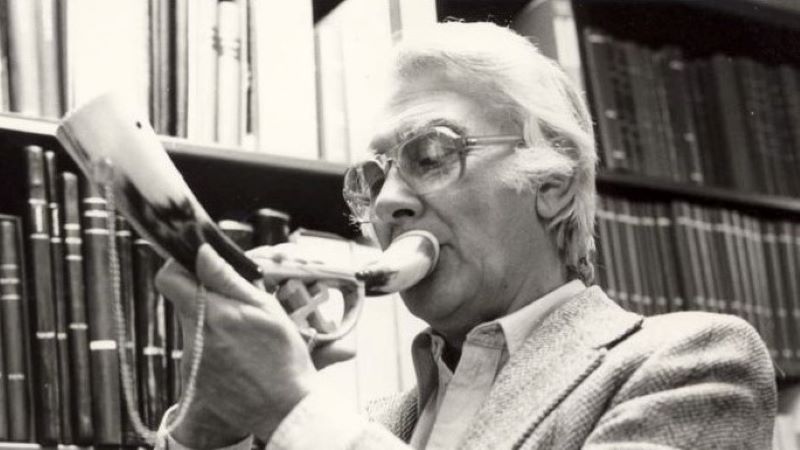
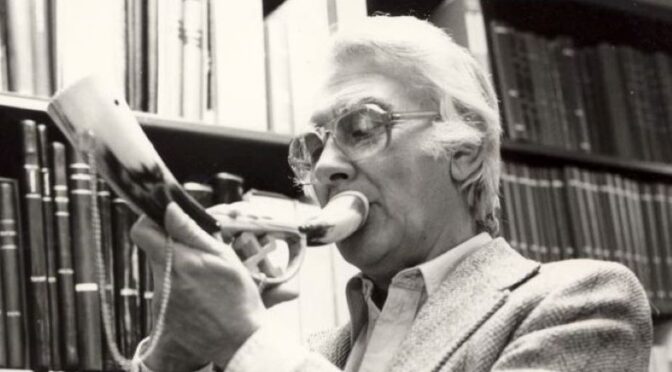
Jon Bilbao playing an alboka. Photo from the Jon Bilbao Basque Library.
  • Jon Manuel Bilbao Azkarreta was born on October 31, 1914 in Puerto Rico. His father Juan had left the Basque Country at the age of 12 looking for opportunity. There Juan met Matilde Azkarreta. In 1917, the family moved back to the Basque Country, where Jon grew up. He got a bachelor’s degree from the University of Valladolid and then studied Medieval History at the Central University of Madrid.
  • He had intentions of returning to Bilbo where there were plans to open a Basque university but the Spanish Civil War broke out and he joined the Eusko Gudarosteak (Basque Battalions). The day Bilbo fell, Jon escaped in the dead of night to France, making his way back to Puerto Rico. He eventually enrolled in Harvard, then Columbia, then the University of California, Berkeley, to continue his doctoral studies. However, he never finished. 
  • As a a deputy director of the “Basque Government in Exile” he was sent to Idaho to research the Basques there and to fund-raise for the government. During this time, he was very active in fight against fascism and, after World War II, was named a Knight of the Belgian Order of the Crown. In 1943, he became as citizen of the United States.
  • During these years, he began work on what would become Eusko Bibliographia, a reference documenting every item ever published on Basque topics. In the end, it took him 20 years to complete this monumental task. At a time before the internet where finding scholarly resources was challenging, this work was indispensable for Basque scholars.
  • He returned to the Basque Country for a few years, working with J.M. Barandiaran, before moving next to Cuba and then back to the Basque Country. In 1958, he was arrested by Franco’s government. He wasn’t imprisoned due to his American citizenship but was expelled from Spain. Moving to Biarritz, he was soon expelled by the French government, causing him to return to the United States.
  • He taught at Georgetown University and the Naval Academy before being recruited by William Douglass to join the new Basque Studies program at the University of Nevada, Reno. With Douglass, he toured Latin America and wrote Amerikanuak: Basques in the New World, the definitive history of Basques in the western hemisphere.
  • He retired from Reno in 1980 and returned to the Basque Country once again. He was excited by a number of projects related to the Basques, the diaspora, and the creation of a Basque library, but things didn’t quite materialize as he hoped. He died on May 23, 1994 after suffering multiple strokes.

A full list of all of Buber’s Basque Facts of the Week can be found in the Archive.

Primary sources: Jon Bilbao, Wikipedia; Estornés Zubizarreta, Idoia; Elia Itzultzaile automatikoa. Bilbao Azcarreta, Jon. Auñamendi Encyclopedia. Available at: https://aunamendi.eusko-ikaskuntza.eus/en/bilbao-azcarreta-jon/ar-14146/

Basque Fact of the Week: Tota Aznar de Pamplona

The medieval history of the Basque Country is both fascinating and so convoluted. There are so many marriages back and forth between different families as royals tried to consolidate and expand power that it becomes dizzying. A great example is Tota, or Toda, Aznar of Pamplona. Her skill as a diplomat and in establishing power through marrying her children places her as a central figure in the history of the Basque Country.

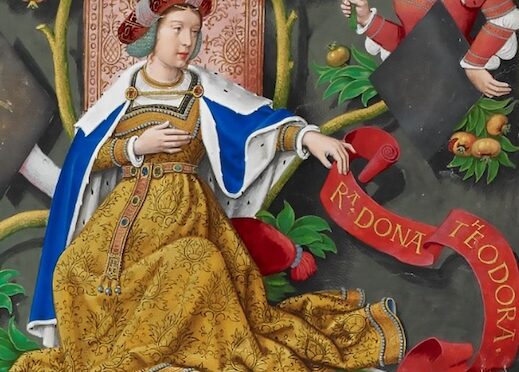
Toda de Pamplona, as painted by António de Holanda in 1530. Image from Wikidata.
  • Tota Aznar, or Toda as she was more commonly called, was born in the 9th century – possibly on January 2, 876. She was born into nobility. Her father was Don Aznar Sánchez, Lord of Latraun, and her mother was Doña Oneka. She was the granddaughter of King Fortuño Garcés “the Monk”; as such, she belonged to the Arista dynasty.
  • She married Sancho I of Pamplona, Sancho Garcés, who was of the Ximena dynasty. Thus their marriage united the two most powerful families of Pamplona. 
  • Toda was a very skilled diplomat. As one example, she arranged the marriage of her daughter Sancha first to Ordoño II of Asturias. When he died, she arranged the marriage of Sancha with Álvaro Harrameliz, and after he died, with Fernán González, the Count of Castile, bringing the County of Álava as her dowry. She arranged similar marriages for her other daughters, solidifying the position and power of her family.
  • Sancho I died in 925. His brother, Ximeno Garcés (who also was Toda’s sister Sancha’s husband), succeeded him, but also became the guardian of Sancho and Toda’s son García Sánchez I. Ximeno didn’t last long, dying in 931, at which point García became king, but since he was still a minor, Toda became regent and his guardian.
  • The royalty of Pamplona was intertwined with the nearby Muslim rules (Toda was aunt or, more likely cousin, to Caliph Abd-al-Rahman III). In 934, Toda signed a treaty with Abd-al-Rahman III, which helped to cement the rule of her son, but by 937 Toda had already broken her treaty, leading to conflict. In 939, she is noted as having defeated “an innumerable army of Saracens,” saving the king.
  • After García rose to the throne in his own right, Toda becomes less prominent in records. However, by 958 she is noted as ruling her own subkingdom in the areas of Deio and Lizarrara.
  • Her last great feat as a powerful ruler was promoting her grandson, Sancho I of León, known as Sancho the Fat. She enlisted the aid of Abd-ar-Rahman III to cure Sancho’s obesity, which his Jewish physician Hasdai ibn Shaprut said he would do if Toda visited Córdoba, the seat of Abd-ar-Rahman’s power. She did, along with her son and grandson, and this visit proved to be a huge diplomatic event. Sancho was cured and went on to reclaim the throne of León.

A full list of all of Buber’s Basque Facts of the Week can be found in the Archive.

Primary sources: Estornés Lasa, Bernardo. Toda Aznárez de Larraun. Auñamendi Encyclopedia. Available at: https://aunamendi.eusko-ikaskuntza.eus/en/toda-aznarez-de-larraun/ar-139997/; Toda of Pamplona, Wikipedia

Basque Fact of the Week: The Time Spain Planned to Conquer China with an Army of Basques

It seems inconceivable today, but in the late 1500s, the rulers of what is now Spain thought they could conquer China and then the rest of Asia with an army of 10,000 to 20,000 soldiers. They thought they could persuade Japan to join them. What’s more, this army was going to be primarily Basque. Leaders often overreach, thinking they are invincible, their ambitious getting the better of themselves (and, unfortunately, all of those around them); but this plan seems even more foolhardy than most.

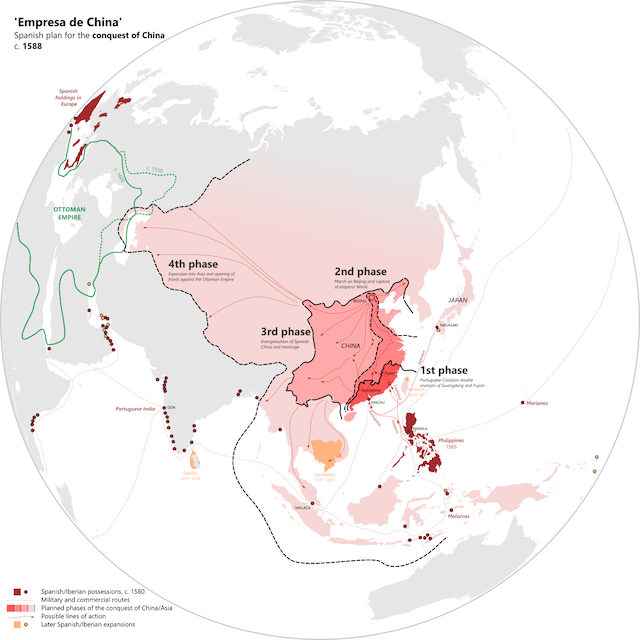
The stages of the Empresa de China plan. Image from Wikimedia.
  • In the late 1580s, a plan was devised by Spanish leaders to invade China. The goals were to Christianize the nation, plunder its wealth, and establish a base of operations from which Spain could conquer other parts of Asia. There were even plans for Spanish soldiers to mix with Chinese women and to establish encomiendas using local labor, much as they did in the Americas.
  • Versions of this plan had been floated before. Hernán Cortés made such a proposal in 1526. Martin de Rada, one of the first missionaries to visit China, suggested such a plan in 1575, though he did not advocate the use of force, but rather “persuasion and evangelization.” Francisco de Sande, governor of the Philippines from 1575 to 1580, thought a force as small as 4,000-6,000 could take China.
  • The one that actually took hold – the Empresa de China or Chinese Enterprise – was pitched by diplomat Alonzo Sánchez. A Jesuit missionary, Sánchez had been to the Philippines and saw an opportunity to expand Spanish and Christian influence. He was able to get a version of his plan to King Philip II who, with his Council of State, began developing the plan. Amongst others, Basque Juan de Idiáquez y Olazábal helped Sánchez get his plan in front of the king. The Bishop of Manila and another Basque, Domingo de Salazar, also advocated for the plan.
  • Spain reasoned that, because of the ease with which they had conquered the Americas and the Philippines, China would be similarly easy. From a Spanish perspective, China was a wild place which, while densely populated, didn’t have a military spirit. They thought that a small force of some 15,000 soldiers could take China, aided by popular resurrection once the Spanish came. 
  • Of the soldiers that were part of the planned contingent, some 12,000 were meant to be Basque. Sánchez made this specific recommendation. There was no reason given for this suggestion, though one can speculate that the great reputation of Basques as navigators – such as Juan Sebastián Elkano, Miguel de López de Legazpi (founder of Manila), Andrés de Urdaneta (López de Legazpi’s navigator who discovered the return route to America from the Philippines), and Martín de Goiti (explorer of the Philippines) – made them desirable for this mission. Other soldiers from Japan and Portugal were also part of the plan.
  • The plan was derailed by the defeat of the Spanish Armada when it tried to invade Britain in 1588 and subsequently abandoned.

A full list of all of Buber’s Basque Facts of the Week can be found in the Archive.

Primary sources:  Los 12.000 vizcaínos que debían conquistar China para Felipe II by Javier Muñoz, El Correo; Empresa de China, Wikipedia; El plan más meticuloso y ambicioso de Felipe II para el Imperio Español: conquistar China con ayuda de Japón by Alejandro Alcolea, Xataka

Basque Fact of the Week: Some Basque Beliefs about Death

Death and taxes, the only things that can’t be avoided. Death eventually claims us all and it is no wonder then that people develop special beliefs around death. People develop special rituals around those who have died and the handling of their body. In the Basque Country, there are also beliefs and rituals connected with the soul of the dead, both to help them in their journey and to prevent them from being trapped on Earth. Many ancient Basque beliefs and traditions were ultimately either transformed or replaced by Christianity. 

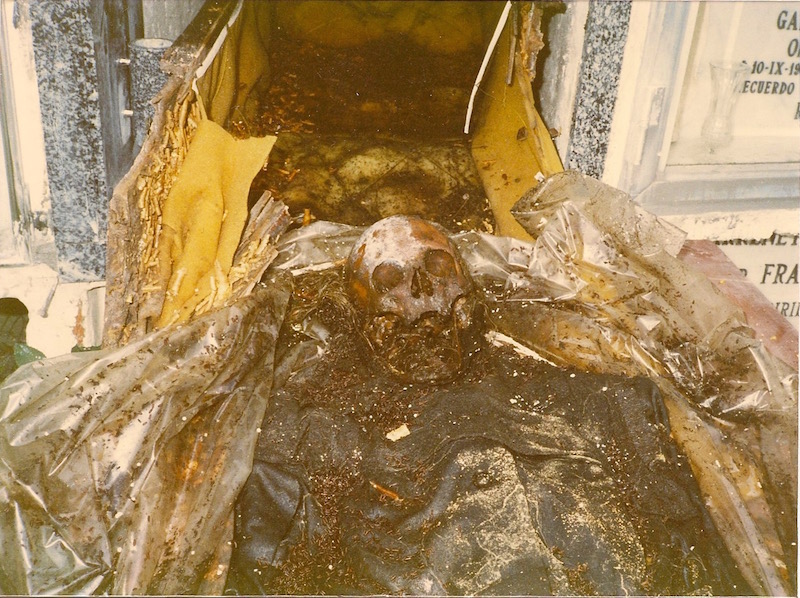
The remains of my great great grandmother as her body was being moved to the crypt. You can read about that story here.
  • As might be expected, a serious illness was seen as a presage of death. That said, such illnesses were often attributed to God, as a punishment for sins. Or, alternatively, as the result of the evil eye or malevolent spirits that constantly swarmed everywhere, spreading disease and agony. And, as I’ve written about before, various animals also foretold death.
  • When someone died, their eyes and mouth had to be closed quickly, otherwise they might draw others to their “side,” or to the realm of the dead.
  • It was believed that demons, evil spirits, or even the devil himself lurked around the death bed and could tempt people to say blasphemous things. In Christian times, this led some people to putting into their will language that protected them: “And if, through weakness, the severity of my illness, or the persuasion of the evil enemy, I should say or utter anything against the Holy Faith, I hereby renounce it and declare that it is not, nor will it ever be, my intention, but rather to always remain in the Holy Faith…”
  • While a sudden death was taken to be a sign of damnation, of God not giving the person time to prepare, a prolonged death was also viewed negatively. In some places, an oil lamp was lit and it was thought that the person would die when the oil ran out. Or if someone continued to suffer, it was because their soul was trapped and they couldn’t escape the room, so a window might be opened.
  • When someone was deathly ill, if a domestic animal died (a cow in Bermeo, a hen in Gorozika), it was taken as a good sign, as the animal took the place of the person.
  • When someone had died, it was the task of the women to prepare the corpse. In old times, the body was simply wrapped in a sheet or shroud, called a hil-mihise – people were not buried in a coffin. People would make their own shrouds, many years in advance of their own death, in preparation.
  • Another ancient tradition was tying the body’s hands and feet with rope, more recently with ribbons. Originally, this may have been done to restrict the dead from returning as an apparition.
  • As in many places, bodies were buried with items. Today these are often religious in nature – crucifixes or rosaries. However, in past times, weapons and coins might have been buried with the dead. In any case, these items were thought to be useful for the dead in the afterlife.
  • While the body was being prepared and was on display in the house, in some places mirrors were covered with a black cloth. It was thought that if one looked into a mirror with the body in the house, they might see witches or even the dead him or herself.
  • Finally, death was associated with impurity. So, when someone died, their mattress would be burned. Or a bundle of straw was burned while a prayer was recited. In some places, the stables also had to be purified. And yet in others brandy and herbs were burned.

A full list of all of Buber’s Basque Facts of the Week can be found in the Archive.

Primary sources: Madariaga Orbea, Juan. Muerte. Auñamendi Encyclopedia. Available at: https://aunamendi.eusko-ikaskuntza.eus/en/muerte/ar-82465/

Basque Fact of the Week: The Urberuaga Spa of Bizkaia

This one may be of interest to only me…

Driving along the highways in the heart of Bizkaia, there is a sign that appears on the side of the road that simply says Urberuaga, but there is nothing really there. It turns out that there used to be a quite renowned spa in the area, as the naturally thermal and gaseous waters were known to promote good health. It is an interesting story of the rise and demise of a once-prominent institution.

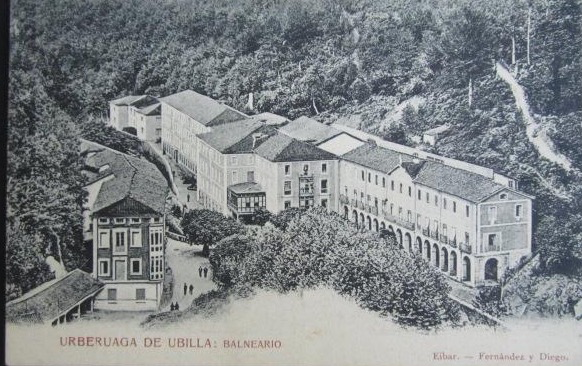
An aerial view of the Urberuaga spa. Image from the blog of Idoia Goiti.
  • The name Urberuaga, and by extension Uberuaga, comes from the words ur (water) + bero (hot) + aga (place of), thus meaning place of hot water or hot springs.
  • Urberuaga de Ubilla is a neighborhood of Markina-Xemein, situated between the mountains Itoñamendi and Ekarrein, straddling the banks of the Artibai River. The neighborhood, which officially got its name in 1980, has never had more than a few hundred people.
  • The spa of Urberuaga de Ubilla was built between the years of 1870 and 1872. The thermal waters, distinct from other springs, had long been known to have medicinal properties, primarily for digestive and urinary issues. In fact, the waters were first mentioned in the 16th century. People had learned about the medicinal properties of the water and came to the area to drink it. Before the spa was built, a bathhouse was constructed in 1825.
  • The spa closed in 1872 because of war, but reopened and expanded: in 1879, Los Arcos, the first grand building, was erected; in 1882, the even larger Casa Francesa was built; and, in 1888, the Casino was constructed. The spa boasted, amongst other things, a room where sprayed water could be breathed, an elegant hall with nickel-plated fixtures, and mosaic floors that offered a touch of hygiene and elegance. The spa could accommodate 350 guests and had two large dining halls that could hold 90 and 130 people, respectively.
  • The waters had a temperature of about 80 degrees Fahrenheit. The spa consisted of three springs – Santa Águeda, San Juan Bautista, and San Justo – with a flow of about 2.5 gallons per second. The water itself was full of bicarbonate and nitrogen gas which provided some of its beneficial properties. In fact, the quantity of nitrogen gas was quite high which is part of what made these waters unique.
  • In 1983, the spa was destroyed by a series of floods. After the spa was closed, they continued to bottle the mineral waters to sell but that was abandoned in 1993. There were some short-lived plans to construct a hotel on the site of the spa, but those were also ultimately abandoned. Today, the site is overgrown with vegetation and barely recognizable. A colony of bats has made the derelict buildings its home.
  • There is a second Urberuaga spa, this one in Algzola, Elgoibar, Gipuzkoa. Built around 1846 on the grounds of the old farmhouse Etxe Zuria, it closed in 1976, though the site continues to bottle the water.

A full list of all of Buber’s Basque Facts of the Week can be found in the Archive.

Primary sources: UBILLA-URBERUAGA. Auñamendi Encyclopedia. Available at: https://aunamendi.eusko-ikaskuntza.eus/en/ubilla-urberuaga/ar-133553/;URBERUAGA DE UBILLA, Balneario de. Auñamendi Encyclopedia. Available at: https://aunamendi.eusko-ikaskuntza.eus/en/urberuaga-de-ubilla-balneario-de/ar-136282/; Urberuaga, el Balneario abandonado (Markina) by Gullivervan; El agua del balneario de Urberuaga podría abastecer a los 7.800 vecinos del Artibai by Mirari Artime, El Correo; El balneario abandonado de Urberuaga, Piensa en un lugar; URBERUAGA, Balneario de. Enciclopedia Auñamendi. Available at: https://aunamendi.eusko-ikaskuntza.eus/es/urberuaga-balneario-de/ar-136281/; Urberuaga de Ubilla, Estudio de sus aguas nitrogenadas by Doctor Don José Hernández Silva, Madrid, Imprenta de Ricardo Rojas, 1895

We Must Remember Them: WWII Veteran Regina Bastida, 104, Reflects on Memory and Service

by Sancho de Beurko Association

A centenarian World War II veteran reflects on memory, sacrifice, and the effort to build the National Basque WWII Veterans Memorial in Gardnerville, Nevada.

At 104 years old, Regina “Reggie” Bastida is among the last living World War II veterans of Basque origin — and one of the few remaining voices of the generation that helped define modern America.

Born in Boise, Idaho in 1922 to Basque immigrant parents, Regina served with the U.S. Army Nurse Corps during World War II and belongs to the generation often called the “Greatest Generation.” Their service helped defend the democratic values that continue to shape the United States today.

In a recently-recorded interview in Boise, Regina shared a message that captures both the spirit of her generation and the purpose behind the National Basque WWII Veterans Memorial:

“We want to remember our young men that went to war and gave their lives for our country.”
— Second Lieutenant Regina “Reggie” Bastida
U.S. Army Nurse Corps

Her words remind us that remembrance is not only about the past — it is about the civic principles her generation stood for: duty, sacrifice, service, and democracy. 

After more than a decade of research, the nonprofit homeland history association Sancho de Beurko has identified over 2,150 men and women of Basque descent who served during World War II across the United States and abroad. In many ways, their story reflects a familiar American narrative: immigrants — some of them not yet citizens — and the sons and daughters of immigrant families who stepped forward to serve both their country of adoption and the country of their birth during one of the defining moments of the twentieth century. 

Today, the project has reached an important milestone. The Town of Gardnerville, Nevada, has designated a site in Heritage Park for the memorial, and a conceptual design has been completed. The goal is to dedicate the memorial before the end of 2026, ensuring that the service of this generation is honored while their voices can still guide us.

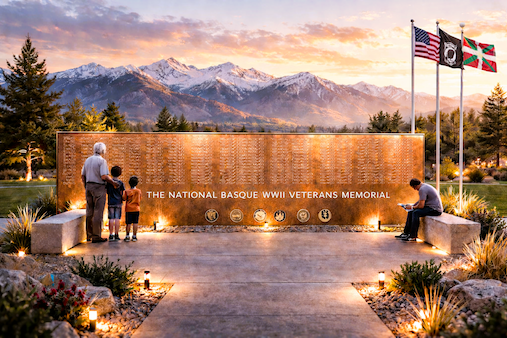
Conceptual rendering of the National Basque WWII Veterans Memorial proposed for Heritage Park in Gardnerville, Nevada.

“Echoes of two wars, 1936-1945” aims to disseminate the stories of those Basques and Navarrese who participated in two of the warfare events that defined the future of much of the 20th century. With this blog, the intention of the Sancho de Beurko Association is to rescue from anonymity the thousands of people who constitute the backbone of the historical memory of the Basque and Navarre communities, on both sides of the Pyrenees, and their diasporas of emigrants and descendants, with a primary emphasis on the United States, during the period from 1936 to 1945.

THE AUTHORS
Guillermo Tabernilla
 is a researcher and founder of the Sancho de Beurko Association, a non-profit organization that studies the history of the Basques and Navarrese from both sides of the Pyrenees in the Spanish Civil War and in World War II. He is currently their secretary and community manager. He is also editor of the digital magazine Saibigain. Between 2008 and 2016 he directed the catalog of the “Iron Belt” for the Heritage Directorate of the Basque Government and is, together with Pedro J. Oiarzabal, principal investigator of the Fighting Basques Project, a memory project on the Basques and Navarrese in the Second World War in collaboration with the federation of Basque Organizations of North America.

Pedro J. Oiarzabal is a Doctor in Political Science-Basque Studies, granted by the University of Nevada, Reno (USA). For two decades, his work has focused on research and consulting on public policies (citizenship abroad and return), diasporas and new technologies, and social and historical memory (oral history, migration and exile), with special emphasis on the Basque case. He is the author of more than twenty publications. He has authored the blog “Basque Identity 2.0” by EITB and “Diaspora Bizia” by EuskalKultura.eus. On Twitter @Oiarzabal.

Josu M. Aguirregabiria is a researcher and founder of the Sancho de Beurko Association and is currently its president. A specialist in the Civil War in Álava, he is the author of several publications related to this topic, among which “La batalla de Villarreal de Álava” (2015) y “Seis días de guerra en el frente de Álava. Comienza la ofensiva de Mola” (2018) stand out.

The National Basque WWII Veterans Memorial is envisioned as the first and only national monument in the United States dedicated exclusively to Basque-American World War II veterans. More importantly, it is intended as a civic space where future generations can reflect on the values that Regina’s generation embodied.

Honoring this generation is also a race against time. 

Projects like this are never the work of a single organization or community. They are built through the commitment of people who believe that remembrance matters.

For those who feel moved by Regina’s message, there are many ways to help bring this tribute to life  — whether by supporting the project directly, sharing its story, or helping connect it with others who care about preserving this chapter of American history.

Those who wish to support the Memorial may do so through our secure online donation page:

https://my.cheddarup.com/c/national-basque-wwii-veterans-memorial/items

Because as Regina reminds us, the purpose is simple:

We must remember them.

If you are a relative of a Basque WWII veteran and you would like to find out if he or she is on the list, please contact the project researchers: sanchobeurko@gmail.com

Basque Fact of the Week: Sugegorri, the Viper of the Basque Country

My mom tells a story of my dad where they were out in the countryside working, spending the night camping in the field. Somehow, my dad became aware of a rattlesnake nearby and freaked out, dousing the whole area with gas and lighting it on fire to kill the snake. My mom said it was because he was deathly afraid of snakes because of a “red snake” he knew about in the Basque Country.

I admit, I was a bit skeptical about this existence of this “red snake,” so I asked, and indeed it is a thing: the sugegorri – literally “red snake” – is a viper native to the Basque Country.

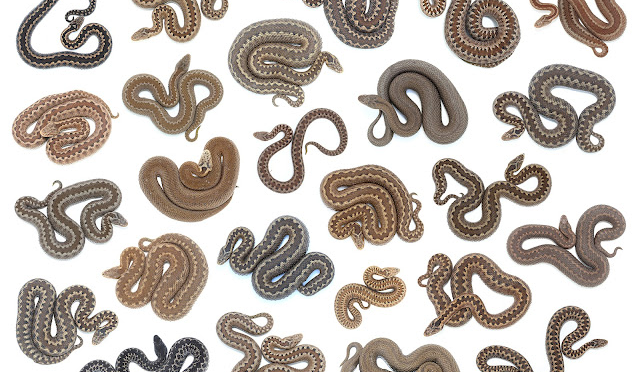
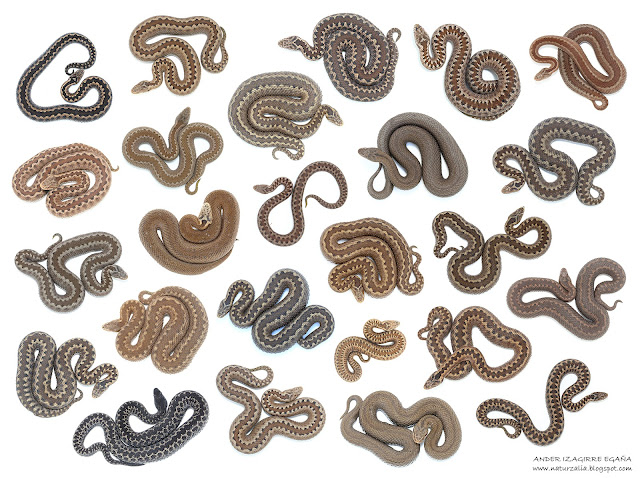
A collection of sugegorriak. Image from Asociación Herpetológica Española.
  • There are three types of vipers that are native to the Basque Country and, more generally, the Atlantic coastal regions nearby: the Cantabrian viper (Vipera seoanei), on the Atlantic side; the aspis viper (Vipera aspis aspis), in the Pyrenees themselves; and the Lataste viper (Vipera latastei), in the south. The latter is rare. 
  • Sugegorri – literally red snake – is both a general term for a class of vipers and more specifically to the Cantabrian viper, though there are two subspecies of snakes that fall in this class: Vipera seoanei seoanei and Vipera seoanei cantabrica. 
  • The sugegorri is polymorphic, meaning it can take on various colors and patterns. Typically, males, which can be smaller than females, are white and blue-barred, with strong black markings. Females are brown or reddish. The belly is blue or black; sometimes with white spots. The tail is yellow, orange and red underneath. There are some very dark, almost black, specimens.
  • Various beliefs were associated with snakes and, more specifically, vipers in the Basque Country. For example, in Bedaroa, they thought that a viper would return to the scene of the crime, so to speak, after biting someone, so the people would go to the spot the next day to kill it. In places like Karrantza, Sara, and Gernika, they thought that vipers didn’t bite, but rather stung people with their tongues. The gathering and/or hiding of certain herbs could protect against snake attacks. Or one should carry garlic, but never cheese.
  • Some believed that the common slow worm, a legless lizard, protected men from snakes by warning them when they were sleeping in the countryside. Sometimes they would do this by wiggling their tail in the sleeping man’s ear. However, they would only warn men, whom they considered friends – they didn’t warn women.
  • The bite of the viper was considered very dangerous, with people in Erroibar saying that if you were bit by a viper, you would die within an hour.
  • An interesting side note… in Basque, the verb “to die” is hil. However, in some places, for snakes and other animals, other words are used to say “to die.” Examples include akaatu (used for harmful animals), akabau, galdu (used for the violent death of a snake, literally meaning lost), kalitu, and amaitu (meaning finished).
  • The ultimate snake is the herensuge. Some beliefs suggest that all snakes descend from the herensuge. In some places, it was thought that vipers came from snakes and could eventually turn into a dragon.

A full list of all of Buber’s Basque Facts of the Week can be found in the Archive.

Primary sources: Most are linked directly in the post.

Basque Fact of the Week: Courtship in the Basque Country

Love is the universal language, so they say. Though sometimes it is more difficult to “speak” than even Euskara! In every culture, there are norms of how men and women socialize and get to know one another, and this is true in the Basque Country. Particularly in rural areas before the advent of phones and the like, there were strict expectations on how young men and women interacted. While that has changed dramatically in the last decades, it is still interesting to see how Basque society expected young folks to navigate this part of their lives.

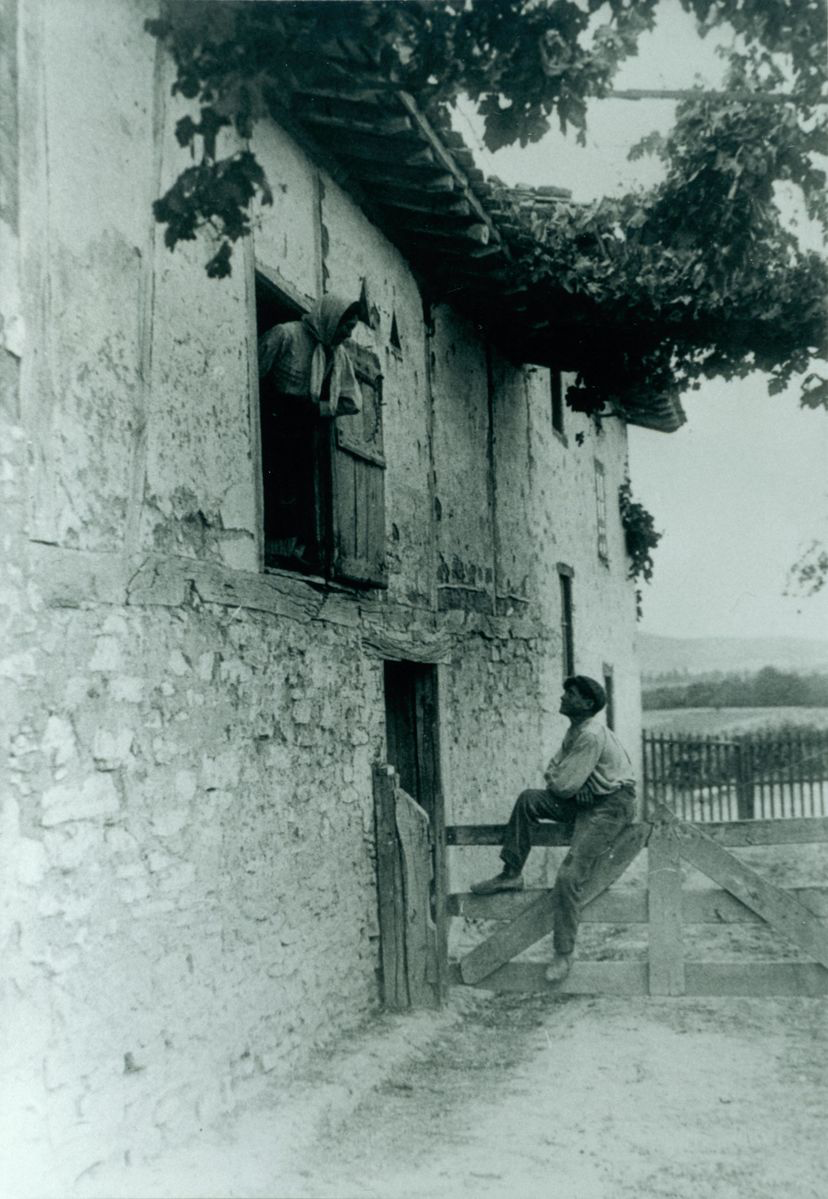
Galanteo – or courting/wooing a young woman from under her window. Image from Atlas Etnográfico de Vasconia.
  • In old times, before TV and the internet, young men and women had few opportunities to mingle – both worked a full day and had little free time. Dances on Sundays and holidays and meeting after religious services were some of the few occasions men and women could meet. Sometimes, after a big task such as a harvest, a home would host a dance that also brought young men and women together. Or those tasks themselves provided that opportunity. Later, young people had more free time and would often “go to the mountains” to socialize. When a couple was ready to “announce” they were courting, the boy would often walk the girl home.
  • Young people who wanted to find a boyfriend or girlfriend often prayed to saints, particularly Saint Anthony, to help them in their quest. In some places, young women would go to the chapel and place a pin in a panel: a black-headed pin for a dark-haired boy and a white-headed pin for a blonde. The first girl to bath on Saint John’s day would find a boyfriend within a year. 
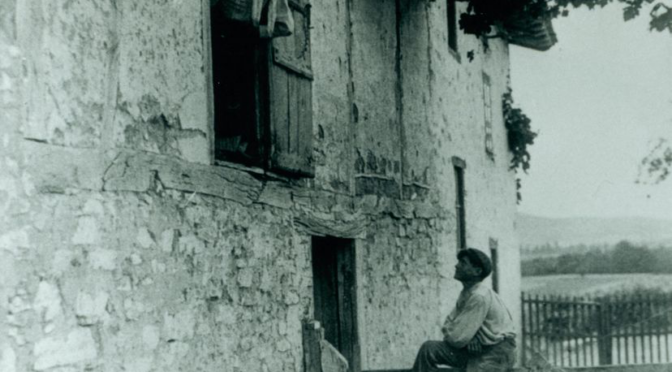
  • In some places, boys would head to a girl’s house to serenade her as a group. Or, they would go individually and just talk to the girl who was up in her room while the boy stood outside. If another boy had already gotten there, the second might throw stones at him to get him to leave. Sometimes, the girl would let the boy into her room by climbing a ladder.
  • Girls also showed their affection, primarily through treats. Piperopilak are sweets, a type of cake, that the girl could buy or make and give to the boy of her affection. Sometimes, she would put it in her pocket and let the boy she liked search her to find it. If a boy was serenading a young woman and she fancied him, she (or her father!) might drop a bollo – a sweet bread – from her window.
  • However, it was expected that the boy take the lead and that the girl not show too much interest, that she play hard to get. It was also frowned upon for girls to go out at night – they might be called farolas, or streetlights. If a woman made the first move, she was often criticized with sayings such as “la morcilla nunca vaya tras el gato” – the sausage should never chase the cat. 
  • Depending on the location, summer or winter was considered the best time to start a courtship. Summers were great because of all of the festivals, particularly the big ones which drew people from multiple towns. However, the summer was also full of hard work, so winters were thought better in some places.

A full list of all of Buber’s Basque Facts of the Week can be found in the Archive.

Primary sources: Inicios de la Relación Amorosa, Atlas Etnográfico de Vasconia

Basque Fact of the Week: Ainhoa, A Gem in Lapurdi

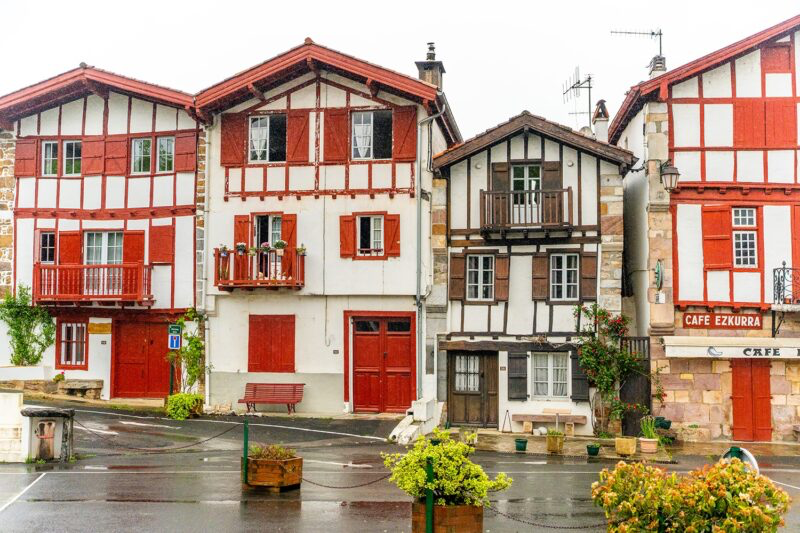
The Basque Country holds so many hidden gems. We are all familiar with the big places – Donostia, Bilbo, Vitoria-Gasteiz, Pamplona/Iruña – but there is so much more to see. Spectacular waterfalls. Strange geological forms. Nature reserves. Small villages untouched by modernization. Ainhoa falls in this last category. A small town in Lapurdi on the border between France and Spain, it has seen a lot of history. Despite all of the conflict, it has managed to retain a medieval charm.

What are your hidden Basque gems?

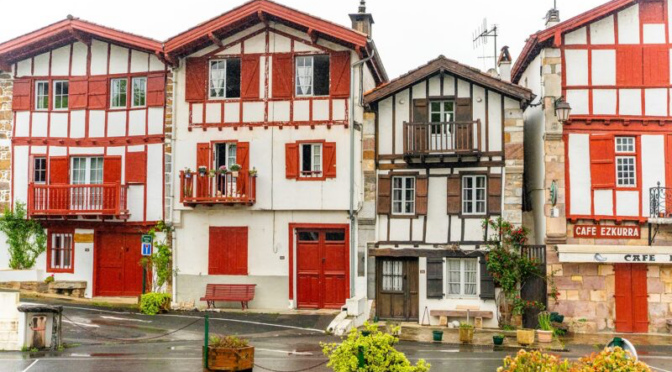
Photo of Ainhoa, “The most beautiful village in France,” from tourisme64.com.
  • Ainhoa is what is called a commune in France. It was founded sometime in the 13th century. As it sat on the border between the Duchy of Aquitaine and the Kingdom of Nafarroa, it was founded as a stop for pilgrims on the Camino de Santiago. In 1238, Theobald I of Navarre bought the toll rights of the town, meaning he was able charge those pilgrims a fee to pass through.
  • As Lapurdi was then under the English crown, Ainhoa was at the center of the tensions between the two kingdoms and, in fact, the residents of Ainhoa paid taxes to both England and Nafarroa. This lasted until the 15th century when Ainhoa and neighboring regions came under French rule.
  • The town, along with several others, was destroyed 1636 during the Thirty Years’ War (1618-1648) when Spain invaded. Only the church – a recognized historical monument – and one house, named Machitorénéa, which had been built only a few years earlier in 1629. 
  • Ainhoa is a so-called Bastide style town, with one street around which the town was built, and later rebuilt. Today, the town is home to just over 600 people.
  • In the early 1700s, Ainhoa, primarily the women of the town, was central to the revolts against the salt tax and other taxes. The revolts started in Ainhoa in 1724, spreading to the rest of Lapurdi and then other parts of Iparralde, in the following years. 
  • In 1794, during the French terror and after Iparralde had been incorporated into larger French departments, towns like Ainhoa on the border with Spain were declared to be “infamous communes” – people were arrested and deported to other parts of France. These were “any citizen suspected of having an anti-revolutionary spirit or of having an understanding with the Spanish.” They returned later that year but only with great difficulty.
  • Today, Ainhoa retains much of that original medieval flavor – it has been named one of France’s most beautiful villages. The cemetery, right next to the church, has some excellent examples of funeral steles that are common to the Basque Country. And, Ainhoa boasts Ithurria, a one-star Michelin restaurant. Amazing for such a small town!

A full list of all of Buber’s Basque Facts of the Week can be found in the Archive.

Primary sources: Estornés Zubizarreta, Idoia; Berger, Marie Claude. AINHOA. Auñamendi Encyclopedia, 2025. Available at: https://aunamendi.eusko-ikaskuntza.eus/en/ainhoa/ar-7408/; Ainhoa, Pyrénées-Atlantiques, Wikipedia; Ainhoa, Le Guide de Pays Basque; This medieval Basque village survived destruction in 1629 – its red-and-white houses hide France’s most authentic pilgrimage town, World Day; Aïnhoa a charming medieval village, Biper Gorri Camping